This site is supported by our readers. We may earn a commission, at no cost to you, if you purchase through links.
A ball python evolved on dry savanna floors. A green tree python spends its life 8 meters up in humid canopy. Cage them the same way, and one gets respiratory infections while the other refuses to eat—same genus, same care sheet, wildly different outcomes.
That’s the trap most new keepers fall into: treating "python" as one habitat template instead of five distinct blueprints. Grassland, rainforest, wetland, canopy, swamp—each species carries its native environment in its biology, from humidity tolerance to hunting posture.
Understanding python species habitat needs means matching enclosure to origin, not guesswork. Get the ground layout, temperature gradient, and humidity right, and feeding, shedding, and behavior tend to fall into place on their own.
Table Of Contents
- Key Takeaways
- Python Habitats by Species
- Enclosure Size and Layout
- Temperature and Humidity Needs
- Hides, Substrate, and Enrichment
- Lighting, Cleaning, and Health
- Frequently Asked Questions (FAQs)
- What snake is worth $100,000?
- What does a python need to survive?
- What’s the friendliest snake ever?
- Can pythons be domesticated?
- How do pythons choose nesting sites for eggs?
- Can pythons share territories with other reptiles?
- What vegetation types provide optimal python camouflage?
- How does seasonal flooding affect python habitat selection?
- Do pythons migrate between habitats during different seasons?
- How often should I feed my python?
- Conclusion
Key Takeaways
- Match each python’s enclosure to its native terrain—grassland, rainforest, wetland, canopy, or swamp—since species-specific humidity, temperature, and layout needs differ significantly even within the same genus.
- Maintain a proper thermal gradient (roughly 6–10°F between warm and cool zones) and species-appropriate humidity levels, since incorrect ranges directly cause respiratory infections, feeding refusal, and shedding problems.
- Provide secure, appropriately placed hides, correct substrate depth and type, and species-relevant furnishings (branches for arboreal snakes, burrowing substrate for ground dwellers) to reduce stress and support natural behavior.
- Scale enclosure size and features gradually as your python grows, upgrading juvenile setups to adult minimums in phased steps while maintaining consistent light cycles, cleaning routines, and annual vet checks for long-term health.
Python Habitats by Species
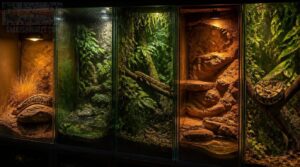
No two pythons come from the same corner of the world, and their enclosures shouldn’t look the same either. Each species carries habits shaped by its native terrain, from dry grassland to soaked wetland, and your setup needs to reflect that. Here’s what five popular pythons expect from the space you build them.
If you’re still narrowing down which snake fits your space and lifestyle, this guide to popular python species breaks down their temperaments and care needs side by side.
Ball Python Grasslands
Picture the open savanna at dusk, where a Ball Python waits near a termite mound for prey to pass. Recreate this with rodent burrow access, scattered hides, and warm ground temps.
- Grassland basking zones
- Termite mound hides
- Rodent burrow access
- Natural prey simulation
- Seasonal rain cycles
Prioritize substrate safety, proper enclosure size, thermal gradient, and humidity control for thriving grassland behavior.
For proper care, make sure adequate humidity during shedding periods.
Carpet Python Forests
Leave the open savanna behind, and step into eastern Australia’s rainforest understory, where Carpet Pythons work both ground and canopy. They shelter in hollow logs and tree crevices, ambushing rodents and lizards by night.
| Habitat Feature | Enclosure Equivalent |
|---|---|
| Tree hollows | Elevated hide boxes |
| Leaf litter | Deep, moisture-retaining substrate |
| Canopy cover | Climbing branches |
| Riparian zones | Humidity gradient |
| Decaying logs | Ground-level hides |
Burmese Python Wetlands
Trade the forest canopy for slow-moving rivers and marsh edges — this is where Burmese Pythons hunt. They shelter in reed beds, using aquatic movement corridors to travel between prey-rich margins.
Females favor elevated, sunlit nest site selection near water. Watch for wetland degradation impact: shrinking habitat concentrates prey but shortens prey availability shifts windows, so replicate a stable temperature gradient, humidity control, and safe substrate for consistent hunting behavior.
Green Tree Python Canopies
Green tree pythons trade wetland margins for life aloft, where survival hinges on branch spacing and perch height rather than water access.
- Layered branches, 1.5–8m up
- Humidity zones near 70-90%
- Prey ambush from concealed perches
- Canopy gaps for basking
- Climbing enrichment mimicking wild structure
Replicating an arboreal enclosure means prioritizing vertical complexity and humidity control over floor space.
A custom bioactive build with sturdy branches, dense foliage, and misting systems mimics the canopy conditions arboreal species need to thrive—these snake environment setup tips walk through the essentials.
Blood Python Swamps
Blood pythons need swamp conditions replicated closely: humidity around 70-90%, warm-side temps of 85-90°F, and thick, absorbent substrate like cypress mulch for burrowing.
Add leaf litter and low branches for ground cover enrichment, and place water bowls in quiet corners—checked often for hygiene, since these snakes ambush near water sources in the wild.
Enclosure Size and Layout
Getting the enclosure size right matters just as much as picking the right species, since a cramped or oversized space can stress your snake out fast.
Your python’s needs will shift as it grows, and its living space should shift right along with it.
Here’s what to think about as you plan the size and layout, from hatchling to full-grown adult.
Juvenile Space Needs
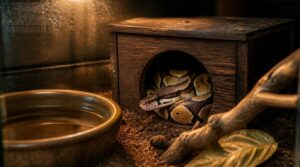
Baby pythons don’t need much room, but what they get matters most:
- Minimum habitat size: 18" L x 12" W x 12" H
- A snug hide box for security
- Shallow water dish for drinking and soaking
- Clean substrate, spot-cleaned daily
- Weekly feedings on appropriately-sized prey
Keep quarters modest and secure — oversized enclosures stress juveniles, making them feel exposed rather than safe.
Adult Enclosure Minimums
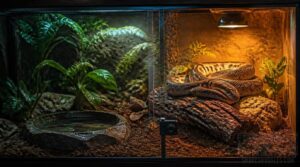
Once your python outgrows juvenile quarters, minimum floor space jumps considerably. General recommended dimensions sit near 36 L x 24 W x 24 H, though species vary—Burmese pythons need far more.
Substrate depth of 3-6 inches allows burrowing, while secure locking prevents escapes. Include a water bowl size large enough for soaking, and prioritize proper temperature regulation for snakes throughout.
Ground Space Requirements
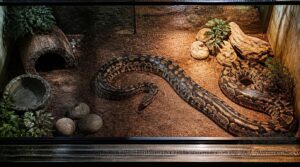
Footprint dimensions matter more than total volume for a ground-dwelling snake, since floor space drives natural movement.
- Keep 60 cm clearance for access
- Layer substrate 3-4 inches deep
- Route drainage away from the base
- Anchor the enclosure securely
Enclosure ventilation needs and a steady habitat cleaning schedule prevent mold, while substrate safety for reptiles helps maintain thermal gradient underfoot.
Vertical Climbing Space
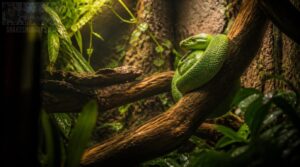
Not every python stays grounded — arboreal species like green tree pythons spend most of their lives off the floor, so vertical climbing space matters as much as footprint.
Add sturdy climbing branches and shelves at varying angles, sized to the snake’s body width for secure grip. Height should equal roughly half the snake’s length. Textured backgrounds and secure anchoring mimic natural bark, giving arboreal snakes confident, injury-free movement through their enclosure setup.
Gradual Habitat Upgrades
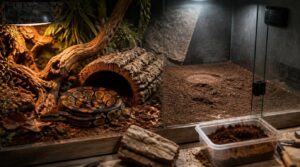
Resist the urge to overhaul everything at once — snakes acclimate better through phased upgrades than sudden change. Add one feature (a hide, branch, or substrate patch) every few weeks, timed around shedding cycles and your own availability, then run a quick welfare check.
Modular panels make this easier, letting you expand without new construction or added stress.
Temperature and Humidity Needs
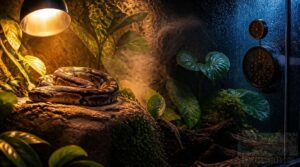
Once your enclosure’s built and sized right, temperature and humidity become your next big job. Your python can’t regulate its own body heat, so it’s relying on you to build a habitat that does the work for it. Here’s what you need to get right, from both sides of the thermal gradient to that hygrometer on the wall.
Warm Side Temperatures
Heat drives digestion, so your basking spot matters most. Ball pythons need 29–32°C, carpet pythons 30–33°C, and Burmese pythons 31–33°C — never exceeding 34°C, which risks tissue damage.
Maintain a 6–10 degree gradient between warm and cool zones using shielded heaters. Track readings with two digital thermometers, since one faulty sensor can mean a cooked snake.
Cool Side Temperatures
Cool zones balance the warm side, giving your snake somewhere to retreat and self-regulate. Most species do well between 75°F–90°F (24°C–32°C), though exact needs vary:
- Ball pythons: 24–28°C
- Carpet pythons: 22–26°C
- Burmese pythons: 26–30°C
Track this zone with digital thermometers at mid-height, watching for nighttime temp stability—cool sides shouldn’t dip below 18°C, or metabolic stress follows.
Species Humidity Ranges
Temperature isn’t the only gradient that matters—humidity by species varies just as widely. Ball pythons thrive at 60–80% (5070 humidity won’t cut it long-term). Green tree pythons need sustained tropical humidity, 70–90%, mimicking canopy moisture. Desert-adapted species prefer 3050 humidity levels instead.
Check readings with a reliable humidity gauge placed near hides, and consider a moss box for humidity control in problem enclosures.
Shedding Humidity Support
Shedding pulls moisture right out of the skin, so your snake needs a temporary humidity boost—not a permanent change.
- Mist daily to hit 60-70% RH
- Add a moss box with damp sphagnum moss
- Keep the water bowl full for hydration
- Watch substrate dampness—soggy invites mold
A humidity gauge near the hide confirms you’re supporting the shedding cycle without overdoing it.
Hygrometer Placement Tips
Where you mount the hygrometer matters as much as the reading itself.
Place the sensor 4–5 feet off the floor, away from doors, vents, and direct sun. Keep it 1.5–3 feet from water bowls or misting zones to avoid skewed spikes. Skip amplifiers and electronics. For larger setups, add probes per enclosure—multi-room monitoring keeps humidity control honest.
Hides, Substrate, and Enrichment
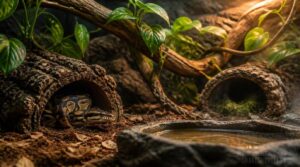
A python’s enclosure needs to feel less like a tank and more like a slice of its natural world. Getting the physical setup right—hides, substrate, and a few climbing options—matters just as much as temperature and humidity. Here’s what to think about as you furnish the space.
Secure Hiding Spots
A snake without a hide is a snake in a constant state of alert. Give every python more than one hide — one on the warm side, one on the cool — sized snug enough to trigger that reassuring full-body contact ground-dwelling snakes crave.
A snake without a hide lives in constant alert, so give every python a snug retreat on both warm and cool sides
- Low-profile entrances blended with décor
- Half-buried boxes mimicking natural terrain
- Furniture-style hides with concealed access
- Consistent placement to reduce stress
Safe Substrate Choices
Match substrate to species: aspen wood shavings or reptile carpet for drier setups, coconut husk (eco earth) or cypress mulch for tropical humidity. Always avoid cedar or pine — their oils irritate respiratory tracts. Skip fertilizers and pesticides entirely.
Paper-based bedding works well for quarantine or juveniles. Rotate substrate every 4–6 months, spot-cleaning daily to prevent bacterial buildup.
Burrowing Opportunities
Ball pythons and blood pythons instinctively dig, so substrate depth matters more than most keepers realize — aim for 4–6 inches.
- Coconut husk ecoearth for humidity retention
- Sphagnum moss layered near hides
- Loose, packable substrate for tunnel formation
This natural burrow simulation helps with energy efficient digging and rounds out solid ground-dwelling habitat design, giving burrowing opportunities that reduce stress in secretive species.
Climbing Branches
Give arboreal snakes, like green tree pythons, sturdy hardwood limbs at least 3 inches thick, positioned within 12–18 inches of each other for natural traversal.
Branch placement matters as much as size — avoid smooth or decaying wood, favor forked junctions for grip, and keep branches free of sharp angles. Good terrarium decoration doubles as functional reptile enrichment, supporting real climbing techniques your snake would use in the wild.
Water Bowl Placement
Where you place the water bowl matters as much as the bowl itself. Set it on the cool side placement, tucked near a secure hide so drinking doesn’t mean exposure.
If your snake still manages to flip the dish, preventing snake water bowls from tipping comes down to choosing the right anchoring method for your setup.
If you’re still not sure why your snake keeps fouling its bowl despite good placement, common reasons snakes poop in their water bowl can help you pinpoint the real cause and fix it for good.
A bowl with a smooth, non-porous surface — like the ones featured in this guide to terrarium water bowls for ball pythons — is especially easy to sanitize without disrupting your snake’s routine.
Raise it with bowl height adjustment as your snake grows. Add a separate soaking bowl for humidity support, and keep a weekly cleaning schedule — snake water bowl hygiene prevents bacterial buildup fast.
Lighting, Cleaning, and Health
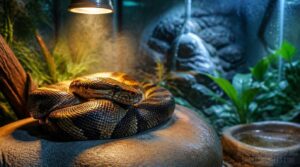
A well-lit, clean enclosure does more than look nice—it keeps your python’s internal clock and immune system on track. Get the light cycle, hygiene routine, and vet care right, and everything else in the habitat falls into place around it. Here’s what each piece involves.
Day-Night Light Cycles
Your python’s internal clock runs on light cues, not the calendar, so consistent daily timing matters more than exact hours. A steady 12-hour light, 12-hour dark schedule helps circadian rhythm regulation, with gentle dawn and dusk transitions easing the shift.
Keep nocturnal phase lighting minimal—dim red or infrared only—since bright light after dark disrupts natural cycles and stresses your snake.
UVB Considerations
UVB isn’t universally required, but many keepers offer it anyway since it helps natural calcium metabolism and helps prevent metabolic bone disease.
If used, position bulbs 12–18 inches above the basking spot, creating a gradient from strong to shaded zones. Replace bulbs every 6–12 months regardless of appearance, and check output with a UVB meter periodically.
Daily Spot Cleaning
Bulbs handled, waste comes next. Spot-check the substrate daily, removing feces and urates before bacteria take hold.
Wipe the water bowl with a pet-safe antibacterial solution and refill it fresh. Blot damp patches rather than scrubbing, and match substrate type (aspen, cypress mulch, coconut fiber) to how easily it absorbs moisture between your snake’s regular feedings.
For a full routine that covers deep cleans as well as daily upkeep, this step-by-step guide to cleaning a snake enclosure shows how often to do each task.
Ventilation and Mold Prevention
A clean bowl and dry substrate mean little without proper airflow management. Stagnant, humid air breeds mold on glass and enclosure walls.
- Keep vents unblocked
- Air out post-misting
- Watch for musty odors
- Choose inert reptile substrate types
- Use mold-safe disinfectant, rinsed thoroughly
Cross ventilation prevents condensation buildup, supporting balanced humidity control in terrariums while protecting your snake’s respiratory health.
Veterinary Health Checks
Even the healthiest-looking snake benefits from a yearly once-over by a qualified exotic veterinarian. A proper visit covers Essential Signs Assessment, Organ Palpation Check, Dental Health Screening, and Joint Mobility Evaluation, plus a Parasite Prevention Review. Between annual checkups, it’s worth knowing the warning signs that separate normal snake breathing from a respiratory emergency, so you can act fast if something seems off.
Seek specialist reptile veterinary care promptly if you notice wheezing, regurgitation, or lethargy — classic emergency veterinary signs tied to common python illnesses like respiratory infections or mouth rot.
Frequently Asked Questions (FAQs)
What snake is worth $100,000?
Think six figures for a snake and most picture a king cobra, not a python. The High Blue Green Tree Python actually tops that mark, with standout specimens fetching $180,000–$200,000 thanks to rare morph pricing and documented breeding lineage value.
What does a python need to survive?
Survival hinges on a properly sized enclosure with a thermal gradient, correct humidity, a secure hide box, appropriate substrate depth, a soaking-sized water dish, consistent light cycle, and a feeding schedule matching prey size to body width.
What’s the friendliest snake ever?
No single species wins outright, but ball pythons rank highest for beginner suitability—docile, patient, tolerant of handling. Corn snakes and rosy boas follow closely, prized for calm temperament and predictable behavior, making early socialization and stress reduction easier for first-time keepers.
Can pythons be domesticated?
Not fully. Captive-bred (CB) pythons show genetic domestication traits and calmer temperaments, but they’re semi-domesticated at best — wild instinct retention persists across generations, meaning true behavioral adaptation limits remain despite decades of selective captive breeding.
How do pythons choose nesting sites for eggs?
Picture a female coiled tight in a sunbaked burrow, guarding her clutch.
Nest site selection favors stable warmth and moisture—thermal refuges like leaf litter hollows—while maternal brooding patterns regulate humidity and temperature, boosting egg incubation success against predators and drying out.
Can pythons share territories with other reptiles?
Yes, through resource partitioning and vertical stratification — pythons use different microhabitats than neighboring reptiles. Overlap happens seasonally, but behavioral avoidance usually prevents conflict, provided prey and shelter stay plentiful across shared territory.
What vegetation types provide optimal python camouflage?
Roughly 5,000 species-specific patterns exist across snakes worldwide.
Leaf litter patterns, canopy dappled light, shrubland texture matching, wetland reed shadows, and mangrove root concealment each match a python’s coloring to grassland, woodland, rainforest, scrubland, and rocky outcrop backdrops.
How does seasonal flooding affect python habitat selection?
Rising water triggers flood pulse movement, pushing pythons toward edge habitat preference along swamps and woodland margins.
Prey aggregation zones and nest site selection shift accordingly, while microclimate exploitation near rocky outcrops and rainforests offers thermal refuge from submerged grassland.
Do pythons migrate between habitats during different seasons?
Wild pythons do shift seasonally, tracking water access and prey availability rather than migrating long distances. Movements follow rainfall, flooding, and reproductive cycles, connecting wetlands to uplands.
Your enclosure won’t need seasonal changes, but stable thermal gradients mimic this natural rhythm.
How often should I feed my python?
Hatchlings need meals every 5 to 7 days, juveniles every 7 to 14, and adults every 14 to 21 days. Use feeding tongs with thawed frozen rodents sized to your snake’s girth, and let weight, not the calendar, guide adjustments.
For a deeper look at technique and timing, how to properly offer food to pet snakes covers everything from tong angle to post-feeding handling.
Conclusion
The paradox is simple: the more precisely you copy the wild, the less your snake behaves like it’s in captivity at all. Meeting python species habitat needs isn’t about buying more gear—it’s about reading one animal’s origin and building backward from there.
A ball python burrows because grassland demands it; a green tree python coils on a branch because canopy shaped it. Get the origin right, and the snake tells you the rest.