This site is supported by our readers. We may earn a commission, at no cost to you, if you purchase through links.

Imagine this: your bearded dragon flops under the lamp like it’s sunbathing on a beach, then bolts away seconds later like the sand caught fire. Sound familiar? That back-and-forth dance usually means the lamp sits in the wrong spot.
So how far should heat lamp be from tank? Most setups need 12 to 18 inches from the basking surface, but wattage, bulb type, and your reptile’s species all shift that number around.
Get it wrong and you’re looking at scorched skin or a lizard who never warms up enough to digest a meal. Get it right, and your pet basks like it’s living its best life. Let’s figure out exactly where that sweet spot sits for your setup.
Table Of Contents
- Key Takeaways
- How Far Should Heat Lamps Be?
- Heat Lamp Distance by Wattage
- Distance Guidelines by Reptile Species
- Measure Basking Temperatures Correctly
- Signs Your Lamp is Too Close
- Signs Your Lamp is Too Far
- Choose The Right Heat Lamp
- Set Up Heat Lamps Safely
- Top 4 Products for Reptile Setups
- Fine-Tune Lamp Distance Over Time
- Frequently Asked Questions (FAQs)
- How close is too close for a heat lamp?
- Can I leave a heat lamp on all night in my chicken coop?
- Can I leave my heat lamp on all day?
- How far should a heat lamp be from a basking spot?
- Can heat lamps run 24 hours a day?
- How often should heat lamp bulbs be replaced?
- Do reptiles need heat lamps at night?
- Can multiple reptiles share one heat lamp?
- What happens if the power goes out?
- Conclusion
Key Takeaways
- Start your heat lamp 12 to 18 inches above the basking surface, then fine-tune with a thermometer since wattage, bulb type, and species all shift the ideal spot.
- Always measure temperature right at the basking surface (not tank air or top), since that’s the only accurate way to know if your reptile is getting safe, comfortable warmth.
- Watch your reptile’s behavior alongside your thermometer readings—avoiding the warm side, camping under the lamp nonstop, or skipped meals all signal the distance needs adjusting.
- Keep heat and UVB on separate fixtures, use ceramic sockets and secure mounting, and store flammable materials at least three feet away to prevent burns or fire hazards.
How Far Should Heat Lamps Be?
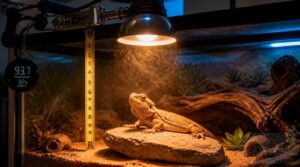
Picking the right spot for your heat lamp isn’t just a guess, it’s a bit of a science. The good news? A few simple checks can get you there without any trial and error headaches. Let’s break down exactly how to nail that distance every time.
Start by matching your bulb wattage to your tank size, then fine-tune placement using this guide to optimal basking temperatures for snakes.
Start 12–18 Inches Above
Twelve to eighteen inches. That’s your golden zone for most heat lamps, creating a solid thermal gradient your reptile can use to warm up or cool off.
Start there, then grab a thermometer for verification. Different wattages and species temperature needs mean this range is a starting point, not a forever setting. Safety first, always—too close scorches, too far leaves them cold.
Measure From Basking Surface
Forget measuring from the top of the tank—always measure from the basking surface where your reptile actually sits. Place your temperature gauge right at that spot.
Adjust lamp height until you hit your species’ target basking temperature. This is the only way to get an accurate surface temperature reading and keep that thermal gradient safe and comfy for your animal.
Check Manufacturer Distance Limits
Before you go wild adjusting your lamp, check the manufacturer’s distance limits right on the label or datasheet. These specs aren’t just suggestions—they’re about safe heat delivery and avoiding nasty surprises like overheating or fire.
Always measure from the basking surface, compare your setup to the recommended range, and jot it in your care log for easy compliance checks later.
Adjust Using Temperature Readings
Manufacturer specs get you in the ballpark, but your thermometer tells the truth. Calibrate it first (an ice bath should read 32°F), then track surface and air readings daily.
Compare surface vs air temperature to check your thermal gradient. If readings drift, nudge the lamp an inch and log the change—this trend tracking makes future adjustments way easier.
Heat Lamp Distance by Wattage
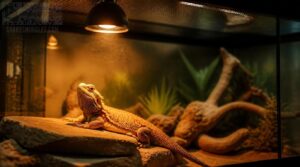
Not all bulbs are created equal, and wattage makes a big difference in how far your lamp should sit from the tank. A 25-watt bulb behaves nothing like a 150-watt one, so guessing the distance can leave your reptile too cold or too toasty.
Let’s break it down watt by watt, starting with the smallest bulbs and working our way up.
25. Watt Lamp Distance
A 25-watt bulb is the gentle giant of heat lamps—low power, but still needs respect. Place it 12 to 18 inches above the basking surface as your starting point.
Watch your surface temperature closely, since ceramic heat emitter distance and LED lamp placement rules differ from standard bulbs. Adjust wattage and distance together until your reptile’s basking spot hits its species temperature target safely.
50. Watt Lamp Distance
Fifty watts is the sweet spot for many setups, but distance makes or breaks it. Mount 12 to 18 inches up, then use a thermometer for a Temperature Stability Check.
- Narrow beam: shorter distance works
- Wide beam: raise it higher
- Ball pythons: 12–16 inches
- Recheck often for safety
For heat output considerations, note that incandescent bulbs generate significant heat with low energy efficiency.
75. Watt Lamp Distance
Why does 75 watts feel like the "just right" bowl of porridge for so many tanks? It sits at 12 to 18 inches, though ball pythons like it closer, around 12–14 inches for that cozy 90–95°F zone.
| Enclosure Size | Distance | Basking Goal |
|---|---|---|
| Small | 12 in | 90°F |
| Large | 18 in | 85°F |
Always verify with a thermometer.
100. Watt Lamp Distance
Now we’re bringing out the big guns. A 100-watt bulb throws serious heat, so give it 12 to 18 inches of clearance to avoid a scorched basking zone.
Mercury vapor versions need the higher end, since they combine heat and UVB output.
Always double-check with a thermometer — safety and steady warmth matter more than guesswork.
150. Watt Lamp Distance
Okay, this is the big kahuna of basking bulbs. A 150-watt lamp needs 12 to 18 inches of clearance, no exceptions.
Ball pythons like 12–15 inches, bearded dragons around 14, and turtle docks prefer 16–18. Go closer, risk burns. Go farther, warm zone flops.
Always confirm with a thermometer — safety first, always.
Distance Guidelines by Reptile Species
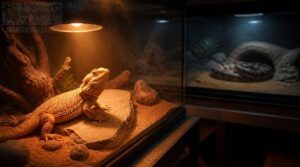
Here’s the thing: not every reptile wants the same amount of heat. A ball python and a bearded dragon have totally different ideas of "cozy." Let’s break it down species by species so you get the distance just right for your scaly buddy.
Ball Python Warm-Side Distance
Ball pythons want their warm side sitting at 88 to 92°F, measured right at the basking surface, not the air above it. Start your heat lamp around 12 inches up, then adjust using real readings. A thermostat keeps things steady within 2 degrees.
Skip the gradient here and your snake’s digestion pays the price.
Turtle Basking Dock Distance
For turtle basking dock distance, you want the lamp about 10–12 inches above the dock, aiming for 85–90°F right where the turtle’s shell sits. If you’re also running a fogger nearby, keep it at least 12 inches from your basking lamp, following this reptile fogger setup guide, to avoid condensation and heat conflicts.
Keep the dock centered so the whole carapace gets heat, and make sure the turtle can reach it easily with its front legs.
Adjust the height if temps aren’t spot-on!
Bearded Dragon Basking Distance
For a bearded dragon basking spot, aim for the lamp about 6–8 inches above the platform. You want a surface temp check of 100–107°F using an infrared thermometer. Use a reflector to focus heat and keep a safe clearance zone so your dragon doesn’t get scorched. Always set up a heat gradient for easy thermoregulation.
Species-Specific Temperature Targets
Every reptile has its own basking temperature sweet spot. For example, snapping turtles need 85–90°F, while ball pythons thrive at 88–92°F. If you’re raising a desert lizard, aim for a basking area of 38–40°C.
Always create a temperature gradient in the tank, monitor with a thermometer, and adjust for seasonal shifts.
Measure Basking Temperatures Correctly
Getting basking temperatures right is a game changer for your reptile’s health. If you’re not sure how to check them, you’re definitely not alone. Here’s what you need to know to make sure your setup stays in the safe zone.
Use Digital Probe Thermometers
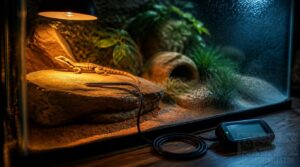
Ever tried juggling thermometers like hot potatoes? Stick with a digital probe thermometer for real results. Place the probe right on the basking spot—don’t guess! Watch for battery life alerts so readings stay sharp. Calibrate for accuracy using ice-point checks. Log data for your temperature gradient. Fast response times help with thermal safety.
| Probe Placement | Battery Monitoring | Calibration Method |
|---|---|---|
| Basking Surface | Low Battery Alert | Ice-Point Test |
| Warm Side Air | USB Recharge | Test Cap |
| Water Area | Auto Power-Off | CalCheck Feature |
| Gradient Spots | Data Logging | Response Timing |
Check Surfaces With Infrared
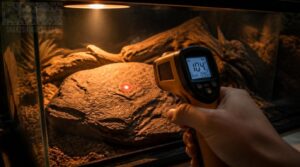
Grab an infrared thermometer and point it right at the basking spot—think of it like a magic laser for finding hot patches.
Quick surface checks reveal thermal contrast patterns across rocks, docks, and substrate. Watch for insulation gaps near lids or edges.
Don’t forget to set the emissivity for accurate readings on matte versus shiny surfaces—one tweak, big difference!
Measure Warm-Side Air Temperature
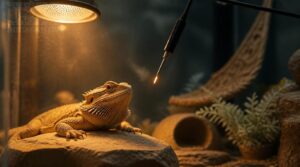
How do you catch the real warmth your reptile feels? Stick a digital probe thermometer right in the open air above the basking spot—not buried in the substrate. Let the heat lamp run for at least 15 minutes, then check for a steady ambient temperature. Calibrate your thermometer, track temps throughout the day, and aim for a gentle thermal gradient.
| Feeling | Air Temp | Behavior |
|---|---|---|
| Toasty | 35–40°C | Happy basking |
| Chilly | 40°C | Avoids lamp |
Test After Setup Changes
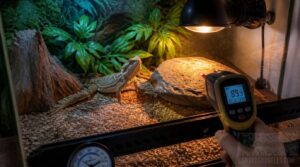
So you just moved that heat lamp — now what? Grab your thermometer and get checking, because guessing is not a plan.
- Temperature shift should stay within 2–3°C
- Watch for behavior adaptation within 24–72 hours
- Verify humidity stays in range
- Inspect for new hot spots or scorched substrate
Recheck the gradient too — warm and cool sides still need that safe wattage-driven split.
Monitor Temperature Throughout Day
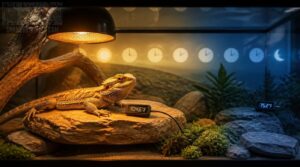
One reading tells you nothing — tanks heat up and cool down like a rollercoaster all day long.
Do daily temp logging at peak sun hours and again at night. Keep sensor placement consistent, track temp trends weekly, and set alert thresholds so your basking temperature never sneaks past safe limits while your ambient temperature stays steady too.
Signs Your Lamp is Too Close
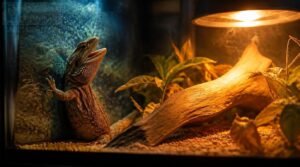
Sometimes your reptile tells you the lamp’s sitting too close before you even grab a thermometer. Little clues pop up in the tank, in their behavior, and even on the substrate itself. Here’s what to watch for so you catch the problem early.
Basking Surface Feels Excessive
Ever touch a car hood in July? That’s basically your reptile’s basking spot when the lamp sits too close. Surface temperatures climbing past the target range dry out skin, create harsh hotspots, and leave patchy warm-and-cool zones instead of a smooth gradient.
Watch for peeling or irritation—that’s your cue to raise the lamp and restore safe, even heat.
Reptile Avoids Warm Side
Your reptile keeps hiding, and it’s not being shy—it’s telling you something’s wrong.
Thermoregulation depends on choice. When the warm side turns brutal, cool side preference takes over completely, and basking spots go untouched.
Watch for:
- Rare visits to the warm zone
- Head turns toward heat, then quick retreats
- Skipped meals from feeding disruption
- Restless, stressed pacing
That’s temperature avoidance in action. Time to raise that lamp.
Skin Burns or Irritation
Avoidance is a warning shot. Actual burns mean the shot already landed.
Skin starts cooking above 120°F after just 10 seconds, and at 130°F, damage hits in five. Watch for lasting redness, blisters, or odd shedding.
| Sign | Meaning | Action |
|---|---|---|
| Redness 30+ min | Mild burn | Add barrier, cool skin |
| Blisters | Second-degree | Vet visit needed |
| Retained shed | Skin damage | Lower lamp wattage |
Tank Temperature Spikes
Burns are the animal’s problem. Spikes are the tank’s.
Burns hurt your reptile, but temperature spikes signal your whole tank setup is failing
A too-close lamp causes sudden heat surges, pushing warm-side readings well past target. Watch for thermometer jumps that settle fast — that overshoot pattern signals wrong wattage or distance.
Check temps every 15–30 minutes after adjustments. Log daily highs. Spotting fluctuations early beats scrambling once your reptile’s already stressed and panting on the warm side.
Substrate Becomes Dangerously Hot
The tank’s air can look fine while the floor turns into a griddle. That’s the sneaky part.
Check substrate temps directly under the lamp with an infrared thermometer. Anything creeping past 122°F (50°C) means burn risk. Dark, dry, or uneven substrate heats fastest — raise the lamp or add a thermostat before your reptile learns the hard way.
Signs Your Lamp is Too Far
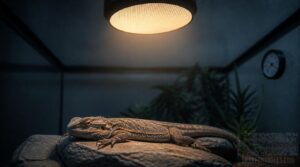
Now flip the script and think about a lamp set too far away. Your reptile can’t hit the right temps no matter how hard it tries, and that causes its own set of problems. Here’s what to watch for when your setup is running a little too cold.
Basking Spot Stays Cool
Ever check the thermometer and think, "that’s it?" A cool basking spot usually means your heat lamp sits too far away. Fixes:
- Lower the lamp 1–2 inches
- Verify surface temp with an infrared thermometer
- Match wattage to tank size
Keep adjusting until the basking spot hits target range—your reptile’s digestion depends on it!
Reptile Constantly Seeks Heat
Watch how your buddy acts, not just the thermometer. If your reptile camps out under the lamp all day and won’t budge, that’s thermoregulation screaming for help. Normal basking involves moving between warm and cool zones. Constant heat-seeking (outside of brumation recovery or a behavioral fever) usually means the wattage just isn’t cutting it—time to adjust that thermal gradient.
Digestion or Activity Slows
When basking temps run cold, your reptile’s whole body slows down like a car stuck in first gear. Low heat tanks metabolism rate and wrecks gut motility.
Watch for:
- Sluggish digestion, undigested food lingering
- Reduced nighttime activity
- Poor appetite despite normal meal size
Check wattage and hydration level—dehydration only worsens slow transit.
Warm Side Misses Target
Why does that basking spot feel lukewarm no matter what you try? Your heat lamp might just be too far from the mark.
| Species | Target Range | Common Miss |
|---|---|---|
| Bearded dragon | 100–110°F | Stuck near 90°F |
| Ball python | 88–92°F | Stuck near 80°F |
| Turtle dock | 85–95°F | Stuck near 75°F |
Consistency matters—recheck with a digital thermometer often.
Increase Heat Gradually
Patience beats rushing every time. Move your heat lamp closer by 1 to 2 inches, wait 24 hours, then check surface temps.
- Confirm Wattage Start Locations before adjusting
- Track Species Heat Targets with a log
- Watch Behavior Monitoring During Adjustments
- Use a thermostat for steady control
Incremental Height Changes protect your reptile’s thermal gradient while safely reaching target temperatures.
Choose The Right Heat Lamp

Distance only works if you’ve got the right bulb doing the job in the first place. Different lamps behave differently, so picking the wrong one can throw off all your careful measuring. Here’s a quick rundown of your options so you can match one to your setup.
Basking Bulbs
Think of basking bulbs as your reptile’s personal sunbeam. They pump out heat and light together, mimicking real daylight cycles.
Wattages run 25W to 150W, so match wattage to tank size. Bigger tanks need more punch to create that warm, glowing basking spot your scaly buddy can’t resist.
Ceramic Heat Emitters
No glow, all glow-up for warmth: that’s a Ceramic Heat Emitter. It radiates 2–10 micron infrared without wasting energy on light, giving great thermal efficiency. The ceramic shell withstands brutal temperatures and offers real long-term durability.
Just remember: they need ceramic socket compatibility, so grab the right fixture. Match wattage to distance, watch ambient temperature, and safety stays simple.
Mercury Vapor Bulbs
Ready for a real power player? Mercury vapor bulbs pull double duty—heat and UVB in one. You’ll want at least 12–18 inches clearance for safe UV protection distance.
Check that your fixture and ballast are HID-rated and can handle the heat. Their lifespan is wild (up to 24,000 hours!), but always handle with care—mercury’s inside.
Match Wattage to Tank
If you grab a 50-watt heat lamp for a 10–20 gallon tank, you’re on track—too much wattage and your reptile’s sweating buckets; too little and it’s shivering.
For bigger tanks, try two smaller heaters for even warmth and backup.
Matching wattage to tank size saves energy and money, and makes adjusting for seasonal changes way easier.
Separate Heat From UVB
Don’t let your heat lamp and UVB bulb play tug-of-war over your basking spot. Always use separate fixtures—heat for warmth, UVB for vitamin D.
Keep UVB higher than the heat lamp, and angle them so you don’t create a fiery overlap. Add a UVB shield if things get crowded.
This keeps your reptile comfy and safe.
Set Up Heat Lamps Safely
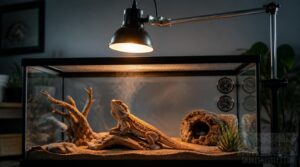
Let’s talk safety—because nobody wants fried reptiles or a melted tank. Setting up your heat lamp the right way keeps your pet comfy and your nerves calm. Here’s what you need to look out for before you flip the switch.
Use Ceramic-Socket Fixtures
Ever wonder why you shouldn’t use a plastic socket for your reptile’s heat lamp? Ceramic sockets handle intense heat, resist cracking, and protect against electrical mishaps. Here’s what makes them a top pick:
- Heat tolerance—no melting!
- Long-lasting durability
- Safe wiring installation
- Ideal for high-watt bulbs
Your reptile’s safety starts right here.
Secure Lamps Against Falls
If your lamp takes a tumble, you’re in hot water—literally. Secure lamp mounting is a must: use adjustable wall or ceiling arms and check brackets hold at least five times the lamp’s weight. For bases, pick heavy, broad-footed models and add sand or lead shot for stability.
Cable management matters; keep cords clipped and switches out of reach to avoid accidents.
Keep Flammable Materials Away
Don’t risk your reptile’s home turning into a barbecue.
Keep flammable materials—like towels, paper, and cardboard—at least three feet from your heat lamp. Use fire-resistant coverings near the fixture, and stash flammable supplies in a metal cabinet.
A clutter-free area plus a heat shield barrier means less worry and safer basking temperatures every day.
Add Thermostats or Dimmers
If you want to keep basking temps steady, hook up a thermostat for automatic cycling and set your target zone.
For fine-tuning, use a dimmer switch—just make sure your bulb is dimmable. Smart thermostats let you adjust from your phone.
Double-check sensor placement and calibrate for accuracy. Tweak the hysteresis setting so you’re not chasing wild temperature swings.
Avoid Glass Heat Traps
Think glass is just for show? Nope—glass heat trapping can roast your reptiles if you’re not careful. Here’s how to keep your setup safe:
- Use solar control glass or coatings to block infrared.
- Install external shading devices like awnings or blinds.
- Test with thermal modeling before you commit.
- Make sure nighttime cooling is effective—ventilation matters!
Top 4 Products for Reptile Setups
If you want your reptile setup to run smoothly, the right gear makes all the difference. There’s a handful of products I trust to keep things safe and comfy for your critters. Let’s take a look at what belongs in your tank.
1. Zoo Med Reptisun T5 HO 10.0 UVB Lamp
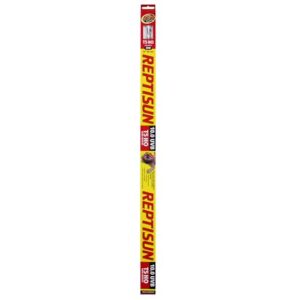
If you’re serious about keeping reptiles healthy, the Zoo Med Reptisun T5 HO 10.0 UVB lamp is a standout choice. This high-output bulb blasts UVB up to 22 inches, so even your big lizards get what they need. It’s perfect for bearded dragons and tortoises who love a sunbath.
Just remember, replace it every 6–12 months—UVB fades even if the lamp’s still glowing. Use a compatible T5 HO fixture and don’t let the glass break!
| Best For | Larger desert reptile species like bearded dragons, tortoises, and uromastyx that need strong UVB in spacious habitats. |
|---|---|
| Product Type | UVB Fluorescent Lamp |
| Target Animal | Desert Reptiles |
| Primary Purpose | UVB/UVA Lighting |
| Supports Bone Health | Yes |
| Replacement Frequency | 6-12 Months |
| Enclosure Size Fit | Large Habitats |
| Additional Features |
|
- Provides high UVB output for effective vitamin D3 synthesis and bone health
- Enhances appetite, activity, and natural behaviors with added UVA exposure
- Covers large enclosures evenly, ideal for bigger reptiles
- UVB output declines over time, requiring replacement every 6–12 months
- Not suitable for small enclosures due to length and intensity
- Glass construction is fragile and may break during shipping or handling
2. Rep-Cal Phosphorus-Free Calcium Powder with D3
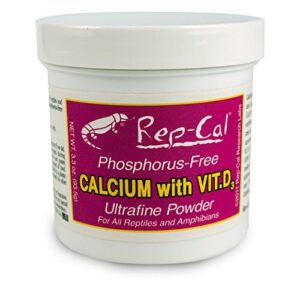
Looking for a bone-boosting secret? Rep-Cal Phosphorus-Free Calcium Powder with D3 has your reptiles covered. It’s made from 100% natural oyster shell calcium carbonate, finely ground so it sticks to feeder insects and veggies like magic.
The added vitamin D3 helps reptiles absorb calcium, especially those without enough UVB. Sprinkle, shake, or dust—just don’t overdo it.
One jar lasts ages, but remember: this powder doesn’t replace proper lighting or balanced nutrition. Use wisely for strong shells and happy herps!
| Best For | Reptile and amphibian owners who want an easy, effective way to boost their pets’ calcium intake and support bone health. |
|---|---|
| Product Type | Calcium Supplement |
| Target Animal | Reptiles & Amphibians |
| Primary Purpose | Calcium/D3 Supplementation |
| Supports Bone Health | Yes |
| Replacement Frequency | Up to 1 Year |
| Enclosure Size Fit | Any Size |
| Additional Features |
|
- Ultrafine, flavorless powder easily coats insects, fruits, and veggies
- Contains vitamin D3 to help with calcium absorption
- One jar lasts up to a year with regular use
- Overuse can lead to excess supplementation and health issues
- Does not substitute for proper UVB lighting
- Needs careful mixing to ensure even coverage on food
3. Mazuri Freshwater Aquatic Turtle Food
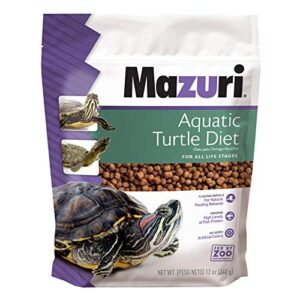
Calcium’s covered—now let’s talk dinner. Mazuri Freshwater Aquatic Turtle Food gives your shelled buddy a nutritionally complete floating pellet, so no extra supplements needed.
Made with fish meal, chicken meal, and porcine meat and bone meal, it packs serious protein for carnivorous turtles. The pellets float and mimic natural feeding, encouraging that fun foraging instinct turtles love.
Just know it contains corn, soy, and wheat, and some owners find the pellets smaller than expected. Still, it’s a solid staple diet for healthy shells.
| Best For | owners of freshwater carnivorous turtles who want a convenient, all-in-one staple diet without mixing in extra supplements. |
|---|---|
| Product Type | Turtle Food Pellets |
| Target Animal | Freshwater Turtles |
| Primary Purpose | Nutritional Diet |
| Supports Bone Health | Yes |
| Replacement Frequency | Per Feeding Schedule |
| Enclosure Size Fit | Any Size |
| Additional Features |
|
- Nutritionally complete, so no need for additional supplements
- Floating pellets encourage natural foraging behavior
- High protein content from fish, chicken, and porcine meal supports shell and growth health
- Contains corn, soy, and wheat, which may not suit all dietary preferences
- Pellet size is smaller than some users expect
- Priced higher per ounce than some competing brands
4. Zoo Med PowerSun UV 160 Watt Bulb
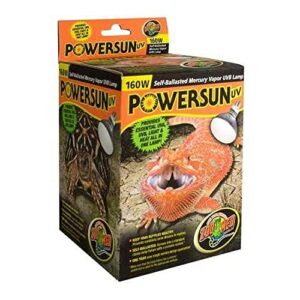
Now for the big gun: the Zoo Med PowerSun UV 160W. This self-ballasted mercury vapor bulb throws UVA, UVB, and heat from one bulb—no ballast box needed.
Its nickel-plated threads resist corrosion, and UVB reach extends several feet, perfect for big terrariums or aviaries where regular tube lights just can’t keep up.
Just watch your placement carefully. It comes with a one-year warranty, though some owners report shorter bulb life, and returns mean you’re covering shipping.
| Best For | Owners of large reptile or bird enclosures who need strong UVB penetration and supplemental heat from a single all-in-one bulb. |
|---|---|
| Product Type | Mercury Vapor Lamp |
| Target Animal | Reptiles & Birds |
| Primary Purpose | UVB Heat & Lighting |
| Supports Bone Health | Yes |
| Replacement Frequency | Around 1 Year |
| Enclosure Size Fit | Large Enclosures |
| Additional Features |
|
- Combines UVA, UVB, and heat in one self-ballasted bulb, no separate ballast required
- UVB projects several feet, making it effective for large terrariums and aviaries
- Nickel-plated threads resist corrosion and fit securely in standard ceramic sockets
- Requires careful distance placement to avoid overheating or under-exposure
- Some bulbs burn out before the one-year warranty period ends
- Warranty replacements require you to pay for return shipping
Fine-Tune Lamp Distance Over Time
Getting the distance right isn’t a one-and-done deal. Your reptile’s needs shift with the seasons, bulbs wear down, and setups need a little love now and then. Here’s how to keep everything running smoothly for the long haul.
Raise or Lower Gradually
Patience wins here. Move your heat lamp just 1 to 2 inches at a time, then wait 24 hours before checking again.
This slow distance tuning prevents temperature swings that stress your reptile. Track each shift with a digital thermometer, confirm fixture compatibility, and log results. Controlled heat progression, not sudden jumps, keeps basking spots safe, stable, and comfortable.
Watch Your Reptile’s Behavior
Numbers matter, but your reptile’s got opinions too. Gaping mouths, pacing, or skipped meals mean the lamp’s too close. Ignoring water and basking cues invites bigger stress.
Watch for:
- Stress indicators like tight tail coils or lethargy
- Sudden feeding changes or refusal to eat
- Shifts in activity level or hiding behavior
Trust these signals as much as your thermometer.
Recheck Seasonal Temperature Changes
Ever notice your basking spot drifting even though the lamp hasn’t moved? Blame the seasons. Summer sun and winter chill both sneak into your tank, so schedule shift period monitoring each spring and fall.
Track humidity shifts, watch your reptile’s behavior, and recalibrate your thermostat as needed. A quick nighttime check confirms cooling stays safe too.
Clean Fixtures Regularly
Since dust loves to hog the spotlight (literally), give fixtures a wipe weekly with a microfiber cloth. Every few weeks, vacuum vents for dust removal, and check gaskets for wear.
- Weekly dusting
- Corrosion prevention
- Seal inspection
- Fixture safety checks
This routine keeps your heat lamp running true, so temps stay accurate and electrical safety stays solid.
Inspect Bulbs and Wiring
Grab a flashlight and give that bulb a once-over: cracks, black spots, or a cloudy haze mean it’s done.
Check socket contacts for corrosion or pitting, and inspect wiring insulation for fraying.
Confirm wattage matches your fixture, and snug up any loose connections.
Regular checks catch wiring issues before they become real safety headaches.
Frequently Asked Questions (FAQs)
How close is too close for a heat lamp?
Too hot burns skin, too close sparks danger. Keep your minimum safe distance at 12 inches from flammables. Closer than that risks burns and a real fire hazard—always check surface temps before trusting the setup.
Can I leave a heat lamp on all night in my chicken coop?
Honestly, it’s risky. All-night heat lamps raise fire risk from bedding ignition and electrical hazards. Try temperature control alternatives like ceramic emitters or better insulation—safer for your coop, and your chickens sleep easier too.
Can I leave my heat lamp on all day?
Nope, skip all-day heat lamp cycling. Your reptile’s tank needs a nighttime temperature drop to mimic nature. Pair a thermostat with humidity checks, watch fire safety, and save energy—your scaly buddy (and your electric bill) will thank you.
How far should a heat lamp be from a basking spot?
Picture your poor lizard basically getting sunburned indoors—yikes! Generally, keep the heat lamp 12 to 18 inches above the basking spot, then fine-tune using an infrared thermometer until you hit your species’ target temperature safely.
Can heat lamps run 24 hours a day?
Running heat lamps nonstop isn’t ideal—it messes with your reptile’s circadian rhythm and risks overheating or burns. Use a thermostat and timer for proper day-night heating cycles, keeping ambient zones safe without constant, risky operation.
How often should heat lamp bulbs be replaced?
Swap most bulbs every 6 to 12 months, though wattage matters: 25-watt bulbs age faster, while mercury vapor lasts 12 to 18 months. Watch temperature dips, not just burnt-out looks, and use a thermostat to stretch bulb life safely.
Do reptiles need heat lamps at night?
Only if ambient room temps dip below their target zone. Skip the glowing heat lamp though—it messes with sleep. Try ceramic heat emitters with thermostat regulation instead, adjusting gradually to keep your reptile’s nighttime behavioral thermoregulation safe and steady.
Can multiple reptiles share one heat lamp?
Yes, but only with a temperature gradient, matching species compatibility, smart lamp positioning, and thermostat regulation. Watch behavioral thermoregulation cues closely—if one reptile hogs the warm spot, safety and comfort both take a hit.
What happens if the power goes out?
Your tank turns into a fridge with legs the second power dies. Insulate with towels for reptile tank insulation, grab emergency lighting, and check a backup power bank while monitoring temperature until your heat lamp’s back online safely.
Conclusion
Someday your reptile will bask like a pro, stretched out and perfectly content, but only if you nail the setup first.
Knowing how far should heat lamp be from tank turns guesswork into confidence. Twelve to eighteen inches is your starting line, not your finish line. Watch your pet’s behavior, trust your thermometer, and adjust like a scientist, not a psychic.
Get the distance right, and basking time becomes what it should’ve been all along: pure, warm, worry-free comfort.