This site is supported by our readers. We may earn a commission, at no cost to you, if you purchase through links.

A ball python cooking on the glass isn’t a dramatic accident—it’s the predictable result of a bulb hung too close, with no thermostat standing between it and disaster. Snakes can’t feel radiant heat the way you do until it’s already done damage, so the setup work happens before your snake ever enters the tank.
Get the wattage wrong, skip the guard, or misplace the probe, and you’re not just risking a burn—you’re disrupting the thermoregulation your snake depends on to digest, shed, and stay healthy.
Here’s how to set up a snake heat lamp that holds a steady gradient, keeps your snake safe, and gives you real control over its environment—from bulb selection to probe placement, no guesswork required.
Table Of Contents
- Key Takeaways
- How to Set Up a Snake Heat Lamp
- Set Species-Specific Temperature Targets
- Create and Test Thermal Gradients
- Manage Day and Night Heating
- Prevent Heat Lamp Safety Hazards
- Frequently Asked Questions (FAQs)
- How long do you leave a heat lamp on for a snake?
- How to properly set up a heat lamp?
- What should my snakes heating pad be set at?
- How to keep a snake warm at night?
- Can heat lamps be left on continuously without a timer?
- What happens if the heat lamp suddenly stops working?
- How often should heat lamp bulbs be fully replaced?
- Is a heat lamp necessary if using under-tank heating?
- Conclusion
Key Takeaways
- Always wire your heat lamp through a calibrated thermostat with the probe placed at basking height in open air, since guesswork or misplacement can lead to burns or a collapsed thermal gradient.
- Match bulb type and basking temperature to your snake’s species—for example, 88–92°F for ball pythons and boas, 85–90°F for corn snakes—rather than using a one-size-fits-all setup.
- Run your heat lamp on a 12-hour on/off timer and switch to a ceramic heat emitter at night, since true darkness and a stable day-night cycle are just as important as daytime warmth.
- Protect against fire and injury by using a secured guard, GFCI-protected wiring, and three feet of clearance from flammable materials, and inspect all equipment daily since bulbs and thermostats degrade over time.
How to Set Up a Snake Heat Lamp
Setting up a heat lamp isn’t just about screwing in a bulb and hoping for the best—every piece matters. Get the wattage, placement, and thermostat wrong, and you’re looking at burns, stress, or worse for your snake. Here’s exactly what you need to get right, step by step.
If your snake still seems off despite a perfect setup, watch for bubbling, wheezing, or sores, and see this guide to treating a snake’s bacterial infection.
While you’re dialing in the heat setup, it’s worth keeping an eye on shed quality too, since incorrect temperatures often show up first as signs of incomplete snake shed like retained eye caps.
If you’re picking up your first bulb, this beginner’s guide to choosing the right heat lamp for pet snakes breaks down the basics before you make a costly mistake.
Get the wattage, placement, or thermostat wrong, and your snake pays the price in burns, stress, or worse
Choose a Species-Appropriate Bulb
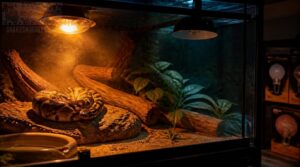
Not every bulb suits every snake. Ball pythons need 90–95°F baskings, corn snakes 85–92°F—wattage and bulb type must match.
Choose incandescent or radiant heat bulbs (40–60 watts) for daytime warmth, ceramic emitters for nighttime heat without light. Check color temperature (3000–3500K) for natural glow, balancing heat output against light disruption to protect your snake’s nocturnal rhythm.
Ball pythons require a thermal gradient with 95°F at the warm end and 78°F at the cool end to properly regulate body temperature, as noted in their habitat requirements.
Mount Lamp on Warm Side
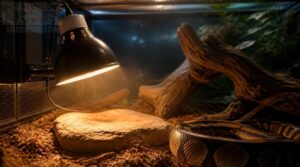
Once you’ve picked the right bulb, mounting placement makes or breaks your gradient. Fix the lamp on the warm side only, using a stable bracket rated for heat exposure.
Leave clear interior space around the fixture for airflow and even heat distribution. Adjust height until the basking zone reads correctly, then let your thermostat control hold it steady.
Install a Protective Lamp Guard
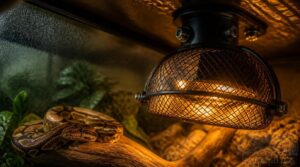
With your lamp mounted, the bulb itself becomes a hazard your snake can reach. Fit a metal cage guard around the bulb and socket, secured without touching the surface.
- Snap-style guards install fastest
- Check clearance of at least 1 inch
- Match diameter to bulb plus collar
- Inspect monthly for cracks
- Clean with a damp cloth only
Connect Lamp to Thermostat
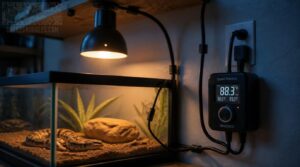
A guard stops burns, but constant heat still risks overheating without a thermostat control. Wire it between the lamp and outlet, never inside the housing, switching only the hot conductor.
| Check | Requirement |
|---|---|
| Voltage | 120V or 240V AC |
| Load | Match thermostat amperage to bulb wattage |
| Location | Dry, moisture-free mounting |
| Wiring | Grounded outlet, no frayed cords |
Position Thermostat Probe Correctly
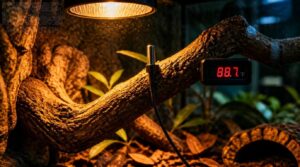
Where you place that probe determines whether your thermostat control actually works. Mount it at your snake’s basking height, 2 inches minimum from the lamp, in open air—never on substrate, hides, or conductive surfaces. Calibrate against a digital thermometer first (±0.5°F), then check weekly. Adjust height in 1-inch increments if readings drift 2°F off target.
Placement accuracy protects your entire gradient.
Even a few inches off can create cold spots, so check this guide to reptile heating mats for kids and families before positioning yours.
Set Species-Specific Temperature Targets
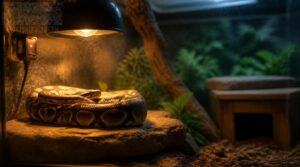
Once your lamp and thermostat are wired up, the next step is dialing in the right numbers for your snake. Every species has its own basking and cool-side targets, and getting them wrong stresses your snake far more than you’d expect. Here’s what to aim for, species by species.
Ball Python Basking Temperatures
Ball pythons crave heat like a sunbather craves noon. Aim your basking spot for 88–92°F (31–33°C), checked with an infrared thermometer, not guesswork.
- Use a 60–100W basking lamp
- Place the thermostat probe at basking height
- Keep hides in both warm and cool zones
Never exceed 95°F — that’s when digestion gives way to heat stress.
Corn Snake Basking Temperatures
Corn snakes run cooler than ball pythons, so don’t chase the same numbers. Keep the basking surface temperature at 85–90°F, checked with a probe thermometer.
| Zone | Target |
|---|---|
| Basking | 85–90°F |
| Cool side | Mid 70s–low 80s |
| Nighttime | 70–75°F |
| Digestion | Stable warm zone |
This gradient helps digestion and natural nighttime cooling.
Boa Constrictor Basking Temperatures
Boas run bigger and beefier than corn snakes, so their basking zone needs to work harder. Aim for 88–92°F on the surface, verified with a probe—not a guess.
Wire your heat lamp through a thermostat, probe positioned right on the basking surface, to lock in that gradient and support digestion without scorching your boa’s ventral scales.
Cool-Side Temperature Targets
A cool side that’s too warm ruins the whole point of a gradient. Ball pythons need 72–79°F, corn snakes 77–82°F, boas 75–79°F.
Verify with a temperature probe under a hide—don’t guess. Check readings twice daily, keep ambient swings within 1–2°C, and watch humidity, since a too-warm cool side often spikes moisture and undermines thermal regulation.
Desert Versus Tropical Needs
Think Sahara, not rainforest. Desert species need a hotter, drier basking zone (90–102°F) with low 20–40% humidity, sandy substrate, and 12–14 hour daylight. Tropical snakes want steadier 86–92°F warmth with higher moisture retention.
- Basking heat
- Humidity range
- Substrate type
- Daylight length
- Hydration source
Match your heat lamp and gradient to species origin, not habit.
Create and Test Thermal Gradients
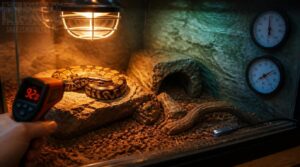
Once your lamp and thermostat are wired up, the real work starts: proving the gradient actually functions. Numbers on a dial mean nothing until you’ve checked them against real conditions inside the tank. Here’s what you need to verify before your snake ever sets foot inside.
Place Warm and Cool Hides
Once your lamp’s mounted, hides come next. Place the warm hide directly beneath the basking zone, opening away from airflow, slightly off substrate for a trapped heat pocket. The cool hide belongs opposite, shaded, on stable ground away from drips. Use nonporous materials only, and clean both weekly.
Proper hide placement completes your gradient—without it, thermoregulation fails.
Measure Surface Temperatures
With hides placed, grab an infrared thermometer and check the actual basking surface temperature—not just air readings. Match emissivity settings to your substrate (usually 0.95–0.98), hold the sensor perpendicular with full contact, and verify calibration against a known standard first.
Take multiple readings across the basking area for accurate thermal gradient mapping before trusting any single number.
Monitor Ambient Temperatures
Surface readings only tell half the story. Place an ambient probe near the enclosure’s middle, at your snake’s resting head height, away from vents or lamps. Target 72–82°F on the cool side.
Log readings twice daily, using a calibrated logger (±0.5°C accuracy) to catch drift before it stresses your snake.
Check Humidity Levels
Once your temperature probes are logging clean data, don’t skip humidity — it works hand-in-hand with your gradient. Keep RH between 40–60%, checked via digital hygrometer away from heat sources. Watch for foggy glass or dry, cracked scales.
- Place hygrometer mid-enclosure
- Mist morning and evening
- Log RH with temps
- Watch shedding cycles
- Adjust for seasonal AC swings
Test Before Adding Your Snake
Before your snake ever sees its new home, run a 72-hour dry test. Confirm thermostat accuracy, log baseline temps at basking, mid, and cool zones, verify humidity range, and check heat source placement holds steady. Watch for equipment stability — no flickers or cycling errors. Keep an emergency plan ready. Only then does the gradient earn its stripes.
Manage Day and Night Heating
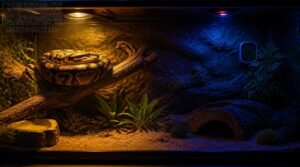
Your snake’s body clock depends on more than just basking heat—it needs a real cycle of light and dark to function properly. Getting this rhythm wrong disrupts thermoregulation even when your daytime temperatures are perfect. Here’s how to build a day-night heating routine that actually mimics nature.
Set a Daylight Timer
Manual switches invite mistakes. A daylight timer removes guesswork by syncing your heat lamp to real sunrise and sunset times via geolocation setup.
Program weekend programming separately if your routine shifts, enable DST override so clocks stay accurate, and confirm battery backup keeps schedules intact during outages. Seasonal adjustments matter too—shortening winter photoperiods protects your snake’s thermal gradient and basking zone consistency alongside the thermostat.
Provide True Nighttime Darkness
Once your daylight timer clicks off, true darkness must follow—below 0.1 lux, no glow from your heat lamp.
Shield fixtures, seal door gaps, and skip nightlights. Verify with a lux meter. True nighttime darkness protects circadian rhythms, stabilizes your thermal gradient, and keeps your thermostat readings honest without stray light interference.
Use Ceramic Heat Emitters
Darkness doesn’t mean cold. Swap your daytime heat lamp for a ceramic heat emitter—it radiates infrared heat with zero visible light, so nighttime basking zone temperatures hold steady without breaking the gradient.
Mount it at the same height, pair it with your thermostat, and verify surface temperature with a probe. Keep the area ventilated; these run hot.
Avoid Red or Blue Bulbs
Colored bulbs won’t help your snake’s circadian rhythm—they disrupt it. Red light provides heat but no true daylight cue, dulling activity. Blue light stresses reptile eyes and skews feeding behavior.
Stick with white or ceramic heat sources; they support natural thermoregulation and let you visually monitor hydration, shedding, and stress signs your snake’s basking zone temperature alone won’t reveal.
Separate Heat From UVB
One fixture for heat, another for UVB—crowding both together wrecks your gradient and your bulb’s lifespan.
Mount UVB on its own dome, at or above 15 inches from your snake. Use non-reflective basking surfaces to avoid UV hotspots.
Check both fixtures often for silicone seal wear or heat damage that compromises shielding.
Prevent Heat Lamp Safety Hazards
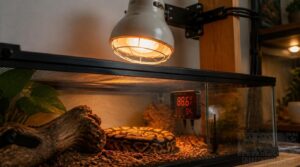
A heat lamp does its job well, but it can just as easily start a fire or burn your snake if you get careless. The wiring, the wattage, the distance—every piece carries some risk if you skip the details. Here’s what you need to check and maintain to keep your setup safe.
Maintain Safe Lamp Distance
Since even an inch of drift can scorch skin, treat distance as non-negotiable: keep the bulb 18 inches from your snake and 6 inches clear of bedding. Mount fixtures so lamp height adjustment stays fixed, not fiddled with.
After any lid removal, run a quick distance verification routine—measure, confirm, move on.
Secure Fixtures and Electrical Cords
Distance means nothing if the fixture itself can shift. Mount brackets securely to bear the lamp’s full weight, using wall anchors rated for the surface—never drywall alone.
Route cords through channels, clipped every 3 feet, away from bedding and sharp edges. Install strain relief at entry points. Use grounded three-prong plugs on a dedicated, GFCI-protected circuit—never daisy-chain devices.
- Anchor brackets to studs, not just drywall
- Clip cords every 3 feet along walls
- Add strain relief where cords enter fixtures
- Test grounded outlets and GFCI monthly
Keep Materials Away From Heat
Wiring isn’t the only fire risk lurking near your lamp. Anything flammable—paper towels, bedding bags, spare substrate—needs three feet of clearance minimum.
| Store Nearby | Store 3+ Feet Away |
|---|---|
| Heat-resistant shelving | Paper, fabric, chemicals |
| Metal tool bins | Cardboard boxes |
Use heat-resistant shelving for anything that must stay close, and never stack bins over cords where heat builds up unseen.
Inspect Equipment Daily
Clearance won’t matter if the lamp itself is failing. Run a daily equipment check: confirm mounting, inspect the guard, and test thermostat accuracy against your temperature probes. A 1–2 minute response lag signals trouble.
- Check wiring for fraying
- Confirm guard is intact
- Verify thermostat reading
- Log results with date/initials
Document everything—your thermal gradient depends on it.
Replace and Clean Components
Bulbs degrade before they die—swap every 6–12 months regardless of glow. Clean the guard, check wiring connections, and wipe the outlet monthly.
| Component | Action |
|---|---|
| Bulb | Replace 6–12 months |
| Guard | Clean, inspect screws |
| Probe | Alcohol wipe |
| Wiring | Check fraying |
| Outlet | Dry after wiping |
Thermostat calibration matters most; skip it, and your gradient drifts unnoticed.
Frequently Asked Questions (FAQs)
How long do you leave a heat lamp on for a snake?
Picture a ball python basking under a lamp left on around the clock — weeks later, it’s refusing food. Run your heat lamp 12 hours on, 12 off, mimicking natural day-night cycles for proper thermal regulation and steady basking temperatures.
How to properly set up a heat lamp?
Mount the bulb on the warm side, guard it against direct contact, and wire it through a calibrated thermostat. Position the probe under the basking zone, keep proper distance, and confirm your temperature gradient allows real thermal regulation before adding your snake.
What should my snakes heating pad be set at?
Get this wrong and your snake pays for it. Set your heat mat to 88–92°F for ball pythons, 85–90°F corn snakes, 82–85°F boas — always species specific, with a thermostat controlling the gradient precisely.
How to keep a snake warm at night?
Swap the daytime bulb for a ceramic heat emitter, pair it with a thermostat, and keep a warm-side hide in place. Darkness matters as much as temperature—your snake needs true night, not another glowing light.
Can heat lamps be left on continuously without a timer?
An unwatched heat lamp is a house fire waiting to happen. Never run it without a timer — continuous use overheats enclosures, wrecks bulb lifespan, and strips away the day-night gradient your snake’s thermoregulation depends on.
What happens if the heat lamp suddenly stops working?
Your basking spot cools fast, and the thermal gradient collapses. Expect lethargy, appetite loss, and stress. Check breakers, swap the bulb, or add a backup ceramic heater while monitoring temperatures closely to prevent lasting health risks.
How often should heat lamp bulbs be fully replaced?
Plan on replacing bulbs every 6 to 12 months, sooner for high-wattage desert setups. Watch for dimming output, color shifts, or flickering—these signs of wear mean replacement time has arrived, regardless of whether the bulb still glows.
Is a heat lamp necessary if using under-tank heating?
Not always, but skipping it can leave your snake in a flat, lifeless microclimate. A thermal gradient needs vertical warmth too—an undertank heater alone often can’t raise ambient air enough for tall enclosures or true basking behavior.
Conclusion
An ounce of prevention beats a pound of cure, and nowhere is that truer than under a heat lamp.
Once you know how to set up a snake heat lamp correctly, you’re not guessing anymore—you’re controlling a habitat that mirrors the wild without its dangers.
Thermostats catch what your eyes can’t; guards catch what accidents would.
Check the gradient, trust the numbers, and your snake will thermoregulate exactly as nature intended.
That’s mastery, built one degree at a time.