This site is supported by our readers. We may earn a commission, at no cost to you, if you purchase through links.

A ball python can’t make its own heat. Your enclosure has to do it, and one bad choice can turn a cozy hide into a burn hazard in an afternoon. Snakes that sit on a 45°C hot spot won’t always move away, and that’s where trouble starts.
The right ball python heat source options build a gradient: 26–32°C on the warm side, a basking surface that never passes 38°C, and a cooler 22–26°C retreat. Heat pads, ceramic emitters, deep heat projectors, radiant panels and bulbs each deliver that warmth differently. Here’s how they compare, plus the thermostats and thermometers that keep every one of them safe.
Table Of Contents
- Key Takeaways
- Ball Python Temperature Requirements: Warm Side, Basking Surface, and Cool Side
- Ball Python Heat Source Options Compared
- How to Choose a Heat Source for Your Ball Python’s Enclosure
- Safe Heat Source Placement, Thermostats, and Temperature Monitoring
- Top 10 Ball Python Heating Products and Accessories
- 1. iPower Reptile Heat Pad
- 2. Inkbird Digital Temperature Controller Thermostat
- 3. Zoo Med Reptile Heat Cable
- 4. Flukers Ceramic Heat Emitter
- 5. Zilla Reflector Dome Light Fixture
- 6. Digital Timer Outlet Switch
- 7. BN Link Mechanical Outlet Timer
- 8. Exo Terra Digital Thermometer
- 9. Etekcity Infrared Thermometer Gun
- 10. Zilla Terrarium Heat Mat
- Frequently Asked Questions (FAQs)
- What is the best type of heat source for ball pythons?
- Is 92 degrees too hot for a ball python?
- Is 70 degrees too cold for a ball python at night?
- What is the best heating option for a ball python?
- What is the best heating source for snakes?
- Do ball pythons need a heat source at night?
- Can you leave a heat lamp on 24/7 for ball python?
- What is the best source of heat for snakes?
- How do I keep my ball python warm?
- Can heat sources harm a ball python?
- Conclusion
Key Takeaways
- You’ll keep your ball python safe by building a thermal gradient with a 26–32°C warm side, a basking surface that never passes 38°C, and a cooler 22–26°C retreat.
- Every heat source you use, whether it’s a pad, cable, ceramic emitter, projector, panel or bulb, needs to run through a thermostat, because unregulated heat is the fastest route to burns and fires.
- You should mount heaters over or under one end only, guard them so your snake can’t touch them, and put the thermostat probe at surface level in the warm zone.
- You can’t trust a single reading, so check both sides with two thermometers (plus an infrared gun for surfaces), log any drift, and keep nights from dropping below about 22°C.
Ball Python Temperature Requirements: Warm Side, Basking Surface, and Cool Side
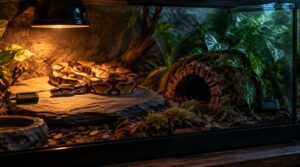
For a healthy ball python, temperature isn’t a guess. It’s your most important job. Your snake relies on you to build a proper thermal gradient, so it can move between heat and relief whenever it needs.
Setting up a warm side near 88–92°F and a cooler side in the high 70s is easier with this tropical snake enclosure setup guide.
Keep the warm side ambient at 26–32°C (80–90°F). Set the basking spot at 32–38°C (90–100°F), measured right at the surface. Never push past 38°C (100°F), because burns happen fast. Keep the cool side ambient at 22–26°C (72–79°F).
Why does this matter? A uniform enclosure stresses your python. Juveniles need slightly warmer basking for digestion, and nights shouldn’t stay below 22°C (72°F) for long.
Reliable temperature monitoring keeps you safe and confident. Probe both sides, log nightly min and max, and recalibrate your sensors regularly.
Ball Python Heat Source Options Compared
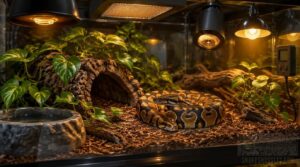
Your ball python can’t pick its own heat source, so the choice falls to you. Below, you’ll find five heat source options compared side by side. Which one fits your setup best?
Heat Pads and Cables
Instead of guessing, use a heat pad as your under tank heater, and pair it with a temperature controller.
A heat cable suits larger enclosures. Keep it shielded, and route it along the edges.
To protect your thermal gradient, check three things:
- Offset the pad from corners.
- Raise cables on ceramic tile spacers.
- Cross-check readings with a second thermometer weekly.
Ceramic Heat Emitters
Want heat without light? A ceramic heat emitter is your answer. Mount it 6 to 12 inches above the substrate, over one end, with a guard so your snake can’t touch it.
Always run it through a thermostat. That’s basic heat source safety. Good temperature regulation keeps the warm side near 88 to 92°F and protects your thermal gradient, while the cool side stays cooler.
Deep Heat Projectors
Ceramic emitters aren’t your only dark-friendly heat source. A Deep Heat Projector sends infrared down in a narrow beam, so it warms surfaces more than air. That gives your ball python a real basking spot without bright light.
Mount it overhead, angled slightly, over one end only. Aim for 88 to 92°F. Run it through a thermostat, then use temperature monitoring at both ends to protect your thermal gradient.
Radiant Heat Panels
Warmth from a radiant heat panel reaches your snake without glaring light. Why does that matter? Your ball python sleeps, hides, and digests in the dark, so steady night heat protects its routine. Mount the panel on the lid, and it warms objects directly rather than the air.
- Silent operation
- Low energy use
- Even thermal gradient
- Less substrate heating
- Easy upkeep
Always pair it with a temperature controller. Check heat source placement and temperature monitoring with an infrared thermometer.
Daytime Heat Bulbs
Bulbs give your ball python a visible, defined basking spot. They’re a smart heat source in a cool room, where ambient air can’t hold the warm side at 88°F.
Always run the bulb through a thermostat. Skip a temperature controller, and you’re risking burns. Mount the fixture above the enclosure, never inside it. Check heat safety with an infrared thermometer.
How to Choose a Heat Source for Your Ball Python’s Enclosure
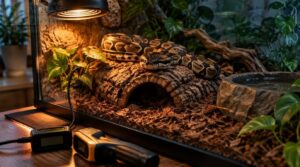
Picking the right heat source isn’t guesswork, and your snake’s health depends on getting it right. The five steps below walk you through matching heat to needs, from checking temperatures to placing every heater safely. Follow them in order, and you’ll build a setup you can trust.
Check Temperature Needs
Your ball python can’t tell you it’s cold. So you have to know the numbers first.
Your ball python can’t tell you when it’s cold, so you must learn the right temperatures before it suffers
Aim for 88–92°F on the warm side and 78–82°F on the cool side. That thermal gradient drives temperature regulation. Check your thermostat settings, confirm with a temperature controller and probe placement on the warm and cool zones, never on substrate. Nights drop to 68–75°F.
Compare Heat Sources
Picture a sunbeam on a warm rock. That’s your goal. Each heat source paints that picture differently.
A heat pad warms the floor, but hot spots happen. A ceramic heat emitter heats the air without light, yet dries it. A deep heat projector builds a basking spot. Which fits your setup? Whatever you pick, run it through a temperature controller.
Plan Day-Night Heating
Does your snake need the same heat at midnight? No. Your daytime heat gradient shouldn’t vanish after dark.
Build your cycle in three steps:
- Run your heat source on a 12:12 timer.
- Drop the nighttime temperature 5–10°F, never more.
- Let your temperature controller ease changes gradually.
That’s smart thermal gradient maintenance. Abrupt drops stress your python, so keep every change slow.
Regulate and Monitor Heat
Would you trust a guess with your snake’s life? Don’t. A temperature controller keeps every heat source in check. Set your thermostat settings to hold 31°C on the warm side, then confirm with a second thermometer.
Probe placement matters. Keep the probe at substrate level, away from direct heat. Check temperature probe accuracy weekly, then log your temperature gradient setup.
Position Heaters Safely
Your thermostat is set, so now place the heat. Good heat source placement keeps one end warm and the other end cool.
- Mount heaters on one side, letting your python escape the heat.
- Guard every element for burn prevention, and tuck cables into conduit.
- Set thermostat probe positioning beside the warm zone for temperature spike prevention.
Check heat source compatibility.
Safe Heat Source Placement, Thermostats, and Temperature Monitoring
You’ve picked your heater. Now you’ve got to place it right. Heat source placement decides whether your setup protects or hurts. Bury a heat mat under the substrate or fix it to the enclosure wall, never where your ball python can touch it. Mount a ceramic heat emitter overhead inside a guard. Keep everything on the warm side so your gradient stays 8–12°C.
Next, add a digital thermostat. Put the probe at basking surface level, not beside the heater. Set the warm side to 32–35°C and the cool side to 22–26°C.
Then comes temperature monitoring. Use two thermometers, one per side, and check them twice daily. Log any drift beyond ±2°C lasting over 24 hours. Why guess? Just check again.
Top 10 Ball Python Heating Products and Accessories
You’ve sorted out placement, thermostats, and monitoring, so now it’s time to shop. The ten picks below cover heat sources, regulation gear, and the small accessories that keep your ball python’s setup steady. Each one earns its spot by helping you build a safe, reliable gradient.
1. iPower Reptile Heat Pad
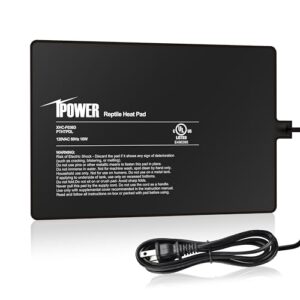
Owners report the iPower pad’s adhesive can start peeling after one to two months. Check it often. A loose pad means poor contact and a cold spot.
Still, the iPower Reptile Heat Pad earns its spot. It’s 8" x 12" and pulls 16 watts, which suits a 30 to 40 gallon tank. Its PTC heating material warms up fast, and the waterproof, moisture-proof build controls humid setups and easy cleaning. A 3M adhesive backing sticks it to the terrarium, and the 6-foot cord with a standard 120V US plug reaches most outlets.
Here’s the catch: it has no built-in temperature control. You need an external thermostat. Heat trapped under a tank can start a fire, so lift the terrarium on rubber feet for airflow. Mount the pad under one side only. That builds the gradient your ball python needs.
| Best For | Reptile, lizard, and amphibian owners with a 30 to 40 gallon terrarium who already have (or will buy) an external thermostat and want a fast-heating, waterproof pad for one side of the tank. |
|---|---|
| Product Type | Heat pad |
| Power Rating | 16W |
| Cord Length | 6 ft cord |
| Built-in Temp Control | No |
| Thermostat Use | Needs external thermostat |
| Main Drawback | Adhesive may peel |
| Additional Features |
|
- Fast-warming PTC heating material in a waterproof, moisture-proof design that handles humid setups and easy cleaning
- 8" x 12" size at 16 watts suits a 30 to 40 gallon tank, and the 6-foot cord with a standard 120V US plug reaches most outlets
- Strong 3M adhesive backing attaches it to the terrarium, and it works for other uses like germination, home brewing, and kombucha
- Adhesive may weaken over time, with reports of peeling after one to two months, which causes poor contact and cold spots
- No built-in temperature control, so an external thermostat is required
- Heat trapped under a tank can start a fire, so the terrarium must be lifted on rubber feet for ventilation
2. Inkbird Digital Temperature Controller Thermostat
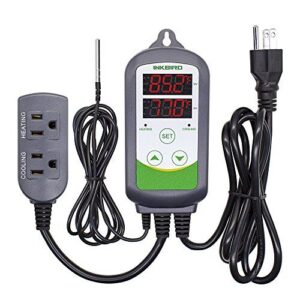
Remember that iPower pad with no built-in control? This is its partner. Ever wonder how you’d keep your ball python’s Warm Side steady at night? The Inkbird answers that.
It has dual relays, so it runs heating and cooling gear at once. The dual display shows set and measured temperature together. A buzzer alarm sounds for high or low readings, or a sensor fault. That’s early warning before trouble starts.
The specs are solid. It helps 1100W at 110V, so check your heater’s rating first. The 1.8m NTC probe is included. Accuracy is ±1°C between -50 and 70°C. Range runs -50 to 120°C.
Place the probe in the warm zone, never against the heat source. Set a firm high limit. Test it with a separate Thermometer.
One warning: buyers say the instructions are unclear. Read them twice before powering up.
| Best For | Reptile keepers, homebrewers, and small-appliance hobbyists who need steady, alarm-protected temperature control for heating or cooling gear, such as a ball python enclosure’s warm side, a fermentation chamber, or a freezer. |
|---|---|
| Product Type | Thermostat controller |
| Power Rating | 1100W max at 110V |
| Cord Length | 1.8m probe |
| Built-in Temp Control | Yes |
| Thermostat Use | Is the thermostat |
| Main Drawback | Unclear instructions |
| Additional Features |
|
- Dual relays run heating and cooling equipment at the same time.
- The dual display shows measured and set temperatures together, and the buzzer alarm warns of high or low readings or a sensor fault.
- The 1.8m NTC probe is included, with a wide -50 to 120°C range and ±1°C accuracy between -50 and 70°C.
- Buyers say the instructions are unclear, so you’ll want to read them carefully before powering up.
- The maximum load is 1100W at 110V, so you have to check your heater’s rating first.
- Accuracy drops to ±2°F (about ±1°C) only within the stated ranges, so it’s smart to verify readings with a separate thermometer.
3. Zoo Med Reptile Heat Cable
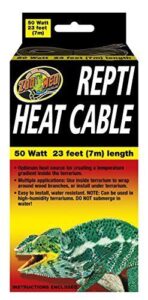
Flexibility is the big selling point of the Zoo Med Reptile Heat Cable. Need warmth in an odd-shaped enclosure? You can wrap it around branches and cage furniture, run it under a tank, or tuck it into a breeder rack.
This 50 watt cable suits tanks of 30 to 40 gallons. Its water-resistant design controls humid habitats, and the 6.5 foot cold lead keeps the plug end away from heat.
Safety comes first. Treat this cable as a secondary heat source, never your only one. Always connect it to a reliable thermostat, and keep the cable in firm contact with the surface it warms, because air gaps weaken heat transfer. Check temperatures at several spots with a thermometer.
Be realistic. Some owners report uneven output, and a few report complete failure. Monitor it.
| Best For | Reptile keepers with odd-shaped or humid enclosures of 30 to 40 gallons who want an inexpensive, flexible secondary heat source to use alongside a primary heater and a reliable thermostat. |
|---|---|
| Product Type | Heat cable |
| Power Rating | 50W |
| Cord Length | 6.5 ft cold lead |
| Built-in Temp Control | No |
| Thermostat Use | Needs reliable thermostat |
| Main Drawback | Uneven output, failures |
| Additional Features |
|
- Flexible design that can be wrapped around branches and cage furniture, run under a tank, or tucked into a breeder rack
- Water-resistant build that suits humid habitats
- Includes a 6.5 foot cold lead that keeps the plug end away from heat
- Some owners report uneven or inconsistent heat output
- A few owners report complete failure, so it needs regular monitoring
- Works only as a secondary heat source, never as the primary heating solution
4. Flukers Ceramic Heat Emitter
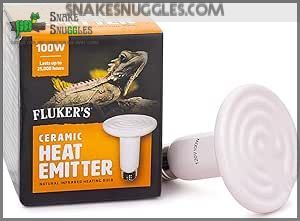
Heat without light suits a nocturnal snake. The Flukers Ceramic Heat Emitter is a reliable heat source. Mount this ceramic heat emitter high, inside a guard, and run it through a temperature controller. Then check four things:
- Hold the basking surface at 95 to 105°F.
- Support thermal gradient creation with cooler zones.
- Keep flammable substrates clear.
- Wipe dust off it regularly.
| Product Type | N/A |
|---|---|
| Power Rating | N/A |
| Cord Length | N/A |
| Built-in Temp Control | N/A |
| Thermostat Use | N/A |
| Main Drawback | N/A |
| Additional Features |
|
5. Zilla Reflector Dome Light Fixture
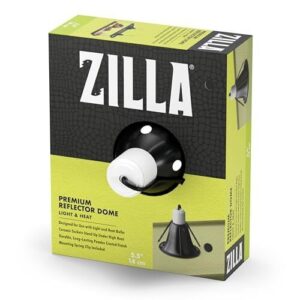
A bare bulb socket clipped to a screen lid once cost a keeper I know a melted cord and a scary night. Fixture quality matters, so why gamble?
The Zilla Reflector Dome is a compact 5.5-inch fixture with a powder-coated black exterior and a reflective white interior. That interior pushes light and warmth down into the enclosure instead of wasting it. The ceramic socket works with high-heat bulbs, but it helps bulbs up to 60 watts only. Bigger 150W bulbs won’t fit, so plan wattage first.
A spring clip grips screen tops, and the 6-foot cord has an in-line switch for daily use. Bulbs aren’t included.
The catch: the clip can slip if your lid is tipped or propped open. Keep the lid flat. Pair the dome with a thermostat, because this fixture has no built-in temperature control.
| Best For | Reptile keepers with screen-top terrariums who want a compact, reasonably priced dome that directs heat and light into the enclosure using bulbs of 60 watts or less. |
|---|---|
| Product Type | Reflector dome fixture |
| Power Rating | Bulbs up to 60W |
| Cord Length | 6 ft cord |
| Built-in Temp Control | No |
| Thermostat Use | Needs thermostat |
| Main Drawback | Clip may slip |
| Additional Features |
|
- The reflective white interior pushes light and warmth down into the habitat instead of wasting it.
- The ceramic socket is built for high-heat bulbs, and the spring clip holds the fixture to screen enclosures.
- The 6-foot cord has an in-line on/off switch, which makes daily use easy.
- It supports bulbs up to 60 watts only, so larger bulbs such as 150W variants won’t fit.
- The spring clip may slip if the terrarium lid is tipped or propped open.
- Bulbs are not included, so you need to buy one separately.
6. Digital Timer Outlet Switch
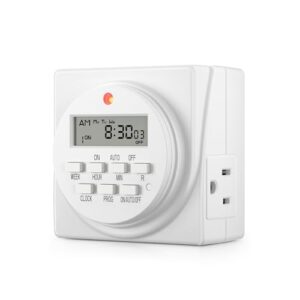
Eight on/off programs. That’s what this timer gives you across two grounded outlets, and it’s plenty for a tidy day-night lighting cycle.
A reflector dome directs heat and light, but who flips the switch at sunrise? This timer does. A backup battery keeps your settings alive through power outages, and Random Vacation mode varies the schedule while you’re away. Daylight Savings mode takes one button press.
Safety first. A timer switches power. It doesn’t read temperature. Run lamps and low-wattage bulbs through it, and keep heat sources on a thermostat, never a timer alone. Stay under the 1725W rating, and keep the unit clear of fabric and heat.
Expect a learning curve. Some users find the interface confusing, and reliability reports are mixed. Charge the internal battery for 30 minutes before use, and unplug the timer while you program it. Give yourself ten quiet minutes, and you’ll master it.
| Best For | Anyone who wants a simple way to automate lamps, fans, or coffee makers on a daily schedule, or to make a home look lived-in while away. |
|---|---|
| Product Type | Digital outlet timer |
| Power Rating | 1725W |
| Cord Length | N/A |
| Built-in Temp Control | No |
| Thermostat Use | Heat source needs thermostat |
| Main Drawback | Confusing interface |
| Additional Features |
|
- Offers up to 8 on/off programs across two grounded outlets
- Random Vacation mode varies the schedule to simulate occupancy
- Backup battery keeps your settings through power outages
- Programming interface is described as confusing by multiple users
- Reliability reports are mixed, with some units failing over time
- Internal battery needs a 30-minute charge first and the timer must be unplugged during programming
7. BN Link Mechanical Outlet Timer
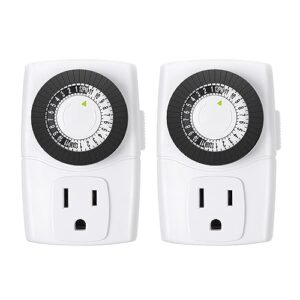
Want a simple way to give your ball python a steady day-night cycle? The BN Link Mechanical Outlet Timer does exactly that, and nothing more.
Push a pin down for ON. Pull it up for OFF. Each pin covers 30 minutes, so you get up to 24 settings per day, and the schedule repeats daily. No batteries. No menus. Two timers come in the pack, which covers a second enclosure.
It controls 125V, 15A, or 1,875 watts resistive, so a lamp or small fixture is easy work.
Here’s the catch. This is a timer only. It can’t read temperature. Always run your heat source through a thermostat, then check the warm side with a thermometer. Would you trust a clock to keep your snake safe? Don’t.
No battery backup exists, so recheck your schedule after any power outage.
| Best For | Reptile keepers, like ball python owners, who want a simple, battery-free way to automate a steady daily light cycle for a lamp or small fixture, as long as the heat source runs through a separate thermostat. |
|---|---|
| Product Type | Mechanical outlet timer |
| Power Rating | 1875W (125V, 15A) |
| Cord Length | N/A |
| Built-in Temp Control | No |
| Thermostat Use | Heat source needs thermostat |
| Main Drawback | No battery backup |
| Additional Features |
|
- Easy pin-based setup: push a pin down for ON and pull it up for OFF, with up to 24 settings per day in 30-minute intervals
- Handles 125V, 15A, and 1,875 watts resistive, and the pack includes two timers for a second enclosure
- Needs no batteries or menus, and offers manual override with On/Off/Timer switch modes
- Timer only: it can’t read temperature, so heat sources must run through a thermostat
- No battery backup, so the schedule resets after a power outage and must be rechecked
- 30-minute intervals limit scheduling precision, and the mechanical dial may stiffen over time
8. Exo Terra Digital Thermometer
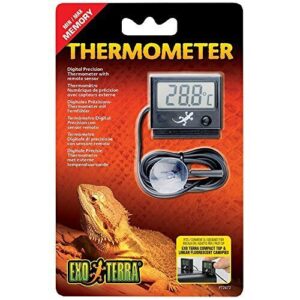
Are you guessing at your ball python’s temperatures? Stop. The Exo Terra Digital Thermometer (PT2472) gives you real numbers. Its remote probe lets you check the warm side near the basking surface, then the cool side, without opening the enclosure.
Min/max memory catches overnight spikes and dips you’d otherwise miss. One button controls modes and memory, and you can switch between Fahrenheit and Celsius. Secure the probe so your snake can’t chew or dislodge it. The clip can be loose on some enclosures, and there’s no power-off, so pull the battery to shut it down.
| Detail | Specs |
|---|---|
| Best For | Precise tracking with remote monitoring and min/max memory to catch overnight fluctuations |
| Product Type | Digital thermometer |
| Power | Battery powered |
| Dimensions | 1 x 5 x 7.8 inches |
| Weight | 1.41 ounces |
| Temperature Control | Monitoring only |
| Features | Min/max memory, remote probe, single button operation |
| Best For | Reptile keepers who want a simple, battery-powered thermometer with a remote probe and min/max memory to track warm-side, cool-side, and overnight temperatures in enclosures for geckos, snakes, hermit crabs, and tortoises. |
|---|
- The remote probe lets you check warm and cool side temperatures without opening the enclosure.
- Min/max memory catches overnight temperature spikes and dips you might otherwise miss.
- Single button operation and a Fahrenheit/Celsius option keep it easy to use.
- There is no power-off function, so you have to remove the battery to shut it down.
- The attachment clip may be loose or incompatible with some Exo Terra enclosures.
- Pets may chew or damage the probe if it isn’t protected or secured.
9. Etekcity Infrared Thermometer Gun
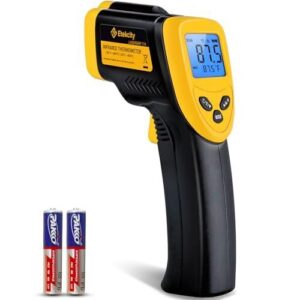
Your probe thermometer tracks air. But what’s your basking surface actually doing? An infrared thermometer answers in half a second, without opening a door or startling your snake.
The Etekcity gun uses a built-in laser to show exactly where you’re measuring, and its backlit LCD is easy to read. With a 12:1 distance-to-spot ratio, you can scan hides, substrate, and basking spots from about 14 inches away. The range runs from -58℉ to 716℉.
Use it for surface temperature monitoring only. Aim at the center of the warm surface from a consistent distance and average three reads. Skip glass, which skews results. Calibrate it first.
Pair it with a thermostat as your temperature control system. The gun verifies, the thermostat regulates. It’s a simple, reliable check for reptile enclosure monitoring that keeps your snake safe.
10. Zilla Terrarium Heat Mat
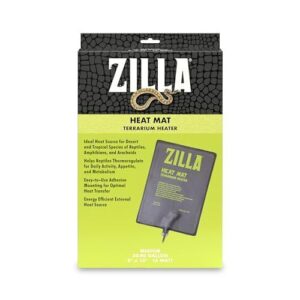
Your infrared gun needs a surface worth measuring. The Zilla Terrarium Heat Mat gives you one.
This heat mat uses carbon fiber technology to spread uniform warmth, topping out at a 113°F maximum temperature. The 16W Medium measures 8.5 x 14.4 inches and suits 30 to 40 gallon glass tanks. Smaller and larger sizes run from 4W to 24W.
The adhesive backing sticks to the outside of the glass. Wires stay out of reach, and heat travels straight up through the floor. That’s exactly what your snake needs for digestion.
There’s no built-in control, so add a temperature controller every time. Low voltage doesn’t mean risk-free. Unregulated, even a mat can build hot spots. Wired correctly, it makes a solid heat source setup for thermal gradient creation, warm on one side, cool on the other. Think of it as a heat pad done right.
Frequently Asked Questions (FAQs)
What is the best type of heat source for ball pythons?
Your warm side should hit 31–32°C, so pick gear that holds it. A heat pad with a temperature controller wins most setups; add a ceramic heat emitter for basking spot warmth and thermal gradient creation.
Is 92 degrees too hot for a ball python?
Yes, 92°F is too hot for a ball python if it’s your basking spot’s constant reading.
Aim much lower. Your thermostat should hold steady temperature regulation, and your thermal gradient needs a cooler retreat nearby.
Is 70 degrees too cold for a ball python at night?
70°F sits at the bottom of the safe 70–75°F range. Your night temperature is still acceptable, but never go lower. Thermostat-driven temperature regulation, a nocturnal heating solution, and thermal gradient optimization boost heat source efficiency.
What is the best heating option for a ball python?
Nothing beats a ceramic heat emitter on a thermostat!
It delivers steady, lightless warmth all night long. Add a heat mat for belly warmth, keep a clear temperature gradient, and enjoy natural basking behavior simulation.
What is the best heating source for snakes?
Think of your enclosure as a climate. A ceramic heat emitter is its steady sun, giving light-free warmth at night.
Pair it with a thermostat and heat mat; heat source connection guards your temperature gradient.
Do ball pythons need a heat source at night?
Picture a 68°F bedroom in January. Your enclosure cools too. Add a heat source, like a ceramic emitter or heat pad, as your nocturnal heating solution. Set the thermostat to hold 75°F. Skip colored lights.
Can you leave a heat lamp on 24/7 for ball python?
Would you sleep under a sun that never sets? Your python won’t either. A 24/7 heat lamp disrupts rest and builds stress.
Make temperature stability via heat source automation, thermostat settings, and thermal gradient monitoring.
What is the best source of heat for snakes?
Your snake won’t applaud a fancy heater, but it’ll notice a bad one.
A ceramic heat emitter with a thermostat wins, while a heat mat helps the temperature gradient. Heat source setup keeps everything safe.
How do I keep my ball python warm?
Warmth is a quiet promise you make every day. Keep it with a heat source like a heat mat or ceramic heat emitter.
Add a thermostat, build a temperature gradient, and leave a cooler retreat.
Can heat sources harm a ball python?
Think heat is harmless? Skip thermostat use and your enclosure heating system can burn your python.
Reliable heat sources, burn risk mitigation, fluctuation prevention matter: overheating causes stress, appetite loss, dehydration, shedding problems, hot spots.
Conclusion
Think of your enclosure as a hillside at dusk: warm rocks on one slope, cool shade on the other, and your snake free to wander between them. That’s the whole goal. The best ball python heat source options only work when a thermostat governs them and a thermometer proves it.
So pick your heater, wire it to a reliable thermostat, and check temperatures weekly. You won’t guess your way to safety. You’ll measure it.