This site is supported by our readers. We may earn a commission, at no cost to you, if you purchase through links.

A ball python can go weeks without food and seem perfectly fine—until it can’t. One of the most overlooked reasons healthy-looking snakes suddenly refuse meals, shed poorly, or become defensive isn’t disease or stress.
It’s a cold belly. Unlike mammals, ball pythons rely entirely on external heat sources to digest food, regulate hormones, and support their immune system.
Get the temperature wrong under that warm hide, and everything downstream suffers. Choosing the right ball python heating pad isn’t just about comfort—it’s the foundation every other part of your setup depends on.
Table Of Contents
- Key Takeaways
- Ball Python Heating Pad Basics
- Temperature Ranges That Keep Pythons Safe
- Heat Pad Size and Coverage
- Features to Compare Before Buying
- Top 10 Ball Python Heating Pads
- 1. BN LINK Reptile Waterproof Heat Pad
- 2. Aiicioo Terrarium Heating Pad
- 3. Aiicioo Reptile Heating Pad 16W
- 4. VIVOSUN Seedling Heat Mat Thermostat
- 5. REPTI ZOO Reptile Heat Pad Adjustable Thermostat
- 6. BN-LINK Reptile Under Tank Heater
- 7. BN-LINK Reptile Heating Pad with Digital Thermostat
- 8. iPower Reptile Under Tank Heater
- 9. Zoo Med Reptitherm Undertank Heater
- 10. REPTI ZOO Reptile Heat Mat Thermostat
- Thermostat Setup and Temperature Monitoring
- Heat Pad Mistakes to Avoid
- Frequently Asked Questions (FAQs)
- What kind of heat pat should a ball python have?
- Are heating pads okay for ball pythons?
- What temperature to set heating pad for ball python?
- How to heat a ball python?
- How to heat up a baby ball python tank?
- What temperature should a Python heat pad be?
- Do ball pythons need a heating pad?
- How much light does a ball python need?
- Do ball pythons need a light fixture?
- What size heat mat for Ball Python?
- Conclusion
Key Takeaways
- A cold belly is the hidden cause behind most feeding refusals and poor sheds — your heat pad isn’t just comfort, it’s what keeps digestion, immunity, and shedding working at all.
- Your heat pad should cover only one-third to one-half of the tank floor, paired with an external thermostat to hold the warm side at 88–92°F and the cool side at 78–80°F.
- Running a heat pad without a thermostat is the single most dangerous mistake you can make — unregulated pads can silently burn your snake before you notice anything wrong.
- Substrate depth, pad size, and enclosure material all affect how much heat actually reaches your snake, so matching these factors carefully is just as important as picking the right pad.
Ball Python Heating Pad Basics

Ball pythons can’t regulate their body temperature on their own, so getting the heat right in their enclosure isn’t optional — it’s everything. A good heating pad does more than just warm the floor; it aids digestion, eases shedding, and gives your snake a safe spot to decompress.
Picking the right one matters more than you’d think — this guide to heating pads for ball pythons breaks down exactly what to look for before you buy.
Here’s what you need to know before picking one.
Why Belly Heat Matters
Ball pythons can’t generate their own body heat — that’s why heat pad placement directly under the warm side matters so much. Belly contact with stable temperatures drives everything from metabolic rate boost to gut microbiota balance.
Here’s what a good undertank heater actually does:
- Activates digestive enzymes for efficient energy utilization
- Enhances immune function support through steady thermal regulation
- Maintains hormonal regulation via a reliable temperature gradient
Warm Hide Comfort and Stress Reduction
Think of the warm hide as your python’s safe room. When heat pad placement creates consistent gentle warmth on the warm side — paired with a cool side retreat — you’re building a real temperature gradient that eases stress.
Behavioral calmness shows up fast: relaxed coiling, steady breathing, fewer defensive displays.
Cozy hide design and humidity interaction together signal thermal consistency that your snake can actually trust.
Digestion and Shedding Support
That calm hide behavior carries right into mealtime. Post-meal temperature consistency is everything — digestive enzyme support literally depends on steady belly warmth. When your heat mat thermostat maintains ideal temperatures, food moves through efficiently. Drop too low, and digestion stalls.
Shed moisture management works similarly: maintaining stable reptile enclosure temperatures keeps skin renewal hydration on track and prevents frustrating stuck sheds.
Why Heat Pads Need a Cool Side
heat pad alone isn’t enough — your ball python needs somewhere cooler to retreat. That temperature differential between warm side and cool side drives everything from behavioral comfort to moisture retention in the substrate.
Here’s what a proper thermal gradient actually does:
- Prevents overheating by keeping one zone cooler for resting
- Maintains heat distribution balance without drying out substrate
- Boosts energy efficiency by focusing warmth where it counts
- Guides natural movement between basking temperature zones
Temperature Ranges That Keep Pythons Safe
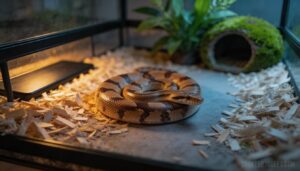
Getting the temperature right in your ball python’s enclosure isn’t guesswork — it’s the difference between a thriving snake and a stressed one. Every zone in the tank plays a specific role, from the warm basking side to the cooler retreat area.
Here’s what the each range should look like and why it matters.
Warm Side Target: 88–92 °F
Your ball python’s warm side should sit between 88 and 92 °F — this is the sweet spot for Metabolic Rate Optimization and Behavioral Thermoregulation. Within this temperature range, digestion actually works.
A heat mat paired with a properly calibrated thermostat ensures Heat Distribution Uniformity and Temperature Sensor Calibration accuracy. Nail ideal temperatures here, and your Thermal Gradient Design gives your ball python genuine control over its own comfort.
Cool Side Target: 78–80 °F
Your cool side needs to stay right at 78–80 °F — that temperature range is what makes the gradient real and functional. Without it, your snake has nowhere to retreat, and stress builds quietly.
Four things that protect this zone:
- Cool Zone Placement opposite the heat mat
- Substrate Conductivity that doesn’t trap warmth
- Airflow Management to prevent warm pockets
- Probe Calibration confirming Nighttime Cool Stability
Daytime and Nighttime Ambient Ranges
Ambient temperature shifts between day and night more than most keepers expect. Daytime highs often push toward 82–85 °F, while nighttime cooling drops ambient readings by 5–15 °F.
Diurnal Temperature Fluctuations can disrupt Thermal Gradient Stability if your thermostat isn’t compensating. Ambient Humidity Interaction also slows Nighttime Cooling Rate, which actually helps.
Seasonal Temperature Shifts make consistent temperature monitoring essential year-round.
| Period | Ambient Temperature Range |
|---|---|
| Daytime | 78–82 °F |
| Nighttime | 70–75 °F |
Safe Surface Temperature Limits
Your heat pad’s surface should never climb past 104 °F — but what actually matters for burn risk guidelines is how much of that heat reaches your snake. Touch temperature thresholds for reptile contact sit closer to 95 °F.
Material heat conductivity and surface insulation strategies affect this directly.
With a good thermostat handling temperature regulation, temperature stability tolerance stays tight, keeping surface temps in a genuinely safe range.
Humidity Balance With Under-tank Heat
Under-tank heating solutions actually work in your favor here. Unlike heat lamps, heat pads minimize surface evaporation, making humidity control far easier to manage.
Pair that with smart Microclimate Zoning — a moist hide near 70–90% humidity, dry open zones at 40–60% — and your python thrives.
Use Moisture Retention Substrate like cypress mulch, apply solid Ventilation Strategies, and keep your Water Dish Placement on the cool side.
Humidity Monitoring Tools confirm the balance daily.
Heat Pad Size and Coverage

Getting the size right makes a bigger difference than most people expect. A pad that’s too small leaves your python without enough warmth, and one that’s too large creates uneven hot spots that are hard to control.
Here’s what to look for before you buy.
Covering 1/3 to 1/2 of The Floor
Your heat pad should cover one-third to one-half of the floor — no more. This sweet spot is where heat gradient benefits really shine: your ball python gets a warm zone for digestion and a cooler retreat for natural snake thermoregulation behavior.
It also delivers real energy consumption savings and keeps substrate compatibility manageable. Placement precision matters — choosing the right heat pad size for ball python enclosures makes all the difference.
Matching Pad Size to Enclosure Footprint
Once you’ve nailed that one-third to one-half rule, the next step is matching your pad to your actual enclosure footprint. Think of it as footprint ratio calculation in practice:
- A 10-gallon tank pairs well with an 8×10-inch pad
- A 20-gallon needs roughly 9×12 inches
- A 40-gallon calls for 12×20 inches
Substrate depth impact and enclosure shape considerations matter too — thicker bedding absorbs heat, so size selection should account for that.
Avoiding Oversized and Undersized Mats
Getting the size wrong causes real problems on both ends.
An oversized mat pushes warmth across too much floor space, throwing off your temperature gradient and risking burns along enclosure edges. Going too small, and heat concentrates in one tight spot instead of spreading evenly.
Proportionate coverage — one-third to one-half of the floor — gives you gradient balance, better energy efficiency, and safer substrate compatibility overall.
Tank Material and Compatibility Checks
Your enclosure’s material matters more than most people realize.
Polyethylene heat tolerance drops around 60–70°C, meaning excessive pad heat can warp plastic tanks. Glass tolerates higher surface temps but risks thermal shock from sudden temperature swings. FRP offers solid chemical resistance, while aluminum frames need corrosion prevention coatings near moisture.
Always confirm liner moisture barrier integrity and substrate insulation compatibility before committing to any adhesive heat pad.
Best Placement Under The Warm Side
Once you’ve confirmed material compatibility, placement becomes your next call.
Position the pad flush under the warm side—edge alignment with the tank wall matters here. Leave a ventilation gap so heat doesn’t trap unevenly.
Place your warm hide directly above it, using a substrate barrier underneath. That hide overhang position creates a natural thermal gradient path, guiding your snake between warm side and cool side effortlessly.
Features to Compare Before Buying

Not all heating pads are built the same, and the differences matter more than you’d think. Before you buy, there are a few key features worth checking so you don’t end up with something that underperforms or creates a safety risk.
Here’s what to look at.
Waterproof and Moisture-resistant Backing
Moisture is a real threat to heating pads in ball python setups. Here’s what Backing Material Types and Moisture Barrier Performance actually mean for heat pad safety and heat pad durability:
- PVC backing blocks liquid from reaching the subfloor entirely
- Thermoplastic layers stay stable under high humidity
- Rubber-based backings resist warping from spills
- Adhesive heat pads require moisture-resistant adhesive for proper Adhesive Compatibility
- Vapor barriers reduce humidity transfer for durable construction
Prioritize Cleaning and Maintenance ease and Durability Under Humidity — these material considerations protect your snake long-term. An IPX7 immersion rating(https://www.flw-bag.com/info/waterproof-vs-water-resistant-vs-moisture-proo-102856837.html) guarantees protection against full submersion.
Flexible Silicone Vs Carbon-film Mats
Silicone and carbon-film mats each bring something different to the table. Flexible heat pads made from silicone conform to irregular tank bottoms, making Installation Flexibility a clear win — especially for ball pythons that need consistent belly contact.
Carbon-film options heat up faster, giving you better Heat Transfer Speed.
Both demand a heat pad thermostat integration for safety, but silicone manages Durability Under Humidity more reliably long-term.
Silicone mats also provide even heat distribution, preventing hot‑spots across the tank.
Built-in Thermostat Vs External Thermostat
Built-in thermostats keep Wiring Complexity low — everything’s in one unit, so setup is fast.
But if you’re managing multiple tanks, an external thermostat wins on Scalability Across Enclosures and Calibration Precision, since its probe sits independently from the heat source.
For serious temperature regulation in snake enclosures, external controllers also offer better Redundancy Options and smarter Control Architecture for long-term safety.
Auto-shutoff and Overheat Protection
What happens if thermostat fails overnight? That’s where Auto‑Shutoff Mechanisms and Overheat Protection Thresholds become non‑negotiable.
A reliable heat mat uses a Thermal Cutoff Switch and Temperature Sensor Calibration to cut power before surfaces exceed safe limits. Look for Safety Certification Standards on any pad you buy — these safety features are your last line of defense against serious overheating risk.
Cord Durability and Adhesive Quality
A frayed cord is a fire hazard waiting to happen. Check that your heat mat has solid Jacket Abrasion Resistance and strong Adhesive Bond Strength at mounting points. Strain Relief Design protects the cord where it meets the plug — a common failure spot.
- Look for Environmental Aging Tests certification
- Confirm Thermal Expansion Compatibility with your tank material
- Follow installation guidelines for adhesive pads for easy mounting
Top 10 Ball Python Heating Pads
Finding the right heating pad comes down to size, safety features, and how well it pairs with a thermostat. The options below cover a range of budgets and enclosure setups, so there’s something here for most ball python keepers.
Here are ten worth considering.
1. BN LINK Reptile Waterproof Heat Pad
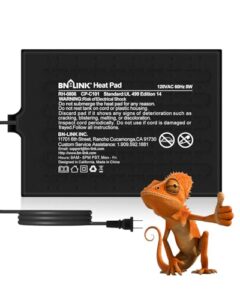 View On Amazon
The BN LINK Reptile Waterproof Heat Pad is a solid starting point for new ball python keepers. At 6×8 inches and just 8 watts, it fits neatly under a 10-gallon setup and won’t spike your electricity bill.
The waterproof silicone surface accommodates humid enclosures without a fuss and wipes clean easily.
One thing to keep in mind — you’ll need an external thermostat. Without one, surface temps can climb past safe limits.
Pair it right, and it delivers steady, reliable belly heat.
| Best For | New reptile keepers setting up a small enclosure (10 gallons or less) for ball pythons, amphibians, or other heat-loving pets. |
|---|---|
| Power Wattage | 8W |
| Voltage | 120V AC |
| Pad Size | 6×8 in |
| Adhesive Backing | Yes |
| Waterproof | Yes |
| Thermostat Included | No |
| Additional Features |
|
- Waterproof silicone surface handles humidity well and wipes down in seconds
- Low 8W draw keeps energy costs minimal without sacrificing steady belly heat
- Adhesive backing makes setup quick — no tools, no hassle
- Needs an external thermostat to stay safe; surface temps can get too high on their own
- May not generate enough heat for larger or poorly insulated tanks
- Strong adhesive makes repositioning a pain once it’s stuck down
2. Aiicioo Terrarium Heating Pad
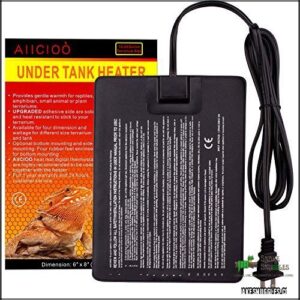
If you’re looking for something even more budget-friendly, the Aiicioo Terrarium Heating Pad is worth a look. At $12.99, it won’t strain your wallet, and its 8-watt nichrome wire delivers even, consistent warmth — no hot spots to worry about.
The rubber feet raise the tank just enough to let excess heat escape, which matters for safety. Keep in mind that surface temps can reach 104–122°F, so pairing it with an external thermostat isn’t optional — it’s the smart move.
| Best For | Budget-conscious reptile and small pet owners who need a simple, plug-and-play heat source for a 10–20 gallon tank. |
|---|---|
| Power Wattage | 8W |
| Voltage | 120V AC |
| Pad Size | 8×6 in |
| Adhesive Backing | Yes |
| Waterproof | No |
| Thermostat Included | No |
| Additional Features |
|
- At $12.99, it’s one of the most affordable heating pads out there — easy to try without much risk.
- Dead simple to install: peel, stick, plug in, done.
- Low 8-watt draw keeps electricity costs down while still delivering steady warmth around the clock.
- No built-in temperature control, so you’ll want an external thermostat to stay safe.
- Can struggle to heat larger tanks or thick sand substrates effectively.
- The adhesive near the power cord has been known to loosen or melt over time, and a few units arrive dead on arrival.
3. Aiicioo Reptile Heating Pad 16W
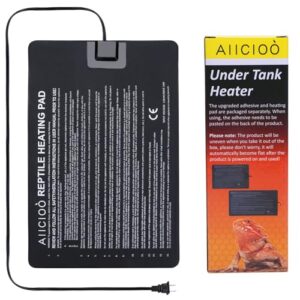
Need a step up in power? The Aiicioo 16W heating pad covers 8 by 12 inches — a solid fit for 20 to 40 gallon enclosures.
Its nichrome heating element spreads warmth evenly, which helps you maintain that 88–92°F warm side without fighting uneven hot spots. The PVC backing resists moisture well, and the adhesive holds firmly against glass or acrylic.
You’ll still want an external thermostat, but this pad gives you more output to work with in larger setups.
| Best For | Reptile owners with medium-sized 30–40 gallon terrariums who need reliable, even heat for snakes, lizards, or hermit crabs. |
|---|---|
| Power Wattage | 16W |
| Voltage | 120V AC |
| Pad Size | 14×8 in |
| Adhesive Backing | Yes |
| Waterproof | No |
| Thermostat Included | No |
| Additional Features |
|
- Nichrome heating wire spreads heat evenly, so no annoying hot spots
- PVC backing handles moisture well and sticks firmly to glass or acrylic
- Energy-efficient at 16W — does the job without running up your electric bill
- No built-in thermostat, so overheating is a real risk without an external one
- Adhesive wears out if you remove and reattach it — plan your placement carefully
- Not safe on wood or plastic surfaces, which limits where you can use it
4. VIVOSUN Seedling Heat Mat Thermostat
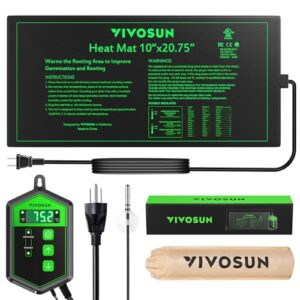
Not all heating pads are built specifically for reptiles — and the VIVOSUN Seedling Heat Mat Thermostat is a good example of a crossover option that works surprisingly well. Originally designed for plant propagation, its far-infrared heating element delivers steady, even warmth across a 10 × 20.75-inch surface.
The built-in digital thermostat lets you dial in temperatures between 68–104°F, giving you solid control over your warm side. Just note the 20W output suits smaller enclosures best.
| Best For | Budget-conscious reptile keepers with smaller enclosures who want precise temperature control without paying for a dedicated reptile mat. |
|---|---|
| Power Wattage | 20W |
| Voltage | 120V AC |
| Pad Size | 10×20.75 in |
| Adhesive Backing | No |
| Waterproof | IP67 Rated |
| Thermostat Included | Yes |
| Additional Features |
|
- Digital thermostat with a temperature probe gives you real control — no guessing if your warm side is hitting the right temp
- Lightweight and easy to store; rolls up and tucks away when not in use
- Low 20W draw keeps electricity costs down over time
- Small size can leave edges of larger trays or enclosures uncovered
- Temperature can overshoot by a few degrees, and adjusting the thermostat takes a long-press sequence rather than a simple tap
- The power cord sits on top of the mat, which can throw off level placement and might need shimming
5. REPTI ZOO Reptile Heat Pad Adjustable Thermostat
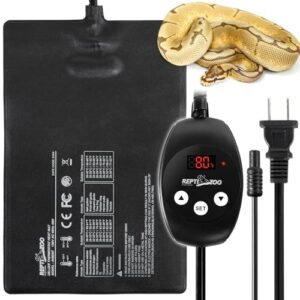
If you want something built for reptiles from the ground up, the REPTI ZOO Heat Pad is worth a close look. Its 24W carbon-fiber element heats up faster than most conventional pads, and the built-in thermostat adjusts from 68°F to 122°F — plenty of range for your ball python’s warm side.
The digital readout shows both current and set temperatures at a glance. At 12 × 8 inches, it fits standard 10–20 gallon tanks well without overcrowding the floor.
| Best For | Reptile owners who want a dedicated heating pad with an adjustable thermostat for turtles, geckos, snakes, bearded dragons, and similar heat-loving pets. |
|---|---|
| Power Wattage | 24W |
| Voltage | 120V AC |
| Pad Size | 12×8 in |
| Adhesive Backing | Yes |
| Waterproof | Yes |
| Thermostat Included | Yes |
| Additional Features |
|
- Carbon-fiber element warms up faster than standard pads, so your reptile isn’t waiting long for the right temperature.
- Wide temp range (68°F–122°F) covers most reptile species and even doubles for seed germination or fermentation projects.
- Waterproof PVC surface makes cleanup easy and protects the pad from spills or substrate moisture.
- The built-in thermostat can overshoot — some users report setting it to 82°F and seeing it climb to 95–100°F, which could stress or harm your pet.
- The adhesive backing tends to lose its grip over time, so the pad may eventually peel away from the glass.
- In cooler rooms (around 67°F or below), 24W may not be enough on its own — you might need a backup heat source.
6. BN-LINK Reptile Under Tank Heater
The BN-LINK Reptile Under Tank Heater keeps things simple without cutting corners. Its 6 × 8-inch mat fits snugly under 10–20 gallon tanks, covering roughly a third of the floor — right in the sweet spot for a proper thermal gradient.
The adhesive backing sticks directly to glass, and the water-resistant surface holds up through routine cleaning.
It doesn’t include a built-in controller, so pair it with an external thermostat to keep your warm side safely between 88–92°F.
| Best For | Reptile and amphibian owners who want a no-fuss heating solution for small 10–20 gallon tanks. |
|---|---|
| Power Wattage | 16W |
| Voltage | 120V AC |
| Pad Size | 8×12 in |
| Adhesive Backing | Yes |
| Waterproof | Yes |
| Thermostat Included | No |
| Additional Features |
|
- Simple peel-and-stick setup — no tools, no hassle
- Low 16W draw keeps electricity costs down
- Flexible mat conforms to different tank shapes and sizes
- No built-in thermostat, so you’ll need to buy one separately
- Adhesive can lose grip over time, especially at the edges
- Heating can run hotter near the edges than in the center
7. BN-LINK Reptile Heating Pad with Digital Thermostat
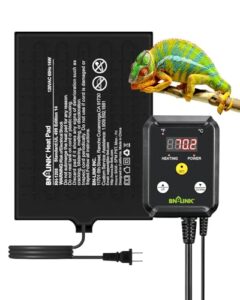
The BN-LINK Reptile Heating Pad with Digital Thermostat bundles everything into one package. The 8 × 12-inch pad covers enough floor space for a solid warm side, while the built-in digital thermostat manages temperature control without requiring a separate controller.
You get LED indicators, a 3-button interface, and a probe cord that reads directly at snake level.
The water-resistant backing holds up well in humid setups.
It’s a practical all-in-one option if you want fewer components to manage.
| Best For | Reptile owners who want an all-in-one heating solution without buying a separate thermostat controller. |
|---|---|
| Power Wattage | 16W |
| Voltage | 120V AC |
| Pad Size | 8×12 in |
| Adhesive Backing | Yes |
| Waterproof | Yes |
| Thermostat Included | Yes |
| Additional Features |
|
- Built-in digital thermostat keeps temps dialed in without extra gear
- Water-resistant, flexible pad holds up in humid tanks
- Simple 3-button setup makes it easy to use right out of the box
- May not get hot enough for reptiles that need high-heat environments
- Adhesive can struggle to stick on wood or particle board surfaces
- Some users have had issues with thermostat accuracy over time
8. iPower Reptile Under Tank Heater
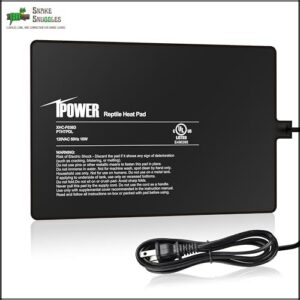
The iPower Reptile Under Tank Heater keeps things simple without cutting corners. The 8 × 12‑inch, 16‑watt pad is built for 30–40 gallon tanks and uses a new PTC heating film that warms up fast and distributes heat evenly across the surface.
Its 3M adhesive backing creates solid contact with the tank floor, which matters for consistent heat transfer. It’s waterproof, UL listed, and comes with a 6‑foot cord.
Just pair it with an external thermostat—it doesn’t include one.
| Best For | Reptile and amphibian owners with 30–40 gallon tanks who want a reliable, no-fuss heat pad that’s easy to clean and built to last. |
|---|---|
| Power Wattage | 16W |
| Voltage | 120V AC |
| Pad Size | 8×12 in |
| Adhesive Backing | 3M Adhesive |
| Waterproof | Yes |
| Thermostat Included | No |
| Additional Features |
|
- Heats up fast and spreads warmth evenly thanks to the PTC heating film
- 3M adhesive creates solid contact with the tank for consistent heat transfer
- Waterproof and UL listed — safe, durable, and easy to wipe down
- No built-in thermostat, so you’ll need to buy one separately to avoid overheating
- The adhesive is strong — great for stability, but a pain if you ever need to move it
- Only works with 120V US outlets, so it’s not an option for international use without a converter
9. Zoo Med Reptitherm Undertank Heater
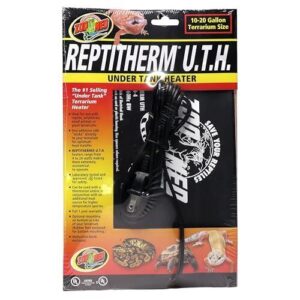
Zoo Med has been in the reptile hobby for decades, and the ReptiTherm Under Tank Heater shows why keepers keep coming back. The 6 × 8‑inch, 8‑watt model covers the warm side of smaller enclosures without overdoing it.
It permanently adheres to the tank exterior for solid heat transfer, heats up within minutes, and carries UL/cUL certification.
Zoo Med does recommend pairing it with a thermostat—especially if your room runs warm. A one-year warranty gives you added peace of mind.
| Best For | Reptile owners keeping smaller species like leopard geckos, ball pythons, or bearded dragons who need reliable, low-profile undertank heat. |
|---|---|
| Power Wattage | 8W |
| Voltage | 120V AC |
| Pad Size | 6×8 in |
| Adhesive Backing | Yes |
| Waterproof | No |
| Thermostat Included | No |
| Additional Features |
|
- Heats up fast — usually within 10–20 minutes, so your enclosure gets up to temp quickly
- Permanently adheres to the tank exterior for consistent, direct heat transfer
- UL/cUL certified and backed by a one-year warranty for peace of mind
- Can run very hot without a thermostat, which is a real burn risk for your animals
- The adhesive doesn’t always stick well to every surface, so you might need extra securing
- Only 6 × 8 inches, so it won’t cut it for larger enclosures or bigger species
10. REPTI ZOO Reptile Heat Mat Thermostat

REPTI ZOO’s 8×12-inch heat mat packs a lot of value into a $25.99 package. The carbon-film element spreads heat evenly, and the built-in dual temperature protection with a 122°F upper limit keeps things safe without a separate thermostat. That’s a real convenience for keepers on a budget.
The three-button digital controller lets you dial in your warm side quickly.
Just note that it works best on glass tanks in the 30–40 gallon range—don’t expect it to carry a larger setup.
| Best For | Budget-conscious reptile keepers with small to medium glass terrariums who want simple, no-fuss belly heat without spending extra on a separate thermostat. |
|---|---|
| Power Wattage | 23W |
| Voltage | AC Mains |
| Pad Size | 8×12 in |
| Adhesive Backing | 3M Adhesive |
| Waterproof | No |
| Thermostat Included | Yes |
| Additional Features |
|
- Built-in dual temperature protection with a 122°F safety cap gives you peace of mind without extra gear
- Carbon-film element heats up fast and spreads warmth evenly across the mat
- Removable 3M adhesive lets you mount it on the side to keep floor space open for your animal
- Adhesive backing can be hit or miss—some units show up with weak or missing sticking power
- Switching between Fahrenheit and Celsius isn’t intuitive, and some batches only display Celsius
- No external probe means you’re trusting the built-in thermostat, which makes precise spot-temperature control tricky
Thermostat Setup and Temperature Monitoring
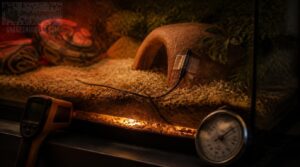
Getting your thermostat set up correctly is what separates a safe enclosure from a dangerous one. A few key monitoring habits will help you catch problems before your ball python ever feels the difference.
Here’s what you need to know to keep temperatures dialed in.
Where to Place The Thermostat Probe
Your thermostat probe placement makes or breaks heat mat safety.
For the warm side probe, position it on the enclosure floor above the pad — not touching the glass or buried under substrate.
A substrate layer probe works well between the mat and bedding for accurate surface readings.
Route the wire along the side wall, and revisit your temperature probe placement with any seasonal shift.
Digital Thermometers for Warm and Cool Sides
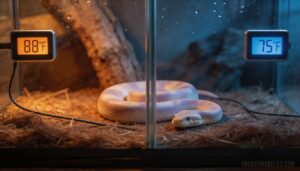
Once your probe is locked in, you need two thermometers — one for each side. Place a digital thermometer on the warm side and another on the cool side to track your full temperature gradient.
Look for models with waterproof housing, sensor drift monitoring, and data logging so you can catch problems early.
Good battery management keeps readings reliable around the clock. Calibration procedures matter too — verify accuracy monthly.
Infrared Gun Spot Checks

Digital thermometers give you your baseline, but an infrared gun catches what probes miss. Point it at the substrate surface above your heat pad, and you’ll instantly see if your temperature gradient holds up across the warm side.
- Emissivity Settings – Match to your substrate type for accurate readings
- Distance Ratio Calibration – A 12:1 ratio works well for most enclosures
- Laser Targeting Accuracy – Aim steadily; avoid air currents near the beam
- Spot Check Frequency – Scan multiple points daily, not just once
First 24-hour Testing and Adjustments

Once infrared gun confirms an even gradient, shift your focus to the first 24 hours — your real proving ground.
Start a Baseline Temperature Log and do a Probe Placement Check every few hours.
Watch for Substrate Moisture Impact on heat transfer, and note any behavioral observation clues your Python gives.
Thermostat Calibration matters most here: adjust once, then let it settle.
Redundant Probes for Safer Control
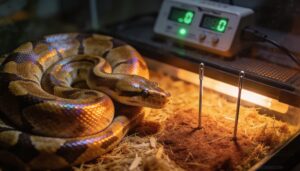
One sensor is good. Two is how you sleep at night.
Running redundant probes means your setup cross‑checks itself — if the primary temperature probe drifts or fails, Dual Sensor Logic switches control automatically. Failure Detection and Alarm Thresholds catch mismatches before your Python ever feels them. Data Logging keeps a trail you can review.
Three safety considerations for reptile heating equipment worth knowing:
- Schedule Probe Calibration monthly to keep both sensors reading within close tolerances.
- Place one probe on the warm side, one on the cool side — never let them touch the substrate directly.
- Set deviation bands tight so small divergences trigger a safe switch, not a delayed response.
Heat Pad Mistakes to Avoid
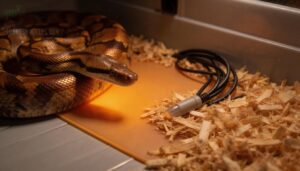
Even the best heating pad won’t help your ball python if it’s set up the wrong way. A few common mistakes can put your snake at serious risk, from burns to chronic stress.
Here’s what to watch out for.
Running a Heat Pad Without a Thermostat
Running a heat pad without a thermostat is like driving without brakes — you’re hoping nothing goes wrong, but you have no real control.
A heat pad without a thermostat is just a burn waiting to happen
Without temperature control, pad surfaces can push past 95°F and quietly burn your snake before you notice anything wrong.
Manual Temperature Checks become critical here.
You’ll need to verify surface temps with an infrared gun at least twice daily and keep a Temperature Logbook to spot any upward creep.
| Risk Factor | Without Thermostat | With Thermostat |
|---|---|---|
| Surface temp control | Manual only | Automated |
| Burn risk | High | Low |
| Overnight safety | Unmonitored | Regulated |
Substrate Buffering helps — a thick cypress mulch layer slows direct heat transfer to your snake’s belly.
Safety Cord Inspection weekly also matters since unregulated pads run continuously and stress components faster.
Still, none of that replaces a proper thermostat for maintaining a safe, stable temperature gradient.
Placing The Pad Inside The Enclosure
Placing a heat pad inside the enclosure might seem like it improves Heat Transfer Efficiency, but it’s a serious safety mistake. Direct contact risks burns, disrupts Thermal Gradient Creation, and complicates Safety Wiring and Adhesive Mounting.
Under tank heating — secured outside the enclosure bottom — is the correct approach for Heat mat safety and installation guidelines.
- Substrate Compatibility suffers when pads sit inside, trapping heat unpredictably
- Easy mounting works best on clean exterior glass surfaces
- Heat mat integration with thermostats requires probe access only outside the tank
Heating The Entire Floor Area
Covering the entire floor with a heat pad kills your thermal gradient — and that gradient is everything. Full Floor Coverage sounds appealing for Uniform Heat Distribution, but it eliminates the cool retreat your python needs for Thermal Gradient Optimization.
Your under tank heater should cover only one-third to one-half of the floor. That balance enhances reptile enclosure heating, smart heat mat integration with thermostats, and real Energy Efficiency Gains.
Letting Substrate Block Heat Transfer
Your substrate is quietly working against your heat pad — and most keepers don’t notice until temperatures drift.
Here’s what substrate does to Heat Transfer Pathways:
- Deep layers create Depth Insulation Impact, trapping warmth before it reaches your ball python.
- Damp wood or paper substrates reduce Material Thermal Conductivity, causing uneven substrate heating.
- Air Gap Buffering from loose bedding weakens the temperature gradient.
- Moisture Conductivity spikes can skew thermometer readings.
- Heavy thermal inertia masks true surface temps.
Keep substrate at one inch beneath your warm hide.
Ignoring Appetite, Lethargy, or Burn Risks
Your ball python won’t tell you something’s wrong — but its behavior will. Appetite loss detection and lethargy warning signs are your first clues that temperatures are off.
Instead, keeping a close eye on daily habits paired with a reliable digital terrarium thermometer for ball pythons is the best way to catch temperature problems before they affect your snake’s health.
| Warning Sign | Likely Cause | Action |
|---|---|---|
| Refused meals | Too hot or cold | Check both sides |
| Lethargy | Heat shock risk | Verify warm-side temp |
| Unusual hide use | Burn risk area | Inspect pad surface |
Don’t wait. Behavioral stress cues disappear fast once damage is done.
Frequently Asked Questions (FAQs)
What kind of heat pat should a ball python have?
Your ball python needs a reptile-specific heat pad — ideally self-regulating or thermostatic — placed under one side of the tank to create a temperature gradient that facilitates digestion, shedding, and stress‑free thermoregulation.
Are heating pads okay for ball pythons?
Yes, heating pads are safe for ball pythons when paired with a thermostat and proper placement.
They support digestion, reduce stress, and maintain the temperature gradient your snake needs for long-term health.
What temperature to set heating pad for ball python?
Set your thermostat to maintain a warm side surface of 90–92 °F. Keep the cool side around 78–80 °F.
Always verify with a temperature probe — your dial setting rarely matches actual surface readings.
How to heat a ball python?
To heat a ball python, use an undertank heater paired with a thermostat to maintain a temperature gradient — warm side at 88–92°F, cool side at 75–80°F — for safe, ideal temperatures year‑round.
How to heat up a baby ball python tank?
As the saying goes, "a warm home is a happy home."
Place a heat pad under the warm side, pair it with a thermostat, and maintain an 88–92 °F temperature gradient for your baby ball python.
What temperature should a Python heat pad be?
Your heat pad’s warm side should sit at 88–92 °F, with the cool side around 78–80 °F. That temperature gradient, managed by a reliable thermostat, keeps your ball python comfortable and safe.
Do ball pythons need a heating pad?
Ball pythons absolutely need a heat pad. Without belly heat, they can’t digest food, shed properly, or feel secure.
A heat pad creates the temperature gradient your ball python depends on to stay healthy.
How much light does a ball python need?
Unlike most reptiles, your ball python doesn’t need UVB light. A simple 12-hour day/night cycle with low light intensity is plenty.
Keep it gentle to support stress reduction without disrupting their natural ectothermic regulation.
Do ball pythons need a light fixture?
No, a light fixture isn’t required. Ambient room light meets their circadian rhythm needs just fine.
Skip the nighttime red light—it risks overheating. Simple ambient light levels keep your python comfortable without added stress.
What size heat mat for Ball Python?
A good rule of thumb: your heat mat should cover one-third to one-half of the enclosure’s floor area, giving your ball python a warm zone while keeping a cool side open.
Conclusion
A ball python’s survival hinges on something as simple—and critical—as a warm belly. Yet this basic need demands precision.
The right heating pad isn’t just gear; it’s a lifeline for digestion, immunity, and peace of mind. Choosing the right ball python heating pad transforms guesswork into confidence, ensuring your snake thrives, not just survives.
With safety features, proper placement, and vigilant monitoring, you’re not just heating a tank—you’re crafting a sanctuary.
Your python’s health starts here, under your care.