This site is supported by our readers. We may earn a commission, at no cost to you, if you purchase through links.
A stressed ball python won’t eat, won’t shed cleanly, and will spend every daylight hour pressed into a corner—because it has nowhere to hide. In a classroom setting, that behavioral shutdown becomes a teaching moment gone wrong, and students pick up on it fast. The right hide fixes this, but "right" means more than grabbing the nearest cave-shaped decoration off a pet store shelf.
Snake hides for classroom reptile tanks carry a different weight than hides in a private collection. You’re managing sanitation protocols, curious hands, and animals that need consistent microclimates—all at once. Material choice, interior dimensions, and placement position determine whether your snake stays calm and healthy or stays hidden for the wrong reasons.
The ten options ahead cover every life stage and enclosure size, with the practical details you need to choose confidently.
Table Of Contents
- Key Takeaways
- Top 10 Classroom Snake Hides
- 1. Jihaqua Medium Terrarium Reptile Hide
- 2. Leoterra Medium Snake Hide Reptile
- 3. Zilla Medium Brown Bark Bend Hide
- 4. Zipefy X Large Reptile Hide Box
- 5. Pangea Large Reptile Hide Box
- 6. Zilla Rock Lair Humid Hide
- 7. Exo Terra Medium Gecko Cave
- 8. Reptizoo Moisture Retaining Reptile Hide Cave
- 9. Cavachew 3in1 Reptile Hide Cave
- 10. Zoo Med Small Reptile Cave
- Choosing Safe Classroom Hide Materials
- Sizing Snake Hides Correctly
- Placement for Classroom Tanks
- Cleaning and Humidity Features
- Frequently Asked Questions (FAQs)
- Conclusion
Key Takeaways
- A stressed ball python pressed into a corner isn’t being difficult — it’s telling you the hide is wrong, and fixing that one detail transforms both animal welfare and classroom engagement.
- Material matters more than looks: non-porous resin and smooth plastic wipe clean in minutes, while untreated wood traps bacteria and mites that no disinfectant can fully reach.
- Sizing a hide correctly means your snake should touch two interior walls when coiled — too roomy feels exposed, too tight causes injury, and both show up fast in feeding behavior.
- Placement does half the work for you: a warm-side hide, a cool-side hide, and a mid-tank option give your snake genuine thermoregulation control without any extra equipment.
Top 10 Classroom Snake Hides
Picking the right hide makes a bigger difference than most people expect — for the snake’s stress levels and for how smoothly your classroom routine runs. The options below cover a range of sizes, materials, and humidity features, so there’s something here whether you’re housing a hatchling corn snake or a larger adult.
If you’re unsure which size fits your snake best, this guide to corn snake hide types and sizing breaks it down by age and species so you can get it right the first time.
Ten hides worth considering for your classroom tank.
1. Jihaqua Medium Terrarium Reptile Hide
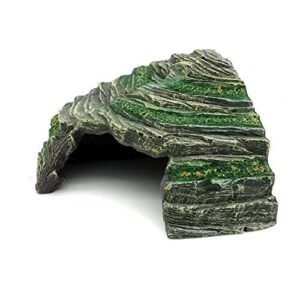
The Jihaqua Medium Terrarium Reptile Hide brings a lot of practical value into a compact 6.7 × 6.7 × 4-inch frame. At roughly one pound, it won’t tip when your snake settles in.
The resin construction wipes clean with standard reptile-safe disinfectants — no deep scrubbing required.
The non-porous interior resists moisture buildup, helps maintain a stable microclimate around shedding time.
It fits comfortably in a 20-gallon setup without crowding the floor, making it a sensible first hide for hatchlings and small juveniles.
| Best For | Small to medium reptile owners — leopard geckos, corn snakes, ball pythons under 3 feet — who want a stable, easy-to-clean hide that doubles as a basking shelf. |
|---|---|
| Material | Resin/hard plastic |
| Dimensions | 6.7×6.7×4 in |
| Humidity Support | Passive microclimate |
| Ease of Cleaning | Smooth non-porous interior |
| Species Suitability | Small-medium reptiles |
| Weight | 1.01 lb |
| Additional Features |
|
- Smooth, non-porous interior wipes down fast and doesn’t trap moisture or bacteria.
- Heavy enough to stay put when your reptile moves around inside.
- The hollow design creates a humid microclimate that really helps during shedding.
- The wide opening might feel too exposed for species that prefer a snug, tight fit.
- Can eat up a good chunk of floor space in tanks smaller than 20 gallons.
- Resin doesn’t hold heat the way real rock does, so thermal mass is limited.
2. Leoterra Medium Snake Hide Reptile
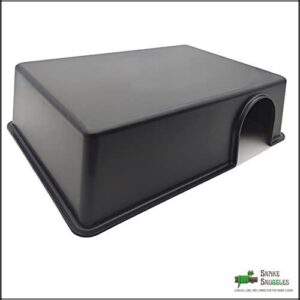
The Leoterra Medium Snake Hide (10.23 × 7.48 × 2.75 inches) suits slightly larger snakes or spaces needing expanded coverage. It comfortably accommodates juvenile corn snakes and ball pythons under 200 g, allowing them to coil while touching two interior walls.
Its top-seal design effectively retains humidity, crucial during shedding cycles. This feature ensures a stable environment for reptiles during vulnerable periods.
Constructed from odor-free plastic, the hide simplifies maintenance: routine cleaning takes minutes, not hours—a significant benefit when students manage care responsibilities.
| Best For | Small reptile owners—especially those raising juvenile corn snakes or ball pythons under 200 g—who want a humidity-retaining hide that’s easy to clean and maintain. |
|---|---|
| Material | Rigid plastic |
| Dimensions | 9.45×7.09×2.36 in |
| Humidity Support | Top-seal retention |
| Ease of Cleaning | Lightweight, easy wipe |
| Species Suitability | Small-medium snakes |
| Weight | 5.11 oz |
| Additional Features |
|
- The top-seal design holds moisture well, which is a real help during shedding when snakes need that extra humidity.
- Odor-free plastic makes cleaning quick and painless—just wipe it down and you’re done.
- Rounded edges and smooth material keep things safe, so no worrying about cuts or irritation.
- Once your snake hits around 200 g, it’ll likely outgrow this hide fast—you’ll need to size up sooner than you’d think.
- It runs a little pricey at $12.99 for what is essentially a small plastic box.
- Lighter snakes might be fine, but bigger ones can push or lift it around the enclosure, so you may need to weigh it down.
3. Zilla Medium Brown Bark Bend Hide
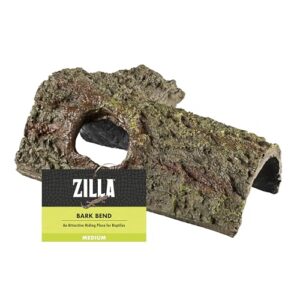
Zilla Medium Bark Bend Hide steps up nicely for larger snakes. At 8.3 × 3.6 × 3 inches, it comfortably accommodates juvenile corn snakes and ball pythons, allowing them to coil against multiple walls.
The open-ended design enables easy observation of your snake through the glass without lifting the hide—ideal for educational settings, such as when students monitor shedding behavior.
Constructed from non-porous synthetic resin, the hide resists bacterial growth and dries rapidly, ensuring classroom cleaning remains efficient and stress-free.
| Best For | Reptile owners with juvenile corn snakes, ball pythons, or similarly sized species who want a hide that’s easy to clean and fun to observe through the glass. |
|---|---|
| Material | Synthetic resin |
| Dimensions | 8.3×3.6×3 in |
| Humidity Support | Open-ended design |
| Ease of Cleaning | Non-porous exterior |
| Species Suitability | Geckos, snakes, crabs |
| Weight | 1.1 lb |
| Additional Features |
|
- The open-sided design lets you watch your snake shed or rest without lifting the hide and stressing it out.
- Non-porous resin resists bacteria and wipes down fast — great if you’re doing frequent cleanings.
- Heavy enough to stay put, and it works in both dry terrariums and shallow water setups.
- Edges around cutouts can come sharp or rough, so you may need to sand them before putting it in with your animal.
- Packaging isn’t always reliable — some arrive cracked and need glue or extra prep before use.
- The opening size may be too snug for larger reptiles or too bulky for very small tanks.
4. Zipefy X Large Reptile Hide Box
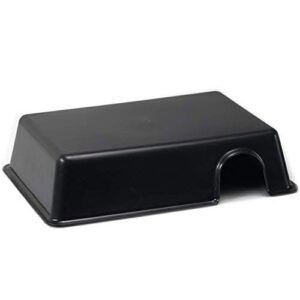
When your juvenile ball python has outgrown smaller options, the Zipefy X-Large steps in with room to spare. Its interior measures approximately 16 × 11 × 4.5 inches, providing enough space for a near-adult snake to coil comfortably without contorting. The 4 × 3.25-inch offset entrance ensures your snake feels secure while allowing quick feeding access.
Constructed from polypropylene, the enclosure enables fast wipe-downs between classes. Rounded edges prioritize student safety during routine handling and checks, combining practicality with secure design.
| Best For | Reptile owners with juvenile to near-adult ball pythons, boas, geckos, or tarantulas who want a roomy, easy-to-clean hide that’ll last through several growth stages. |
|---|---|
| Material | Plastic/resin |
| Dimensions | 13×8.6×3.1 in |
| Humidity Support | Enclosed interior |
| Ease of Cleaning | Easy-clean surface |
| Species Suitability | Ball pythons, boas, geckos |
| Weight | 0.23 kg |
| Additional Features |
|
- Sturdy plastic and resin build that holds up well over time and cleans up fast
- Single entrance mimics natural hiding spots, which helps snakes feel secure
- Backed by a 12-month no-questions replacement or refund warranty
- May be a tight squeeze for fully grown adult boas or large ball pythons
- Plastic look won’t win any awards for realism compared to stone or wood hides
- Runs pricier than basic acrylic options, so budget shoppers might hesitate
5. Pangea Large Reptile Hide Box
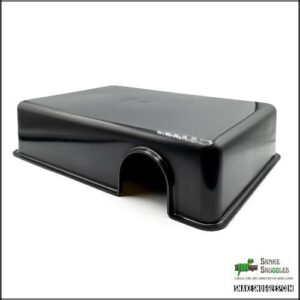
The Pangea Large Reptile Hide Box earns its spot here because it doesn’t overcomplicate things.
Its wide, smooth opening fits most snakes comfortably—check these snake hide sizing and safety tips to make sure it’s the right fit for yours.
Measuring 13.25 × 9 × 3.25 inches externally, with an interior of roughly 13 × 8 × 3 inches, it comfortably fits adult ball pythons and sub-adult boas in 28–41 quart tubs or 40-gallon breeders.
The 1/8-inch ABS plastic resists warping under heat lamps, while its smooth, non-porous surfaces wipe clean in seconds.
Its offset door opening reduces stress, encouraging your snake to actually use it.
| Best For | Keepers housing adult ball pythons, boas, or similar-sized snakes in rack systems or 40-gallon breeder tanks who want a no-fuss, easy-to-clean hide. |
|---|---|
| Material | Injection-molded plastic |
| Dimensions | 13.25×9×3.25 in |
| Humidity Support | Smooth non-retaining |
| Ease of Cleaning | Smooth plastic resists warping |
| Species Suitability | Ball pythons, boas, geckos |
| Weight | 9.59 oz |
| Additional Features |
|
- Roomy interior fits most adult-sized snakes comfortably without feeling cramped
- Smooth plastic is dead simple to wipe down and disinfect between cleanings
- Works across a wide range of setups — racks, tubs, and standard tanks alike
- Too big for small or juvenile snakes, which can make them feel exposed and stressed
- Takes up a solid chunk of floor space in smaller enclosures
- Plain black look won’t win any style points — you’ll need to DIY it if aesthetics matter
6. Zilla Rock Lair Humid Hide
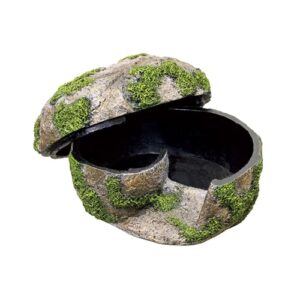
The Zilla Rock Lair Humid Hide does double duty — it looks like part of the habitat while actively supporting healthy sheds. At 11 × 7.75 × 6 inches, it fits medium-to-large snakes without crowding the tank floor.
The solid top creates a stable basking surface, and the side entrance traps moisture inside, keeping humidity where your snake needs it most.
Add damp sphagnum moss inside, and you’ve got a microclimate that works.
Heavy resin construction means it won’t tip when a curious ball python pushes against it.
| Best For | Reptile owners with small to medium species like leopard geckos, crested geckos, or ball pythons who want an easy way to maintain a humid hide without a complicated setup. |
|---|---|
| Material | Durable resin |
| Dimensions | 5.5×5×4 in |
| Humidity Support | Removable top/moss |
| Ease of Cleaning | Removable lid access |
| Species Suitability | Small-medium reptiles |
| Weight | Unspecified resin |
| Additional Features |
|
- The removable top makes it simple to add moss or wet paper towels and clean things out without a hassle.
- Sturdy resin keeps it from tipping over when your reptile decides to climb or push around inside the enclosure.
- The dark, enclosed design gives shy reptiles a secure spot to decompress, which genuinely helps reduce stress.
- Too small for larger snakes over 30 inches — they’ll outgrow it fast.
- Resin can crack if dropped, so you’ll want to handle it carefully during cleaning.
- Humidity doesn’t maintain itself — you have to add substrate like moss or damp towels to get the full benefit.
7. Exo Terra Medium Gecko Cave
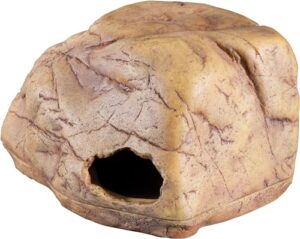
The Exo Terra Gecko Cave Medium is an honest pick for smaller classroom reptiles — particularly leopard geckos or frog-eyed geckos — where a compact, stress-reducing retreat matters. At 5 × 6 × 3.7 inches and 1.65 lb, it won’t shift when active geckos push through the O-shaped entry.
Add damp sphagnum moss inside, and it becomes a functional humidity hide that facilitates clean sheds.
Just keep in mind: this one’s sized for geckos, not ball pythons.
| Best For | Leopard gecko and frog-eyed gecko owners who want an affordable, stable hide that doubles as a humidity retreat for easier shedding. |
|---|---|
| Material | Smooth resin |
| Dimensions | 5×6×3.7 in |
| Humidity Support | Removable top/moss |
| Ease of Cleaning | Detachable top |
| Species Suitability | Medium geckos, snakes |
| Weight | 1.65 lb |
| Additional Features |
|
- Solid and heavy enough to stay put — active geckos won’t knock it over
- Pop the top off, add damp moss, and you’ve got a ready-made humidity hide
- Neutral look fits both desert and tropical setups without clashing
- Too cramped for larger reptiles like adult ball pythons — strictly a gecko-sized hide
- Moisture evaporates fast, so you’ll need to re-spray it regularly to keep humidity up
- The entry hole sits a bit high off the ground, which can be awkward for younger or smaller juveniles
8. Reptizoo Moisture Retaining Reptile Hide Cave
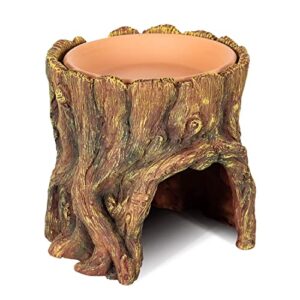
The Reptizoo hide pulls double duty in a classroom tank. Its non-porous resin body is easy to wipe clean with reptile-safe disinfectants — a real advantage when students handle maintenance.
The standout feature is the removable terracotta water basin on top. As water evaporates through the clay, it quietly raises interior humidity to support clean sheds, no misting required.
At 1.64 lb, the hide stays securely in place. Just refill the dish daily; it dries out faster than expected.
| Best For | Small reptile owners — especially teachers or hobbyists — who want a simple, low-effort way to boost humidity and give their animal a cozy hide. |
|---|---|
| Material | Resin/terracotta |
| Dimensions | 5.2×5.2×5.2 in |
| Humidity Support | Terracotta water dish |
| Ease of Cleaning | Removable clay dish |
| Species Suitability | Small-medium reptiles |
| Weight | 1.64 lb |
| Additional Features |
|
- The terracotta dish passively releases moisture as it evaporates, so you get a humidity bump without buying a separate humidifier
- Resin body is easy to wipe down, which makes it a solid pick for classroom tanks where kids help with upkeep
- The tree-root look blends naturally into a terrarium without looking cheap or out of place
- The dish dries out fast — daily refills are pretty much non-negotiable
- The interior can get slimy if you skip cleanings, so it needs more attention than a plain hide would
- Smaller cavity means larger reptiles or adult leopard geckos probably won’t fit comfortably
9. Cavachew 3in1 Reptile Hide Cave
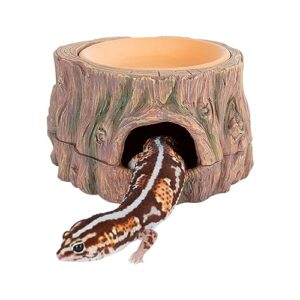
The Cavachew combines three tools in one enclosure: a resin cave, terracotta humidity dish, and detachable base. These components separate for cleaning, a critical feature for weekly classroom rotations.
At 6 × 6.4 × 3.5 inches, the enclosure fits comfortably in 20- to 40-gallon tanks without overcrowding floor space. Its entrance opening suits juveniles well, though larger adults may find it tight.
Constructed from non-toxic, smooth-edged resin, the design ensures safety during student handling between sessions.
| Best For | Reptile keepers with juveniles or small adults — especially those with leopard geckos, crested geckos, or similar species — who want a low-maintenance, multi-purpose hide that simplifies tank setup and cleaning. |
|---|---|
| Material | High-grade resin |
| Dimensions | 6×6.4×3.5 in |
| Humidity Support | Terracotta dish included |
| Ease of Cleaning | Fully disassembles |
| Species Suitability | Small reptiles, amphibians |
| Weight | 2.1 lb |
| Additional Features |
|
- Three functions in one piece — hide, humidity dish, and feeding platform — so you’re not juggling separate accessories
- Pulls apart easily for cleaning, which makes weekly maintenance way less of a chore
- Non-toxic resin with smooth edges means it’s safe to handle and won’t stress your animals
- The entrance opening runs small, so larger adult reptiles may not fit comfortably
- The terracotta dish can get slimy fast and needs regular, careful cleaning to stay sanitary
- It’s a bit bulky and heavy at 2.1 lbs, which can feel cramped in smaller tanks
10. Zoo Med Small Reptile Cave
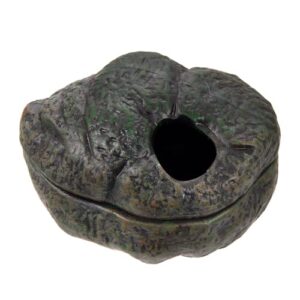
The Zoo Med Small Reptile Cave earns its spot as a reliable starter hide for hatchlings and small juveniles. Its ceramic build retains humidity well when filled with damp sphagnum moss or Eco-Earth, supporting cleaner sheds without much adjustment.
The removable lid gives you quick access for spot-cleaning or egg checks — a genuine time-saver during busy classroom days.
At roughly 4 to 5 inches long, it’s best suited for corn snake hatchlings or small garter snakes before they outgrow it.
| Best For | Hatchlings and small juvenile reptiles like ball pythons, corn snakes, and leopard geckos that need a snug, humid hide to feel secure. |
|---|---|
| Material | Textured resin |
| Dimensions | 6.9×6.2×5.3 in |
| Humidity Support | Fillable moss cavity |
| Ease of Cleaning | Removable top half |
| Species Suitability | Ball pythons, corn snakes |
| Weight | 5.92 oz |
| Additional Features |
|
- The 3-in-1 design works as a dry hide, humid hide, or egg-laying spot — a lot of versatility for one piece of kit.
- Removable lid makes cleaning and egg checks quick and easy without stressing your animal.
- Heavy resin construction keeps it in place and holds up well over time.
- Small interior means growing snakes will outgrow it faster than you’d like.
- A determined or larger reptile can still knock the lid loose if it’s not sitting just right.
- The surface can feel a bit shiny and smooth, which looks less natural and may reduce grip for some species.
Choosing Safe Classroom Hide Materials
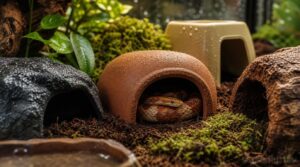
The material your snake’s hide is made from matters more than most people realize, especially in a classroom where sanitation and safety are non-negotiable.
Some options clean up easily and hold humidity well, while others quietly harbor bacteria or leach harmful chemicals over time.
Here’s what to look for before you buy.
Plastic Versus Resin Hides
Both materials have real trade-offs worth knowing before you buy. Plastic hide boxes win on Weight Comparison and Cost Efficiency — they’re budget-friendly options that clean up fast. Resin caves offer enhanced Detail Realism but carry Off-gassing Risks if not fully cured.
Key material considerations:
- Plastic is lighter and easier to handle daily
- Resin captures realistic cave shapes precisely
- Temperature Stability favors dense resin constructions
- Size, material, and ease of cleaning favor smooth plastic
- Always verify BPA-free, phthalate-free certification for both
The resin’s liquid state before curing can affect off‑gassing if not fully hardened.
Ceramic Humidity Retention
Ceramic hides work differently than plastic or resin — it’s all about Microstructural Porosity. The Pore Size Distribution across micro and mesopores drives the Moisture Release Cycle, keeping humidity steady for up to 24 hours.
Glaze Impact matters too: a clear matte finish lets moisture migrate without slicking the surface.
Thermal Mass Benefits help buffer sudden temperature swings, making ceramic a reliable humidity assistance option for shedding support.
Avoid Porous Untreated Wood
Unlike ceramic’s controlled moisture release, untreated wood works against you entirely. Moisture Absorption Risks compound quickly — once wood swells from Structural Warping Issues, gaps trap debris and waste.
Bacterial Growth Potential climbs quickly in those crevices, and Sanitization Challenges make proper disinfection nearly impossible.
Pest Harboring Concerns are real too, especially mites.
Stick to nonporous resin surface options every time.
Non-toxic Sealed Surfaces
Once you’ve ruled out wood, the next question is what sealed surfaces actually mean in practice.
Water-Based Formulations cure into a smooth interior finish that won’t off-gas around students—Low VOCs matter in enclosed classrooms.
Food-Safe Sealers on nonporous resin surfaces tolerate student-safe cleaning with diluted vinegar or bleach.
A Durable Finish keeps the top seal design intact through weekly cleaning and maintenance cycles.
Tip-resistant Hide Designs
A hide that tips over mid-lesson is more than an inconvenience — it’s a stressor for the snake and a distraction you can’t afford. Look for a low center of gravity, weighted base inserts, and rubber foot pads that grip tank glass firmly.
Multi-point anchoring, anti-tip lip edges, a removable top, smooth interior, rounded edges, and a secure retreat all work together to keep things steady.
Sizing Snake Hides Correctly
Getting the size right is honestly the most overlooked part of setting up a classroom snake enclosure. A hide that’s too big leaves your snake feeling exposed, while one that’s too small creates stress that shows up in feeding and behavior.
Here’s what to look for at each stage of growth.
Hatchling Hide Dimensions
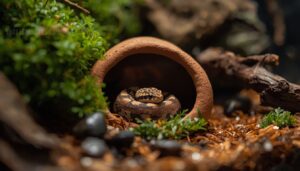
Newborn snakes need a hide that fits like a snug burrow — tight enough to feel secure, yet open enough for safe movement. For a hatchling snake hide buying guide, size and fit matter more than aesthetics.
- Length Range: 1.5–3.5 inches
- Chamber Height: 0.75–1.25 inches
- Base Footprint: 1.5–3 inches square
- Dome Proportion: 1–2.5 inches tall
Keep that size ratio close — snug, not restrictive.
Juvenile Snake Hide Sizing

As your juvenile snake grows through 2–3 growth spurts, girth-based measurements become your most reliable guide. For ball pythons up to 400 mm, target a 6–8 cm interior diameter; corn snakes need 7–9 cm.
Run a two-hide preference test — juveniles consistently choose the snugger option. When they stop, that’s your signal to shift hides.
Adult Snake Hide Fit
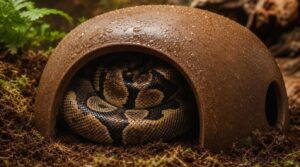
An adult ball python needs roughly 8 by 6 inches of interior floor space — enough for full girth accommodation without leaving gaps that break that snug, burrow-like contact. Ceiling height matters too; it should allow comfortable coiling without forcing the head up.
Check snout clearance when your snake enters — no sharp angles. Dual entry options reduce stress, and weight stability keeps the hide firmly in place.
Entrance Opening Guidelines
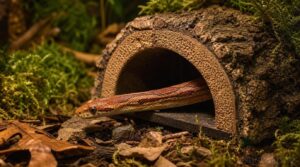
Clearance width should run 1.5–2 times your snake’s body diameter — tight enough to feel secure, open enough to prevent injury.
Think of entrance design the way you’d approach hardware operability standards: functional and forgiving.
Slip-resistant thresholds prevent wobble during entry. Aim for smooth, rounded edges with enough approach depth so your snake enters without hesitation.
Coiled Contact Comfort
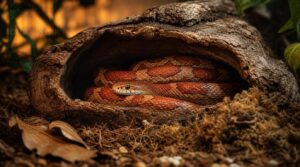
A properly sized hide isn’t just shelter — it’s a postural support system. Interior slope design guides your snake into a natural coiled position, promoting healthy posture.
Uniform spring constant materials ensure coil pressure distribution is evenly distributed across the body, reducing strain. This structural integrity forms the foundation of a secure retreat.
Look for a non-reflective finish inside to reduce stress cues, and prioritize breathable liner insulation to balance warmth without trapping moisture.
That’s secure retreat, done right.
Placement for Classroom Tanks
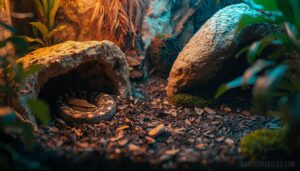
Where you place hides in a classroom tank matters more than most people realize. Done right, it gives your snake control over its own comfort — and that means a calmer, healthier animal your students can actually observe.
What you need to know about placement before anything else is prioritizing the snake’s well-being through strategic hide positioning.
Warm-side Hide Placement
Place your warm side hide directly above or adjacent to the heat source to support snake thermoregulation without forcing the animal into open, exposed areas.
A ventilation gap design beneath the hide — elevated platform stability helps here — moderates surface conductivity selection and maintains humidity balance control.
Keep the heat source’s proximity tight but buffered, ensuring the temperature gradient stays within 2–4°F of the surrounding warm zone.
Cool-side Hide Placement
Your cool side hide placement works best at the far end of the reptile enclosure, as far from the heat source as possible. Target floor substrate compatibility by confirming floor-level temperatures fall between 72–80°F using a probe thermometer — not just wall readings. Distance from heat matters here; if the cool side still reads warm, move the hide farther rather than redesigning the setup.
Middle-gradient Third Hide
Once your cool-side hide is set, a mid-tank position completes the thermal gradient. For enclosures over 40 gallons, a third hide placed along this thermal plateau gives your snake a true middle-ground option.
Choose a scale-friendly grip surface — textured resin works well — and position it to encourage a relaxed coil. That subtle moisture gradient here promotes consistent snake welfare without overcomplicating your reptile enclosure setup.
Entrances Facing Away
Orient your snake hides so the entrance design faces the tank’s back wall. This simple choice delivers stress reduction, draft minimization, and visual camouflage in one move — students will see the natural bark look exterior, not a startled snake.
Whether you’re using a wall-mounted hide or magnetic hide system, rear-facing openings also improve cleaning accessibility and support thermal stability throughout your enclosure.
Avoiding Dangerous Hot Spots
Even the best hide placement falls apart if heat builds up unchecked. Keep these five practices in your routine:
- Conductive Material Choice — Plastic and resin hides won’t spike heat the way metal does, making them safer near the heat lamp.
- Heat Source Buffer — Never place hides directly under radiant panels; a 2–3 inch gap protects the temperature gradient.
- Temperature Logging — Record warm and cool temperature zones daily using a dual-probe thermometer to catch gradual shifts early.
- Airflow Enhancement — Subtle ventilation around hide entrances prevents stagnant hot pockets from forming inside the enclosure.
- Hot Spot Alarms — Set a simple alert if your warm-side hide exceeds the species-safe maximum, so you catch spikes before your snake does.
Knowing where to place hides starts with understanding how temperature regulation flows across your tank. Monitor it consistently, and you won’t be guessing.
Cleaning and Humidity Features
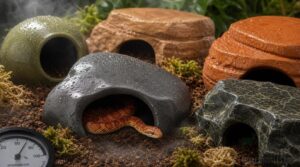
Keeping your classroom snake healthy comes down to two things you can actually control: clean hides and steady humidity. The options below are chosen with both in mind, so you’re not guessing which ones hold up to weekly disinfection or support a clean shed.
Here’s what made the cut.
Moist Hides for Shedding
Shedding success starts with microclimate stability, and that’s where a quality humidity hide earns its place. Terracotta and ceramic options excel at humidity retention, while polymer moisture systems offer passive vapor exchange that keeps conditions consistent without daily intervention. Aim for 60–80% RH inside the hide, positioned in the middle temperature zone for temperature balance and reliable moisture retention throughout each shed cycle.
Sphagnum Moss Use
Few substrate choices do as much quiet work as sphagnum moss inside snake hides. It holds up to 20 times its weight in water, gives reliable moisture buffering without constant intervention. Its natural antimicrobial benefits reduce bacterial buildup between cleanings, and its fibrous structure provides natural cushioning that visibly calms snakes entering the hide — a detail students notice immediately.
Sphagnum moss holds up to 20 times its weight in water, quietly buffering humidity and calming snakes without daily intervention
This makes it ideal for live reptile husbandry demonstrations.
Daily Spot-cleaning Routine
Daily spot-cleaning takes maybe five minutes, but when done right, it prevents bacterial buildup that weekly disinfection alone can’t catch. Reach for microfiber cloths — the Microfiber Technique is essential here, as fibers lift debris without shedding lint into smooth interiors.
Use a spray bottle for Residue-Free Wiping, and follow Air-dry Timing: surfaces need 15–30 minutes before the snake returns.
A simple Cleaning Log tracks consistency.
Weekly Disinfection Steps
Weekly cleaning runs deeper than a quick wipe — think of it as resetting the enclosure’s health baseline.
- Surface Pre-wash with soap and water removes organic soil before any reptile-safe disinfectant can work properly.
- Contact Time matters — let the EPA-registered solution dwell for the full labeled period.
- Equipment Segregation means separate cloths per enclosure, preventing cross-contamination.
- Ventilation Management speeds drying and limits chemical exposure.
Student-safe Maintenance Practices
Student safety doesn’t stop when the snake goes back in the tank. Maintain chemical-free sanitizers and a reptile-safe disinfectant in clearly labeled storage systems to ensure students always select the correct product. Student handling protocols must include routine inspection checklists for rounded edges, smooth interiors, and removable tops to guarantee consistent safety standards.
An emergency spill response plan is essential—prioritize factors like size, material, and ease of cleaning to minimize risks. This proactive approach ensures thorough sanitization and faster classroom turnover, directly supporting safer student interactions and efficient maintenance.
| Feature | Why It Matters | Student Benefit |
|---|---|---|
| Rounded edges | Prevents cuts during handling | Safer student contact |
| Smooth interior | Eases disinfectant wipe-down | Faster classroom turnover |
| Removable top | Full interior access for cleaning | Thorough sanitization |
Frequently Asked Questions (FAQs)
Can multiple snakes share one hide safely?
Most snakes are solitary by nature, so sharing one hide rarely works safely. Species compatibility, aggression indicators, and chronic stress all factor in — multiple hides and feeding zone separation are non-negotiable.
How often should classroom hides be replaced?
Plan your replacement schedule around a simple inspection checklist: replace plastic hides every 12–24 months, resin every 9–18, and foam every 6– Budget allocation for two spare hides per tank keeps downtime minimal.
Do snakes prefer darker or lighter colored hides?
Different strokes for different folks" applies here too. Color behavior bias is real — snakes use thermoregulation color and light absorption cues.
Species shade preference and camouflage stress levels guide hide acceptance more than any single color rule.
What hide styles work best for shy snakes?
Shy snakes settle fastest in an Enclosed Dark Cave with a Tight Neck Opening, Opaque Covered top, Double Chamber layout, and Slip-Resistant Interior.
All these elements are key to strong hide acceptance and natural retreat behavior.
Are hides suitable for other classroom reptiles too?
Whether you’re housing geckos, skinks, or anoles, species compatibility, thermal preference, and humidity adaptation all shape enclosure design.
Multiple hides with varied texture enrichment and low material toxicity serve virtually every classroom reptile well.
Conclusion
A calm snake is a classroom that teaches itself—students read the body language, ask the right questions, and leave with something real. The wrong hides quietly unravels all of that. Choosing the best snake hides for classroom reptile tanks means matching material, size, and placement to the animal in front of you, not the one on the packaging.
Getting these three details right ensures your snake stays settled, your students stay engaged, and the lesson holds.