This site is supported by our readers. We may earn a commission, at no cost to you, if you purchase through links.

Most new corn snake owners get the habitat wrong before their snake even arrives home. Not because they’re careless, but because the advice online is scattered, contradictory, and often written by people who’ve never set up an enclosure themselves.
A corn snake isn’t a "starter pet" that tolerates neglect. It’s a living thermoregulator that depends entirely on you to recreate the conditions its biology expects. Temperature gradients, humidity levels, substrate depth — get these wrong and you’ll spend months troubleshooting stress, bad sheds, and refused meals.
The good news: corn snake environment setup follows a clear, logical sequence. Nail each step in order, and you’ll build a habitat your snake actually thrives in.
Table Of Contents
- Key Takeaways
- Choose The Right Corn Snake Enclosure
- Add Substrate, Hides, and Enrichment
- Create a Safe Temperature Gradient
- Balance Humidity, Lighting, and Shedding Support
- Maintain a Clean, Secure Corn Snake Habitat
- Frequently Asked Questions (FAQs)
- How do you set up a corn snake habitat?
- Do corn snakes need a proper habitat?
- Do corn snakes need an enclosure?
- How do I set up a corn snake enclosure?
- How do you maintain a corn snake bioactive enclosure?
- How do I set up a corn snake tank?
- How often should water bowls be cleaned?
- Can corn snakes cohabitate with other snakes?
- What signs indicate stress in corn snakes?
- How do you handle a corn snake safely?
- Conclusion
Key Takeaways
- Your corn snake’s survival depends on a precise thermal gradient — a warm end of 85–90°F, a cool end of 75–78°F, and a basking spot hitting 88–92°F — because it can’t regulate its own body temperature without your help.
- Substrate depth isn’t cosmetic: hatchlings need 1–2 inches and adults need 3–4 inches to support natural burrowing, proper drainage, and a stable humidity range of 40–60%.
- Three dedicated hides — warm, cool, and humid — are non-negotiable, since skipping even one leaves your snake without the security it needs to eat, shed, and behave normally.
- Daily hygiene habits (refreshing water every 24 hours, spot-cleaning waste immediately, and checking lid locks and vents each morning) compound into the consistent environment that keeps stress, disease, and escapes from taking hold.
Choose The Right Corn Snake Enclosure
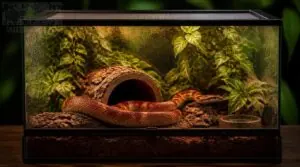
Your enclosure is the foundation of a safe, low-stress corn snake habitat. Size, construction, airflow, and security all matter before you add heat, substrate, or décor. Use the following points to choose and prepare the right home for your snake.
Getting these fundamentals right from day one sets your snake up for a calm adjustment period — you’ll find a solid walkthrough of everything from enclosure sizing to first-week care in this corn snake beginner’s setup guide.
Adult Enclosure Size Requirements
Give an adult corn snake room to travel. Start with a 40 gallon tank, but aim for 36 by 18 by 18 inches or larger. The snake should be able to stretch without pressing against walls.
A longer enclosure also creates a reliable thermal gradient. Keep humidity at 40-60%, with enough floor space for warm and cool resting areas. Use durable, non-toxic materials and secure fittings to support enclosure safety standards.
Hatchling Enclosure Sizing
Smaller quarters help a young corn snake feel secure while you monitor growth and meals. Begin with 10 gallons for hatchlings, or a 12–18-inch tub, then use enclosure size scaling as length increases.
- Choose hatchling enclosures with limited height.
- Match space to hatchling feeding frequency.
- Provide two snug hides.
- Use a secure lid and escapeproof design.
Avoid oversized, exposed layouts.
Tank, PVC, and Vivarium Options
As your hatchling grows, upgrade from a temporary tub to a 40 gallon breeder, measuring 36 by 18 by 18 inches, or larger.
Glass tanks are widely available but heavy. PVC vivariums insulate better, resist moisture, and allow custom dimensions. Wood-framed vivariums look natural but need waterproof sealing. Choose a front-opening enclosure that holds secure furnishings and allows easy cleaning.
Ventilation and Airflow Balance
A well-insulated PVC or glass enclosure still needs secure ventilation. Use top and side vents to create gentle crossflow, with intake near one corner and exhaust on the opposite side. This prevents damp, stagnant pockets without blowing directly across your snake.
Aim for 8–12 full air changes daily. Fine screens or metal mesh lids with four clamps support stable ventilation airflow while keeping debris out. Keep vents clear of substrate and inspect them weekly for dust.
Escape-Proof Lids and Cable Ports
A corn snake can exploit a gap no wider than its head. Use a rigid metal mesh lid with four clamps, plus locking mechanisms or a slide latch for redundant lid security. Fit escapeproof enclosure seals around every rim.
Once your enclosure is secure, exploring corn snake behavior patterns and enrichment ideas can help you recognize whether your snake’s nightly perimeter roaming signals contentment or stress.
Route heater and probe cords through capped, rubber-grommeted ports; secure ventilation must never become an escape route under normal use, either.
Add Substrate, Hides, and Enrichment
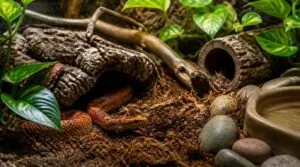
Substrate, shelter, and cover turn an empty enclosure into a place your corn snake can use with confidence. Each choice affects security, movement, moisture, and daily behavior. Start with these five setup decisions.
Choose Safe Substrate Materials
Choose dust-reduced, non-toxic substrate that absorbs waste, permits normal burrowing, and matches your humidity goals. Aspen, coconut husk, cypress mulch, and recycled paper bedding are reliable choices. Coconut fiber holds moisture; aspen dries faster.
Avoid cedar, pine, silica sand, calcium sands, and fine powders. Their oils or particles can irritate airways, cause impaction, or trap bacteria in damp corners.
Pairing a safe substrate with well-calibrated heat lamps for reptile terrariums helps you maintain dry, consistent warmth that discourages the bacterial growth problematic substrates tend to invite.
Set Proper Substrate Depth
Depth matters more than most keepers expect.
Give hatchlings 1 to 2 inches of substrate, enough to support safe burrowing depth without risk of impaction. Juveniles and adults need 3 to 4 inches, which aids drainage and temperature gradient.
High-humidity enclosures benefit from 4 to 5 inches of substrate layering to retain moisture and slow bacterial buildup. Check depth weekly.
Add Warm, Cool, Humid Hides
Three hides are non-negotiable.
Place a warm side basking surface hide near the heat source, targeting 82 to 88°F.
Your cool side retreat sits at the opposite end, holding 74 to 78°F.
The humid hide with moist sphagnum moss goes where condensation collects naturally, keeping humidity above 75%.
Each needs a snug entry opening to make your snake feel secure.
Install Climbing Branches and Cover
Snakes explore vertically, so give yours the structure to do it safely. Mount 1 to 3-inch hardwood branches at staggered heights, mixing horizontal and diagonal angles to create natural climbing routes. Space limbs 6 to 8 inches apart so your snake can move without falling.
Tuck cover pieces between branches to form sheltered nooks. That added privacy encourages natural hiding behavior without needing extra hides.
Consider a Bioactive Setup
A bioactive setup turns your enclosure into a self-regulating habitat. Isopods and springtails form the cleanup crew, breaking down waste in the substrate and naturally controlling odors without any daily scooping.
- Live plants buffer humidity and create natural hides
- A LECA drainage layer prevents waterlogged substrate
- Springtails and isopods reduce mold and waste buildup
- Stable humidity helps maintain consistent, healthy shedding
Create a Safe Temperature Gradient
Temperature is one of the few things your corn snake genuinely can’t manage without your help. Getting the gradient right means understanding a handful of specific measurements, equipment choices, and placement rules. Here’s what you need to set up each part correctly.
Your corn snake cannot regulate its own temperature—getting the gradient right is entirely up to you
Set Warm, Cool, Basking Temperatures
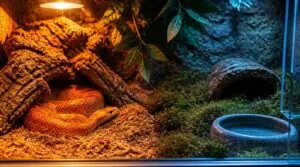
Think of your enclosure as a spectrum, not a single fixed setting. The warm end should hold between 85 and 90°F (29–32°C), while the cool end needs to stay around 75 to 78°F (24–26°C).
Your basking spot must reach 88 to 92°F (31–33°C) to properly support digestion. At night, a 5 to 10°F temperature drop is perfectly safe and expected.
Select Safe Heating Equipment
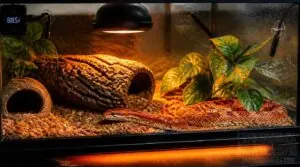
The right gear turns target ranges into reality. Ceramic heat emitters supply heat without light, while an under-tank heat mat adds secondary warming on the warm end. Prioritize thermostat compatibility and heat source safety for stable thermal gradient optimization.
- Ceramic heat emitters for heat without disrupting light cycles
- Under-tank heat mats for secondary warm-end floor warming
- Radiant heat panels for overhead ambient warmth
- Certified, thermostat-compatible gear for heat source safety
Connect Heaters to Thermostats
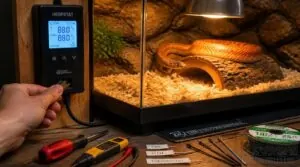
Plug each heater through your thermostat’s outlet before switching power on. Turn the breaker off first, label both wire ends, and confirm the thermostat voltage matches your heater’s rating. That single step covers heat source safety for both your heat mat and ceramic emitter, keeping your enclosure’s thermal gradient locked in range.
| Heater Type | Compatible Thermostat | Key Note |
|---|---|---|
| Ceramic heat emitter | Proportional | No relay needed under 600W |
| Under-tank heat mat | On/off or proportional | Use as secondary warming only |
| Radiant heat panel | Proportional | Best for ambient temperature control |
| High-wattage heater (600W+) | Relay kit required | Isolates thermostat from heavy current |
Monitor Day and Night Temperatures
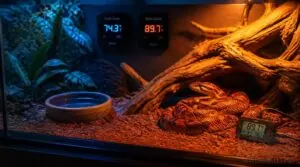
Once your heaters are connected, daily temperature monitoring tells you whether the thermal gradient is holding.
- Basking spot: 88–92°F during daylight hours
- Cool side: keep this at 75–82°F
- Nighttime ambient should sit at 70–75°F
- Record readings every 30 minutes on the warm side
- Use temperature monitoring tools to verify probe accuracy
Temperature spikes above 95°F will stress your snake fast.
Position Probes for Accurate Readings
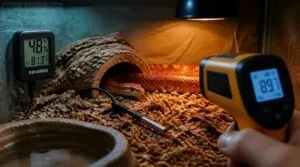
Probe placement makes or breaks your thermal gradient data. Place your temperature probe tip flat against the substrate on the warm side, not dangling in mid-air, where ambient air creates false readings.
Verify spot temperatures using an infrared temperature gun to cross-check your thermostat probe regularly. Position your hygrometer sensor at mid-height, away from water dishes, for representative ambient conditions.
Balance Humidity, Lighting, and Shedding Support
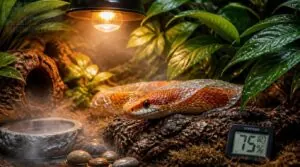
Getting humidity and lighting right isn’t just about comfort — it directly affects how well your corn snake sheds, breathes, and regulates its daily rhythm. A few targeted adjustments to moisture levels, hygrometer placement, and lighting schedules can make the difference between a clean shed and a stuck one.
Here’s what each element requires and why it matters.
Maintain 40–60% Humidity
Skin that sheds in patches almost always points to a humidity problem. Keep your enclosure at humidity 40–60% year-round, and use a hygrometer to confirm it.
If patches persist despite stable humidity, snake scale discoloration causes can help you rule out deeper hormonal or pigmentation issues affecting your snake’s shed.
Moisture-retentive materials like cypress mulch support steady humidity control between mistings. A humid retreat shedding aid, such as a damp moss hide, gives your snake targeted moisture at shed time.
Place Digital Hygrometers Correctly
Where you place your hygrometer shapes what your humidity readings actually show.
- Mount at mid-height, away from basking spots
- Keep sensors clear of vents to prevent false readings
- Avoid placing above water dishes
- Add a second probe for temperature monitoring across zones
- Recalibrate after each sensor placement change
A second probe covers your blind spots.
Adjust Moisture Without Soaking Substrate
Raising humidity without soaking substrate is a balance worth getting right. Use small misting bursts aimed at enclosure walls, not the substrate directly.
Moisture-retentive materials like coconut fiber release humidity gradually, smoothing out spikes. Wet substrate near your sensor skews readings, so refresh your water bowl daily and watch for biofilm buildup that quietly pushes ambient humidity past your target.
Prevent Mold and Stagnant Air
Stagnant air is mold’s best friend in any vivarium. Enclosure ventilation systems that deliver 8-12 air changes daily create steady convection flow, preventing moisture-retentive materials from staying damp.
Watch for early warning signs:
- Fuzzy patches on substrate or hides
- Musty odors after misting
- Wet clumps near water bowls
- Dark discoloration on wood decor
Dry any wet spots within 48 hours.
Set UVB and Daylight Cycles
UVB lighting does more than light up your enclosure. It triggers vitamin D3 synthesis, which corn snakes need for healthy calcium absorption. Run a T5 HO fluorescent tube 8-12 hours daily to support a consistent day/night cycle and stable circadian rhythm lighting.
| Light Schedule | Requirement |
|---|---|
| UVB on (day) | 8-12 hours, 290-315 nm |
| Lights off (night) | Complete darkness |
| Bulb type | T5 HO fluorescent tube |
| Replace bulbs | Every 6-12 months |
Always include a shaded retreat so your snake can control its own exposure.
Maintain a Clean, Secure Corn Snake Habitat
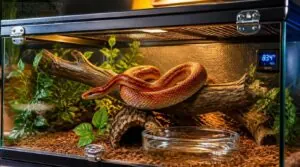
A clean habitat isn’t just about appearances — it’s one of the most direct ways you protect your corn snake’s health and keep escapes from happening.
Small daily habits compound into big results, and a few focused routines cover everything from water hygiene to enclosure security.
Here’s what your maintenance schedule should look like.
Perform Daily Safety Checks
Each morning, run five quick checks before touching anything else:
- Verify lid locks and latch security
- Check vents and cable ports for escape gaps
- Read your hygrometer, targeting 40-60% humidity
- Inspect the water bowl for biofilm buildup
- Observe your snake’s activity and body condition
Daily spot cleaning fits naturally into this same routine.
Spot Clean and Refresh Water
After your daily checks, spot cleaning takes only minutes. Pull out waste and shed fragments right away, before bacteria get a foothold.
Dump and refill the water bowl every 24 hours with room-temperature potable water. Discard anything cloudy or debris-filled immediately.
If biofilm forms along the rim, scrub with a reptile-safe disinfectant, allow full contact time, then rinse until no residue remains.
Schedule Deep Cleaning and Disinfection
Spot cleaning takes care of the day-to-day, but every three months you need to go deeper. Remove the snake, then scrub all surfaces with a 1:64 bleach solution or chlorhexidine disinfectant, following the product’s contact time exactly. Rinse everything thoroughly to eliminate chemical residue. Air the enclosure for at least 30 minutes before returning your corn snake.
Replace Substrate as Needed
Even after a thorough deep clean, substrate replacement can’t wait when warning signs appear.
Replace substrate immediately when you notice:
- A sour smell or visible mold growth
- Substrate moisture retention has left bedding soggy or clumped
- Spills or waste residue missed during spot cleaning
Maintain at least 2 to 3 inches of fresh substrate depth for burrowing comfort.
Maintain Feeding-Time Hygiene
Feeding always leaves behind scent and residue that bacteria thrive on. Use a separate feeding tub to keep prey odor away from the main enclosure and reduce contamination risk.
| Task | Timing |
|---|---|
| Remove feeding residue | After every feeding |
| Apply reptile-safe disinfectant | 30-second contact time |
| Rinse and dry tub | Before next use |
| Spot clean enclosure | Daily |
Wash your hands before and after every feeding session.
Frequently Asked Questions (FAQs)
How do you set up a corn snake habitat?
You need four things working together: a 40-gallon tank at 36×18×18 inches, safe substrate, a thermal gradient of 75–90°F across both ends, and humidity between 40–60%. That’s the foundation of any solid corn snake environment setup.
Do corn snakes need a proper habitat?
Without a temperature gradient, stable 40-60% humidity, correct substrate depth, and secure hiding spots, your snake’s health declines quickly.
A thorough Corn Snake Environment Setup isn’t optional, it’s the foundation of responsible, long-term captive care.
Do corn snakes need an enclosure?
A corn snake requires a secure enclosure to regulate temperature, control humidity, and stay safe. Enclosure size matters; adults need at least a 40 gallon tank with correct adult dimensions, proper escapeproofing, and lid security.
How do I set up a corn snake enclosure?
Think a larger tank stresses snakes? It doesn’t. Use a 40 gallon tank, make your substrate selection, layer it 3-4 inches, place hiding spots on both ends, build a temperature gradient, and maintain humidity 40-60%.
How do you maintain a corn snake bioactive enclosure?
A bioactive setup works like a living community, not a sterile tank. Keep humidity between 40-60% to support healthy shedding, spot-clean waste weekly, and let your bioactive cleanup crew of springtails and isopods handle the rest.
How do I set up a corn snake tank?
Setup isn’t as complicated as it looks. Adults need a 40-gallon enclosure, 3-4 inches of substrate for natural burrowing behavior, a temperature gradient reaching a 90°F basking spot, 40-60% humidity, and optionally a bioactive base.
How often should water bowls be cleaned?
Clean your water bowl daily, rinsing with hot water and soap after every refill. Do a deep clean weekly using a pet-safe disinfectant, allowing proper disinfectant contact time before rinsing and refilling.
Can corn snakes cohabitate with other snakes?
Like solitary travelers forced to share a single room, corn snakes rarely handle cohabitation well. Stress, feeding aggression, and disease transmission risks climb fast. Keeping each snake in its own enclosure is always the safer choice.
What signs indicate stress in corn snakes?
Feeding refusals, escape attempts, and stuck shed are the clearest signs your snake is under stress. Low humidity worsens shedding problems, so monitor levels consistently. Stress reduction always starts with identifying and fixing the source.
How do you handle a corn snake safely?
Corn snakes don’t resist handling when approached correctly. Use both hands to support the full body, keep movements slow and deliberate, and limit sessions to 10-15 minutes to avoid stress. Wash hands before and after.
Conclusion
It’s no coincidence that corn snakes thriving in captivity live in enclosures that mirror what their biology already expects.
Every step in this corn snake environment setup guide exists for a biological reason. Get the temperature gradient right, humidity steady, hides placed correctly, and your snake stops surviving and starts thriving.
The habitat doesn’t need to be perfect. It needs to be consistent. That consistency is what separates a stressed snake from a settled one.