This site is supported by our readers. We may earn a commission, at no cost to you, if you purchase through links.

Most people picture snakes as decorative pets, content to sit in a hide all day. Then midnight rolls around, and your corn snake is covering every inch of its enclosure, climbing cork bark, digging into the substrate, and hunting along the glass like it owns the place. That’s not random activity. It’s a full behavioral repertoire, and too many keepers never see it because they’re asleep.
Here’s the good news: understanding corn snake behavior and enrichment ideas doesn’t require guesswork. Their movements, postures, and habits tell you exactly what they need, from deep burrowing substrate to prey-scented trails that keep hunting instincts sharp. You just have to learn the language. Once you do, you’ll spot the difference between a relaxed explorer and a stressed snake in seconds, and your husbandry will never be the same.
Table Of Contents
- Key Takeaways
- Corn Snake Behavior: Normal Activity and Stress Signs
- 5 Habitat Enrichment Ideas for Corn Snakes
- 5 Feeding and Foraging Enrichment Ideas
- Safe Handling and Out-of-Enclosure Enrichment
- How to Keep Corn Snake Enrichment Safe
- Frequently Asked Questions (FAQs)
- What is good enrichment for a corn snake?
- What are some good enrichment toys for corn snakes?
- What makes a corn snake happy?
- How to know if a corn snake is happy?
- What is the best enrichment for corn snakes?
- What are the enrichment ideas for snakes?
- How to make your corn snake happy?
- How to make corn snakes more active?
- What enrichment activities are suitable for corn snakes?
- How do you enrich a corn snake?
- Conclusion
Key Takeaways
- Corn snakes are nocturnal, expressive animals whose body language—loose coils and slow tongue flicks versus S-neck postures, tail flicking, or rigid stillness—tells you clearly whether they’re relaxed or stressed.
- Effective habitat enrichment combines deep burrowable substrate (3–4 inches for adults), anchored climbing structures, hides at both temperature ends, and decor rotated every 4–6 weeks with only one or two items changed at a time.
- Feeding enrichment like prey-scented trails, ventilated foraging boxes, and varied feeding locations keeps hunting instincts sharp, but should be timed to evening activity peaks and skipped right after meals.
- Safe enrichment depends on reptile-safe, non-toxic materials (avoiding aromatic woods like cedar and pine), firmly anchored decor, short handling sessions the snake leads, and logging responses so you can adjust gradually over time.
Corn Snake Behavior: Normal Activity and Stress Signs
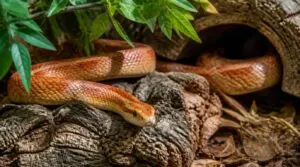
Corn snakes are more expressive than most people expect, and their behavior follows predictable, readable patterns. Once you know what normal looks like, stress signals become obvious rather than ambiguous. The behaviors covered here are what you’ll actually observe day to day.
From tongue flicking to hiding habits, this guide to corn snake behavior patterns breaks down what each cue means so you can read your snake with confidence.
Evening and Nighttime Activity
After sunset, corn snakes shift into active mode. As nocturnal hunters, they often ramp up movement between 8 PM and 3 AM.
Your lighting schedules drive this rhythm. Align dusk transitions with their natural cycle.
Signs of healthy nighttime activity:
- Roaming enclosure perimeters steadily
- Resting coiled in secure hides
- Increased alertness near feeding routines
Temperature gradients sustain this behavior overnight.
Climbing, Burrowing, and Exploring
Once active, corn snakes split their energy between climbing, burrowing, and mapping their space. They use textured climbing structures like cork and driftwood to ascend deliberately, while burrowing instincts pull them downward into loose substrate for shelter or ambush. Substrate depth of 6 to 8 inches helps both.
Varied exploring pathways and substrate diversity give them real choices to make. Like many animals, corn snakes benefit from behaviors shaped by adaptation and natural selection, where heritable traits that improve survival become more common over generations.
Hunting and Feeding Responses
All that exploring fulfills hunting and feeding instincts. Corn snakes track scent trails with their tongue, strike quickly, and constrict prey with one to three coils. In captivity, you’ll see hungry snakes pacing, lifting their heads, and extending forward at dusk. Feeding enrichment and movement go together, so vary prey placement and try puzzle feeders to keep natural hunting skills sharp without overfeeding.
Relaxed Handling Behaviors
A calm corn snake reads like an open book. During gentle handling sessions, expect a loose coil around your wrist, slow muscle waves instead of darting, and steady breathing with no rigid tail. These relaxed movement cues show your snake feels secure.
- Loose, even coiling without tension
- Slow, controlled climbing on your forearm
- Tail stays soft, never gripping tightly
- Brief pauses without escape attempts
Building trust and human-snake bonding happens here. Support the whole body, keep sessions under 10–15 minutes, and let your snake set the pace. Socialization and handling responses improve with consistency; a snake that rests calmly on you for several minutes is telling you the routine works. Watch for stress signals, but reward calm behavior by ending sessions on a good note.
Defensive Postures and Stress Signals
When a corn snake feels threatened, its body language changes fast. Watch for defensive postures and stress signs: a C-shaped coil when lifted, an S-shaped neck, rapid tail flicking, or a raised, retracted head. Stress signals also include gaping, rigid stillness lasting over 60 seconds, and jerky escape bursts.
Since improper enclosure setups, rough handling, and sudden environmental changes can make any corn snake defensive, this guide on whether male or female corn snakes are more aggressive explains what really drives that behavior.
Multiple cues together confirm distress. Release your snake into a warm hide, then observe whether relaxed movement returns. If socialization and handling responses stay poor, adjust your gentle handling sessions.
5 Habitat Enrichment Ideas for Corn Snakes
A well-designed enclosure does more than house your corn snake—it gives those natural climbing, burrowing, and hiding instincts somewhere to go. The good news is you don’t need an elaborate setup to make it happen. Here are five practical habitat enrichment ideas you can put to work this week.
Adding moisture-retaining hides and a humid microclimate at the cool end also supports those natural cycles—this guide to ideal humidity levels for snakes breaks down the numbers worth aiming for.
Build Secure Climbing Routes
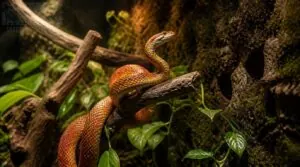
Think corn snakes stay on the ground? Think again. Semi-arboreal instincts drive them upward, and climbing structures satisfy that drive. Build secure climbing routes using anchored glass fiber reinforced platforms at staggered heights.
Creating clear pathways and routes with textured, non-slip panels gives grip without injury. Offer branches and gentle climbing opportunities at three distinct angles. This environmental enrichment strategy works alongside your temperature gradient that encourages movement.
Place Hides at Both Ends

Place hides at both ends of the enclosure to create a warm and cool microclimate corridor. The warm hide sits on the basking side; the cool hide offers retreat at the opposite end. This helps natural thermoregulation day and night. A sturdy reptile hide box for terrariums makes a great choice here, since its solid walls hold heat well on the basking side while staying easy to clean.
Space hides at least two body lengths apart, keep them sturdy, and inspect regularly for cracks.
Offer Deep, Burrowable Substrate
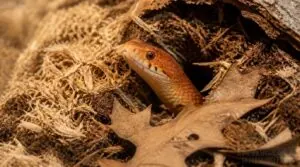
Burrowing is a natural behavior worth supporting. Give adults 3 to 4 inches of loose substrate; hatchlings need only 1 to 2 inches, juveniles 2 to 3.
Aspen suits dry enclosures and spot-cleans easily, while coconut fiber and cypress mulch act as moisture-buffering substrates in humid setups. Add leaf litter for surface cover. Keep bedding loose, never packed, and leave vertical space above it.
Maintain Temperature and Humidity Zones
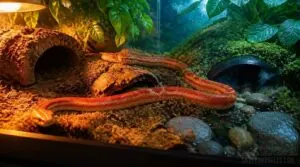
A temperature gradient that encourages movement is the backbone of enrichment. Target 28 to 32 Celsius at the basking end, 22 to 26 at the cool side.
Getting this gradient right also depends on proper heating equipment, so our guide to setting up a boa enclosure covers which heat sources work best.
Pair that with humidity control: a 60 to 70 percent damp hide, 40 to 50 percent dry zone. Your moisture-buffering substrates stabilize both.
Together, temperature gradients and humidity control become environmental stimulation.
Rotate Decor While Preserving Security
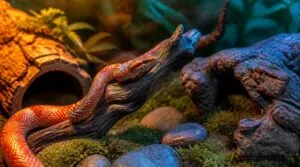
Novelty matters to a corn snake’s brain. Rotate decor occasionally—every 4 to 6 weeks—so exploration stays rewarding and natural behaviors stay sharp.
Change only one or two items per rotation. Every piece must anchor firmly; a shifting branch becomes a crushing hazard. Keep multiple secure hides in different areas untouched, and preserve the temperature gradient that encourages movement. Your snake should explore novelty, not relearn the enclosure.
5 Feeding and Foraging Enrichment Ideas
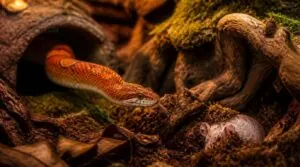
Feeding time is the highlight of your corn snake’s week, so why let it be boring? A snake that hunts with its tongue and heat-sensing pits deserves more than a thawed rodent dropped in front of its hide. These five ideas tap into natural foraging instincts without complicating your routine.
Create Prey-Scented Trails
Tap into your corn snake’s most powerful sense: smell. Prey-scented trails transform feeding time into genuine olfactory enrichment that mirrors natural foraging behavior.
Rub a thawed prey item along natural materials—clean leaves or cardboard—then drag a 1 to 2 inch wide path from a hide toward a feeding zone. Add gentle curves, not straight lines, and refresh the trail daily.
Watch tongue-flicking increase; that’s engagement.
Try Ventilated Foraging Boxes
A foraging box takes scent trails one step further—it’s a puzzle feeder your snake must actually investigate. Use a clear plastic container, 8 to 12 centimeters square with 2 to 3 centimeter height, fitted with a mesh or perforated lid for ventilation.
Cut small one-way entry holes so prey scent escapes while the prey stays contained. Your corn snake works the problem, tongue-flicking around the openings. A removable tray catches fur and waste between sessions.
A small animal mesh lid container works perfectly here, since the ventilated top lets scent drift out while keeping the prey securely inside for your snake to puzzle out.
Vary Feeding Locations Safely
Once your snake masters the foraging box, vary where you feed. Feeding Enrichment And Movement works best when you alternate stations at opposite ends of the enclosure, encouraging natural exploration without forcing exposure.
Follow these five rules:
- Keep a secure hide within 15 centimeters of each station
- Use non-porous, sanitizable substrates around feeding sites
- Maintain consistent distance from the temperature gradient
- Log every feeding location and response
- Adjust sites gradually based on observation
Watch those pathways, textures, and your snake’s appetite. Comfort drives acceptance.
Schedule Activities During Active Hours
Timing matters as much as location. Corn snakes are nocturnal hunters, peaking between 7 and 11 pm, so schedule feeding and environmental enrichment strategies inside that window, not on your nine-to-five schedule.
Let temperatures drop 3 to 5 degrees Fahrenheit toward evening. Use quiet red lighting, avoid sudden flashes, and skip sessions during post-activity rest. Watch for relaxed movement, and end immediately if tension or gaping appears.
Match Enrichment to Feeding Cycles
When you align enrichment with feeding schedules, engagement doubles. Corn snakes eat every 5 to 7 days, so introduce scent trails and foraging toys one day before feeding to trigger natural hunting behavior. Skip puzzle feeders immediately post-meal, when digestion demands warmth and stillness.
Time supervised out-of-enclosure exploration mid-cycle, never around feeding days. Watch the feeding response closely; if appetite drops or regurgitation risk rises, simplify and slow down.
Safe Handling and Out-of-Enclosure Enrichment
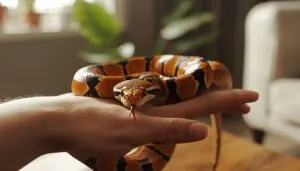
Handling is where trust gets built, and it’s also where most mistakes happen. A corn snake that feels secure outside its enclosure will explore confidently, while one that feels unsafe will show it fast. Here are five guidelines to keep your out-of-enclosure time safe, low-stress, and rewarding for both of you.
Start With Short Sessions
Trust isn’t built in a day, and neither is handling tolerance. Keep initial sessions under five minutes, ending before fatigue or stress appears. This limits cortisol spikes and keeps the experience positive. Return your corn snake to a warm, secure hide afterward so it can recover.
Consistent short sessions are the foundation of building trust and human-snake bonding, gradually improving tolerance for enrichment.
Support The Entire Body
Supporting the entire body transforms handling from a threat into comfort. A dangling snake feels insecure, so distribute its weight evenly across both hands. Place one hand under the thorax and the other near the vent, keeping the body close to your forearm. This prevents sudden wriggles and protects the spine.
Follow four contact points:
- Neck support to guide head direction
- Midsection for even belly pressure
- Tail to prevent overextension
- Forearm contact to stabilize movement
Proper handling builds trust and reinforces your snake’s sense of security.
Use Escape-Proof Exploration Areas
A corn snake can wedge through any gap wider than its eye.
Because escapes are so easy, a secure lid and tight-fitting vents matter, and this corn snake enclosure setup guide walks through the details.
Escape-proof exploration areas make supervised out-of-enclosure exploration safe. Use solid, monolithic barriers with sealed seams, tamper-resistant latches, and smooth rounded corners. Keep climbing structures anchored with three-point contact, and offer hide boxes plus substrate options for security. Check every session for loose decor.
Let The Snake Set Pace
Your corn snake isn’t racing anyone. A five-minute session that the snake leads beats an hour you control.
When handling your corn snake, a short session it leads is worth more than a long one you control
Watch the cues. Slow tongue flicks, relaxed coiling, and brief pauses mean assessment, not boredom. Yawning or retreating to hide boxes signals unease, so end calmly.
Pace-setting looks like this:
- Waiting for the snake to initiate exploration
- Matching sessions to natural rhythms, like evening activity
- Keeping the temperature gradient stable so movement stays voluntary
- Adjusting to seasonal shifts in activity
You set the stage. The snake sets the clock.
Stop When Stress Signals Appear
Knowing when to quit is a skill. A hiss, tail vibration, or S-shaped neck means the session ends now—calmly, not abruptly.
| Signal | Your response |
|---|---|
| Musking or defecating | Return gently, leave undisturbed |
| Rapid escape attempts | Stop restraining, guide home |
| Flattened body, rigid stillness | Place in enclosure, offer hides |
| Closed-mouth bluff strike | End session, reassess handling frequency |
Observation and adjustment over time turns stress signals into husbandry data. Respect them.
How to Keep Corn Snake Enrichment Safe
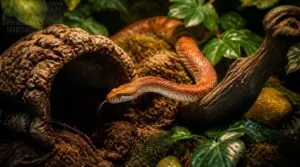
Enrichment should challenge your corn snake, never endanger it. The difference between a stimulating setup and a hazardous one often comes down to material choices and placement details that are easy to overlook. Before you add anything new to the enclosure, run through these five safety checks.
Choose Non-Toxic, Easy-Clean Materials
Because a corn snake explores everything with its tongue and body, every object you add becomes something it touches constantly. Choose reptile-safe materials that won’t off-gas, leach, or harbor bacteria. Four reliable options:
- Bamboo and cork bark
- Glass and ceramic decor
- Stainless steel hardware
- Untreated, sealed concrete
Easy-clean materials simplify disinfection. Scrub with mild soap, rinse fully, dry completely. Substrate safety starts here.
Secure Branches, Rocks, and Decor
A wobbly branch is a broken rib waiting to happen. Anchor climbing structures with corrosion-resistant fasteners rated for outdoor moisture, spaced to hold two to three times your snake’s weight. Drill live branches for bolts or stainless cable ties, then clean and dry them first.
Set rocks on compacted, non-slip substrate, blunt their edges, and stabilize irregular bottoms with hidden braces. Check every mounting point monthly.
Avoid Aromatic Woods and Oils
Cedar, pine, and eucalyptus release volatile oils that inflame a corn snake’s airways. Skip aromatic woods and essential-oil cleaners entirely. When introducing safe nontoxic objects, rely on these rules:
- Choose aspen, cypress, or plain plastics
- Rinse décor with hot water only
- Store oils far from the enclosure
- Verify reptile-safe materials labels
For scent enrichment with natural materials, plain cork and ceramic work best.
Inspect Enrichment for Hidden Hazards
Hidden hazards hide in plain sight. Inspect enrichment for hidden hazards before every introduction: check for loose screws and splinters, sharp edges, and small parts that could detach and cause entanglement. Wobble-test branches and ledges. Verify coatings are nontoxic and colors won’t fade into sightlines.
Whether you’re introducing safe nontoxic objects or planning supervised outofenclosure exploration, choose reptilesafe materials and rely on observation and adjustment over time.
Track Responses and Adjust Gradually
Watch how your corn snake answers every change you make. Tracking responses turns guesswork into husbandry skill. Log date, time, activity, and conditions; tag each entry with the adjustment tested. Behavioral observation reveals what works.
- Note hiding spikes after new decor
- Watch for confident climbing and burrowing
- Confirm stable feeding responses
Allow 3 to 7 days for acclimation, then adjust gradually. Enrichment rotation succeeds through observation and adjustment over time.
Frequently Asked Questions (FAQs)
What is good enrichment for a corn snake?
Good enrichment for a corn snake means climbing structures, deep burrowable substrate, hide boxes at both temperature ends, scent trails, puzzle feeders, and rotated decor that sparks natural foraging without stress.
What are some good enrichment toys for corn snakes?
What are some good enrichment toys for corn snakes? Climbing structures like cork bark and driftwood, hide boxes, deep burrowable substrate, puzzle feeders, and scent trails all work. Try rotating decor monthly to keep exploration fresh.
What makes a corn snake happy?
What makes a corn snake happy? A secure thermal gradient, deep burrowable substrate, multiple hides, and consistent environmental enrichment that encourages natural behaviors like climbing, cruising, and scent-trailing during dawn and dusk activity peaks.
How to know if a corn snake is happy?
How to know if a corn snake is happy? Look for calm cruising at dusk, relaxed coils, steady tongue flicks, enthusiastic feeding, and quick recovery after handling. Consistent behavioral observation reveals contentment better than any single moment.
What is the best enrichment for corn snakes?
The best corn snake enrichment combines climbing structures, deep burrowable substrate, scent trails, and rotating decor—stimulation that sparks natural prowling, digging, and hunting instincts, keeping your snake mentally engaged and active.
What are the enrichment ideas for snakes?
Irony first: the "boring" pet is often the one you’re enriching wrong. Snake enrichment ideas include climbing structures, puzzle feeders, scent trails, rotating decor, and supervised handling that sparks natural hunting instincts.
How to make your corn snake happy?
How do you make your corn snake happy? Start with habitat basics—temperature gradients, secure hides, deep substrate—then add corn snake enrichment ideas that encourage natural behaviors and reduce stress.
How to make corn snakes more active?
How to make corn snakes more active? Many owners mistake rest for laziness—healthy thermoregulation requires effort.
Feed during evening hours, rotate climbing branches and vines weekly, maintain temperature gradients of 80–85°F, and use scent trails to spark natural roaming.
What enrichment activities are suitable for corn snakes?
Suitable corn snake enrichment includes climbing branches, hide boxes, scent trails, puzzle feeders, rotating decor, deep burrowable substrate, and supervised out-of-enclosure exploration during evening activity hours.
How do you enrich a corn snake?
You enrich a corn snake through habitat diversity—secure climbing branches, rotated hides, varied substrate options, and scent trails that encourage natural foraging. These enrichment techniques promote engagement, exploration, and overall behavioral health.
Conclusion
Here’s the paradox: the less you interfere, the more your corn snake reveals. Mastering corn snake behavior and enrichment ideas means stepping back, observing, and letting natural instincts do the work.
Your snake doesn’t need constant attention. It needs a thoughtfully built world, then space to use it.
Watch closely. Adjust slowly. One night you’ll catch that confident, glass-patrolling explorer and realize you built exactly that.