This site is supported by our readers. We may earn a commission, at no cost to you, if you purchase through links.
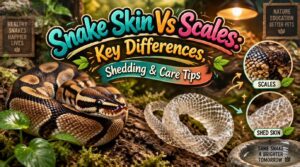
Run your thumb along a snake’s back and you’re touching skin, not armor. Those scales aren’t plates glued on. They’re folds of the epidermis, hardened keratin stitched to the flexible tissue between them.
The snake skin vs scales difference comes down to this: scales are the visible, rigid surface, while skin is the whole living organ. Damage one and you’ll see trouble in the other, from stuck sheds to dull, rough patches.
Learn how each part is built, how texture changes movement, and how to keep both healthy through every shed.
Table Of Contents
- Key Takeaways
- Snake Skin Vs Scales: What’s The Difference?
- How Snake Skin and Scales Are Built
- Snake Scale Textures and Their Functions Compared
- How Shedding Renews Snake Skin and Scales
- Caring for Your Snake’s Skin and Scales
- Top 1 Snake Skin Care Product
- Frequently Asked Questions (FAQs)
- Is snake skin called scales?
- How can you tell if a snake is poisonous by its scales?
- What’s the difference between scales and skin?
- How to tell a snake from snake skin?
- Do snakes have scales on their eyes?
- How many scales does an average snake have?
- Can damaged snake scales grow back?
- Why do some snakes have colorful scale patterns?
- Are snake scales waterproof or water-resistant?
- Conclusion
Key Takeaways
- You’re not dealing with two separate things: scales are the visible, hardened surface of your snake’s skin, so a problem in one usually shows up in the other.
- Each scale is a fold of epidermis made of keratin, which is why your snake sheds in one intact sheet and why its scale count is fixed at hatching.
- Smooth scales help your snake slip through tight spaces, while keeled scales have a raised ridge that cuts glare and drag but traps debris, so you’ll need to spot-clean more often.
- You’ll keep skin and scales healthy by matching humidity to the species (50-60% for ball pythons, 30-40% for corn snakes) and offering a damp sphagnum hide during sheds to prevent retained eye caps and tail constriction.
Snake Skin Vs Scales: What’s The Difference?
The biggest mistake keepers make is treating snake skin and snake scales as two separate things. They aren’t. Snake scales are simply the visible, hardened surface of the epidermis, and the skin is the whole living organ that carries them.
Because healthy scales reflect hydration and infection risk, it helps to know the temperate forest snake hibernation sites where wild snakes safely overwinter without damaging their skin.
Snake scales aren’t separate from the skin; they’re simply its visible, hardened surface, and the skin is the whole living organ carrying them
Here’s the split. Skin is the covering, including flexible tissue between scales that lets your snake stretch around a meal. Scales are the tough plates you see and feel when you run a finger along its back. They protect against abrasion and water loss, and their shape shifts depending on where they sit.
Why does it matter? Scale structure and skin health are linked, and shedding affects the whole covering. A problem in one usually shows up in the other.
How Snake Skin and Scales Are Built

Once you see skin as a single organ, the build makes sense. Every scale is a fold of epidermis, not a plate glued on top. That’s why your snake sheds in one coherent sheet.
Scale structure rests on two keratin families, and their balance sets stiffness on the surface and flexibility at the hinge. The scale overlap mechanism tucks each hinge under the next scale, so the covering bends without gaping.
Check these four features:
- Scale microstructure: keratin layers give the outer surface its stiffness.
- Scale morphology: wide ventral scales grip the ground, while head scales form plates.
- Scale arrangement patterns: dorsal rows run odd in number, widest at midbody.
- Scale count: fixed at hatching, so scales only grow larger.
Snake Scale Textures and Their Functions Compared

Run your thumb along a snake’s flank and you’re reading its scale texture. That surface decides how your snake grips, glides, and moves through its world. Below, we compare the two types you’ll meet most, smooth and keeled, so you can see what each one does best.
If you’re weighing how each texture affects handling and care, this guide to smooth vs keeled snake scales shows which species fall into each group.
Smooth Scales
feel like polished river stone beneath your fingertips.
Without a keel, each scale lies flat, and that scale texture lets a snake slip through burrows and tight crevices.
Check the scale rows on a king snake and you’ll see the friction signature: slick overall, yet grippy enough underneath to prevent backward slide.
Scale shedding keeps that shine intact.
If dull patches linger after a shed, check your enclosure’s moisture levels, since low humidity is a common cause of incomplete sheds.
Keeled Scales
Run your thumb down a rattlesnake’s back and you’ll feel the difference at once. Keeled scales carry a raised ridge along the center, so the surface reads rough, almost like fine sandpaper.
That ridge isn’t decoration. It cuts glare, breaks up reflected light, and helps a water snake shed drag.
Scale shedding keeps each keel intact. Study your snake’s dorsal rows closely.
A reptile magnifying glass for scale inspection makes it easy to spot tiny keel damage or stuck shed along each dorsal row.
How Shedding Renews Snake Skin and Scales

When you watch a snake shed, you’re watching ecdysis, and it’s far more than a surface peel. A fresh epidermal layer forms beneath the old one across the entire body, then lymphatic fluid seeps between them to loosen the old keratin sheet.
That’s scale renewal in action, and it follows a predictable skin shedding cycle. Here’s what you’ll notice:
- Dull skin and a blue, milky look as the spectacles cloud over.
- A reclusive, food-shy snake that hides and skips meals.
- A clear, intact sheet peeled off nose to tail.
Shedding isn’t cosmetic. Juveniles do it up to a dozen times yearly because they grow fast, while adults slow down. It costs energy, and your snake is vulnerable throughout. Respect it.
Caring for Your Snake’s Skin and Scales

You protect scales best by controlling habitat humidity. Ball pythons thrive at 50-60%, corn snakes at 30-40%, and both need those numbers to complete clean shedding cycles.
Offer a humid hide packed with damp sphagnum moss during shedding. It prevents retained eye caps and tail constriction, the two failures you’ll regret missing.
Choose cypress mulch or coconut fiber. They hold moisture steadily and support skin regeneration without breeding mold. Mist lightly only if your hygrometer reads low, and never soak the whole substrate.
| Check | Target |
|---|---|
| Ball python humidity | 50-60% |
| Corn snake humidity | 30-40% |
| Shed hide | Damp sphagnum |
Inspect scale texture too. Keeled scales trap debris, so spot-clean often. Healthy biomechanical adaptation depends on intact skin, and intact skin never lies.
Top 1 Snake Skin Care Product

Think of a good skin care spray as a first-aid kit you can actually trust, because when a bite, burn, or stuck shed shows up, you need a gentle flush that cleans the wound without a single harsh ingredient. That’s what Vetericyn Plus Reptile Wound and Skin Care delivers. Its hypochlorous acid formula flushes debris without steroids, antibiotics, alcohol, or bleach.
Reach for it when you see:
- Bite wounds from a feeder that fought back
- Lamp burns that distort scale texture
- Waxy shedding film clinging after dull, stuck sheds
- Abnormal shedding cycles tied to poor body hydration
Spray the area, let it sit, then wipe gently. You’re cleaning, not scrubbing. Skin that’s been stripped by harsh chemicals heals slower, and your snake pays for it.
Don’t treat the spray as a cure-all, though. Recurring problems usually trace back to husbandry, humidity, or nutritional status. Use it to support healing, then fix the cause. Keep one ready before trouble starts.
Frequently Asked Questions (FAQs)
Is snake skin called scales?
Not quite. Snake skin is the whole covering, and scales are its visible, overlapping surface. They’re part of the skin, formed from the epidermis, and made of keratin. Shedding, or ecdysis, replaces them together.
How can you tell if a snake is poisonous by its scales?
You can’t. Scale pattern alone won’t reveal venom delivery, because smooth and keeled scales appear on both harmless and dangerous species. Skip the guesswork: species identification matters. If you’re unsure, keep your distance.
What’s the difference between scales and skin?
You’re looking at one structure, not two. Skin is the whole covering, and scales are its exposed surface, made of keratin. Beneath them, living epidermis, nerves, and blood vessels do the work.
How to tell a snake from snake skin?
Check the eyes first. A live snake has clear, responsive eyes and flicks its tongue, while shed skin is dry, papery and limp. Look at the dorsal scales and ventral scales: real ones feel moist and three-dimensional.
Do snakes have scales on their eyes?
Ever wonder why a snake never blinks? Yes, each eye wears a spectacle scale, a clear, fixed disc of keratin in the epidermis.
It’s shed during ecdysis cycles, turning cloudy first.
How many scales does an average snake have?
Think of your snake as a suit of armor stitched from keratinized epidermis. Most carry roughly 200 ventral scales and 15 to 19 dorsal scale rows at mid-body.
Your scale count is fixed at hatching.
Can damaged snake scales grow back?
It depends on how deep the damage goes. Surface scrapes heal as new epidermis forms, and later shedding often restores a clean look. If scale formation tissue is destroyed, you’ll see permanent scarring or a missing scale.
Why do some snakes have colorful scale patterns?
Color on a snake is never decoration. Pigment cells set the base hue, while microscopic scale structures add iridescence. Then evolution assigns the job: camouflage patterns hide ambushers, and bold warning colors tell predators to back off.
Are snake scales waterproof or water-resistant?
A rattlesnake can sit in the desert sun for hours without drying out. That’s water-resistant, not waterproof. The scales’ keratin and lipids slow water loss and shed droplets, but they never seal you off completely.
Conclusion
Think of skin as the house and scales as the shingles. One keeps everything inside alive, the other shields it from the weather. Once you grasp the snake skin vs scales difference, every shed, texture, and rough patch starts making sense.
Watch for clean, complete sheds, steady humidity, and scales that lie flat and glossy. Those are your proof the whole system is working.
Tend the living organ, and the armor takes care of itself.