This site is supported by our readers. We may earn a commission, at no cost to you, if you purchase through links.

Is your ball python soaking in the water bowl again, or hiding when it should be out exploring? Your snake isn’t being dramatic. It might be cooking.
Heat lamps are tricky. A bulb that feels cozy to you can turn a basking spot into a frying pan, leaving pink scales, belly blisters, and patchy sheds behind. Let’s be honest, guessing by feel just doesn’t cut it, since a ball python’s air temperature above 95°F spells trouble.
Knowing how to tell if a heat lamp is too hot protects your snake and your home. Here’s how to spot the warning signs, read the numbers, and fix the problem safely.
Table Of Contents
- Key Takeaways
- Signs Your Snake’s Heat Lamp is Too Hot
- Measure Heat Lamp Temperatures Accurately
- Compare Temperatures With Your Snake’s Species Requirements
- Fix an Overheating Heat Lamp Safely
- Prevent Heat Lamp Burns and Fire Hazards
- 4 Heat Lamps and Fixtures to Assess
- Frequently Asked Questions (FAQs)
- Conclusion
Key Takeaways
- Watch for the warning signs of overheating, like soaking in the water bowl, hiding, refusing meals, open-mouth breathing, or pink, blistered belly scales, because your snake can’t tell you it’s too hot.
- Trust real tools over your hand by measuring the basking surface with an infrared thermometer and the warm and cool air with probes, then checking your thermostat against a separate thermometer several times a day.
- Compare your readings to your species’ targets, such as 88-92°F on the basking surface for ball pythons, and treat air above 95°F as a sign of heat stress.
- Fix overheating by switching the lamp off, lowering the output with a dimming thermostat or lower wattage bulb, changing one setting at a time, and always using a wire guard and thermostat to prevent burns and fires.
Signs Your Snake’s Heat Lamp is Too Hot
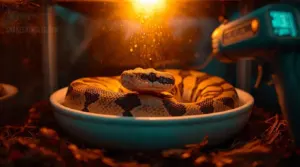
A snake that’s too hot won’t send you a memo, so you have to read the clues. Is your ball python parked in the water bowl all day? Hiding when it should be roaming? Turning down meals for no clear reason? Those are your first flags.
If any of that sounds familiar, check how to tell if your snake’s habitat is too hot to confirm whether heat is the cause.
Watch the body too. Open-mouth breathing without any wheezing or bubbles often means the snake is trying to dump heat. Lethargy, twitching, stargazing, or wobbly coordination are serious, so act fast.
Then check the belly. Pink or red scales, blisters, or sores show where your snake met a hot surface. Retained eyecaps and patchy sheds point to dehydration.
Let’s be honest, your hand is a decent early warning. If the substrate feels uncomfortable after two seconds, it’s too hot for a snake lying on it.
Measure Heat Lamp Temperatures Accurately
Is your thermometer telling you the truth, or just what you’d like to hear? Guessing is how snakes end up cooked or chilled, so we’ll check three spots with real tools. Here’s what to measure, in order, to get accurate readings you can trust.
Check Basking Surface Temperatures
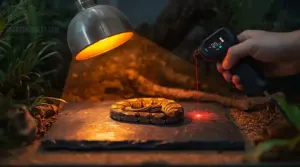
Grab an infrared thermometer and check the spot your snake actually lies on. Run the lamp for three hours first, so the surface has time to heat up fully.
Aim straight at the basking platform, not the air or the enclosure walls. Bearded dragon keepers follow the same rule, since basking surface temperature reflects the heat an animal actually feels through contact, while air readings can be misleading. Then scan several spots across it. Your snake’s whole body needs a safe place to rest, so check the full coverage area.
Measure Warm-Side and Cool-Side Air
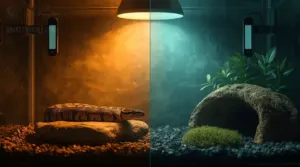
Surface readings only tell half the story. What about the air your snake breathes?
Set a digital thermometer probe at mid-height on the warm side and another on the cool side. Keep both away from the lamp’s glare, or you’ll measure radiant heat, not true ambient air temperature.
Check a few times through the day. Room temperature shifts, and so does your enclosure.
Verify Thermostat Readings Throughout The Day
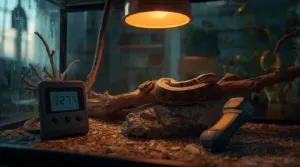
Is your thermostat telling the truth? Let’s be honest, it only knows what its probe feels. Check it four times daily:
Placing one probe at the warm end and another at the cool end gives you an honest picture, and this thermostat setup guide for a boa constrictor tank shows exactly where to put them.
- Morning, once the lamp has warmed up.
- Midday, when the room heats.
- Evening, before lights-out.
- Night, after everything settles.
Compare each reading with a separate digital thermometer. Gaps beyond three degrees mean trouble, so recalibrate it or replace it.
Compare Temperatures With Your Snake’s Species Requirements
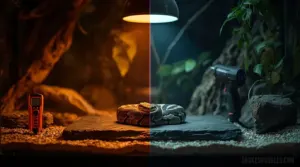
Ask yourself this: does your reading match what your snake actually needs? A number means nothing until you hold it up against the right yardstick.
Ball pythons want a basking spot surface temp of 88-92°F, with the warm side at 78-82°F and the cool side at 70-75°F. Corn snakes like a surface temp near 90°F and a cool zone around 75°F. Kingsnakes and milk snakes prefer 85-90°F at the basking spot. Write those ranges down first.
Let’s be honest: a few degrees over isn’t a disaster, but air above 95°F for ball pythons spells heat stress. Treat your species’ range as your target holding temp, and if your thermostat regulation keeps drifting past it, your ambient environment is running hot.
Fix an Overheating Heat Lamp Safely
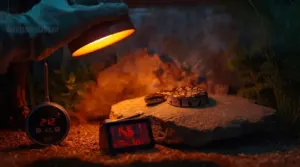
Switch off the lamp the moment a reading looks too high, and let the enclosure cool. Adjusting a hot setup is like rearranging a pan on a lit stove, so don’t.
Once things cool, what’s the gentlest fix? Lower the output. A compatible dimming thermostat gives you smooth temperature control, while a lower wattage bulb trims heat at the source. Raise the lamp if you can, since proximity changes surface heat. Skip improvised coverings and never block ventilation.
Change one setting at a time. Then remeasure the basking surface and the air before you run things normally again. Still too hot? Check the thermostat probe placement, and suspect a failed relay if the lamp stays on past the set point.
Prevent Heat Lamp Burns and Fire Hazards
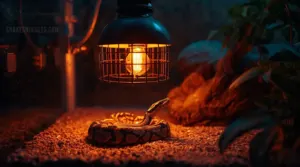
Imagine this: a ball python noses up against an unguarded bulb overnight and wakes up with a scorched belly. It happens faster than you’d think, and let’s be honest, it’s always preventable.
Treat that lamp like a campfire you can’t supervise. Here’s your checklist:
- Put a wire guard around every bulb so curious noses never touch hot glass.
- Clamp fixtures firmly, because a falling lamp is a nightmare.
- Keep paper, wood, and fabric at a safe minimum clearance.
- Plug everything into a thermostat for reliable temperature control.
- Check cords and plugs often for melting or fraying.
Skip these steps, and surface burn potential and fire hazard thresholds sneak up on you. Burn prevention takes five minutes. Regret takes much longer.
A few minutes of safety work now beats a lifetime of guilt over a preventable burn or blaze
4 Heat Lamps and Fixtures to Assess
Wondering which lamps and fixtures deserve a spot on your radar? Here are four setups worth checking against the heat signs and temperature numbers we just covered. Think of each one as a suspect to assess, so grab your thermometer and read on.
1. SUNMORY LED Floor Lamp with Remote
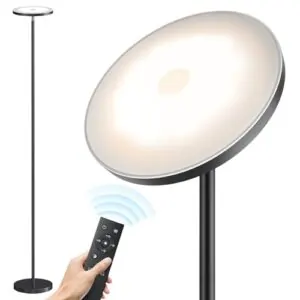
Wondering if a floor lamp belongs in a snake article? Here’s the twist: it’s a handy tool for the room, not the enclosure.
This LED model is a safe lighting option for the space around your setup. At 32W with 3000 lumens, it brightens the room without blasting heat. Dim it from 5% to 100%, swap color temperature from 3000K to 6000K, and use the 50-foot remote.
It’s mostly plastic, though, so keep it well away from any basking lamp. Assembly takes 5 to 10 minutes.
| Best For | Snake keepers and other home users who want a dimmable, adjustable floor lamp to light the room around a setup, or a living room, bedroom, office, or nursery. |
|---|---|
| Power | 32W |
| Dimensions | 9.8″D x 9.8″W x 69″H |
| Weight | 8.9 pounds |
| Light Type | Adjustable LED, 3000K-6000K |
| Best For | Home and office lighting |
| Durability Concerns | Primarily plastic construction |
| Additional Features |
|
- Dims smoothly from 5% to 100%, with color temperature adjustable from 3000K to 6000K.
- The remote works from up to 50 feet away and remembers your settings.
- The lamp head rotates 350° horizontally and 180° longitudinally, and the 32W, 3000-lumen output is energy efficient.
- It’s built mostly from plastic, so it should be kept well away from any basking lamp.
- It needs 5 to 10 minutes of assembly.
- The weighted base adds stability but may make it harder to move around.
2. Hoakya 275W Infrared Heat Lamp
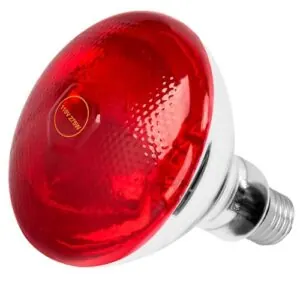
Ever wonder what happens when you point a tiny sun at a snake tank? This bulb answers that question loudly. It’s a 275W, 110V infrared bulb built for saunas, salon stands and therapy lamps, not reptile care, so let’s be honest: it’s a risky pick.
At 6 inches, it hits roughly 1431 mW/cm². That’s intense. Because heat fades with distance squared, a small height change means a big temperature swing.
Use it only in a large enclosure, with a ceramic socket and a probe-driven thermostat.
| Best For | Sauna owners, salons, and infrared therapy setups that need a 275W, 110V replacement bulb for radiant warmth on benches, treatment tables, or heat lamp stands. |
|---|---|
| Power | 275W |
| Dimensions | 6.8 x 5.1 x 5.1 inches |
| Weight | 8.47 ounces |
| Light Type | Deep red and near infrared |
| Best For | Saunas and therapy lamps |
| Durability Concerns | Mixed quality and durability |
| Additional Features |
|
- Delivers 275W of infrared radiant heat for saunas and therapy lamps
- Emits deep red visible light and near infrared radiation
- Fits standard base 110V systems, making it an easy replacement bulb
- Built for saunas and therapy lamps, not reptile care, so it is a risky pick for snake tanks
- Intense output (roughly 1431 mW/cm² at 6 inches) means small height changes cause big temperature swings, so it needs a large enclosure, a ceramic socket, and a probe-driven thermostat
- Some users report it gives off mostly heat rather than detectable infrared light, with mixed feedback on quality and durability
3. Woods Aluminum Reflector Clamp Lamp
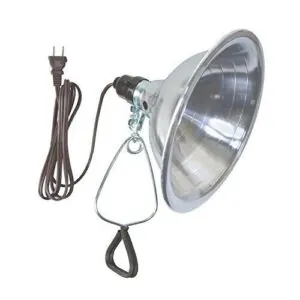
Ever wished a lamp could just clamp on and get to work? This one does, and it’s about as simple as heat lighting gets.
The 8.5-inch aluminum reflector focuses light where you aim it, and the double ball joint makes aiming easy. It takes up to a 150-watt E26 bulb, so match your wattage to your enclosure and keep a thermostat in the loop. The 6-foot cord helps with placement.
Let’s be honest about the clamp, though. Reviewers report it slipping and breaking, so test the grip before every use.
| Best For | Indoor gardeners, artists, and photographers who want a simple, budget-friendly clamp lamp for focused light and warmth in a home, office, or studio, and who don’t mind checking the clamp’s grip before each use. |
|---|---|
| Power | Up to 150W |
| Dimensions | 8.75″ L x 8.75″ W x 12″ H |
| Weight | 9.6 ounces |
| Light Type | Standard bulb light (up to 150W) |
| Best For | Indoor gardens and studios |
| Durability Concerns | Mixed clamp and durability |
| Additional Features |
|
- The 8.5-inch adjustable aluminum reflector and double ball universal joint let you aim light exactly where you need it.
- It accepts up to a 150-watt E26 bulb, giving you flexibility to match light and warmth to your setup.
- The 6-foot cord and push button switch make placement and operation easy.
- Clamp strength and stability get mixed feedback from users.
- Some users report the lamp keeps falling off its fixture.
- Durability is inconsistent, with reports of the lamp breaking after about a month.
4. Flukers 75W Basking Spotlight Bulb
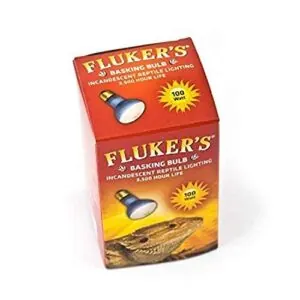
So the clamp holds. Now, what goes inside it?
This bulb is a simple 75-watt incandescent spotlight, about 5.5 inches tall and just 1.6 ounces. It aims heat and infrared light at one basking spot, which helps with appetite and digestion.
Hang it outside the enclosure, never inside.
Here’s the catch. Reviewers report burnout within three months, and feedback on value is mixed. Keep a spare on hand, and let’s be honest, a thermometer too.
| Best For | Reptile owners with lizards, snakes, turtles, or leopard geckos who need a simple, low-cost spotlight to create a warm basking spot and don’t mind keeping a spare bulb on hand. |
|---|---|
| Power | 75W |
| Dimensions | 2.5 x 2.5 x 5.5 inches |
| Weight | 1.6 ounces |
| Light Type | Incandescent and infrared |
| Best For | Reptile basking areas |
| Durability Concerns | Burnout within three months |
| Additional Features |
|
- Aims heat and infrared light at one basking area
- Supports appetite, digestion, and core body temperature regulation
- Small, lightweight, and suitable for many reptile species
- Multiple reports of burnout within three months
- Mixed feedback on reliability and value for money
- Some customers say it stops working prematurely
Frequently Asked Questions (FAQs)
Is it okay to leave a heat lamp on all night?
Usually, no, not with a regular bright bulb. Light all night scrambles your snake’s sleep and stresses it out. Switch to a ceramic heat emitter on a thermostat instead, since it gives heat without light.
Are ceramic heat emitters safer than heat lamps?
Mostly, yes, but only with the right setup. A ceramic heat emitter gives off no light, so your snake keeps its day and night rhythm. It still gets hot, so use a thermostat and a guard.
Whats the ideal wattage for a 40-gallon tank?
Think of wattage like a stove burner: too high scorches, too low never warms. For a 40-gallon, start with 50-75 watts, then adjust by bulb proximity until the basking spot hits your exact target temp.
How often should I replace my reptiles heat bulb?
Think of a heat bulb like a pair of running shoes. They look fine long after they’ve stopped doing their job. Most last 6 to 12 months, so mark the install date on the base and check your bulb lifespan against it.
Do snakes need UVB lighting alongside heat lamps?
Think of heat as the sunshine and UVB as the vitamin pill. Snakes can survive on whole prey alone, so UVB isn’t strictly required. Still, it’s smart best practice for your snake’s health.
Should I turn off heat lamps during summer months?
Is it true that summer means lamps off? Not quite. Most snakes still need warmth, so check temperatures first. If your room runs hot, switch the lamp off by day, or at least at night, but keep a backup heat source handy.
Conclusion
Ready to stop guessing and start protecting your snake?
Knowing how to tell if heat lamp is too hot comes down to two habits: watching your snake and trusting a thermometer over your hand.
Your hand is a terrible judge, and scales don’t lie. Keep the basking spot in range, the air below 95°F, and a thermostat on every lamp.
Get it right, and your python can ditch the water bowl and be a snake.