This site is supported by our readers. We may earn a commission, at no cost to you, if you purchase through links.

A retic that outgrows its cage doesn’t stop growing—it just starts testing the glass. Every hinge, every seam, every silicone bead becomes a stress point under 200 pounds of muscle. That’s the reality breeder-grade enclosures are built for, and it’s why "big enough for now" fails snake owners fast.
Building snake terrariums takes more than stacking a tub with substrate and calling it done. Dimensions, ventilation, thermal gradients—each decision either works with your snake’s biology or fights against it.
Get the framework right from the start, and maintenance becomes routine instead of crisis management.
Table Of Contents
- Key Takeaways
- How to Choose The Right Snake Terrarium Size
- Step-by-Step Terrarium Construction Guide
- Setting Up Heating and Humidity Zones
- Selecting Substrate, Hides, and Enclosure Decor
- Ongoing Terrarium Maintenance and Cleaning
- Frequently Asked Questions (FAQs)
- How often should I replace UV bulbs?
- Whats the best terrarium location in my home?
- Can I use live plants safely?
- How do I prevent mold growth?
- What backup heating options work during power outages?
- How much does a DIY snake terrarium typically cost?
- Can I house two snakes in one terrarium?
- How long does it take to build a terrarium?
- What tools do I need before starting construction?
- How often should I upgrade my snakes enclosure?
- Conclusion
Key Takeaways
- Size enclosures for adult growth from the start, using species-specific minimums like 48"×24"×24" for ball pythons and up to 240"×96"×48" for reticulated pythons, since undersized cages cause stress and health problems.
- Build with non-toxic, moisture-resistant materials like PVC, HDPE, glass, or melamine, and seal all joints with aquarium-grade silicone cured 24-48 hours before use.
- Maintain a stable basking-to-cool thermal gradient (85-95°F to 75-80°F) and species-appropriate humidity (40-80% depending on type) using calibrated thermometers, hygrometers, and thermostats.
- Combine daily spot-cleaning with monthly deep disinfection and regular ventilation checks to prevent mold, escape gaps, and health issues before they escalate.
How to Choose The Right Snake Terrarium Size
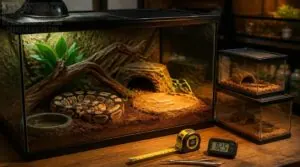
Size mistakes cause more snake health problems than almost anything else you’ll deal with as a keeper. Get the dimensions wrong, and you’re fighting stress, poor thermal cycling, and stunted growth for years. Here’s what you need to know before picking a home for your snake.
Before you buy a tank, it’s worth reading up on the most common snake husbandry mistakes, since enclosure size is just one piece of a much bigger puzzle.
Glass Vs. Wood Vs. Melamine Enclosures
The material you pick shapes your whole custom snake habitat build. Glass gives clear visibility and scratch resistance but limits insulation. Wood looks warm and natural, though it needs sealing against rot. Melamine balances affordability with moisture resistance.
- Glass: durable, visible, poor insulator
- Wood: aesthetic, insulating, rot-prone
- Melamine: budget-friendly, low-maintenance
Regardless of the material, make sure you provide small hiding places to help your snake feel secure.
Choose based on long-term maintenance tolerance, not just tank size or upfront cost.
Minimum Dimensions by Snake Species
Whatever material you choose, size comes first. Ball pythons and corn snakes need a minimum 48"×24"×24" footprint, while boas require 72"×30"×30". Reticulated pythons demand up to 240"×96"×48". King snakes get by with 40"×20"×20", but always plan for adult growth, not the hatchling in front of you. Match tank size to species requirements, not guesswork.
Custom-Built Vs. Pre-Made Cages
Once you know the tank size your snake needs, the next call is who builds it. Pre-made cages save time, using standard profiles and factory doors for quick setup, but fixed sizing wastes space.
Custom-built enclosures cost more upfront yet let you match dimensions exactly, add security features, and swap worn parts later, a real win for long-term durability and DIY snake enclosure projects.
Vertical Space for Arboreal Snakes
Height matters more than floor space for arboreal species. Green tree pythons need 3 to 4 feet of vertical clearance, while emerald tree boas want 4 to 6 feet.
Build in perch density using branches 1 to 4 inches thick, spaced 6 to 12 inches apart. Anchor them securely, then bridge gaps with sub-perches so climbing paths stay continuous and stress-free.
Planning for Adult Snake Growth
Why build small when your snake won’t stay that way? Base sizing on girth-to-length ratios—2.5 to 4 times girth—not today’s measurements.
- Skipped growth planning means costly upgrades later
- Cramped adults show more stress, less appetite
- Relocation stress hits hard during upgrades
- A future-proofed enclosure means one build, one home
Plan a 4×2 foot footprint minimum, reassess at adulthood, and avoid the enclosure upgrade timeline altogether.
Step-by-Step Terrarium Construction Guide
You’ve settled on a size, so now it’s time to build. Every decision here, from framing to sealant, affects your snake’s safety and your own peace of mind. Here’s how to put it all together, step by step.
Choosing Safe, Non-Toxic Materials
Every material touching your terrarium eventually meets warm, humid air, and that’s when hidden toxins offgas fastest. Skip zinc-plated hardware and solvent-based finishes; both spike VOC emission risks.
Since sustained dampness accelerates offgassing, pairing safe materials with a solid grasp of ideal temperature and humidity ranges for ball pythons helps you avoid trapping moisture against toxic surfaces.
Choose glass, stainless steel, or ceramic tile instead of treated wood, since these inert materials won’t leach chemicals.
Seal joints with aquarium-safe silicone, a proven aquatic sealant for reliable waterproofing without off-gassing danger.
Framing With PVC, HDPE, or Hardwood
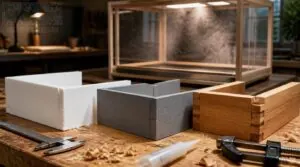
Pick your frame material like you’d pick tires: it decides how the whole build experiences moisture. PVC resists rot in humid setups; HDPE won’t swell or warp. Hardwood needs kiln-drying and tight mortise-and-tenon joinery for strength.
- PVC — lightweight, easy silicone bond
- HDPE — insect-resistant, no painting needed
- Hardwood — natural aesthetic, load-bearing strength
- Modular panels — quick disassembly
- Non-toxic sealants — contamination-free interiors
Sealing Joints With Aquarium-Grade Silicone

Every seam in your build is a potential leak or escape point, so aquarium-grade silicone is non-negotiable.
Prep surfaces first: wipe glass or acrylic free of dust and oils for maximum bond strength.
Apply beads along joints, then let cure 24-48 hours before handling.
Cured silicone resists thermal expansion and stays non-toxic, safe for reptiles once fully set.
Installing Secure Locks and Hinges
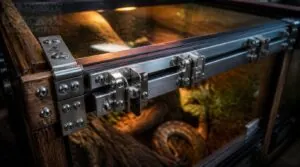
Snakes are escape artists, so hardware makes or breaks your DIY snake enclosure.
- Multi-point locking engages three-plus points for exterior-grade security
- Heavy-duty hinges rated 1000+ lbs resist kick-in and sagging
- Reinforced strike plates with 3-inch screws anchor into studs
- Tamper-resistant screws stop prying at the frame
Combine these for a truly escapeproof lid, then verify smooth latch engagement before housing your custom snake habitat.
Building Cross-Flow Ventilation Systems
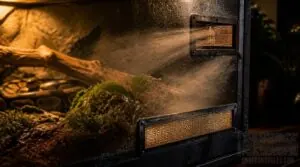
Good ventilation isn’t about drilling random holes—it’s engineering airflow. Place intake vents low on the front, exhaust vents high on the back, creating a true cross-flow ventilation path that avoids short-circuiting near the glass. This inlet-outlet spacing pulls fresh air across the entire enclosure, stabilizing your microclimate.
Skip mesh smaller than your snake’s head, and you’ll maintain environmental stability without sacrificing security.
Setting Up Heating and Humidity Zones
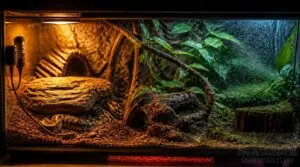
Your frame’s built and sealed, but a snake can’t survive on good carpentry alone. Temperature and humidity control turn that box into a living space your snake can actually thrive in. Here’s how to get every zone dialed in right.
Creating a Basking-to-Cool Gradient
Think of your terrarium as having two rooms: one for warming up, one for cooling off. Place the primary heat source at one end so warmth radiates diagonally, creating a natural basking-to-cool gradient. Verify gradient stability with three thermometers—basking surface, warm air, cool air. Position the thermostat probe right at the basking zone.
- Basking zone: 85–95°F
- Cool zone: 75–80°F
- Gradient span: 15–20°F
- Check readings daily, first week
Ceramic Heat Emitters Vs. Halogen Bulbs
Choosing a heat source shapes your snake’s whole thermal world. Ceramic heat emitters deliver infrared warmth without light—ideal for nighttime heating. Halogen bulbs add visible light, supporting daytime activity cues but raising burn risk if placed too close.
| Feature | Best Option |
|---|---|
| Nighttime use | Ceramic emitter |
| Energy efficiency | Ceramic emitter |
| Light cues | Halogen bulb |
| Burn risk | Halogen bulb |
| Lifespan | Ceramic emitter |
Placing Digital Thermometers and Hygrometers
Whichever bulb you pick, you still need accurate data to trust it. Mount digital thermometers and hygrometers mid-height, away from vents and direct heat, for true readings.
- Place one probe near the basking spot, one on the cool side
- Avoid sensor bias from drafts or splashback
- Calibrate monthly against a known reference
Set digital alert systems to flag swings beyond your target range, protecting microclimate control before problems start.
Matching Humidity Levels to Species
Every species has its own comfort zone, and getting it wrong invites shed problems fast. Ball pythons want 50-60% RH; arboreal species like green tree pythons need 70-80% for slippage-free climbing.
| Species Type | Humidity Range | Key Concern |
|---|---|---|
| Burrowing | 40-50% | Mold prevention |
| Terrestrial | 50-60% | Balanced hydration |
| Arboreal | 60-80% | Shedding success |
Bump humidity 10-15% during molts—dry skin won’t shed clean.
Preventing Overheating With Thermostats
A rogue heat lamp can cook a snake in hours, which is why your thermostat isn’t optional gear. Use multi-zone heat mapping with dedicated sensors per zone, placed away from vents and direct light.
A rogue heat lamp can cook a snake in hours, so a thermostat with multi-zone sensors isn’t optional—it’s essential
Look for:
- Automated overheat alerts
- Auto shut-off on runtime limits
- Humidity-ventilation coordination
Keep sensors calibrated—your basking spot’s accuracy depends on it entirely.
Selecting Substrate, Hides, and Enclosure Decor
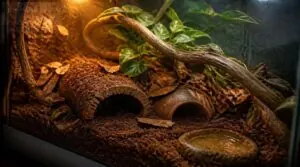
Once your heat and humidity are dialed in, it’s time to build out the floor and furniture of your snake’s world. Substrate, hides, branches, plants, and water placement all work together to shape a space your snake can actually thrive in. Here’s what to keep in mind for each piece.
Best Substrates for Humidity and Burrowing
Substrate is where humidity control meets burrow engineering. Coconut fiber blended with organic topsoil retains moisture while supporting tunnel walls. Cypress mulch packs firmly at 12–24 inches, holding 60–80% humidity with minimal misting. Layer a deep base with a crumb topsoil for stability.
Skip pine, cedar, or sharp inorganics—stick to pesticide-free, food-grade materials that won’t cause impaction or skin injury.
Adding Snug Hides in Both Zones
Skip the single hide compromise—your snake needs one in each thermal zone. Size doorways at 1.5–2.5 inches based on girth, using nonporous hide materials like sealed HDPE or epoxy-coated PVC for humidity resistance.
Hot-side hides run 88–92°F; cool-side stays 72–78°F. Consider dual chamber designs letting snakes shift zones without exposure. Add moisture-retentive substrate inside for stable microclimates that support species-specific needs.
Climbing Branches and Cork Bark Setup
A stable branch can make or break your snake’s confidence to climb. Secure cork bark and hardwood limbs with aquarium-safe silicone, letting joints cure fully before use. Vary height and angle for tiered footholds, always leaving exit gaps. Test every piece under pressure—wobbling risks falls. Choose kiln-dried cork for grip and mold resistance, creating naturalistic microclimates that double as enrichment.
Live Plants for Enrichment and Cover
Green isn’t just décor—it’s a survival tool. Pothos and Boston fern boost humidity through transpiration while creating shaded microclimates for thermoregulation. Position climbers on cork bark for vertical enrichment, especially arboreal species.
Always verify toxic plant risks first; skip Dieffenbachia and Oleander. Watch for pests like mealybugs, and prune dead fronds to keep your naturalistic setup thriving.
Positioning Water Bowls on The Cool Side
Where you set the water bowl matters as much as the bowl itself. Place it on the cool side, near a hide, so evaporation stays slow and humidity stays stable instead of spiking.
For species-specific guidance, explore python habitat needs by species before adjusting bowl placement or enclosure moisture.
Cooler water resists bacterial growth and holds a steadier temperature, so your snake isn’t drinking lukewarm swamp water. Use a shallow, non-slip bowl for drinking security, and nudge placement seasonally as dry spells demand.
Ongoing Terrarium Maintenance and Cleaning
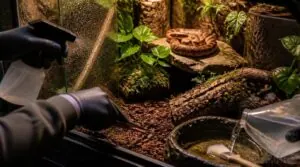
Building the terrarium is only half the job. Keeping it clean and functional is what actually keeps your snake healthy long-term. Here’s what that upkeep looks like, day to day and month to month.
Daily Spot-Cleaning Routines
Every day, grab clean forceps and pull solid waste within five minutes of spotting it—don’t wait.
Wipe bowls, rinse, and refill with fresh water daily to block bacterial buildup. Rake substrate lightly to disrupt waste pockets, then spot-sanitize soiled patches with a reptile-safe wipe. Quick visual checks matter too: scan glass, vents, and decor for grime before it compounds into a real mess.
Monthly Deep Cleaning and Disinfection
Once a month, go beyond spot-cleaning and hit everything spot-checks miss—substrate cracks, vent seams, hidden grime.
- Scrub decor with enzymatic cleaners to cut biofilm
- Swap moldy substrate instead of spot-treating it
- Wipe humidistat sensors with alcohol for accurate readings
- Log date, products, and areas cleaned
This routine slashes microbial buildup by 99%, keeping your terrarium’s sanitation protocols tight between deeper quarterly overhauls.
Safely Removing Snakes for Upkeep
Deep cleaning means your snake needs a temporary exit, and how you handle that moment matters as much as the cleaning itself.
| Tool | Purpose | Distance |
|---|---|---|
| Snake hook | Guided removal | 6 feet |
| Ventilated tub | Secure holding | N/A |
| Cut-resistant gloves | Bite protection | Contact |
Use a snake hook to guide, never squeeze, then log the date and behavior observed for quick reference.
Checking Ventilation for Escape Gaps
With your snake safely tubbed, inspect vents for dust buildup (cuts airflow 40%) and gaps exceeding 2mm. Test cross-flow with an incense stick—smoke should clear within 60 seconds.
- Check mesh integrity (1.0-1.5mm pores)
- Inspect silicone seals for cracks
- Verify vent spacing hasn’t shifted
- Confirm no moisture warping
- Log findings with photos
Escape artists exploit overlooked gaps—stay thorough.
Signs Your Setup Needs Adjusting
How do you know it’s time to tweak the setup? Watch for restricted movement cues like corner-pacing or glass-rubbing, plus abnormal shedding patterns or thermal stress indicators.
| Sign | Likely Cause |
|---|---|
| Corner-pacing | Space too small |
| Cracked shed | Low humidity |
| Refusing to bask | Poor gradient |
| Substrate mold | Bad microclimate management |
Address thermoregulation and humidity levels before behavior worsens.
Frequently Asked Questions (FAQs)
How often should I replace UV bulbs?
Swap UV bulbs every 6-12 months — output drops well before the glow fades. Track hours, test intensity with a meter yearly, and replace at manufacturer limits to keep germicidal efficacy intact for proper UVB-dependent husbandry.
For a full picture of keeping your reptile healthy and secure, reptile enclosure maintenance tips cover everything from bulb schedules to escape-proofing your setup.
Whats the best terrarium location in my home?
Funny enough, the spot you’d pick for a reading nook works here too: away from vents, radiators, and drafty windows. Aim for stable room temperature (18-24°C), low foot traffic, north or east-facing light, and a level, sturdy surface.
Can I use live plants safely?
Yes, with care. Choose non-toxic plants like snake plants or spider plants, use inert soil mixes, and position them so your snake can’t ingest roots or soil while foraging.
How do I prevent mold growth?
Dial in ventilation airflow optimization with cross-flow vents, check your hygrometer for accuracy monthly, and swap damp substrate before moisture retention sets in. Pair mold-resistant materials like melamine with strict preventative hygiene and disinfection to keep humidity in check.
What backup heating options work during power outages?
Grid failure doesn’t mean freezing terrarium temps. Battery-powered heat mats work short-term, but propane or kerosene heaters offer stronger backup, heating spaces for hours.
Pair either with a backup thermostat to protect thermal regulation until power returns.
How much does a DIY snake terrarium typically cost?
Commercial setups can top $400 before extras, but a DIY snake enclosure usually runs $150 to $250 total—materials, silicone, hardware, and basic heating included, cutting costs roughly 40% compared to store-bought comparable habitats.
Can I house two snakes in one terrarium?
Technically possible, but risky: species compatibility issues, feeding aggression, and disease transmission make cohabitation dangerous for most pet snakes. Add 25% more floor space minimum, separate hides, and watch for territory dispute signs like regurgitation or refusal to eat.
How long does it take to build a terrarium?
A basic terrarium takes 2 to 4 hours, while custom builds with wiring stretch to 12 hours. Add 24 hours for curing silicone before introducing your snake—rushing this step risks toxic off-gassing during those critical first days.
What tools do I need before starting construction?
Grab a tape measure, square, and level for layout accuracy, plus a circular saw or jigsaw for cutting panels. Add a drill, clamps, aquarium-grade silicone, and safety gear—gloves, goggles, dust mask—before touching any thermoplastic or hardwood material.
How often should I upgrade my snakes enclosure?
Watch for space adequacy indicators: crowded coils, constant wall contact, or dips in feeding activity. Most snakes need their first upgrade within 12–24 months. Time it after successful feeding, once shedding stress has passed and digestion’s settled.
Conclusion
A weak seam can undo a thousand dollars of good intentions in one night.
Building snake terrariums isn’t decoration—it’s engineering that respects a wild animal’s strength and instincts. Get the dimensions, ventilation, and thermal gradient right, and you’ll spend weekends enjoying your snake, not chasing escape gaps or humidity crashes.
Master the framework once, and every future enclosure feels like second nature. That’s the difference between owning a snake and truly caring for one.