This site is supported by our readers. We may earn a commission, at no cost to you, if you purchase through links.
Glass holds cold like a grudge. Since it conducts heat away from your terrarium faster than plastic or wood ever will, a healthy basking zone on one side can mask a cold, sluggish floor on the other. That gradient failure is how you end up with a reptile that stops eating and won’t say why.
Reptile heating pads for glass terrariums solve this, but only when wattage, coverage, and thermostat control match your species and tank size. Get those wrong, and you’re either cooking substrate or leaving your animal in a thermal dead zone.
Ten pads made the cut here, along with the wattage math, probe placement, and safety checks that keep your setup working for years, not months.
Table Of Contents
- Key Takeaways
- Top 10 Reptile Heating Pads
- 1. Bn-Link Reptile Under Tank Heater
- 2. BN-LINK Reptile Under Tank Heat Mat
- 3. Aiicioo Reptile Heating Pad Thermostat Combo
- 4. Pawfly reptile heat pad thermostat
- 5. ReptiKing reptile terrarium heating pad
- 6. Vivosun Reptile Heating Pad Thermostat Combo
- 7. iPower Reptile Under Tank Heater
- 8. ReptiKing Reptile Heat Pad Thermostat
- 9. Lucky Herp Reptile Heat Pad
- 10. Tikaton Adjustable Reptile Heat Pad
- Choosing The Right Heat Pad
- Safe Glass Tank Installation
- Thermostats and Temperature Control
- Heating Pad Care and Safety
- Frequently Asked Questions (FAQs)
- How to heat a glass terrarium?
- Can I put a heat mat on a glass tank?
- How to keep heat in a glass enclosure?
- What are the heat pads for reptile terrariums?
- Can I use a heating pad with any substrate type?
- How long do reptile heating pads typically last?
- Should heating pads run continuously or on a timer?
- Can heating pads be used with bioactive terrarium setups?
- Conclusion
Key Takeaways
- Since glass conducts heat unevenly, a working basking zone can hide a dangerously cold floor, so unregulated heat pads risk either scorched substrate or a thermal dead zone.
- Match wattage to tank size (roughly 8-16W for 10 gallons, 16-24W for 20 gallons, 24-32W for 40 gallons) and cover only 25-60% of the floor so your reptile can still choose a cooler spot.
- Always pair a heat pad with a thermostat and centered probe, since fixed-range mats alone (often 104-122°F) can cause thermal burns without active regulation.
- Proper installation and upkeep matter as much as the pad itself, so elevate the tank, avoid air gaps and moisture buildup, inspect cords and adhesive monthly, and replace pads every 2 to 5 years.
Top 10 Reptile Heating Pads
Not every heat pad on the market meets the wattage, waterproofing, and construction standards your glass terrarium actually needs.
Pairing the right heater with a properly sized enclosure matters just as much, so check out this guide to choosing terrariums built for boas before you buy either.
I’ve narrowed the field down to ten units that hold up under real conditions, from hatchling setups to large 40-gallon enclosures.
Here’s how they compare on power, safety features, and build quality.
1. Bn-Link Reptile Under Tank Heater
At just 6 by 8 inches and 8 watts, this pad suits 10–20 gallon glass tanks without overheating small enclosures. The flexible waterproof film resists curling and grips glass firmly, even through routine wipe-downs.
Contact temperatures run 104–122°F, so thermostat regulation isn’t optional—unregulated use risks thermal burns. With 120V compatibility and a 15-month warranty, it’s a solid baseline choice, but pair it with a controller before placing it under any glass terrarium.
| Best For | This heater is best for reptile and amphibian keepers with 10–20 gallon glass terrariums who need steady, low-wattage bottom heat. |
|---|---|
| Waterproof | Yes |
| Adhesive Mounting | Strong adhesive |
| Glass Surface Only | Yes |
| Power Output | 8W |
| Voltage | 120V AC |
| Rapid Heating | Yes |
| Additional Features |
|
- Flexible, waterproof design that grips glass firmly and wipes clean easily
- Energy-efficient 8-watt power draw keeps electricity costs low
- Backed by a 15-month manufacturer warranty for added peace of mind
- Requires a separate thermostat to prevent overheating and burns
- Only works on glass surfaces, limiting compatibility with other enclosure types
- Bulkier profile may need extra ventilation space underneath the tank
2. BN-LINK Reptile Under Tank Heat Mat
Step up to the 8 by 12 inch version, and you’re covering 10–20 gallon tanks at 16 watts—double the size, double the power draw, same 104–122°F range.
The flexible film conforms to curved glass without losing adhesion, and the waterproof coating shrugs off substrate spills during cleaning. Multi-layer construction resists delamination longer than basic film mats.
Since coverage jumps but temperature range stays fixed, you still need a thermostat. Skipping one here risks the same burn hazard, just across more surface area.
| Best For | This heat mat is best for reptile, amphibian, and small animal owners with 10–20 gallon terrariums who need steady, energy-efficient warmth for glass enclosures. |
|---|---|
| Waterproof | Yes |
| Adhesive Mounting | Integrated adhesive |
| Glass Surface Only | Yes |
| Power Output | 16W |
| Voltage | 120V AC |
| Rapid Heating | Yes |
| Additional Features |
|
- Rapid heating technology brings the mat up to temperature within minutes
- Waterproof, flexible construction resists spills and conforms easily to curved glass surfaces
- Energy-efficient 16-watt design provides steady 24-hour heat without driving up electricity costs
- Requires a separate thermostat, since the fixed 104–122°F range can pose a burn risk without one
- Limited to terrarium use on glass only—not suitable for water aquariums or submersion
- Only a 15-month warranty, which is relatively short for a long-term heating device
3. Aiicioo Reptile Heating Pad Thermostat Combo
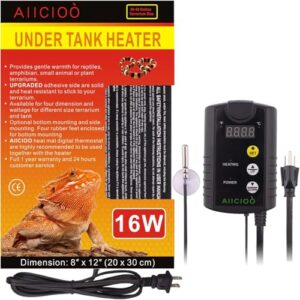
Once you need finer control than a fixed-range mat offers, the Aiicioo combo earns its spot with a built-in digital thermostat running 68–108°F.
The probe reads terrarium temperature directly, so output adjusts instead of running fixed. Rubber feet aid bottom-mount dissipation, and upgraded adhesive holds on glass exteriors—side or bottom placement both work.
Available in 8W or 16W, it scales to enclosure size. Since regulation’s built-in, you avoid stacking a separate thermostat purchase onto your setup costs.
| Best For | Reptile and hermit crab owners who want precise, adjustable warmth for a glass terrarium without buying a separate thermostat. |
|---|---|
| Waterproof | Yes |
| Adhesive Mounting | Upgraded adhesive |
| Glass Surface Only | Yes |
| Power Output | 16W |
| Voltage | 120V |
| Rapid Heating | Yes |
| Additional Features |
|
- Built-in digital thermostat with a probe for continuous, accurate temperature monitoring
- Upgraded adhesive and rubber feet allow secure, stable mounting on the bottom or side of a glass tank
- Reaches target temperatures quickly, so the terrarium warms up within minutes
- Only works on glass surfaces—not suitable for plastic, acrylic, or water tanks
- Must stay on the outside of the enclosure and needs proper ventilation to prevent localized overheating
- Shouldn’t be fully covered, which can limit some placement or decor options
4. Pawfly reptile heat pad thermostat
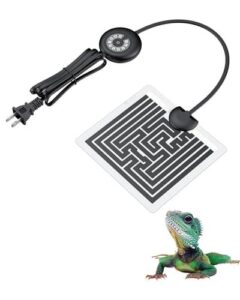
Where the Aiicioo bundles regulation into the pad itself, Pawfly separates the two components, pairing a 5W pad with a standalone thermostat for dedicated temperature control.
The pad measures 6 x 5.5 inches, fitting small-to-medium glass tanks as an under-tank heater only—not for vertical mounting.
The thermostat holds setpoint within a couple degrees Celsius, cutting power as temperatures approach target. That feedback loop matters: it minimizes hot spots that stress reptile skin and metabolism over time.
| Best For | Reptile and small pet owners who want precise, adjustable temperature control for small-to-medium glass tank enclosures. |
|---|---|
| Waterproof | IPX3 |
| Adhesive Mounting | N/A |
| Glass Surface Only | Yes |
| Power Output | 5W |
| Voltage | N/A |
| Rapid Heating | Fast heating |
| Additional Features |
|
- Standalone thermostat holds setpoint within a couple degrees Celsius, reducing hot spots
- Separating pad and thermostat allows for dedicated, fine-tuned temperature control
- Compact 6 x 5.5 inch pad fits neatly under small-to-medium glass tanks
- Under-tank use only, so it can’t be mounted vertically against walls
- Limited to small-to-medium tanks, which may not suit larger enclosures
- Requires managing two separate components instead of one all-in-one unit
5. ReptiKing reptile terrarium heating pad
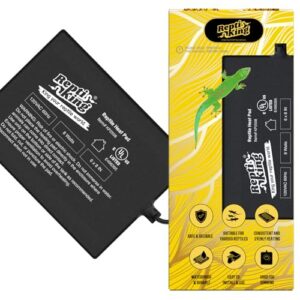
A flexible carbon fiber element gives this pad even heat distribution without the hotspots that stress reptile skin. It’s low-profile enough to sit under glass tanks 20-40 gallons without disrupting substrate depth.
Pair it with a reliable thermometer setup so you can track surface warmth alongside the broader temperature and humidity zones outlined in this guide to building naturalistic terrariums.
Water-resistant coating experiences humidity splashes, though it’s not a full submersion-rated IP67 unit. Adhesive backing secures it to glass, and built-in thermal cutoffs shut power if temperatures exceed safe limits—critical, since unmonitored overheating can burn a basking animal before you notice.
| Best For | Reptile owners with bearded dragons, snakes, lizards, or hermit crabs housed in glass tanks who want steady, low-energy background heat. |
|---|---|
| Waterproof | Yes |
| Adhesive Mounting | Adhesive backing |
| Glass Surface Only | Yes |
| Power Output | 8W |
| Voltage | N/A |
| Rapid Heating | N/A |
| Additional Features |
|
- Even heat distribution helps avoid hotspots that can stress or burn reptile skin
- Waterproof, adhesive-backed design makes it easy to mount and clean in humid enclosures
- Low energy consumption (8W) allows for safe, continuous habitat heating
- Requires a separate thermostat, since the pad alone can’t regulate temperature
- Compact size may not provide enough coverage for larger tanks
- Adhesive backing only works well on certain surfaces, limiting placement options
6. Vivosun Reptile Heating Pad Thermostat Combo
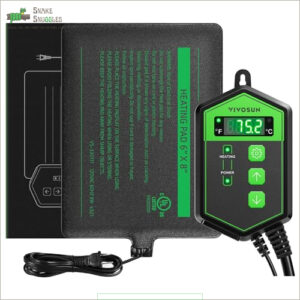
This 8×12 inch pad pairs with a digital thermostat covering 40–108°F, so you’re not eyeballing temps. Far infrared heating spreads warmth evenly, and the UL-certified build with a water-resistant surface makes routine cleaning easy without wiring exposure.
3M adhesive mounts it bottom or side; don’t fold the pad, since creasing damages internal elements. The thermostat’s hanging tab allows external placement, keeping it accessible for monitoring while you dial in stable warm-side temperatures.
| Best For | Reptile owners looking to maintain a stable, precisely regulated warm zone in terrariums for turtles, lizards, frogs, and similar pets. |
|---|---|
| Waterproof | IP67 |
| Adhesive Mounting | 3M adhesive |
| Glass Surface Only | Yes |
| Power Output | N/A |
| Voltage | N/A |
| Rapid Heating | N/A |
| Additional Features |
|
- Far-infrared heating technology delivers even, consistent warmth across the pad
- Digital thermostat with a 40–108°F control range allows precise temperature regulation
- IP67-rated, water-tight surface makes cleaning simple and safe
- Objects should never be placed on top of the pad, as this can cause overheating
- Requires proper adhesive mounting or hanging setup, limiting placement flexibility
- Only compatible with North American electrical outlets, limiting use elsewhere
7. iPower Reptile Under Tank Heater
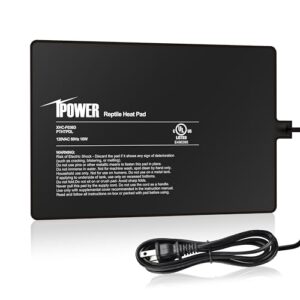
Four watts might sound small, but for a 4×7 inch pad on a compact glass tank, that’s plenty. The solid-state PTC element self-regulates, avoiding the temperature spikes cheaper mats produce.
A control knob adjusts warm-side output between 85–92°F, which suits most small to medium species without extra hardware. 3M adhesive makes mounting easy, and the moisture-resistant surface tolerates routine terrarium humidity.
Since it’s low-wattage, it works best on smaller enclosures—don’t expect it to heat a 40-gallon tank efficiently.
| Best For | Reptile, amphibian, or small mammal owners with a 30–40 gallon terrarium who want a fast, reliable, energy-efficient way to maintain warm-side temperatures. |
|---|---|
| Waterproof | Yes |
| Adhesive Mounting | 3M adhesive |
| Glass Surface Only | Yes |
| Power Output | 16W |
| Voltage | 120V |
| Rapid Heating | Yes |
| Additional Features |
|
- Rapid heating technology brings the pad up to temperature within minutes, so pets aren’t left waiting in a cold enclosure
- PTC heating material self-regulates and comes with solid insulation, giving more even, consistent heat transfer
- Waterproof, moisture-proof build with strong 3M adhesive makes it easy to mount and simple to clean without safety worries
- Must be elevated or fitted with rubber feet when bottom-mounted, since trapped heat can pose a fire risk
- Only heats to about 86°F at typical room temperature, which may not be enough for species needing higher basking temps
- Actual surface temperature can vary depending on your terrarium’s environment, so results may differ from the listed specs
8. ReptiKing Reptile Heat Pad Thermostat
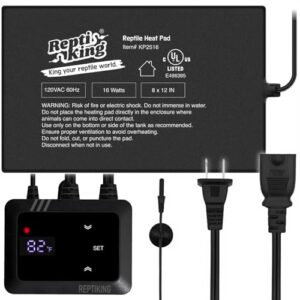
This model pairs a heat mat with a dedicated PID controller, dialing temps from 68°F to 113°F in single-degree increments. A built-in sensor tracks surface heat, while an optional external probe validates substrate readings near the basking zone.
Auto shutoff triggers if temps climb past 122°F, protecting against runaway heat. Adhesive backing secures the mat to glass, and cords should stay clear of moisture. Recalibrate periodically if room temps shift.
| Best For | Reptile owners looking to maintain precise, stable warmth for bearded dragons, snakes, lizards, or hermit crabs in glass terrariums. |
|---|---|
| Waterproof | Yes |
| Adhesive Mounting | Adhesive backing |
| Glass Surface Only | Yes |
| Power Output | 16W |
| Voltage | N/A |
| Rapid Heating | N/A |
| Additional Features |
|
- PID controller allows precise, single-degree temperature adjustments from 68°F to 113°F
- Auto shutoff at 122°F adds a reliable safety layer against overheating
- Waterproof, adhesive-backed design makes installation and cleaning simple
- Requires adhesive application, which can make repositioning difficult once installed
- Periodic recalibration is needed if room temperatures fluctuate
- Limited to terrarium and reptile habitat use only
9. Lucky Herp Reptile Heat Pad
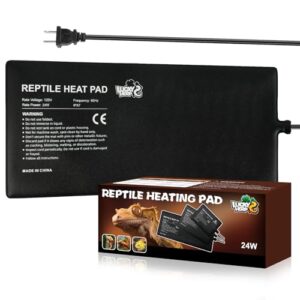
This 24W pad uses waterproof PVC construction built for glass terrarium mounting, with adhesive backing designed to resist peeling during routine cleaning. Since the surface experiences moisture well, splashes from misting or water dish spills won’t compromise the heating element underneath.
Available in sizes matching common tank footprints, it’s flexible enough to conform to the glass without air bubbles trapping heat unevenly. Reinforced cord areas reduce wear from daily handling, so longevity stays solid with proper care.
| Best For | Reptile, amphibian, and hermit crab owners looking for a budget-friendly way to maintain steady tank temperatures for pets like lizards, turtles, and snakes. |
|---|---|
| Waterproof | Yes |
| Adhesive Mounting | Strong adhesive |
| Glass Surface Only | Yes |
| Power Output | 24W |
| Voltage | N/A |
| Rapid Heating | N/A |
| Additional Features |
|
- Constant temperature design with dual protection helps prevent overheating
- Waterproof PVC material holds up against splashes and routine tank cleaning
- Flexible, foldable design makes installation and storage easy
- Adhesive requires a clean glass surface, so it may not work well with other tank materials
- Careful installation is needed to avoid trapped air bubbles affecting heat distribution
- Limited to glass terrariums or tanks, reducing versatility for other enclosure types
10. Tikaton Adjustable Reptile Heat Pad
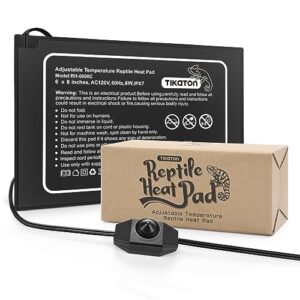
Manual control gives you the most flexibility here: a rotating switch lets you dial temperatures from 40°F to 108°F, covering desert and tropical species alike. The solid-state nichrome element pairs with flexible PVC construction, so it folds to fit 10-40 gallon tanks without cracking.
IPX67 waterproofing controls misting runoff, and 3M adhesive secures mounting. Sizes range from 8W to 24W. Since it’s glass-only, skip wood or acrylic surfaces, and always pair it with a thermostat for reliable regulation.
| Best For | Reptile, amphibian, and arachnid owners with glass terrariums who want adjustable, energy-efficient heat for desert or tropical setups. |
|---|---|
| Waterproof | IPX67 |
| Adhesive Mounting | 3M adhesive |
| Glass Surface Only | Yes |
| Power Output | 8-24W |
| Voltage | 120V |
| Rapid Heating | N/A |
| Additional Features |
|
- Manual rotating switch allows precise temperature customization for a wide range of species
- Flexible, foldable PVC construction with IPX67 waterproofing holds up well in humid or misted enclosures
- Energy-efficient design (8W–24W) with multiple sizes to fit different tank dimensions
- Compatible with glass terrariums only, not wood, plastic, or acrylic enclosures
- Requires a separate thermostat for consistent, reliable temperature regulation
- Indoor use only, with performance affected by ambient room temperature
Choosing The Right Heat Pad
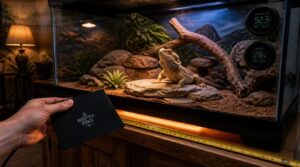
Not every heat pad fits every tank, and guessing wastes money and risks your reptile’s health. Tank dimensions, species, and wattage all factor into the decision before you buy anything. Here’s what you need to weigh first.
Glass Terrarium Size Matching
Twenty gallons doesn’t tell you much until you know the footprint. Internal dimensions, not volume, decide where heat goes—a 20-gallon long (30x12x12) suits under-tank pads far better than tall equivalents.
Vertical space adds climbing room but complicates gradients. Match pad size to floor area, not tank capacity, and factor substrate depth, since deep substrate insulates and shifts your actual surface temperature.
Snake Species Heat Needs
Species dictates thermal targets, and getting this wrong stresses your snake’s metabolism. Tropical species need 80-85°F basking zones, desert species run hotter at 90-95°F with cooler nights, temperate species prefer 70-85°F gradients, hatchlings need consistent 82-90°F warmth for growth, and active foragers need 85-90°F post-meal zones for digestion. Match your reptile heating pad’s output to your species before buying anything.
It’s essential to understand specific snake temperature requirements to make sure your pet maintains proper metabolic health.
Wattage by Tank Size
Once you know your snake’s target range, wattage math follows fast. Gallon-to-wattage ratios guide undertank heating pads: small tanks run 8-16 watts, mediums 16-24, larges 24-32.
- 10-gallon: 8-16 watts
- 20-gallon: 16-24 watts
- 40-gallon: 24-32 watts
- Temperature gap: cooler rooms push wattage upward
- Dual heaters: split larger glass terrariums for even distribution
Pad Coverage Guidelines
Coverage percentage matters as much as wattage. For 20-gallon setups, cover 60-70% of the base; 40-gallon tanks need 40-60% to avoid one overheated zone. Avoiding air gaps ensures even heat distribution—no substrate insulation between pad and glass.
Species-specific coverage varies: desert species need partial coverage for microclimates, while tropical species require broader footprints for consistent thermal gradients throughout the reptile enclosure.
Supplemental Versus Primary Heat
Since not every enclosure needs full-tank warmth, decide whether your pad functions as a primary or secondary heat source. Primary heat sustains baseline terrarium temperature continuously; supplemental units create isolated basking zones for microhabitat heat zoning.
Combining both, using dual-stage control strategies, improves energy consumption optimization and smooths seasonal heating transitions—so your thermal gradient stays stable without running one system constantly.
Safe Glass Tank Installation
Buying the right pad is only half the job, since a poorly installed heater can crack glass, burn substrate, or scorch your reptile. Placement, mounting, and elevation all affect how safely that heat reaches your tank. Here’s what you need to get the installation right.
Under-tank Pad Placement
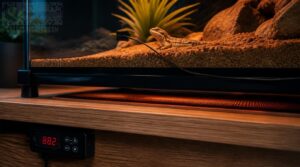
Where the pad sits matters as much as which pad you buy. Set it on a flat, level surface only—warped glass or uneven stands create hot spots and risk thermal burns.
Keep pads clear of ventilation openings, align edges within the tank footprint, and use a thermostat probe at the warm side.
Watch for condensation trapped underneath; trapped moisture degrades adhesive fast.
Side-mounting Heat Pads

Two setups, two strategies. Side-mounting works best when substrate moisture is a concern, since the pad sits flush against the exterior glass wall instead of underneath bedding.
This creates a vertical heat gradient rather than a floor-level one, delivering warmth through direct glass heat transfer while keeping wiring completely clear of spills, humidity, or digging reptiles.
Creating Warm Zones
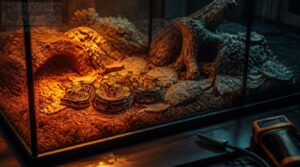
A single warm patch beats whole-tank heating every time. Cover one-third to half the floor, no more, so your reptile can move off the heat when it wants.
Cover only one-third to half the floor with heat, so your reptile can always choose to move away
- Target 28–32°C
- Center the probe on the patch
- Test with an infrared thermometer
- Keep the cool side clearly separate
This thermal gradient drives natural thermoregulation and gives snakes a genuine basking refuge.
Elevating Glass Terrariums
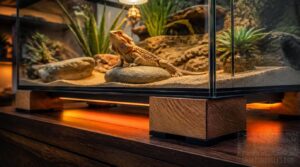
Glass conducts heat unevenly, so raising your terrarium 2 to 6 inches on wood or acrylic risers improves airflow beneath the enclosure. This prevents condensation buildup and hot spots against the pane.
Solid wood or powder-coated metal stands handle humidity without warping. Non-slip feet stop wobble.
Elevation also gives your heating pad’s warmth room to distribute evenly instead of trapping moisture against furniture.
Avoiding Substrate Overheating
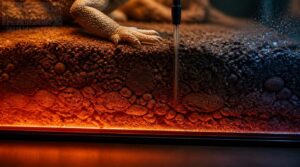
Two inches of substrate isn’t just bedding, it’s insulation between your reptile and dangerous heat concentration.
- Thermal burns from direct glass contact
- Compacted substrate creating hot spots
- Unstable thermal gradient stressing thermoregulation
- Moisture buildup skewing temperature readings
Maintain air pockets weekly, monitor microclimates with probes, and pair every setup with a thermostat for reliable terrarium temperature control.
Thermostats and Temperature Control
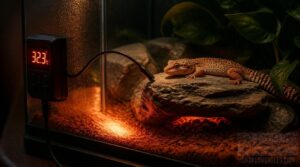
A heat pad alone won’t keep your reptile safe, since temperatures can climb fast without something regulating them. A thermostat is what turns raw heat into controlled, predictable warmth your animal can actually rely on. Here’s what you need to know about setting one up correctly.
Why Thermostats Matter
Why does a heat pad alone leave your setup vulnerable? Without a thermostat, wattage runs constantly, risking thermal burns and substrate scorching.
PID regulation cuts thermal swings far better than on-off cycling, supporting steady thermoregulation and metabolic function. Since consistent warmth aids digestion and shedding, precise temperature control isn’t optional.
Smart monitoring features also help lower energy costs while giving you automated oversight, day and night.
Probe Placement Tips
Probe contact accuracy determines whether your thermostat actually protects your reptile. Place the probe on the warm-side glass, centered, away from pad edges, at direct contact—no air gaps.
Map thermal gradients using two probes in larger tanks. Avoid microclimates under décor. Calibrate against a reference thermometer first, since drift beyond 1°C means replacement, preventing thermal burns before they start.
Warm-side Temperature Ranges
Once probe calibration checks out, set your target range by species, not habit.
- Tropical species (leopard geckos): 88–92°F
- Desert dwellers (bearded dragons): 95–105°F
- Temperate snakes (corn snakes): 82–88°F
- Chameleons: 84–90°F
Metabolic needs shift with seasons, so recheck your thermal gradient after temperature swings. Basking zone stability matters more than hitting a single perfect number.
Preventing Dangerous Hot Spots
Dialing in a target range doesn’t guarantee even heat. Localized hotspots form when pads sit under thick glass seams, folded substrate, or decor blocking airflow.
| Hotspot Cause | Detection Method | Fix |
|---|---|---|
| Substrate heat traps | Infrared thermometer scan | Thin bedding layer |
| Pad edge overlap | Manual touch-check | Reposition pad |
| Blocked airflow | Weekly heat mapping | Clear decor |
Map surface temps monthly; drift signals thermostat or probe calibration failure.
Monitoring Daily Temperatures
Consistency beats intuition when tracking terrarium temps. Log readings twice daily, morning and evening, using baseline logging methods established at setup.
- Record both °C and °F
- Note exact probe position
- Flag any excursion beyond range
- Test probe accuracy weekly
This captures diurnal variation tracking and catches drift early. Pair manual logs with digital monitoring alerts for reliable, automated temperature monitoring—since equipment fails silently, but data doesn’t lie.
Heating Pad Care and Safety
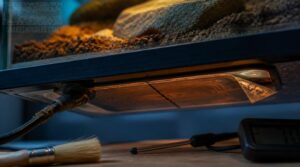
Buying the right pad is only half the job, since even a quality heater can fail without regular upkeep.
Cracked insulation, lifted adhesive, and frayed cords turn a helpful tool into a genuine fire or burn hazard.
Here’s what to check, clean, and watch for so your setup stays safe for the long haul.
Waterproofing and Moisture Risks
Water is the real enemy in a glass terrarium, not the electricity. Moisture ingress happens through cracked seams and failed adhesive edges, so waterproof membrane integrity matters as much as wattage.
Condensation on cooler glass zones invites mold and corrodes electrical terminals over time. Choose IP67 or IPX7-rated pads, keep cords clear of splashes, and manage humidity with proper ventilation.
Checking Adhesive Failure
How long has that heat mat been stuck down? Pull back an edge and inspect the bond line: adhesive residue patterns tell the story. Clean residue on one side signals interfacial failure; torn substrate suggests strength but glass risk.
Watch for:
- Bubbling or lifted adhesive backing
- Uneven edges (debonding indicators)
- Cracked insulation near seams
Catching these early prevents heat mat failure inside your reptile enclosure.
Cleaning Heat Pad Surfaces
Grime buildup on undertank heating pads compromises far infrared transfer efficiency, so cleaning matters clinically, not cosmetically.
Unplug and cool completely before wiping surfaces with a damp cloth and mild soap—never harsh solvents. Avoid abrasive sponges; they degrade PU leather or vinyl coatings.
Rinse thoroughly to manage soap residue, then air-dry fully. Moisture entering seams risks electrical failure in your glass terrarium setup. Inspect material integrity post-cleaning for cracking.
Inspecting Cord Damage
Cords fail silently until they don’t—check yours monthly. Run your fingers along the full length, feeling for cracks or bulges. Look for scorch marks near the plug and corroded prongs; both signal overheating. Any exposed conductor means stop using it immediately.
Since glass terrariums trap humidity, moisture intrusion accelerates insulation breakdown, raising fire and shock risks fast.
Replacing Worn Heating Pads
Every heating pad has a shelf life, so plan on replacement every 2 to 5 years, sooner if it’s running daily in a warm room (3-4 years) or took on moisture. If reptile owners are replacing a heating pad anyway, pairing it with a reliable thermostat setup for apartment living helps catch temperature swings before they become safety issues.
Watch for cracks, uneven heating, discoloration, or sticky adhesive—these signal it’s time. Don’t wait for failure; swap it out, retest thermostat readings, and log temperatures for a week to confirm stable, safe performance.
Frequently Asked Questions (FAQs)
How to heat a glass terrarium?
Wild snakes bask on sun-warmed rock; that’s belly heat in action. Replicate it with an undertank heating element covering 25-40% of floor space, paired with a thermostat, creating the thermal gradient your reptile needs to thermoregulate properly.
Can I put a heat mat on a glass tank?
Yes, but pair it with a thermostat since glass conducts heat poorly. Cover only 25-40% of the floor, monitor ambient temperature, and watch for glass thermal stress—unregulated mats risk cracking or uneven terrarium heating over time.
How to keep heat in a glass enclosure?
Insulate glass sides with closed-cell foam or cork panels, seal edges with silicone, and add reflective foil inside. Lift the tank to cut floor contact loss, avoid drafty windows, and maintain your thermal gradient with consistent thermostat control.
What are the heat pads for reptile terrariums?
Under tank heaters use carbon film or PTC technology, delivering infrared warmth at up to 98% efficiency. Thin, flexible construction (PVC, graphene, aluminum film) ensures even thermal distribution across the enclosure floor, supporting proper thermoregulation without disrupting your reptile’s light cycle.
Can I use a heating pad with any substrate type?
Not exactly. Substrate insulation effects vary widely, so aspen, coconut fiber, or sand slow heat transfer and demand thermostat adjustments, while bare glass conducts heat directly.
Moisture-trapping substrates also risk adhesive failure over time, undermining pad performance and long-term heat distribution.
How long do reptile heating pads typically last?
Most units retire gracefully after 2 to 5 years, depending on build quality. Silicone housings outlast PVC casings, thermostat-controlled pads reduce wear, and moisture exposure accelerates failure.
Watch for uneven warming or slow heat response—early signs it’s time to replace.
Should heating pads run continuously or on a timer?
Pair a timer with thermostat control rather than running continuously—24hour heat sources raise burn risk, dry substrate, and accelerate thermal cycling wear.
Timers support species heating schedules and safer thermoregulation, so your habitat temperature control stays consistent without constant supervision.
Can heating pads be used with bioactive terrarium setups?
Yes, mount pads externally on glass with a thermostat-controlled probe in the warm zone. This preserves microclimate stability, avoids substrate moisture damage, and helps plant growth and microbial activity without disrupting natural thermal gradients your bioactive setup depends on.
Conclusion
Match the wattage, match the coverage, match the thermostat to your species: that’s the whole formula. The best reptile heating pads for glass terrariums won’t fix bad husbandry, but they’ll stop a stable gradient from sliding into a silent emergency.
Glass punishes guesswork, so verify temperatures daily and swap pads before adhesive fails. Get it right once, and your reptile’s thermoregulation stops being something you worry about daily.