This site is supported by our readers. We may earn a commission, at no cost to you, if you purchase through links.
Most snakes die slowly in glass boxes that look fine. A bare tank with a heat rock and a water bowl keeps a ball python alive, but it doesn’t give her anything to do.
Building naturalistic terrariums changes that. Deep, damp substrate lets your corn snake tunnel the way she would in the wild. A warm hide and a cool hide let her choose her own temperature. Branches at different heights give a green tree python somewhere to climb and drape.
You don’t need a rainforest budget or a biology degree. You need the right enclosure size, a steady thermal gradient, and a few smart layers, starting with the enclosure itself.
Table Of Contents
- Key Takeaways
- Choose The Right Enclosure for Your Snake
- Plan Heat, Lighting, and Humidity
- Build Species-Appropriate Substrate Layers
- Arrange Safe Plants, Hides, and Branches
- Add a Cleanup Crew if Bioactive
- Monitor and Maintain Your Naturalistic Terrarium
- Frequently Asked Questions (FAQs)
- Is it cheaper to build your own terrarium?
- What are common terrarium mistakes to avoid?
- What is a naturalistic terrarium?
- What are the four levels of a terrarium?
- How to set up a naturalistic terrarium?
- How do you make a natural terrarium?
- What are common mistakes made when building and maintaining a terrarium?
- How often to water terrarium plants?
- Can I use regular potting soil inside?
- What causes mold in terrarium environments?
- Conclusion
Key Takeaways
- Size your enclosure to your adult snake (1.5 to 2 times her body length), and pick the shape that fits her species, with floor space for a ball python and height for a green tree python.
- Build a thermal gradient with a 28–32°C basking zone, a 24–28°C cool side, a thermostat on every heater, and a digital hygrometer so she can choose her own comfort.
- Use deep, damp substrate (6–12 cm of coco coir and orchid bark) for burrowing and steady humidity, and add drainage only if water puddles.
- Give her two opaque hides, sturdy branches, and safe plants, then check temperatures, humidity, and equipment on a regular schedule, adding springtails and isopods if you want a self-cleaning bioactive setup.
Choose The Right Enclosure for Your Snake
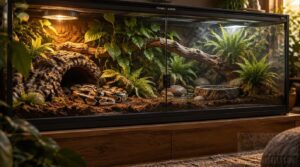
Sizing your enclosure starts with your snake’s body length. Aim for a tank that’s 1.5 to 2 times that length, then plan for the adult, not the hatchling. Buying once beats repacking three times over.
Before committing to a giant species, compare best large pet snake breeds and how to keep them healthy so your setup and budget match what an adult will truly need.
Juveniles can feel exposed in big spaces, so add snug hides and clutter until they fully settle in.
Species-specific needs drive everything else. A ball python wants floor space, while a green tree python wants height. Pick a front-opening, lockable enclosure with smooth, shatter-resistant glass or acrylic, so escapes and stress stay low.
Good ventilation systems prevent mold, but too much airflow wrecks humidity control. Choose a model that lets you adjust both, and leave room for a proper thermal gradient across its full length.
Plan Heat, Lighting, and Humidity
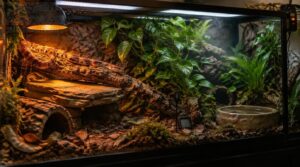
Once your enclosure’s in place, you can dial in the climate that keeps your snake healthy. Start by building a thermal gradient, because snakes regulate their body heat by moving between warm and cool zones.
Work through these four steps:
- Set a basking zone at 28–32°C, with the cool side at 24–28°C.
- Drop night temperatures 5–8°C, and put every heater on a thermostat.
- Give diurnal species 12–14 hours of light, and match UVB lighting requirements to your species, aiming for 5–6% at the basking spot.
- Aim for species-specific humidity control, using a digital hygrometer and a water dish on the cool end.
Keep lighting and heat gradients separate, using ceramic emitters for warmth, LEDs for brightness. Recheck temperature gradients weekly.
For a closer look at safe basking spots and humidity targets, this ball python temperature, humidity, and lighting guide walks through how to balance each setup.
Build Species-Appropriate Substrate Layers
Your snake’s substrate does more than cover the floor of the enclosure. It shapes how humidity holds, how well your animal can burrow, and how easy the whole setup is to manage. Here are the two decisions you’ll make, starting with choosing the right mix.
Choose Substrate for Humidity and Burrowing
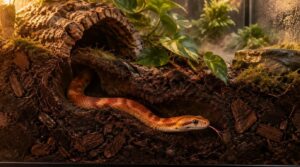
Picture a corn snake that spends its days wedged under a cork hide, bone dry and restless. Swap in a damp, deep layer and she’ll tunnel within a week.
If your corn snake keeps vanishing, this guide to whether corn snakes like to burrow explains how substrate depth and humidity can turn that restlessness into natural tunneling.
A dry, restless corn snake stuck under a cork hide will start tunneling within a week once you give her a deep, damp substrate
Your substrate options matter here. Mix coco coir with orchid bark, keep substrate depth at 6 to 12 cm, and you’ll get stable tunnels plus steady humidity control.
Add Drainage Only When Needed
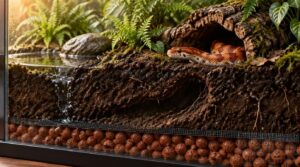
Once your substrate is deep enough for tunnels, ask whether water can escape it. A drainage layer matters only when moisture lingers past your species’ tolerance. Pour water in and watch. If puddles persist, add 5 to 10 cm of expanded clay, topped with mesh.
Small enclosures under 30 L rarely need it. Tweak your watering instead.
If you’re budgeting for a new snake, the real cost of owning a snake includes recurring extras like substrate, so it’s worth planning for those refreshes.
Arrange Safe Plants, Hides, and Branches
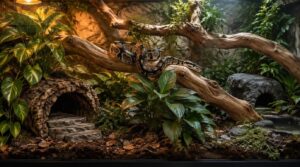
The best naturalistic reptile environments start with reptile-safe plants like pothos or ficus, set in the foreground where thick roots resist digging. Pick tough, stiff leaves that can handle a snake rubbing past, and skip true grasses because they’ll get uprooted fast.
Next, work in your hides and branches:
- Two opaque reptile hiding spots, one warm and one cool, each big enough to coil fully
- A trunk or rock hide with a stepped entrance
- Two to four reptile climbing branches, 2–6 cm thick, at varied heights
- Sealed wood with no sap or splinters
Stagger everything so airflow and heat stay even, and your terrarium aesthetics won’t cost you the gradient. Check your branches often for looseness, and swap damaged pieces.
Add a Cleanup Crew if Bioactive
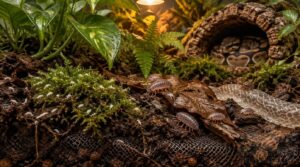
Once your bioactive substrate mix is settled and your plants have rooted, you’re ready to bring in a cleanup crew. Springtails and isopods are the reliable pair, since they eat mold, shed skins, and leftover prey before it fouls the enclosure. Start small. Add a few dozen of each, then let them multiply.
This microfauna keeps ammonia spikes down and feeds your plant roots, which moves you toward a self-sustaining environment. Don’t overdo it, though. Too many decomposers can dry out the substrate and starve roots of oxygen.
Watch for digging near hides and roots, and keep a mesh layer in place so nothing escapes. If you smell odor, ventilate more and feed less residue. That’s smart, low-effort terrarium maintenance.
Monitor and Maintain Your Naturalistic Terrarium
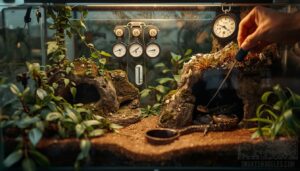
Daily checks sound tedious, but they take five minutes and catch problems early. Walk the enclosure each morning: check the water dish, confirm every hide is reachable, and read both thermometers.
Humidity monitoring works best with a hygrometer at the terrarium’s center. Log the daily high and low, then compare them with shedding and feeding days. A drop over 2-3°C or a rise over 3-4°C points to a failing heater or a draft.
Terrarium maintenance also needs a monthly equipment audit. Test heater guards, sensors, and seals. Each week, sniff for mold and check moisture at 5-7 cm depth.
Plan substrate replacement every 6-12 months, and trim your plant arrangement so airflow stays clear. Larger enclosure size forgives drift better.
Frequently Asked Questions (FAQs)
Is it cheaper to build your own terrarium?
Nothing’s pricier than a "free" weekend project that eats three Saturdays. Yes, DIY usually wins, but only if you size your enclosure right, reuse containers, and pick bulk substrate options before buying kits.
What are common terrarium mistakes to avoid?
Mistakes in naturalistic terrariums can wreck a snake’s health overnight!
You’d be amazed how often a poorly ventilated reptile enclosure, sloppy humidity control, or ignored species-specific needs cause trouble. Pick substrate options wisely. Measure temperatures.
What is a naturalistic terrarium?
Naturalistic terrariums are reptile enclosures that mimic your snake’s wild habitat, not just hold it. You’ll layer substrate options for burrowing depth, add plants and branches, and shape a thermal gradient so your snake chooses its comfort.
What are the four levels of a terrarium?
Your four levels run bottom to top: the drainage layer, a mesh barrier, your substrate, and a leaf litter floor. This substrate layering protects roots and helps with humidity control, ventilation systems, and your thermal gradient.
How to set up a naturalistic terrarium?
Picture damp earth, trailing leaves, and a snake gliding between them.
For naturalistic terrariums, start with enclosure size, then handle substrate selection, burrowing depth, and humidity control. Then add hides, branches, and plants you’ll trust.
How do you make a natural terrarium?
A 28–32°C basking spot anchors naturalistic terrariums.
Match enclosure size to your snake’s length, layer deep coconut fiber for humidity control, add reptilesafe plants and hides, then seed a bioactive environment with isopods and springtails.
What are common mistakes made when building and maintaining a terrarium?
Most keepers stumble on enclosure size first. Skip species-specific needs and you’ll skimp on heat gradients, UVB, and humidity control. Plan substrate depth for burrowing, then avoid soggy layers that breed mold.
How often to water terrarium plants?
Watch the substrate darken like damp bark after rain, then fade to pale. Your watering schedule depends on plant moisture needs: tropical plants usually want water every 3 to 7 days, while succulents can wait up to three weeks.
Can I use regular potting soil inside?
Not straight from the bag. Plain potting soil brings fertilizers, fungi, and unpredictable moisture that can wreck your reptile bioactive substrate. Sterilize it, layer it thinly, or skip it. Smart substrate selection starts with inert, coarser materials.
What causes mold in terrarium environments?
Mold takes hold when humidity stays above 60%, air sits still, and your substrate stays soggy.
Poor humidity control and substrate depth trap moisture, so use a drainage layer and ventilation layering for mold prevention.
Conclusion
Think it’s too much work? It isn’t, once the setup is done. Most of the effort happens on day one, and after that you’re just watching, adjusting, and topping off water.
Building naturalistic terrariums means giving your snake choices: warm or cool, damp or dry, buried or exposed. Get those right and she’ll show you what she needs. Trust what you observe, and let her behavior guide every tweak. Her first burrow is your proof.