This site is supported by our readers. We may earn a commission, at no cost to you, if you purchase through links.

Two corn snakes that look perfectly ordinary can hide a snow-white hatchling in their genes. Cross a pair that each carry amelanistic and anerythristic, and one in sixteen eggs hatches as a snow, while the rest show off normal, amel, or anery coats.
That’s the power of corn snake breeding and genetics. Once you understand how recessive, dominant, and co-dominant morphs pass down, you can predict what’s inside the clutch before the first egg cracks.
You’ll learn to read genotypes, sketch Punnett squares, pick healthy unrelated pairs, condition them for the season, and bring hatchlings through their first meal.
Table Of Contents
- Key Takeaways
- Corn Snake Genetics and Morph Inheritance
- How to Predict Corn Snake Color and Pattern Combinations
- Choosing Healthy Corn Snake Breeding Pairs and Maintaining Genetic Diversity
- How to Prepare and Pair Corn Snakes for Breeding
- How to Incubate Corn Snake Eggs and Care for Hatchlings
- Frequently Asked Questions (FAQs)
- Are corn snakes easy to breed?
- What snakes can corn snakes breed with?
- What smell do corn snakes hate?
- How old does it take for a corn snake to breed?
- How long should breeding pairs rest between clutches?
- How do you determine optimal breeding age for snakes?
- How much does a corn snake breeding project cost?
- Do you need a license to breed corn snakes?
- What health problems affect lavender corn snakes?
- Where can breeders sell corn snake hatchlings?
- Conclusion
Key Takeaways
- You’ll predict your clutches by sketching Punnett squares, since recessive morphs hide in normal-looking carriers and crossing two amel and anery double hets gives a 9:3:3:1 ratio, with one in sixteen hatching as a snow.
- You’ll protect your lines by pairing healthy, unrelated snakes, never siblings or parent-offspring, with females at least three years old and 350g, and by bringing in a fresh animal every few generations.
- You’ll trigger breeding by stopping feeds, cooling your snakes to 50-60°F for 8-12 weeks, and pairing them only after both have taken several meals.
- You’ll get healthy hatchlings by incubating eggs at 82°F in damp vermiculite for about 58 to 62 days, letting pipped babies rest up to 48 hours, and offering a pinky after their first shed.
Corn Snake Genetics and Morph Inheritance
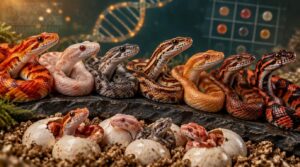
Most corn snake morphs follow a recessive pattern, so you need two copies of the mutant gene before a snake shows the look. Understanding corn snake genetics gives you control over every clutch you plan.
Before you pair any recessive morphs, make sure your corn snake breeding setup requirements are in place so every clutch has the best chance of hatching healthy.
Start with the basic inheritance patterns. Recessive morphs like amelanistic and anerythristic hide in heterozygous carriers, which look normal but still pass the gene on. Dominant morphs like Tessera and Terrazzo show with one copy, so you won’t find hidden carriers. Co-dominant morphs, like Sunkissed and Kastanie, look different with one copy or two, and the double-copy "super" form stands out. The Palmetto morph is an incompletely dominant mutation that first produced heterozygous offspring in 2010 and visual homozygous snakes in 2012.
Keep two terms straight: genotype is the genetic makeup, and phenotype is the color and pattern you see, and the gap between them matters.
How to Predict Corn Snake Color and Pattern Combinations
Now that you know how genotype and phenotype differ, you can put that knowledge to work and forecast your hatchlings before the eggs even drop.
Start with a Punnett square. When you cross two double heterozygotes for amel and anery, you’ll get a 9:3:3:1 ratio: 9 normal, 3 amel, 3 anery, and 1 snow. Those inheritance patterns hold for every clutch.
Follow this routine:
- Write down each parent’s visual traits and known hets.
- Sketch the Punnett square for each gene pair.
- Multiply the odds when you track more than one gene.
- Check your math in an online morph calculator.
Trait expression for Okeetee and Miami phase varies, because polygenic pattern formation shifts color patterns well beyond what any grid predicts.
Because morph lines like Okeetee and Miami phase are often traded and housed together, preventing mites on pet snakes starts with washing up and changing clothes between animals.
Choosing Healthy Corn Snake Breeding Pairs and Maintaining Genetic Diversity

Once you can predict the odds, you’ll want healthy parents to deliver them. Selecting breeding pairs is where your breeding program either thrives or stumbles.
Genetic diversity protects your lines. Pairing relatives raises inbreeding risks, because recessive flaws like kinking in lavender lines or bug eyes in palmetto morphs surface more often.
Keeping detailed pedigree records makes it easier to plan unrelated pairings, and this guide to breeding and selling snakes for profit shows how to turn healthy genetics into steady income.
Use this checklist before you commit:
- Confirm parentage and het status with reputable breeders.
- Choose unrelated bloodlines, never siblings or parent-offspring.
- Check weight, parasites, respiratory signs, and mouth rot.
- Make sure females are three years old and at least 350g.
Bring in a fresh unrelated animal every few generations. Strong genetic health today means sturdier hatchlings tomorrow. Think of every pairing as a handshake between two family histories.
Bring in a fresh unrelated animal every few generations, because every pairing is a handshake between two family histories
How to Prepare and Pair Corn Snakes for Breeding

You’ve picked your pair, so now it’s time to get them ready for breeding season. Your corn snake breeding success depends on two things, and you’ll tackle them in order below. First comes the setup and conditioning that gets your snakes in shape, then the pairing itself.
Since a well-fed female needs solid fat reserves to produce healthy eggs, it helps to plan what to feed breeding corn snakes well before pairing.
Breeding Enclosures and Seasonal Conditioning
Picture a breeder who skips winter cooling and wonders why her females never produce eggs. Don’t let that be you.
Your breeding enclosures need a steady temperature gradient, 80-85°F warm side and 70-75°F cool, plus sensible humidity levels.
Seasonal conditioning comes next. Stop feeding first. Cool snakes to 50-60°F for 8-12 weeks, and your mating season begins right after that.
Once temperatures climb back up, wait for the female’s post-brumation shed before introducing the male, and this corn snake breeding season prep guide walks through the full routine.
Safe Pairing and Mating Observation
Patience pays off when you pair your snakes. Introduce the male to the female’s enclosure after brumation, once both have accepted several meals, and use paper towel substrate so you can spot mating evidence easily.
Watch for chin rubbing and a tail lock lasting 10 to 20 minutes. Separate them afterward, check both snakes, and stop pairing once she kicks him off.
How to Incubate Corn Snake Eggs and Care for Hatchlings

How do you turn a clutch of fresh eggs into healthy hatchlings? Start with a steady incubation temperature of 82°F, and you’ll see hatching in about 58 to 62 days.
- Keep vermiculite damp, never wet, at a 1:1 ratio by weight.
- Check humidity levels weekly for plump, firm, white eggs.
- Remove yellow or moldy slugs promptly.
Candling after two or three weeks lets you apply embryo development research at home, since visible blood vessels confirm a fertile egg. A small, cool-running reptile egg candler flashlight lets you spot blood vessels clearly without overheating the egg or disturbing the embryo.
Once pipped, let hatchlings rest inside for up to 48 hours. Don’t pull them out.
Good hatchling care means a ventilated deli cup with moist paper towel at 75-80°F until the first shed. Then offer a pinky, because proper nutrition starts there.
Frequently Asked Questions (FAQs)
Are corn snakes easy to breed?
Picture a quiet rack of cozy tubs humming with potential.
Corn snake breeding is beginner-friendly, and you’ll manage it by respecting ideal breeding age, offering proper nutrition, and learning corn snake genetics and inheritance patterns.
What snakes can corn snakes breed with?
Corn snakes cross with other rat snakes, kingsnakes, milk snakes and gopher snakes. Hybrid breeding gets risky, though. Reptile genetics, regional variations and genetic lines matter, so keep any hybrids out of your breeding program.
What smell do corn snakes hate?
Honestly, no smell makes your corn snake flee for the hills. Science hasn’t confirmed one.
Perfumes and cleaners just irritate, so skip them. Stick with proper nutrition and stable husbandry, because no proven repellent exists.
How old does it take for a corn snake to breed?
Patience is the slow cooker of breeding. Your corn snake reaches sexual maturity around 18 to 36 months, but the best breeding age depends on weight, not birthdays.
With proper nutrition, you’ll hit reproductive maturity.
How long should breeding pairs rest between clutches?
Give your female at least three to four months of rest between clutches, since recovery time depends on weight and condition, not the calendar.
Patience protects her best breeding age and makes neonate care easier.
How do you determine optimal breeding age for snakes?
Think age alone decides? It doesn’t. Your best breeding age hinges on weight: females at 2-3 years and 300-400 grams, steady feeders. Genetic principles, trait fixation and pedigree analysis only matter once your snake’s healthy.
How much does a corn snake breeding project cost?
Ready to budget like a pro? Expect $500 to $1,500 to start. Breeding stock runs $20-$100 each, plus enclosures, thermostats, and an incubator. Frozen rodents cost $1-$5 per meal, and vet care adds $100-$500 yearly.
Do you need a license to breed corn snakes?
Federally, you don’t need a license to breed corn snakes. States differ, though. Tennessee, Virginia and Indiana require permits for native types, so check your state wildlife agency before starting your breeding program.
What health problems affect lavender corn snakes?
Lavender corn snakes face real health problems you should know about. Their genetic mutations can cause weak hatchlings, kinked tails, and spinal deformities. Heat near 88-90ºF during incubation worsens these issues, so watch your temperatures closely.
Where can breeders sell corn snake hatchlings?
Think of your clutch as a basket of tiny jewels waiting for homes. You can sell your corn snake morphs through MorphMarket, reptile expos, local shops, social groups, or direct pickup, always backed by solid reptile husbandry records.
Conclusion
Picture opening an incubator in late summer and finding a pale, lavender-tinged hatchling you predicted months earlier on a napkin Punnett square. That moment is what corn snake breeding and genetics rewards you with.
You’ve learned to read genotypes, choose healthy unrelated pairs, and time your conditioning. Keep your records tidy and your incubator steady. Every clutch teaches you something new. Your next pairing starts with a simple square, and the snakes do the rest.