This site is supported by our readers. We may earn a commission, at no cost to you, if you purchase through links.

Five breeders control 40% of the annual snake market, and it’s not luck putting them there. It’s genetics, timing, and math. A common corn snake morph nets you $40 to $50. A designer ball python with verified lineage? That same clutch can pull $10,000.
The gap between those numbers is where how to breed and sell snakes for a profit actually gets decided, long before you list a single hatchling online. Get the licensing wrong, skip quarantine, or misjudge a pairing, and you’ll burn through your $2,000 to $10,000 startup capital fast.
Here’s the step-by-step path from empty enclosures to a waiting list of buyers.
Table Of Contents
- Key Takeaways
- Choose Profitable Snake Species
- Build a Legal, Biosecure Breeding Facility
- Pair Breeding Snakes and Track Genetics
- Incubate Eggs and Raise Healthy Hatchlings
- Price, Market, and Sell Snakes Profitably
- Frequently Asked Questions (FAQs)
- What snake is worth $100,000?
- What is the most profitable reptile to breed?
- Do you have to have a license to breed and sell snakes?
- How to start a snake breeding business?
- What are the best snake species to breed for profit?
- How do I set up a proper breeding environment for snakes?
- What is the process for managing the breeding process?
- How do I properly care for snake eggs and hatchlings?
- What are the most effective marketing strategies for selling snakes for profit?
- What permits or licenses are required for breeding?
- Conclusion
Key Takeaways
- Genetics drive the real money in snake breeding—a common corn snake morph nets $40-$50, while a designer ball python with verified lineage can pull $10,000 from the same clutch.
- Skipping the fundamentals is expensive: proper licensing, 90-day quarantine, and disciplined biosecurity stand between you and a wiped-out colony or a $20,000 fine.
- Careful pairing based on pedigree tracking and genetic diversity, not just chasing trendy morphs, protects your profits and keeps inbreeding-related defects from tanking your lines a few generations down the road.
- Getting paid what your snakes are worth comes down to honest disclosure, smart pricing tied to genetics and seasonal demand, and airtight sales records—not just hatching healthy animals.
Choose Profitable Snake Species

Pick the wrong species and you’re feeding snakes that’ll never pay you back. The market rewards breeders who know exactly where the money’s hiding, not the ones chasing whatever looks cool at a reptile expo. Here’s what actually separates a profitable pairing from a expensive hobby.
Ball pythons top that list for a reason—their rare morphs and color combinations keep collectors bidding up prices year after year.
Demand, Competition, and Market Saturation
Before you buy a single snake, run the numbers. The top five breeders soak up 40% of annual sales, so common morphs are brutal. Chase corn snakes ($40-$50) and you’re fighting oversupply. Rare genetics? Less competition, higher margins.
- Ball pythons dominate collector demand
- Common morphs face saturation
- Rare lineages command premiums
- Regional demand shifts fast
- Niche segments stay profitable
Morph Genetics and Sale Potential
Genetics is where the real money hides. A designer ball python morph with verified lineage sells for $500-$10,000, versus $10-$50 for standard stock. Stack multiple traits and allele combination value jumps fast.
Genetic trait research isn’t optional, it’s profit forecasting. Trait rarity pricing plus genetic lineage trust equals 300-500% returns over basic morphs.
Breeding Difficulty and Production Capacity
That 300-500% return means nothing if you can’t produce hatchlings. Clutch size limits (2-6 eggs) and facility space caps cap output hard.
- Aggressive species stress out during pairing, killing your success rate
- Complex husbandry species multiply your failure risk
- Labor scales with every clutch you add
Match temperament and handling tolerance to your capacity before committing.
Seasonal Pricing and Buyer Demand
Timing beats hustle every time. Peak season pricing hits late winter through spring, when demand spikes 20-40% for hot morphs. Off-season discounts (5-15%) move slow inventory.
Buyer readiness timing matters: expos drive 60-80% of seasonal sales, and limited edition spikes reward morphs launched near event dates.
Track market demand analysis, not guesswork.
Startup Costs and Profit Forecasts
Before your first snake pairs up, run the numbers. Initial investment lands between $2,000 and $10,000: racks, heating gear, breeding stock, permits. Monthly operating expenses hit roughly $1,120. Break-even requires 60 hatchlings sold. Profit scenarios range from $1,200 (conservative) to $2,600 (moderate) by year two. A good rule of thumb is to add a contingency fund of 15-20% on top of your one-time and ongoing totals to cover unforeseen costs. Skip this math, and you’re gambling blind.
Build a Legal, Biosecure Breeding Facility
Picking the right species means nothing if your setup falls apart under state inspection or a respiratory outbreak wipes out your breeding stock.
That’s why a detailed snake breeding business plan should cover biosecurity protocols and licensing requirements before you bring home your first pair.
Before you pair a single snake, you need the paperwork, the enclosures, and the climate control locked down tight.
Here’s exactly what that foundation looks like, piece by piece.
Licenses, Zoning, and Insurance

Skip the paperwork and you’re one inspection away from a $20,000 fine. State license requirements vary wildly (Florida’s $50, California’s $83.95), while zoning laws often ban commercial operations in residential zones entirely.
- USDA breeder licenses demand pre-inspection compliance
- Insurance carriers require proof of licensing before coverage
- Records must be retained five years minimum
Skip insurance? One bite claim bankrupts you.
Enclosures and Colony Layout

Efficient enclosure design starts with stackable PVC or melamine enclosures, not glass tanks that crack under humidity swings. Zone your colony deliberately: quarantine separated from breeding stock, feeding rooms away from sleeping units.
Smooth, continuous plastic surfaces sanitize fast. Solid dividers block scent transfer between tiers, while gutters catch spills. Visual access panels mean you inspect without disturbing every animal, saving hours weekly.
Temperature, Humidity, and Ventilation

Get the basking zone wrong by a few degrees and you’ll tank fertility rates before breeding season starts. Run 88-92°F basking with low-80s ambient, using thermostat controlled heat cords, never bare wire. Digital hygrometers track 50-70% humidity for moisture-loving species. Passive vents plus controlled fans deliver 0.5-1.0 air changes hourly. Thermal gradient management isn’t optional, it’s your fertility insurance policy.
Quarantine and Disease Prevention
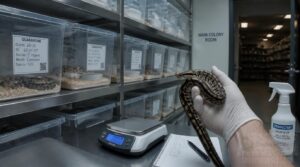
One sick snake can wipe out a season’s profits. Quarantine new arrivals for 90 days minimum, dedicated tubs only, no shared tongs or water dishes.
- Watch for wheezing or mucus (respiratory red flags)
- Track weight weekly for silent decline
- Log every observation, treatment included
- Handle residents first, quarantine last
Enclosure sanitation demands contact-time disinfectants and reptilesafe solutions. Skip biosecurity, lose your colony.
Welfare Standards and Daily Care

A stressed snake stops eating, and a snake that stops eating stops making you money. Daily care means visual health checks, enrichment strategies with hides and varied substrate, and a fixed feeding schedule matching species metabolism.
Use gentle handling techniques, log stress signs like gaping, and pair strict humidity control with temperature gradients. Welfare and profit aren’t opposites, they’re the same spreadsheet.
Welfare and profit aren’t opposites, they’re the same spreadsheet
Pair Breeding Snakes and Track Genetics

Your facility’s built and your stock is settled in. Now the real work starts: turning healthy snakes into healthy, valuable offspring without wrecking your genetic lines in the process. Here’s what you need to nail down before you ever put a male and female in the same tub.
Breeding Readiness and Seasonal Cycling
If your pairs aren’t cycling right, your whole season’s profit stalls before it starts. Prebreeding conditioning demands protein checks and parasite screening weeks out.
Run a cooling period, then adjust:
- Photoperiod down 6-12 weeks
- Nighttime temps dropping seasonally
- Humidity raised pre-shed
- Appetite and shedding logged
Confirmed readiness triggers ovulation, timing your incubation process and hatchling rearing months ahead.
Safe Pairing and Courtship Signs
Once your pairs are cycling, watch the enclosure like a hawk. Tail flicking and head bobbing signal arousal, not aggression. Pupil dilation, olfactory cues, and tongue flicking confirm mutual interest.
Reduced aggression, calm movement, and coiled posture near the mate mean copulation’s likely. Misread these signs and you’ll waste a whole reproductive cycle.
Genetics, Pedigrees, and Pairing Plans
Courtship gets you copulation. Genetics gets you paid. Before pairing anyone, run pedigree charts: squares for males, circles for females, shaded symbols marking your target trait.
Genotype probability calculation predicts hatchling odds. Track carrier status for recessive genes and watch sex-linked traits closely, since X-linked recessives skip generations through carrier mothers. Verified genetics justify $500-$10,000 price tags. Sloppy records don’t.
Genetic Diversity and Inbreeding Prevention
Chase morphs and skip founder line selection, and you’ll pay for it in three generations.
Track inbreeding coefficients on every pairing, run genetic testing where possible, and pull in unrelated stock through genetic rescue before defects surface.
Deep pedigree analysis beats guesswork. Diverse gene pools mean stronger hatchlings, better disease resistance, and a collection that still profits when the recessive-gene crash hits competitors.
Mating, Ovulation, and Health Records
Watching for mating readiness signs protects your investment. Males chase, tail-rub, females stop retreating. Ovulation follows: weight gain, brief appetite dip.
Track everything:
- Pairing dates
- Ovulation confirmation
- Egg-laying date
- Clutch size
- Health checks
Solid recordkeeping systems catch reproductive health issues before they cost you a clutch, and buyers pay premiums for documented lineage.
Incubate Eggs and Raise Healthy Hatchlings

Your snake did her job. Now the eggs are yours to protect, and this is where careless breeders lose an entire clutch overnight. Get these five steps right, starting with how you move those eggs in the first place.
Egg Collection Without Rotation
Roll an egg once and you can drown the embryo. That’s the whole game here: Gentle Egg Handling with tweezers at 45 degrees, upright, broad end up.
Position Marking in pencil before touching anything. Clutch Stability means no shuffling during Incubation Transfer. Label each egg’s lay date for tracking reproductive health straight through to hatchlings.
Incubation Media and Humidity Control
Get your vermiculite perlite mixture wrong and you’ll cook or drown the clutch. Mix 1:1 by weight, keep media moisture retention consistent, and calibrate digital hygrometers to within 2%. Target 85-95% RH for soft-shelled eggs.
Airflow distribution control matters too: gentle circulation stops condensation without drying eggs out. Check egg orientation marking daily.
Temperature Monitoring and Hatch Timing
Three degrees off for 48 hours can deform a whole clutch. Place sensors at every tray level, tape probes to egg equators, and log continuously. Sync humidity with temperature shifts. Set alarm thresholds tight:
- Instant deformity risk
- Lost hatch windows
- Wasted breeding cycles
- Blown profit margins
Stable readings predict pipping within 24-48 hours, timing sales perfectly.
First Sheds and Feeding Schedules
That first shed is the neonate’s clock, ticking loud. Expect it 7 to 21 days post-hatch, humidity locked at 60-70%.
| Signal | Action |
|---|---|
| Cloudy eyes | Raise humidity |
| Clear eye caps | Confirm complete shed |
| Retained skin | Soak, don’t feed |
| Full shed | Offer pinky within days |
Feed only after clean sheds. Rushed feeding invites impaction risk.
Health Checks and Sale Readiness
A snake that looks fine can still be hiding trouble. Run a fecal test for parasites, check the vent, mouth, and skin for infection, and log weight trends before listing.
Confirm the 30 day quarantine’s complete, document everything, and issue a health certificate. Buyers pay premiums for verified records, not guesswork.
Price, Market, and Sell Snakes Profitably

Hatching healthy snakes is only half the job; getting paid what they’re worth is where most breeders leave money on the table. Pricing, marketing, and shipping decisions can turn a $50 corn snake project into a loss or a $10,000 morph into a payday.
Here’s what separates breeders who sell out fast from those still stuck with unsold stock.
True Costs and Profit Margins
If your books don’t show real numbers, you’re guessing at profit.
Direct costs (feed, vet care, housing) eat roughly 28% of expenses; labor costs run 25-35%. Overhead adds another 40-60% for facility payments alone.
Run a real cost-benefit analysis: expect gross margins near 25-50%, but net margins usually land at 10-30% after everything’s paid.
Pricing by Genetics and Demand
Margins mean nothing if you’re pricing blind. Genetic rarity pricing pushes top morphs 50% above standard stock, while unproven lines lag 30% behind verified pedigrees.
Watch the calendar: seasonal spikes hit late spring at 20-40% premiums. Limited hatches from single pairs? Add another 15-25%. Set price floors near 60% of market value, never lower, or you’re bleeding profit margin optimization out the door.
Online Listings, Social Media, Expos
Getting the price right means nothing if nobody sees the listing. Hero image tips matter: clean close-ups against natural setups sell faster on MorphMarket.
Run reels on Instagram and Facebook using species-specific hashtags, post live feeding clips to prove vigor, and answer buyer messages within 24 hours.
Expos demand sharp booth branding and preorder deposits to convert foot traffic into sales.
Buyer Trust and Honest Disclosures
A pretty reel gets clicks, but honest disclosure closes deals and keeps buyers coming back. List exact morph, hatch date, feeding history, and any past treatments, every time.
- The buyer who feels protected instead of duped
- The reputation that outlives any single sale
- The repeat customer who tells five friends
Quarantine steps and health certificates aren’t optional extras. They’re what separates a real breeder from a flipper.
Legal Shipping and Sales Records
Every sale ends at the shipping label. Keep tracking numbers, a signed bill of sale, and buyer ID matching the delivery address.
Crossing state lines? The Lacey Act and US Fish and Wildlife Service rules apply. Retain records five to seven years, export docs, contract terms, licensing paperwork included. Sloppy files invite $20,000 fines. Airtight records mean a bulletproof business.
Frequently Asked Questions (FAQs)
What snake is worth $100,000?
High blue morph green tree pythons hit $445,800 in international sales.
That kind of money demands rare blue morphs, verified premium lineage, and true collector-grade specimens, proving scarcity and genetics, not novelty, drive six-figure snake valuations.
What is the most profitable reptile to breed?
Ball pythons top the list. Rare morphs like sunset and chocolate variants tap huge market demand.
Multiple clutches yearly, and quick maturity mean growing profit margins that outpace corn snakes or standard hognose stock by a wide margin.
Do you have to have a license to breed and sell snakes?
Picture a rack of clipboards next to every enclosure, because that’s compliance reality. Yes, most states demand breeder licenses, zoning approval, and record keeping. Venomous species need federal permits too. Skip legal compliance and risk fines up to $20,
How to start a snake breeding business?
Nail your licensing requirements and legal compliance checklist first. Invest $2,000-$10,000 in breeding stock and enclosures, run market demand analysis on morphs, then build a business model canvas covering inventory management and risk mitigation before your first clutch hatches.
What are the best snake species to breed for profit?
Corn snakes and ball pythons lead the pack for beginner-friendly profit, thanks to steady demand and forgiving care. Boas and hognose snakes reward patience with premium morph pricing once you’ve built genetics and reputation.
How do I set up a proper breeding environment for snakes?
Think telegraph-era precision meets modern tech: pair thermostat-controlled heat cords with a stable thermal gradient (88-92°F basking, 78-82°F cool end), proper ventilation, non-toxic substrate, and a dedicated quarantine setup before any snake joins your breeding colony.
What is the process for managing the breeding process?
Managing the process means goal setting first, then cycle scheduling around seasonality, careful pairing strategies, disciplined incubation techniques with tight temperature control, daily health monitoring, and honest record keeping so every profitability review actually means something.
How do I properly care for snake eggs and hatchlings?
Want hatchlings that actually sell? Keep incubation at 88-90°F with 90-95% humidity, candle eggs early, skip rotation. Post-hatch, quarantine 30 days, offer pinky mice after first shed, and weigh within 24 hours.
What are the most effective marketing strategies for selling snakes for profit?
Visibility sells snakes, not charm. Combine social media marketing, reptile show networking, and email campaigns with honest customer reviews. Track market trends, price by genetics and demand, and build a brand buyers trust enough to return to.
What permits or licenses are required for breeding?
Paperwork before python: skip permits and you’re not breeding, you’re poaching. States require a Reptile Breeders License ($100-$500), USDA permits interstate sales, and wild collection caps (four to five per species) apply regardless of Endangered Species Act status.
Conclusion
Right species, right genetics, right buyer. That’s how to breed and sell snakes for a profit, and it starts long before your first clutch hatches.
The breeders pulling $10,000 from a single pairing didn’t get lucky. They tracked pedigrees, held quarantine standards, and priced with data instead of guesswork.
Your enclosures won’t fill a waiting list. Your records will. Build the system first, and the profit follows on its own schedule.