This site is supported by our readers. We may earn a commission, at no cost to you, if you purchase through links.
Most snake keepers think of UV lighting as optional—a nice-to-have for diurnal species, irrelevant for a ball python curled under a hide at noon. The biology tells a different story.
Without adequate UVB exposure, a snake can’t synthesize vitamin D3 in its skin, and without vitamin D3, intestinal calcium absorption drops regardless of what’s in the prey item. That calcium deficit doesn’t just affect bones—it ripples through muscle contractility, gut motility, and the metabolic machinery that drives digestion itself.
Understanding how UV lighting aids snake digestion means tracing that chain from photon to physiology, and knowing exactly where heat, diet, and species biology either reinforce or replace it.
Table Of Contents
- Key Takeaways
- How UV Lighting Supports Snake Digestion
- UVB, Vitamin D3, and Calcium Absorption
- Heat Makes Digestion Work Properly
- Safe UVB Setup for Snakes
- Building a Digestion-Friendly Enclosure
- Frequently Asked Questions (FAQs)
- What does an UV light do for snakes?
- Why is UV light important for reptiles?
- Can UVB lighting stress certain snake species?
- How often should snakes be fed for optimal health?
- Do snakes need UVB lighting during brumation?
- Can too much UVB exposure harm a snake?
- How does UVB lighting affect snake shedding cycles?
- Conclusion
Key Takeaways
- UVB light triggers a chain reaction in your snake’s skin that produces vitamin D3, which is what actually allows calcium from prey to be absorbed in the gut — skip the UVB, and that chain breaks regardless of diet quality.
- Heat isn’t just comfort; it’s a prerequisite for both digestion and vitamin D3 synthesis, since previtamin D3 can’t convert to its active form without adequate skin warmth, making thermal gradient setup your first priority.
- Glass and most plastics block over 90% of usable UVB, so even a quality bulb becomes functionally useless if there’s a barrier between it and your snake — mesh tops are the only reliable option.
- Whole-prey feeding delivers calcium in a biologically integrated form that supplements can’t fully replicate, but it only pays off when your snake’s D3 status is solid enough to actually pull that calcium across the gut wall.
How UV Lighting Supports Snake Digestion
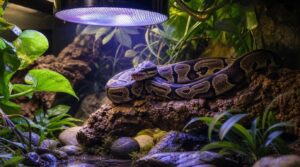
UV lighting does more for your snake than just brighten the enclosure — it quietly drives a chain of biological processes that keep your animal healthy from the inside out. Understanding how UVB connects to vitamin D3, calcium absorption, and metabolism helps you make smarter choices about your setup.
Getting the balance right takes some know-how, so checking out this guide on whether pet snakes actually need UVB light can save you a lot of guesswork.
Here’s how each piece fits together.
UVB Helps Snakes Produce Vitamin D3
When UVB hits your snake’s skin, it triggers a photochemical reaction that converts skin precursors — specifically 7-dehydrocholesterol — into previtamin D3. Intensity threshold matters here; too little irradiance and the conversion stalls.
Environmental filtering through glass or plastic blocks most usable UVB, undermining photochemical efficiency entirely.
Age-related capacity may also influence synthesis rates, making consistent, unobstructed UVB access central to supporting vitamin D3 synthesis in reptiles.
Inadequate UVB can lead to metabolic bone disease, a common serious captive reptile disorder.
Vitamin D3 Supports Calcium Absorption From Prey
Once vitamin D3 synthesis in reptiles is underway, the real work begins in the gut. Your snake’s intestinal cells rely on 1,25-dihydroxyvitamin D3 to upregulate calbindin expression, enabling active transcellular uptake of prey calcium.
This two-step timing means prey calcium bioavailability depends on your snake’s D3 status before feeding — not after. Without adequate plasma 25-hydroxyvitamin D3 levels, ionised calcium concentrations can drift, regardless of prey quality.
- Active transcellular uptake moves calcium across intestinal epithelium efficiently
- Calbindin expression increases when D3 signaling is adequate
- Supplemental D3 can partially compensate when UVB lighting methods for captive reptiles fall short
Better Mineral Use Supports Normal Metabolism
Calcium absorption is just the entry point.
Once ionised calcium levels stabilize through adequate plasma 25-hydroxyvitamin D3, your snake’s broader mineral economy runs more smoothly — Zinc Enzyme Activity assists digestive enzymes, Phosphorus Energy Production fuels ATP-dependent processes, and Magnesium Muscle Function keeps gut motility coordinated.
Mineral Cofactor Efficiency and Calcium Hormone Regulation work together, meaning peak vitamin D3 synthesis doesn’t just feed bones; it sustains whole-body metabolic throughput.
UV Lighting is Supportive, Not a Replacement for Proper Heat
All of that mineral support runs on one condition: your snake has to be warm enough to use it.
Heat priority isn’t optional — thermoregulation drives digestion, enzyme activity, and vitamin D3 synthesis itself. UV supplement benefits collapse without thermal zoning behind them. Think of heat-UV integration as a partnership with a clear lead:
- reliable basking zone (mid-80s °F warm side) comes first.
- Heat source options — mats, panels, ceramic emitters — set the pace.
- UV lighting necessity for captive snakes is real, but secondary to basking behavior and core warmth.
UVB, Vitamin D3, and Calcium Absorption
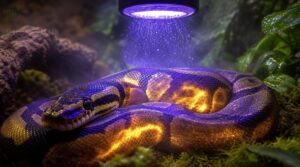
Understanding how UVB actually works inside your snake’s body makes the rest of the setup decisions easier. It all comes down to a chain reaction — UV hits the skin, triggers vitamin D3 production, and that drives how well your snake pulls calcium from its food.
When that D3 chain breaks down — often because temps are too low — you’ll start seeing the signs your snake needs more heat show up as poor appetite and sluggish digestion long before anything looks obviously wrong.
Here’s what’s happening at each step.
How UVB Converts Skin Compounds Into Vitamin D3
The process starts the moment UVB photons in the 290–315 nm range strike 7‑dehydrocholesterol (7‑DHC) in your snake’s skin — a reaction called 7‑DHC photoactivation. This produces previtamin D3, which is thermodynamically unstable and converts to vitamin D3 only with sufficient skin warmth, a process called thermal conversion kinetics.
| Stage | Key Detail |
|---|---|
| 7-DHC Photoactivation | UVB wavelength specificity: 290–315 nm required |
| Previtamin D3 Stability | Unstable intermediate; temperature‑dependent conversion |
| Lumisterol Formation Pathway | Excess UVB redirects previtamin D3 to lumisterol 3 |
| Vitamin D3 Entry | Skin‑derived D3 binds transport protein, enters circulation |
Why Vitamin D3 Matters for Intestinal Calcium Uptake
Once your snake synthesizes vitamin D3, its body converts it to 1,25-dihydroxyvitamin D3 — the hormonally active form driving the vitamin D3 pathway. This hormonal activation triggers intestinal efficiency through active transport and calcium-binding proteins, pulling calcium from prey across enterocyte membranes.
Dose-dependent absorption means better plasma 25-hydroxyvitamin D3 levels translate directly to improved calcium metabolism — and ultimately, steadier ionised calcium levels in circulation.
The Role of Calcium and Phosphorus in Nutrient Use
Getting calcium absorbed is only half the equation — what happens next depends on the mineral ratio between calcium and phosphorus. Too much phosphorus disrupts hormonal regulation, pulling calcium balance off course.
Vitamin D3 synthesis helps the whole system, but only when both minerals are properly balanced:
- Calcium acts as an enzyme cofactor for muscle and nerve function
- Phosphorus drives phosphorus energy transfer in cells
- Absorption competition means excess phosphorus limits calcium uptake efficiency
Why Whole-prey Diets Usually Provide Strong Calcium Support
Whole prey bones are the most reliable natural calcium source your snake gets — no guesswork, no separate calcium supplementation required. When a snake swallows a whole mouse or rat, it consumes an integrated mineral pack: skeleton, marrow calcium, connective tissue, and organs together.
Prey species variation affects exact mineral ratios, but the calcium still arrives coupled to the full nutritional matrix, supporting vitamin D3 synthesis and nutrient absorption efficiently.
Heat Makes Digestion Work Properly
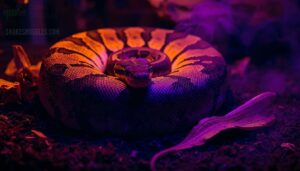
Heat isn’t just comfort for a snake — it’s what makes digestion physically possible. Without the right thermal gradient, even a perfectly fed snake can struggle to process a meal efficiently.
Here’s how temperature drives the whole system.
Snakes Need Warmth to Digest Meals Efficiently
Warmth isn’t optional — it’s the engine behind every meal your snake processes. Enzyme activity rates drop sharply when body temperature falls, slowing digestive transit time and leaving food sitting longer than it should. Meal size impact matters here too: larger prey demands more sustained heat. Hydration’s influence is real, as dehydrated snakes often can’t thermoregulate effectively during digestion.
- Maintain a thermal gradient so your snake can self-regulate postprandial rest
- Belly heat sources directly support enzymatic gut function after feeding
- Larger meals require consistent warm-zone access for extended digestion periods
- Dehydration reduces thermoregulatory capacity, compounding digestive stress
Belly heat versus UV for reptile digestion isn’t a close contest — heat wins every time.
Temperature Affects Vitamin D3 Synthesis and Metabolism
UVB dosage means nothing if your snake’s too cold to use it. Vitamin D synthesis depends on thermal conversion rate — skin temperature kinetics determine how fast previtamin D3 becomes active vitamin D3. Cold inhibition can stall the process entirely. Heat metabolism keeps temperature-dependent enzymes running, supporting calcium metabolism downstream.
| Temperature Zone | Vitamin D3 Conversion | Calcium Metabolism |
|---|---|---|
| Warm (29–32°C) | Efficient | Active |
| Cool (20–25°C) | Slowed | Reduced |
| Cold ( In a snake’s body, bones, muscles, kidneys, and gut form one mineral circuit — disrupt one, and the rest follow |
Understanding calcium metabolism in captive reptiles means recognizing this system as one circuit, not separate parts.
Safe UVB Setup for Snakes
Getting UVB right isn’t complicated, but the details matter.
A few practical decisions — where the bulb sits, what’s between it and your snake, and how you pair it with heat — make the difference between a setup that works and one that falls short.
Here’s what to get right.
Place UVB Where The Snake Can Choose Exposure

Think of your enclosure as a UV dial that your snake controls by moving. Smart UVB Gradient Design means placing the bulb over the warm side, using reflector positioning to concentrate the beam on the basking surface, then leaving the far end shaded — true Choice Zone Placement:
- High-UV sunbeam zone at the basking spot
- Mid-range intermediate corridor between sides
- Low-UV shaded retreat opposite the bulb
- Darkness preserved during the off-timer rhythm
Monitor behavior to confirm your snake actually uses UV lit zones across the gradient.
Avoid Glass or Plastic Between Bulb and Snake
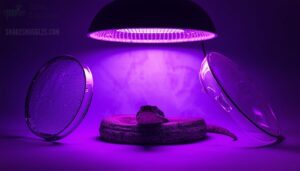
Glass and plastic containers — including plastic terrarium lids, plastic tupperware-style enclosures, and standard aquarium covers — block over 90% of UVB before it reaches your snake’s skin. That’s barrier UV loss in action, and it turns an expensive bulb into a glorified heat lamp.
Material transparency issue runs deeper than it looks: UV shielding pigments embedded in most plastics filter the precise 290–320 nm wavelengths driving vitamin D₃ synthesis, while glass heats up and creates basking spot safety concerns if your snake presses against it.
Heat distortion risk compounds the problem — warped plastic shifts lamp angle, increasing UVB intensity drop at the animal’s position.
| Material | UVB Transmission | Additional Risk |
|---|---|---|
| Standard glass | <10% | Burns on contact, IR heat buildup |
| Clear plastic terrarium lid | <10% | Warps near lamp, UV shielding pigments block output |
| Mesh/screen (metal) | ~95% | Minimal; occasional minor intensity reduction |
| Purpose-built UV plastic | Variable | Verify manufacturer transmission data |
| No barrier (open mesh top) | ~100% | Ideal; follow safety guidelines for UV lamp placement |
Remove the barrier entirely whenever possible.
Provide Hides and Shaded Areas
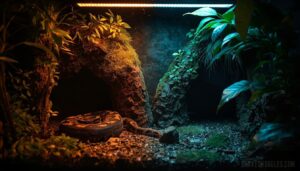
Your snake needs both access to UVB and a way to escape it. Place a dry hide on the warm side and another on the cool side — gradient hide positioning lets the animal self‑regulate exposure without stress.
Shade retreat design is simple: stable, snug, and always reachable. A humidity hide during shedding adds environmental enrichment, balancing the sunbeam method with controlled shade.
Replace UVB Bulbs Before Output Declines
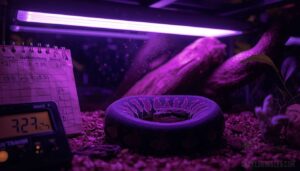
A bright bulb isn’t a working bulb — UV decay over time happens invisibly, long before the lamp flickers. Monitoring UV output and lamp decay demands a system, not guesswork:
- Bulb Age Tracking — Log your start date immediately.
- Operating Hours Log — T5 HO bulbs last ~12 months; compact coils, 6–8.
- Replacement Calendar — Schedule swaps before output drops, not after.
- UVB Meter Testing — Use of UV Index meters in husbandry confirms actual irradiance.
- Output Decline Indicators — Reduced basking behavior signals weakening UVB lamp lifespan.
Use UVB With Thermostated Heat Sources
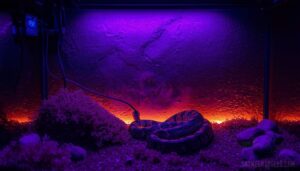
Thermostat‑linked UVB and heat mat setups work as a system, not separately.
Run your UVB on an automated UVB timing schedule — 10 to 12 hours daily — while a probe‑driven thermostat regulates your heat cable or mat to maintain the warm side within a consistent range. This heat‑UVB sync ensures gradient‑based UVB control aligns with the temperatures your snake actually needs for digestion.
Building a Digestion-Friendly Enclosure
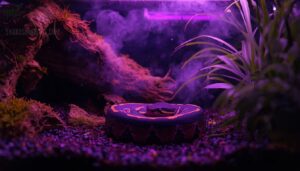
Getting digestion right starts with the enclosure itself. Every element — temperature, lighting, humidity, and your own hands-off discipline after feeding — plays a direct role in how well your snake processes a meal.
Here’s what a digestion-friendly setup actually looks like in practice.
Create a Reliable Warm and Cool Gradient
Heat source positioning determines everything here — place your heat source at one end only, then let the opposite side breathe at ambient temperature for cool zone insulation. Use a thermostat with probe placement accuracy at basking height, not in empty air.
Gradient monitoring with two separate thermometers confirms that your thermal gradient implementation in plastic enclosures stays stable, giving your snake a genuine physiological choice.
Match UVB Strength to Species Needs
Once you’ve nailed your gradient, UVB intensity calibration becomes the next variable — and species-driven, not one-size-fits-all. Habitat-based UVB selection matters because UVB requirements across reptile taxa vary considerably:
- Diurnal species need stronger irradiance for natural sunlight mimicry.
- Nocturnal pythons require lower UVB supplementation levels.
- Forest dwellers need less intensity than desert baskers.
- Species-specific UVB mapping prevents chronic under- or overexposure.
Support Feeding With Proper Humidity and Ventilation
Humidity gradient control works alongside your UVB supplementation setup — both shape the internal environment where snake digestion actually happens.
Target 55–65% ambient humidity for ball pythons, using misting hide placement in the cooler zone so your snake can self-select moisture without saturating the substrate.
Ventilation mesh design prevents ammonia and moisture buildup, while substrate moisture balance keeps conditions stable.
| Factor | Target Range |
|---|---|
| Ambient Humidity | 55–65% |
| Shedding Humidity | Up to 70% |
| Substrate Condition | Damp, not soggy |
Avoid Handling Soon After Meals
Once your snake has eaten, the enclosure does all the work — you don’t need to. Post-feeding stress is a real physiological trigger, and regurgitation risk climbs sharply when handling timing is ignored.
- Wait 48 hours minimum after any meal
- Extend to 72 hours for larger prey items
- Avoid repeated enclosure checks in the first few hours
- Wash hands to prevent scent transfer before any contact
- Keep the room calm — minimal disturbance matters as much as belly heat or UV exposure for snake digestion
Monitor Behavior, Appetite, Shedding, and Body Condition
Once post-feeding calm is established, your attention shifts to reading the animal itself.
Weight Tracking, Prey Response, and Shed Quality are your clearest indicators — a snake holding steady body weight, responding normally to prey, and producing complete shed skins tells you the balance of belly heat versus UV for reptile digestion is working.
Declining Body Firmness or irregular Activity Patterns warrant a closer look.
Frequently Asked Questions (FAQs)
What does an UV light do for snakes?
UVB lighting drives plasma 25-hydroxyvitamin D3 synthesis, supporting calcium metabolism in captive reptiles, hormonal regulation, circadian rhythm alignment, and immune enhancement — while skin pigment activation and UV exposure benefits contribute to overall physiological balance.
Why is UV light important for reptiles?
UV light does far more than support digestion — it drives vitamin D production, regulates circadian rhythm, promotes skin integrity and eye health, strengthens calcium metabolism, and bolsters immune enhancement, making UV exposure benefits are foundational to reptile bone health overall.
Can UVB lighting stress certain snake species?
Yes, it can.
Nocturnal species face stress from overexposure if UVB bulb placement eliminates shaded retreat zones, creating thermal gradient conflict. Always give your snake the choice to leave UV radiation entirely.
How often should snakes be fed for optimal health?
Think of feeding rhythm as a biological clock. Hatchlings need meals every 5–7 days, juveniles every 7–10, adults every 10– Body condition cues guide adjustments better than any fixed calendar.
Do snakes need UVB lighting during brumation?
During brumation, your snake isn’t eating, so prey digestion and calcium absorption practically pause.
Brumation energy conservation takes priority — stable cool temperatures and minimal disturbance matter far more than maintaining a UVB light schedule.
Can too much UVB exposure harm a snake?
Yes, excessive exposure to UVB radiation can cause eye damage, skin burns, and reproductive failure.
Without escape routes, behavioral stress compounds the risk, making hide access non-negotiable in any UVB setup.
How does UVB lighting affect snake shedding cycles?
Shedding frequency ties closely to UVB radiation through photoperiod influence, scale integrity, and hormonal regulation — consistent exposure facilitates predictable molting timing and skin health, helping your snake shed cleanly and on schedule.
Conclusion
It’s rarely one thing that tips a snake’s health in the right direction—it’s the quiet alignment of several systems working together. Understanding how UV lighting aids snake digestion is less about chasing a single fix and more about recognizing that photons, temperature, prey quality, and calcium metabolism are all part of the same conversation.
Get the enclosure conditions right, and your snake’s biology does the rest—efficiently, predictably, and exactly as evolution intended.