This site is supported by our readers. We may earn a commission, at no cost to you, if you purchase through links.
A baby boa constrictor can double its length before its first birthday—yet two snakes hatched the same day, fed the same keeper, can end up dramatically different sizes by year three. Baby boa growth speed isn’t just about time passing; it’s the product of feeding schedules, enclosure temperatures, genetics, and decisions made in those first critical weeks.
Get those variables right, and you’re looking at a healthy 3–6 foot juvenile by year three. Missing them, and growth stalls in ways that aren’t always obvious until the numbers tell you something’s off.
Table Of Contents
- Key Takeaways
- Baby Boa Growth Timeline
- Boa Size by Age Chart
- Feeding and Growth Speed
- Temperature and Habitat Effects
- Genetics and Adult Size Potential
- Top 10 Boa Growth Products
- 1. Boa Constrictor Care Guide
- 2. Rismise Cobra Life Cycle Figurine
- 3. Farmers Secret Snake Plant Fertilizer
- 4. Gardenera Snake Plant Fertilizer Mist
- 5. Tala Organic Hair Growth Oil
- 6. Victor Snake Repellent Granules
- 7. Shenhailan Realistic Snake Garden Model
- 8. HiThrive Snake Plant Liquid Fertilizer
- 9. Fast Draining Snake Plant Soil
- 10. Ortho Yard Snake Repellent Granules
- Frequently Asked Questions (FAQs)
- Conclusion
Key Takeaways
- Feeding frequency matters more than most keepers expect—weekly meals during the first year drive steady growth, while every-two-week schedules make it easy to miss early signs of stunting.
- Your enclosure’s temperature gradient directly controls digestion (80–88°F ambient, 88–95°F basking spot), meaning a cool enclosure stunts growth even when feeding is perfect.
- Genetics set the ceiling before you feed the first mouse—subspecies like dwarf locality boas top out at 3–5 feet, while B. c. constrictor lines can push past 10 feet, so knowing your snake’s lineage sets realistic expectations from day one.
- A clean shed every 4–6 weeks isn’t just a housekeeping milestone—it’s your clearest visible signal that temperature, humidity, and nutrition are all working together as they should.
Baby Boa Growth Timeline
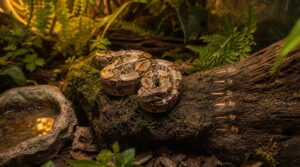
Boa constrictors follow a surprisingly predictable growth pattern once you understand the key phases.
Knowing what to expect at each stage makes care much easier—this boa constrictor size and growth guide breaks it all down clearly.
From the moment they’re born to the point where growth nearly plateaus, each stage comes with its own benchmarks worth tracking.
Here’s how that timeline usually unfolds.
Newborn Boa Size: 18–24 Inches and 55–65 Grams
Your newborn boa arrives somewhere between 18 to 24 inches long and weighing just 55 to 65 grams — a surprisingly compact start for a snake that may eventually top 8 feet. Newborn boas usually measure about 2 ft in length, as shown by the newborn boa length data.
Birth length variability is mostly genetic, and litter size impact varies. This slim weight-to-length ratio means hatchlings need a consistent feeding schedule from day one to build momentum for growth.
First Shed Within The First 14 Days
Within the first 14 days, your hatchling will undergo its first shed, a crucial stage in the juvenile development of boas. Watch for the blue eye indicator: cloudy, bluish eyes signal that the shed is imminent.
Maintain humidity levels around 50–60% and minimize handling to reduce stress during this period. If an incomplete shed occurs, the remedy begins with adjusting the humidity.
Once the eyes clear, you can initiate the feeding schedule.
Typical First-year Growth Range: 22–36 Inches
Once that first shed is behind you, your boa enters one of its most formative windows: the first year of life. Growth rate variability is real here—feeding schedule, prey’s nutrient composition, and enclosure design impact all, shaping where your snake lands within that 22–36-inch range.
Weekly feeders consistently hit the higher end, while bi-weekly schedules produce slower, though still healthy, juvenile growth phases in boas.
Juvenile Growth Phase During Years 1–3
Between years one and three, the rapid juvenile growth phase in boas is where genetics and husbandry collide most visibly.
Your boa’s metabolic rate peaks during this window, with hormonal regulation driving length gains of 6–18 inches annually.
Stress hormone effects from poor enclosure conditions can quietly flatten that growth curve—modeling experts expect boas to commonly reach 3–6 feet by year three under consistent feeding schedules.
Growth Slowdown After Sexual Maturity
Once sexual maturity occurs—typically around 3–5 years—hormonal shifts redirect energy allocation away from rapid length gains toward reproduction and maintenance.
Metabolic decline sets in gradually, and bone remodeling slows considerably. Your boa’s growth ceiling doesn’t disappear, but the pace drops sharply. Seasonal dormancy can exacerbate this plateau.
Adjusting your feeding regimen helps avoid unnecessary weight gain during this natural growth slowdown.
Near-adult Size by 4–5 Years
By ages 4–5, most boas enter near-adult territory, with lengths commonly ranging between 4–6 feet and weights between 2.5–6 kg. Seasonal growth fluctuations persist, but long-term weight stabilization becomes the dominant pattern.
Physiologically, bone density development and muscle mass accretion gradually taper as the snake’s immune system matures. This stage prioritizes monitoring body condition over rapid length gains.
Tracking should emphasize:
- Body condition over raw length gains
- Adjusted feeding frequency to prevent obesity
- Consistent size and weight chart entries to detect subtle shifts
Boa Size by Age Chart
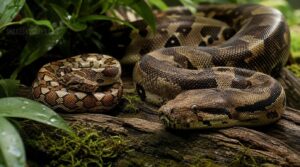
Watching your boa grow is one of the more rewarding parts of keeping these snakes, and having a clear reference makes it much easier to know if you’re on track. Growth varies by age, feeding schedule, and genetics, but the numbers below give you a solid baseline to work from.
Here’s how size usually stacks up from birth through adulthood, providing a framework to monitor your snake’s development effectively.
Birth: 18–24 Inches, 55–65 Grams
Every newborn boa arrives as a compact powerhouse — measuring 18 to 24 inches and weighing just 55 to 65 grams. Maternal nutrition and gestation duration directly influence this hatchling size variability among subspecies. Hatchling sex and seasonal birth timing add further weight variability to the mix.
| Metric | Low End | High End |
|---|---|---|
| Length at Birth | 18 inches | 24 inches |
| Weight at Birth | 55 grams | 65 grams |
| Litter Size | 10 neonates | 65 neonates |
| Membrane Shed | Within hours | Within hours |
| First Skin Shed | Day 1 | Day 14 |
6 Months: Around 141 Grams With Steady Feeding
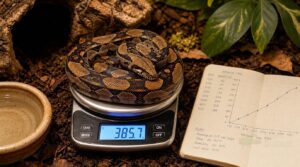
By six months, a juvenile boa fed on a consistent 7- to 10-day schedule typically reaches ~141 grams, establishing a reliable weight tracking standard for growth chart monitoring.
Nutrient absorption improves with proper feeding frequency, directly influencing Body Condition Score assessments.
Watch for growth plateau signs, such as stagnant weekly weigh-ins, to ensure healthy development.
| Achievement | Typical Range |
|---|---|
| Weight at 6 months | ~141 grams |
| Weekly weight gain rate | 20–35 grams |
| Health monitoring interval | Every 1–2 weeks |
12 Months: Commonly 22–36 Inches
At 12 months, juvenile boas typically measure 22–36 inches, a range influenced by factors such as nutritional impact and feeding frequency guidelines for different life stages. Sexual dimorphism early on can also slightly affect these measurements.
| Growth Chart Factor | 12-Month Range |
|---|---|
| Length | 22–36 inches |
| Feeding interval | Every 7–10 days |
| Regional size differences | Dwarf vs. standard locality |
| Health indicators | Consistent shedding cycle |
2 Years: Often 4–5 Feet and 2–4 Kg
By the two-year mark, juvenile boas are hitting a real turning point, with most reaching 4–5 feet in length and weighing 2–4 kg. Your growth chart tracking should reflect this steady climb.
Hormonal growth factors become increasingly active during this phase, while molting frequency shifts to every 4–6 weeks and scale pattern development sharpens visibly. These physiological changes mark a critical transition in their maturation.
The correlation between activity levels and feeding schedules directly shapes weight gain curves at this stage. Maintaining consistent feeding intervals (every 10–14 days) remains key to supporting healthy growth.
| Measurement | Two-Year Range |
|---|---|
| Length | 4–5 feet |
| Weight | 2–4 kg |
| Molting cycle | Every 4–6 weeks |
| Feeding interval | Every 10–14 days |
3 Years: Often 6–7 Feet and 6–8 Kg
At three years, your boa’s skeletal growth patterns and muscle mass development converge into a genuinely impressive form—most individuals reach 6–7 feet in length and weigh between 6–8 kg.
During this phase, hormonal growth peaks remain active, making feeding efficiency and weight-to-length ratios matter more than ever. Growth chart tracking at this stage provides a precise benchmark, revealing exactly where your juvenile boa stands in its development.
| Measurement | Three-Year Range |
|---|---|
| Length | 6–7 feet |
| Weight | 6–8 kg |
| Feeding interval | Every 14 days |
| Shed cycle | Every 4–6 weeks |
| Growth rate | Slowing gradually |
As the growth rate gradually slows, consistent monitoring of these metrics becomes essential for optimal care.
Adult Size: Usually 5–10 Feet Depending on Genetics
Once your boa approaches four to five years, genetics take the wheel. Phenotypic Size Range usually lands between 5–10 feet, but Allelic Size Determinants and Founder Gene Effects within your snake’s lineage decide where it actually falls. Subspecies size differences in boa constrictors are real—Boa imperator stays smaller, while B. c. constrictor pushes higher. Hybrid Size Outcomes and Inbreeding Size Reduction can shift those numbers further.
| Genetic Factor | Size Influence |
|---|---|
| Boa imperator lineage | 5–9 feet typical |
| B. c. constrictor lineage | 7–10 feet typical |
| Dwarf locality genetics | 3–4 feet maximum |
| Hybrid Size Outcomes | Variable, often mid-range |
| Inbreeding Size Reduction | Below-average adult size |
Feeding and Growth Speed
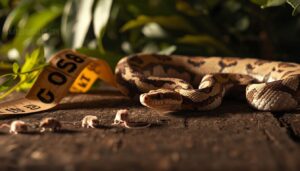
Feeding a baby boa isn’t just about keeping it full — it’s one of the biggest factors driving how fast it actually grows.
Get the frequency and prey size right, and you’ll see steady, healthy gains; get it wrong, and growth stalls or worse.
Here’s what you need to know about feeding your baby boa for the best results.
Best Feeding Frequency for Baby Boas
Getting Feeding Time right for a baby boa isn’t complicated, but it does demand consistency. Most keepers follow a 5–7 day dietary frequency during the early growth phase—and for good reason. Growth Phase Scheduling works best when meals align with your boa’s natural rhythms.
- Wait until after Post-Shed feeding windows clear
- Minimize handling stress before and after meals
- Avoid seasonal adjustments that disrupt routine feeding frequency
Weekly Feeding Versus Bi-weekly Feeding
Weekly feeding keeps your baby boa’s metabolic rate steady, delivering consistent calories without long fasting stress effects. Bi-weekly schedules create fewer body condition checkpoints, making slow growth easier to miss.
For growth rate consistency in juvenile boas, weekly meals distribute digestive load variation more evenly—your growth chart reflects that difference quickly.
Feeding frequency matters more than most keepers expect.
Prey Size: 1–1.5 Times Mid-body Width
Proper prey size selection hinges on one reliable rule: match each meal to 1–1.5 times your boa’s mid-body width. This prey size ratio keeps digestive load manageable, enhances metabolic impact through efficient nutrient absorption, and improves feeding predictability across your schedule.
Gape assessment before each feeding confirms the fit. Prey ratio benefits compound quickly—consistent sizing means steadier growth with fewer regurgitation setbacks.
Why Overfeeding Does Not Equal Healthy Growth
More food doesn’t always mean faster growth. Overfeeding triggers metabolic overload, pushing your boa’s body toward fat storage rather than lean tissue development — a classic case of skeletal lag where mass outpaces bone maturation. Digestive stress compounds these issues, reducing nutrient absorption efficiency.
Overfeeding a boa builds fat, not growth — mass outpaces bone when metabolic overload takes hold
Hormonal imbalance follows, suppressing normal growth signaling. This cascade leads to obesity risks, poor body condition scoring, and growth rate variability, all stemming from a misunderstanding of your boa’s actual nutritional requirements for snakes.
Signs a Baby Boa is Growing Too Slowly
Slow growth rarely announces itself all at once. Watch for stagnant weight over three or more months, limited length gain despite consistent feeding, and a reduced appetite that persists beyond a normal pre-shed pause. These early indicators signal potential issues requiring attention.
Irregular shedding, a plump appearance with softened waist definition, and poor body condition scoring all point to growth rate variability—the kind that indicates a genuinely stunted animal or stress-induced growth retardation. Such signs warrant closer monitoring to address underlying causes.
Regurgitation Risks From Oversized Prey
Oversized prey doesn’t just cause discomfort — it triggers a chain of real physical consequences. Forced swallowing stretches esophageal tissues, raising the risk of esophageal tearing, aspiration risk from regurgitation, and microbial buildup during stalled digestion.
Each failed feeding also means energy cost and nutrient loss your boa can’t recover.
Prey size selection for growing boas isn’t optional — it’s foundational to digestion health.
How Feeding Records Help Track Growth
Think of your feeding log as a living growth chart — not just a record, but your early warning system.
- Longitudinal Analysis catches slow growth before it becomes a crisis
- Record Standardization enables caretaker collaboration across multiple handlers
- Data Visualization turns raw weight and length measurements into readable growth rate charts
- Automated Alerts flag deviations from feeding frequency guidelines for juvenile and adult boas instantly
Temperature and Habitat Effects
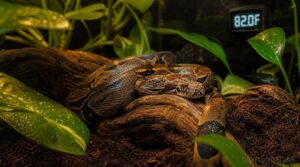
Your boa’s habitat does more than just house it—it directly shapes how fast it grows. Getting temperature, humidity, and setup right makes a real difference in your snake’s development, digestion, and overall health.
Here’s what your enclosure conditions should look like to keep growth on track.
Ideal Temperature Gradient: 80–88°F
Your baby boa’s metabolism runs on temperature, so gradient calibration isn’t optional—it’s foundational.
Maintain an 80–88°F ambient range using precise thermostat accuracy and strategic heat source placement throughout the enclosure.
Consistent temperature monitoring and gradient drift prevention keep digestion efficient and feeding schedules for juvenile boas on track.
A stable temperature gradient directly influences growth rate chart results.
Basking Area: 88–95°F
While ambient temperature sets the baseline, your warm basking spot is where digestion actually kicks into gear. Heat source selection matters here—ceramic emitters and infrared bulbs maintain the ideal range of 88–95°F without light disruption. Surface material choice affects absorption too; dark, non-reflective platforms outperform light-colored alternatives.
A solid temperature monitoring routine promotes a steady growth rate of boas and keeps feeding schedules for juvenile and adult boas predictable.
- Position basking spot placement on the enclosure’s warm end
- Verify surface temps with an infrared thermometer twice daily
- Add guard rail safety barriers to prevent direct contact burns
- Adjust heat source distance if readings drift above 95°F
Humidity Range: 50–60%
Humidity levels matter just as much as heat for the growth rate of boas. Maintaining an enclosure at 50–60% humidity aids in hydration optimization, smooth shedding for juvenile boas, and mold control on the substrate.
Proper hygrometer placement—at snake level—ensures accurate readings. This precision directly supports substrate retention, which helps sustain ideal humidity between mistings.
Consistent substrate moisture facilitates feeding schedules for juvenile and adult boas while creating optimal temperature and humidity conditions critical for healthy growth.
How Cool Temperatures Slow Digestion
Temperature doesn’t just affect comfort — it drives every digestive process your boa depends on. When the enclosure drops below ideal range, three things happen fast:
- Reduced blood flow diverts away from the gut, limiting nutrient absorption
- Enzyme kinetics slow dramatically, stalling protein breakdown
- Slowed gut motility creates regurgitation risk and metabolic depression
Thermal stress from inconsistent temps is a hidden growth killer.
Why Proper Shedding Supports Steady Growth
Shedding marks the intersection of temperature and growth in boas, serving as a visible indicator of Epidermal Moisture Retention and Metabolic Efficiency Boost functioning harmoniously. A clean shed every 4–6 weeks signifies optimal health, as each cycle eliminates old skin layers, strengthens Skin Barrier Immunity, and enables Scale Expansion Mechanics to accommodate growth.
| Shedding Sign | What It Means |
|---|---|
| Clean, single-piece shed | healthy humidity control for reptiles |
| Retained eye caps | Dehydration slowing growth rate |
| Dull, patchy skin | hormonal shedding cycle disruption |
| Frequent incomplete sheds | metabolic stress affecting feeding frequency |
| Consistent 4–6 week cycle | ideal conditions supporting development |
Stress, Hiding Spaces, and Growth Inhibition
Chronic stress is one of the quietest threats to your boa’s development. Cortisol Effects from loud noise, frequent handling, or Social Stress caused by nearby animals suppress appetite and slow digestion. These factors collectively contribute to stress-induced stunted growth.
Thoughtful Hide Placement, Enclosure Enrichment, and smart enclosure design for boas reduce environmental stressors before they trigger harm. Implementing these strategies helps prevent stress-related issues and promotes healthier development.
Stress Monitoring through behavioral cues—such as excessive coiling or reduced movement—enables early detection of potential problems. This proactive approach ensures timely intervention to mitigate stress-induced stunted growth.
Water Access, Hydration, and Skin Health
Your boa’s skin health starts with a clean, stable water source. Bowl placement matters — keep it on the cool side to limit bacterial growth and discourage constant soaking.
Prioritize water quality by changing it every two days.
Hydration monitoring is simple: healthy skin sheds in large, clean pieces every 4–6 weeks. Poor skin moisture often signals that water availability or humidity levels need adjusting.
Genetics and Adult Size Potential
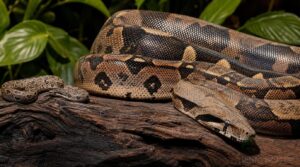
Your boa’s genetics play a bigger role in adult size than most keepers realize. From dwarf island localities topping out at 3–4 feet to Argentine females pushing past 10 feet, the subspecies you’re working with sets the ceiling.
Here’s what to expect across the most common lineages.
Boa Imperator Growth Expectations
Boa imperator exhibits a surprisingly wide size range, with adults typically reaching 5–9 feet. Females run noticeably larger than males due to hormonal influences on metabolic variations and nutrient allocation.
Environmental factors significantly shape growth. Captive versus wild settings, consistent feeding frequency guidelines, and ideal temperature and humidity directly influence the juvenile growth phase in boas.
- Adults average 5–9 ft, with females trending toward the upper end
- Seasonal growth shifts can cause year-to-year variations in growth rate chart readings
- Nutrient supplementation isn’t usually needed when prey rotation is solid
Boa Constrictor Constrictor Growth Expectations
If you’re after a genuinely large snake, Boa constrictor constrictor sets a high bar. Adults commonly reach 7–10 feet, with females pushing toward the upper end thanks to growth hormone influence on nutrient allocation.
Metabolic rate factors and enclosure space impact how quickly they hit those numbers.
Seasonal growth variation means your boa constrictor size and age chart won’t always follow a straight line.
Dwarf Locality Boas and Slower Growth
Dwarf locality boas, such as those from Crawl Cay and Hog Island, operate on a distinct growth hormone timeline compared to larger relatives. These populations exhibit strict size limits of 3.5–5 feet, dictated by a genetic bottleneck rather than environmental factors like prey availability or microclimate management.
Adjust your Boa constrictor size and age chart accordingly:
- Adults max out around 3.5–5 feet
- Feeding frequency guidelines for different life stages still apply every 7–10 days early on
- Lifespan expectations remain comparable to standard imperator boas
- Slower maturation means patience outweighs pushing growth
Despite their smaller stature, these boas retain the longevity typical of the species. Their restricted growth underscores the importance of tailored care, emphasizing consistent feeding schedules and avoiding accelerated growth attempts.
Female Boas Growing Larger Than Males
Female boas consistently outgrow male boas, and this isn’t random—it’s driven by Reproductive Energy Allocation and Female Fat Reserves needed to carry large litters.
Island Dimorphism Patterns mirror mainland trends, with females still reaching greater length and girth.
Mating Selection Pressure favors larger females, while Growth Hormone Differences accelerate their early development.
Expect your female to add noticeably more mass than a male of the same age.
How Lineage Affects Maximum Size
Your boa’s Lineage Growth Ceilings are fundamentally inherited blueprints—Ancestral Size Inheritance means offspring from larger-bodied lines almost always tend to grow bigger.
Geographic Lineage Variation explains why Argentine boas regularly reach 10 feet, while island dwarf populations cap at around 4 feet.
Hybrid Lineage Effects and Epigenetic Growth Modulation can unpredictably shift these size ceilings.
- Lineage determines your boa’s size ceiling before you feed the first mouse
- Continental bloodlines consistently outgrow isolated island populations
- Hybrid offspring may surge early, then plateau unexpectedly
- Knowing your snake’s ancestry sets realistic expectations from day one
Maternal Age and Offspring Growth Potential
Lineage sets the ceiling, but the mother’s age at the time of birth quietly shapes how fast offspring climb toward it. Maternal age effects show up in prenatal nutrient transfer efficiency — younger or very old mothers often deliver neonates with slightly lower birth weight.
Epigenetic programming and age-related IGF-1 variation mean offspring from prime-age females simply start stronger, reflecting maternal metabolic health as a real factor in growth rate variability and genetics in boas.
Sexual Maturity and Reduced Growth Rate
Once sexual maturity arrives — around 18 months in males and 3 years in females — you will notice a clear hormonal growth shift.
Energy reallocation toward gonadal development creates a reproductive trade-off, slowing linear length gains while fat reserve accumulation continues.
Your growth rate chart will reflect this age and size correlation: sexual maturity and growth slowdown consistently appear together as body elongation yields to reproductive readiness.
Top 10 Boa Growth Products
Finding the right products to support your boa’s growth doesn’t have to be overwhelming.
The items below cover the essentials — from care references to habitat tools — so you can make informed choices without second-guessing yourself.
Here’s what’s worth knowing about.
1. Boa Constrictor Care Guide

Think of this guide as your pocket mentor for boa ownership. At just $7.68, the Boa Constrictor Care Guide covers everything from habitat setup and temperature control to feeding schedules and shedding cycles — 54 focused pages published in March 2025.
It’s built for beginners stepping in for the first time, but experienced keepers will find practical updates worth reviewing too.
The one honest caveat: complex medical issues may still require a veterinarian. But as a daily reference, it’s hard to beat for the price.
| Best For | New boa owners who want a solid, no-fluff starting point — and experienced keepers looking for a quick, affordable refresher. |
|---|---|
| Primary Use | Boa care guide |
| Target User | Reptile owners |
| Price (USD) | $7.68 |
| Form Factor | Digital/print book |
| Package Size | 54 pages |
| Key Limitation | Limited medical depth |
| Additional Features |
|
- Covers all the essentials in one place — habitat, feeding, shedding, and health basics
- At $7.68 for 54 pages, it’s genuinely good value for what you get
- Practical enough for beginners but still useful for seasoned hobbyists
- Too brief to go deep on serious medical issues — you’ll still need a vet for complex problems
- Only covers boa constrictors, so don’t expect help with other reptiles
- English only, which shuts out a lot of potential readers
2. Rismise Cobra Life Cycle Figurine
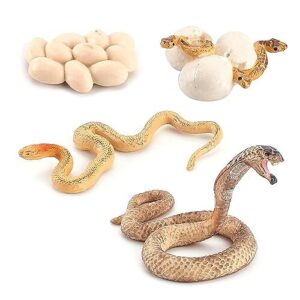
The Rismise Cobra Life Cycle Figurine earns its $11.49 price tag as a classroom-ready visual tool for teaching kids or explaining boa development to visitors. The four-piece PVC set showcases the egg, hatching, neonate, and adult stages in a compact, non-toxic format safe for ages 4 and up.
While it can’t replace a care guide, the figurine serves as a tangible teaching prop for sequencing growth stages. Its practical design makes it a valuable addition to any reptile-themed learning setup.
| Best For | Teachers, homeschool parents, and reptile enthusiasts looking for a simple, low-cost visual aid to explain snake development stages to young kids. |
|---|---|
| Primary Use | Educational toy |
| Target User | Children & educators |
| Price (USD) | $11.49 |
| Form Factor | Plastic figurine set |
| Package Size | 4-piece set |
| Key Limitation | Choking hazard risk |
| Additional Features |
|
- Covers all four life cycle stages in one affordable $11.49 set
- Made with non-toxic, odorless PVC — safe for classroom and home use
- Compact enough to fit on a science station, nature display, or party table
- Pieces are quite small and can be a choking hazard for kids under 4
- Plastic feels cheap and may not hold up well with rough handling
- Product photos can be misleading — the actual figures are much smaller than they appear
3. Farmers Secret Snake Plant Fertilizer

Despite its name, the Farmers Secret Snake Plant Fertilizer isn’t designed for your boa — it’s formulated specifically for Sansevieria and similar houseplants. That said, if you keep snake plants in your reptile room, this liquid concentrate offers real value.
One 8 oz bottle lasts up to six months at the recommended dose of ½ tsp per 2 cups of water for smaller plants. Users consistently report stronger leaves and better color within two to four weeks of regular use.
| Best For | Snake plant owners who want a simple, no-fuss fertilizer they can mix right into their regular watering routine. |
|---|---|
| Primary Use | Snake plant fertilizer |
| Target User | Indoor gardeners |
| Price (USD) | $9.99 |
| Form Factor | Liquid concentrate |
| Package Size | 8 fl oz |
| Key Limitation | Slow visible results |
| Additional Features |
|
- Super concentrated — one 8 oz bottle stretches up to six months, so you’re not constantly rebuying
- Formulated specifically for snake plants, with the right nutrient balance for Sansevieria and close relatives like ZZ plants
- Most users see noticeable improvements in leaf growth and color within just 2–4 weeks
- Not ideal for plants with very different nutrient needs — the formula is built around snake plants, not a general-purpose fix
- Low light can work against it; yellowing leaves have been reported when conditions aren’t quite right
- Results take patience — don’t expect overnight changes, consistent use over several weeks is what gets you there
4. Gardenera Snake Plant Fertilizer Mist

The Gardenera Snake Plant Fertilizer Mist is a ready-to-use foliar spray designed with a 3-1-2 NPK ratio to keep your Sansevieria thriving in the reptile room. Its formula ensures your plants maintain a sharp appearance.
To use, hold the nozzle approximately 12 inches away and mist until leaves are visibly coated, repeating the process weekly. A common issue is the included spray bottle clogging, so keeping a backup atomizer on hand prevents missed feeding cycles.
| Best For | Indoor plant lovers—especially snake plant owners—who want a simple, low-effort way to feed their plants without mixing or measuring anything. |
|---|---|
| Primary Use | Snake plant fertilizer |
| Target User | Indoor gardeners |
| Price (USD) | Not listed |
| Form Factor | Liquid spray |
| Package Size | 8 oz |
| Key Limitation | Spray bottle clogs |
| Additional Features |
|
- The 3-1-2 NPK ratio is gentle and balanced, so you get steady feeding without the risk of overwhelming your plant.
- It’s completely ready to use right out of the box—just grab and spray, no prep needed.
- Works beyond snake plants too, so you can use it on pothos, peace lily, and bonsai without buying a separate product.
- The included spray bottle is known to clog, which means you’ll likely need a backup atomizer sooner rather than later.
- Over-misting without proper watering can lead to root or leaf burn, so it does require a little attention to use safely.
- Results on plants other than snake plants can be hit or miss—it’s clearly optimized for Sansevieria, and other varieties may not respond as noticeably.
5. Tala Organic Hair Growth Oil
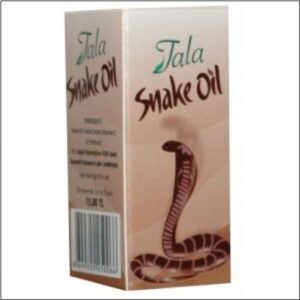
Tala Organic Hair Growth Oil might catch you off guard on a boa care list — and honestly, it should. This product targets human scalp health, not reptile husbandry.
It’s a snake oil-based hair treatment from Turkey, applied 2–4 times weekly to promote hair regrowth, priced at $15.90 per bottle.
No documented clinical support backs its efficacy claims. If you’re building a boa habitat, this one doesn’t belong in your supply kit.
| Best For | Anyone dealing with hair thinning or loss who wants a natural, affordable oil treatment to work into their weekly routine. |
|---|---|
| Primary Use | Hair treatment oil |
| Target User | Hair loss sufferers |
| Price (USD) | $15.90 |
| Form Factor | Liquid oil |
| Package Size | Not listed |
| Key Limitation | No clinical evidence |
| Additional Features |
|
- 100% natural snake oil sourced from Turkey — no synthetic ingredients
- Affordable at $15.90 per bottle
- Includes a scalp massage step that can improve circulation on its own
- No clinical studies back up the hair regrowth claims
- Requires 2–4 applications a week with a 2-hour wait each time — that’s a real time commitment
- No side-effect data available, so patch testing is a must if you have a sensitive scalp
6. Victor Snake Repellent Granules
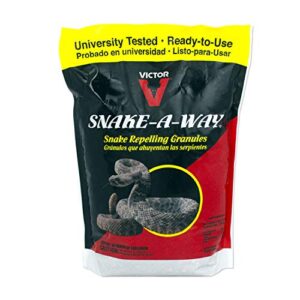
Victor Snake Repellent Granules are a misstep for your boa care setup. This EPA-registered product uses 7% naphthalene and 28% sulfur to disrupt a snake’s Jacobson’s organ, overwhelming their sense of smell to drive them away.
It is designed to keep wild snakes out of yards and gardens, not to support captive boa health or growth. If you’re raising a boa indoors, this granular perimeter treatment has no useful role in your husbandry toolkit.
| Best For | Homeowners, gardeners, and rural property owners in snake-prone areas who want a chemical barrier to keep wild snakes away from yards, sheds, or livestock spaces. |
|---|---|
| Primary Use | Snake repellent |
| Target User | Homeowners |
| Price (USD) | Not listed |
| Form Factor | Granules |
| Package Size | 4.28 lb |
| Key Limitation | Rain reduces efficacy |
| Additional Features |
|
- Covers up to 0.5 acre per bag, so one application can protect a decent chunk of property without multiple purchases.
- Works on both venomous and non-venomous species by targeting the Jacobson’s organ — the snake’s primary way of sensing its environment.
- EPA-registered and made with a biodegradable granule matrix, so it’s not a completely synthetic chemical dump on your lawn.
- The smell is rough — naphthalene and sulfur aren’t exactly backyard-friendly scents, and some users find it hard to tolerate.
- Rain washes out the effectiveness fast, sometimes in under a week, which means frequent reapplication in wet climates.
- Coverage claims are hit or miss; real-world results often fall short of the advertised half-acre radius depending on terrain and species.
7. Shenhailan Realistic Snake Garden Model
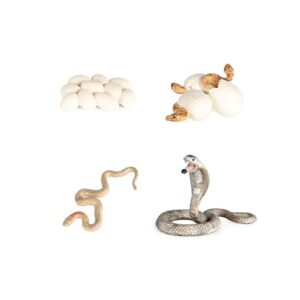
The Shenhailan Realistic Snake Garden Model won’t help your boa grow, but it’s a clever educational prop for showing visitors what a healthy adult snake actually looks like.
Crafted from weather-resistant resin with UV-stable pigments and lifelike scale textures, it realistically mimics small to medium adult snake proportions.
If you’re teaching kids or guests about boa size milestones, placing one of these detailed models alongside your enclosure gives people an immediate visual reference without any handling stress on your actual snake.
| Best For | Hobbyists, educators, and miniature garden enthusiasts who want a fun, hands-off way to showcase snake life cycles or add a nature-themed touch to their décor. |
|---|---|
| Primary Use | Decorative figurines |
| Target User | Hobbyists & educators |
| Price (USD) | Not listed |
| Form Factor | Plastic figurine set |
| Package Size | 4-piece set |
| Key Limitation | Colors may vary |
| Additional Features |
|
- Comes as a set of four figurines, so you get variety right out of the box.
- Great as a visual teaching tool for demonstrating animal growth stages without needing a live animal.
- Versatile enough to use in garden displays, photo shoots, or as a quirky gift.
- ABS plastic can get brittle in extreme heat or cold, so outdoor use has its limits.
- The tiny size (about 1 inch each) makes them easy to lose, especially in a garden setting.
- Colors might look a bit different in person than they do in product photos.
8. HiThrive Snake Plant Liquid Fertilizer

HiThrive Snake Plant Liquid Fertilizer keeps live snake plants in your boa’s enclosure healthy and thriving. This liquid concentrate dilutes to up to 96 gallons per 16 oz bottle — just one teaspoon per gallon at each watering.
Its balanced N-P-K formula includes calcium, iron, magnesium, and zinc, correcting yellowing and stunted growth. The product’s efficiency ensures plants receive essential nutrients without disrupting their care routine.
Since snake plants should only be watered when the soil is fully dry, this fertilizer aligns with a low-maintenance routine, eliminating the risk of overwatering.
| Best For | Snake plant owners who want a simple, no-fuss fertilizer that fits right into their existing watering routine. |
|---|---|
| Primary Use | Snake plant fertilizer |
| Target User | Indoor gardeners |
| Price (USD) | Not listed |
| Form Factor | Liquid concentrate |
| Package Size | 16 fl oz |
| Key Limitation | No NPK ratio listed |
| Additional Features |
|
- One bottle goes a long way — 16 oz makes up to 96 gallons of mixed solution, so it’ll last you a while.
- Packed with micronutrients like calcium, iron, and magnesium, which help fix common issues like yellowing leaves and slow growth.
- Easy to use — just add a teaspoon per gallon when you water, no complicated schedule needed.
- Too much of it can cause nutrient burn, so you have to be careful with the dilution.
- The exact N-P-K ratios aren’t listed, which makes it tricky if you want to dial in your plant’s nutrition more precisely.
- Results aren’t instant — it can take over a week before you notice any real improvement.
9. Fast Draining Snake Plant Soil

If your boa’s enclosure includes live snake plants, the soil they’re potted in matters more than you’d think. Leaves & Soul’s fast-draining mix is designed to prevent root rot without constant attention, making it ideal for busy reptile owners.
The blend combines perlite, coco coir, and peat moss to ensure water moves through quickly and dries within roughly 24 hours. This composition prioritizes moisture control, safeguarding plant health in humid environments.
The 2.2-quart resealable bag keeps the mix fresh between uses, while its versatility extends to drought-tolerant plants like aloe, which often share space near reptile habitats.
| Best For | Reptile owners and beginner plant parents who want a low-maintenance, fast-draining soil that keeps snake plants and similar drought-tolerant species healthy without constant monitoring. |
|---|---|
| Primary Use | Potting soil mix |
| Target User | Indoor gardeners |
| Price (USD) | Not listed |
| Form Factor | Bagged soil |
| Package Size | 2.2 qt |
| Key Limitation | Initial odor present |
| Additional Features |
|
- Drains fast and dries out quickly, which seriously cuts down the risk of root rot — a big deal in humid enclosures
- The resealable bag keeps leftover soil fresh, so you’re not wasting product between repots
- Versatile enough for aloe, African violets, and other drought-tolerant plants beyond just snake plants
- Some buyers notice a funky smell right out of the bag — it usually fades, but it can be off-putting at first
- Might need extra perlite mixed in if your plant needs especially aggressive drainage
- Not a great fit for moisture-loving plants like orchids without some extra amendments
10. Ortho Yard Snake Repellent Granules
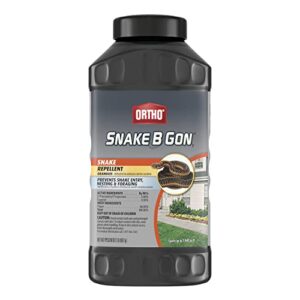
Maintaining snake-free outdoor spaces is just as important as enclosure management. Ortho’s Snake B Gon granules offer a non-lethal barrier using essential oils—cinnamon, mint, clove, and geraniol—that snakes find unpleasant.
One 2 lb bottle covers up to 1,440 square feet, and application is simple: shake the granules side-to-side around foundations, woodpiles, and shed perimeters.
To maintain effectiveness, reapply every 30 days or after heavy rain.
| Best For | Homeowners with pets, kids, or snake-prone yards who want a simple, no-fuss way to keep snakes out without traps or harsh chemicals. |
|---|---|
| Primary Use | Snake repellent |
| Target User | Homeowners |
| Price (USD) | $10.97 |
| Form Factor | Granules |
| Package Size | 2 lb |
| Key Limitation | Not edible-plant safe |
| Additional Features |
|
- Safe around pets and people when used as directed—no worrying about curious kids or dogs getting into something toxic
- Super easy to apply, just shake it around foundations, sheds, and woodpiles, and you’re done
- Covers up to 1,440 sq ft from one $10.97 bottle, which is solid value for most average yards
- Skip the veggie garden—it’s not approved near edible plants, so it has real blind spots for gardeners
- Rain washes it away faster, so you might be reapplying more than every 30 days depending on your weather
- Larger properties will burn through a 2 lb bottle quickly and need multiple containers to get full coverage
Frequently Asked Questions (FAQs)
How long should a 3 year old boa be?
Like a teenager hitting a growth spurt, your 3-year-old boa should measure around 6–7 feet and weigh roughly 6–8 kg — solidly in that rapid juvenile phase before growth begins tapering off.
Can baby boas fast without stunting their growth?
Yes, baby boas can fast briefly without permanent harm.
But skipping more than two consecutive feedings during their first year risks stunting growth, since juveniles need consistent nutrition to hit key developmental milestones.
Do male baby boas grow slower than females?
Male baby boas do grow slower than females. Males can reach sexual maturity around 18 months at just 5 feet, while females usually grow larger and longer throughout their lives.
How do clutch size and litter number affect growth?
Clutch size and litter number both shape early growth. Larger litters mean less maternal investment per offspring, producing smaller neonates with slower initial gains. Smaller litters tend to yield heavier, faster-growing young.
Does brumation slow growth in juvenile boas?
Brumation does slow juvenile boa growth. During cooler rest periods, metabolism drops, digestion halts, and feeding stops — so measurable length and weight gains effectively pause until normal temperatures resume.
Conclusion
The smallest decisions you make now shape the largest animal your boa will become. Baby boa growth speed isn’t measured in months alone—it’s the sum of every feeding, every temperature check, every clean water change stacked quietly over years.
Get the fundamentals right, and the timeline nearly takes care of itself. Ignore them, and no amount of catching up fully closes the gap.
Your snake grows exactly as well as the environment you build around it.