This site is supported by our readers. We may earn a commission, at no cost to you, if you purchase through links.

Picture two boa constrictors side by side: one stretches past your couch, the other barely spans your kitchen counter. Both wear the same species label, yet their size tells wildly different stories. That gap isn’t random.
Genetics, sex, diet, and even zip code all shape how big a boa constrictor gets, and the range surprises most first-time owners. A female can dwarf a male by two feet or more, while a well-fed captive snake often out-bulks its wild cousins.
Understanding these size patterns helps you set realistic expectations, whether you’re building an enclosure or just curious what "full grown" actually means for this snake.
Table Of Contents
- Key Takeaways
- How Big is a Boa Constrictor?
- Adult Boa Constrictors Usually Reach 6–10 Feet
- Boa Constrictor Growth Stages by Age
- What Determines a Boa Constrictor’s Size?
- Largest Boa Constrictor Records
- Boa Size Comparisons and Space Needs
- Frequently Asked Questions (FAQs)
- Is a boa constrictor bigger than an anaconda?
- Are boas aggressive snakes?
- Can boa constrictors be good pets?
- What is the lifespan of a boa?
- How big do boa constrictors get?
- What is the difference between a male and female boa constrictor?
- Are boa constrictors bigger than pythons?
- Do boa constrictors grow bigger than Imperators?
- How big should a boa constrictor enclosure be?
- Where does a boa constrictor live?
- Conclusion
Key Takeaways
- Most adult boa constrictors reach 6 to 10 feet and 15 to 30 pounds, with females typically outgrowing males by a couple feet due to sexual dimorphism.
- Genetics, sex, diet, and habitat all shape a boa’s final size, and captive boas tend to out-bulk their wild relatives thanks to steady, high-calorie feeding.
- Boas grow fastest in their first year, nearly tripling in length, then level off into a stable adult size between years four and seven.
- Even the biggest verified boas top out around 18 feet, making them noticeably smaller than reticulated pythons and green anacondas.
How Big is a Boa Constrictor?

How big can a boa constrictor really get? Most stretch out to 6 to 10 feet, though rare giants push past 13 feet. Females hold the size advantage, often outgrowing males thanks to sexual dimorphism.
Despite their impressive size, boa constrictors are famously shy, preferring to retreat rather than confront a threat—a temperament explored in depth in these fascinating black mamba snake facts, which highlight how differently snake species handle danger.
Since females can grow noticeably larger and stronger, it’s worth brushing up on proper boa constrictor handling techniques before bringing one home.
Genetics, diet, and habitat all shape adult size attainment. Weight varies too, sometimes topping 30 pounds. Whether captive or wild, proper enclosure sizing matters once you know your boa’s true growth potential. These snakes thrive in various environments, including tropical rainforests and savannas.
Adult Boa Constrictors Usually Reach 6–10 Feet
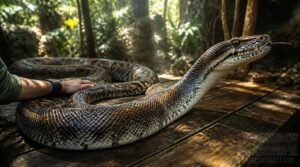
Pick up a full-grown boa constrictor and you’ll notice it’s a lot more snake than most people expect. Length varies quite a bit depending on sex, genetics, and whether it’s wild or captive-raised. Here’s what you can expect once a boa reaches full size.
Typical Adult Length
Picture a snake as long as your couch. That’s a typical adult boa, stretching 6 to 10 feet from snout to vent.
Females usually outsize males, often nearing 10 feet. Wild boas trend slightly shorter than captive ones.
Locality, genetics, and prey availability all shape final length, which is why no two boas grow identically.
Typical Adult Weight
Length only tells half the story. Most adults weigh 15 to 30 pounds, though captive boas fed steady diets often reach 25 to 40 pounds.
Locality matters too: humid lowland populations run heavier than boas from arid regions. Good nutrition, consistent prey size, and stable diet quality push weight up, especially in captivity where careful feeding schedules outpace what wild boas find on their own.
Male Versus Female Size
Sex changes the math. Females commonly reach 8 to 10 feet, males stall around 6 to 8, a gap tied to sexual dimorphism rather than diet.
That size split brings weight disparity too, females carry broader bodies and thicker midsections. Males often show longer tails relative to body length. The pattern holds whether you’re looking at wild populations or captive collections.
Captive Versus Wild Boas
Where a boa lives changes how it grows. Wild boas chase unpredictable meals, so growth rates swing widely between individuals.
Captive boas get steady, high-calorie diets, boosting weight-to-length ratio but limiting muscle development since enclosure size restricts exercise. That’s why a captive snake often looks stockier than its wild counterpart at the same average adult length.
Boa Constrictor Growth Stages by Age
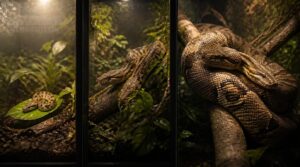
A boa doesn’t arrive at 8 feet overnight, it earns every inch along the way. Watching that journey from hatchling to full-grown adult tells you a lot about how these snakes are built. Here’s what each stage of that growth actually looks like.
Newborn Boa Size
A newborn boa fits comfortably in your palm, no bigger than a garter snake.
Hatchlings measure 12 to 20 inches and weigh just 20 to 60 grams, roughly a handful of coins. They’re fully formed and feed within days on pinky mice.
Warmth, hiding spots, and secure climbing space matter most during these fragile early weeks.
First-Year Growth
Where that palm-sized hatchling goes next might surprise you: some boas nearly triple in length by their first birthday.
- Hatchling size: 12–20 inches
- Year-end length: 3–5 feet
- Feeding: appropriately sized prey, consistent schedule
- Temperature: warm basking spots drive metabolism
- Weight tracking: check every 4–6 weeks
Consistent warmth and feeding build a strong foundation, setting the stage for juvenile growth ahead.
Juvenile and Subadult Size
Between years one and three, growth slows but steadily builds toward subadult size, usually 3 to 5 feet. Feeding frequency drops to weekly, and habitat temperature (80-90°F) still drives digestion.
| Stage | Length |
|---|---|
| Hatchling | 12-20 in |
| Year 1 | 3-4 ft |
| Subadult | 3-5 ft |
| Near-adult | 5-6 ft |
Sexual dimorphism starts emerging here too, subtly, as females begin outpacing males.
When Boas Reach Full Size
Somewhere between years four and seven, growth finally levels off. This is the Maturity Age Range, when boas hit their average adult length of 6 to 10 feet. Sexual maturity usually arrives near this same window.
Genetic variation and enclosure space still shape the final number, but length gains slow dramatically once boas dramatically once boas reach this size stabilization phase.
Growth After Maturity
Growth doesn’t stop at maturity, it just changes shape. Boas shift from adding length to packing on girth, sometimes 10 percent thicker.
Weight gain tracks the seasons, with reproductive females bulking up before egg production.
Watch body condition closely: steady, season-linked gains in captive boas signal good husbandry, while rapid or erratic weight jumps often mean overfeeding.
What Determines a Boa Constrictor’s Size?
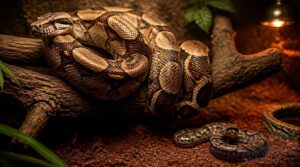
Not every boa grows the same, even with the same genes. A snake’s final size depends on a mix of forces working together, some fixed at birth and others shaped over years of care. Here’s what actually moves the needle on how big your boa gets.
Genetics and Locality
Where a boa’s ancestors called home matters as much as any single gene. Boa constrictor constrictor in South America and Boa constrictor imperator across Central America carry distinct lineages, with mitochondrial DNA haplotypes clustering by region.
Gene flow between neighboring populations fuels local adaptations, so locality-driven divergence shapes size even among overlapping ranges, favoring bigger builds where rainforests provide steady prey.
Sex and Sexual Dimorphism
Genetics sets the ceiling, but sex decides who actually gets there. Females consistently outgrow males in length and weight, since reproductive allocation demands larger bodies for egg production.
Growth divergence appears early, driven by hormonal influence on energy use. Males stay leaner and more active, while females channel mass into fat stores and reproductive tissue, a classic case of sexual dimorphism.
Habitat and Climate
Where a boa grows up matters as much as its bloodline. Rainforests with dense vegetation cover and rich ground temperature ranges (75–86°F) fuel faster growth than drier scrublands.
- Ample humidity for shedding
- Burrow and shelter use
- Elevation habitat limits near 1,500 meters
- Stable temperature gradient
- Year-round prey abundance
These conditions shape wild size before any human factors like diet ever enter the picture.
Diet and Feeding Practices
A jungle can only do so much if the food bowl comes up empty. Nutrition drives growth just as much as climate does.
Prey size should stay near 15–25% of body weight, offered every 7–14 days for juveniles and 14–21 days for adults.
| Feeding Factor | Practical Guideline |
|---|---|
| Prey size | Match snake’s girth |
| Frequency | 7–21 days by age |
| Meal type | Rodents, birds |
| Handling | Wait 48–72 hours |
Captive Living Conditions
Take away the guesswork and boas thrive. Captive boas often outgrow wild ones because you control every variable: a steady temperature gradient, tight humidity control, smart substrate selection, and regular meals without predation risk.
Proper enclosure requirements, from thermal zones to enrichment, remove the stress that slows growth stages in the wild.
Consistency, not luck, is why captive-born boas reach their full genetic potential.
Largest Boa Constrictor Records

Every so often, a boa comes along that rewrites the record books. These outliers push past typical size ranges and spark plenty of debate among keepers and researchers alike. Here’s what the verified data actually shows, and where some claims fall apart under scrutiny.
Longest Verified Boa
Eighteen feet, two inches. That’s the longest verified boa on record, nearly double a typical adult. Confirmed through independent herpetologist checks, photo analysis, and traceable specimen data from Central and South America. Records exceeding 13 feet face strict scrutiny:
The longest verified boa constrictor measured eighteen feet two inches, nearly double the length of a typical adult
- Multiple measurers required
- Snout-to-tail baseline method
- Location and date logged
- Museum-backed documentation
That’s real record verification, not campfire talk.
Heaviest Recorded Boa
Length grabs headlines, but weight tells the real story of a boa’s bulk. The heaviest recorded boa weighed roughly 55 pounds, with reports ranging 50 to 60 pounds depending on hydration. That specimen measured over 13 feet, yet mass, not length, defined its record.
Verified weights come from post-feeding checks, requiring strict measurement protocols wild boas rarely match.
Rare Giant Females
Some females just don’t get the memo about average size. In the wild, standout individuals push past twelve feet, with rare giant females favored by steady prey and mild climates rather than captivity.
These outliers often carry extra reproductive weight from stored fat during breeding cycles. That added bulk means bigger enclosures and stronger thermal gradients to match their metabolic needs.
Unverified Size Claims
Ever seen those "18-foot boa" posts flooding your feed? Most trace back to misidentified anacondas or decades-old newspaper claims never backed by a physical specimen.
Viral size myths thrive on Instagram and Facebook, where photos lack location data or expert measurement. Sellers exaggerate too, advertising snakes as 12-14 feet. Reality check: verified specimens over 13 feet are rare, and the largest recorded specimen measured 14.6 feet.
Accurate Snake Measurement
Numbers only matter if the method behind them holds up. Reliable measurement relies on SVL technique, tube restraint, digital imaging, or string measurement, each cross-checked against weight-to-length ratios:
- Snout-vent length via calibrated tube
- Flexible string along body contours
- Digital imaging from calibrated photos
- Girth stick at heart location
- Hatchling measurements logged from birth
Consistent recordkeeping separates fact from folklore.
Boa Size Comparisons and Space Needs
Numbers only tell half the story until you put your boa next to its cousins. Size makes a lot more sense side by side, and so does the space you’ll need to provide. Here’s how boas stack up against other big snakes, plus what that means for their enclosure.
Boas Versus Ball Pythons
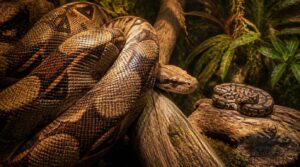
Put a boa next to a ball python and the size gap jumps out immediately.
| Trait | Boa Constrictor |
|---|---|
| Length | 6-10 ft |
| Weight | 22-33 lbs |
| Hatchling | 15-20 in |
| Feeding | Rats, rabbits |
Ball pythons rarely exceed 5 feet or 3.6 pounds. Boas grow faster, eat bigger meals, and need roomier enclosures, roughly six to ten times the mass in a similar footprint.
Boas Versus Burmese Pythons

Ball pythons look tiny next to a boa, but Burmese pythons flip the script entirely.
| Trait | Burmese Python |
|---|---|
| Wild Length | 12-18 ft |
| Captive Max | 20+ ft |
| Reproduction | Egg-laying |
Burmese pythons favor wetlands and flooded habitats, hunting near water, while boas roam forests and grasslands. Pythons lay eggs and incubate them; boas birth live young. Growth rates run faster in pythons too, demanding far larger enclosures.
Boas Versus Reticulated Pythons
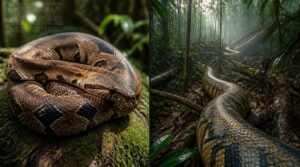
If Burmese pythons impressed you, reticulated pythons take it further. These Southeast Asian giants routinely top 20 feet, with verified specimens near 24 feet, dwarfing any boa constrictor.
| Trait | Boa Constrictor | Reticulated Python |
|---|---|---|
| Max Length | 10-14 ft | 20-24+ ft |
| Growth Rate | Gradual, 4-6 yrs | Rapid, several feet yearly |
| Body Build | Stocky | Slender |
Their diet of deer and pigs fuels that explosive growth, something your boa’s enclosure will never need to match.
Boas Versus Anacondas

Reticulated pythons win on length, but green anacondas win on sheer mass. Averaging 16-17 feet and sometimes topping 29, anacondas can exceed 200 pounds, dwarfing a boa’s 60. Why? They’re aquatic, letting water support that bulk.
Your terrestrial boa, built for climbing and stalking, stays leaner. Different habitats, different builds, same predatory success.
Adult Boa Enclosure Sizing

None of this matters if the enclosure can’t hold your snake. A 6-8 foot boa needs a minimum footprint of 6 by 2 by 2 feet, PVC for heat retention, warm side 88-92°F, humidity 60-70%.
| Size | Length | Height |
|---|---|---|
| Juvenile | 4ft | 18in |
| Adult | 6-8ft | 2ft |
| Large female | 9ft+ | 2ft+ |
Frequently Asked Questions (FAQs)
Is a boa constrictor bigger than an anaconda?
Not usually. Anacondas often outsize boas, reaching 16 to 19 feet and 200+ pounds, while boas top out near 10 feet and 60 pounds. Habitat plays a role too, aquatic anacondas simply have more room to grow long.
Are boas aggressive snakes?
Not really. Boas aren’t hunters of people, they’re ambush predators targeting small mammals. They avoid confrontation, retreating when possible. Defensive hissing or biting only happens when threatened, mishandled, or approached during feeding, not from true aggression.
Can boa constrictors be good pets?
Yes, with realistic expectations. Their calm temperament suits patient handlers, but a 6–10 foot adult, decades-long lifespan, and large enclosure needs make boas a serious commitment, better suited to intermediate keepers than true beginners.
What is the lifespan of a boa?
Good things come to those who wait, and boas prove it. With proper veterinary care, they live 20-30 years in captivity, some reaching 35+, versus just 15-20 years in the wild.
If you’re curious how markings like these develop across generations, this guide to piebald ball python genetics breaks down how allele pairings shape patterns like head retention and dorsal patching.
This longevity boost matters most for egg-laying rarities like the Saint Lucia boa, whose rare snake species information highlights how captive breeding programs support fragile wild populations.
For a look at another master of reptilian theatrics, check out these fascinating gopher snake behavior facts, from their dramatic hissing to their rattlesnake-mimicking tail shakes.
How big do boa constrictors get?
Most boas settle in at 6 to 10 feet, with rare giants pushing past Females outsize males thanks to sexual dimorphism, sometimes by a foot or two, while genetics and locality shape the final number.
What is the difference between a male and female boa constrictor?
Picture two siblings who never stopped growing at the same pace: that’s sexual dimorphism in boas. Females often stretch 8 to 10 feet, males stall around 6 to 8, a gap shaping enclosure needs and breeding plans alike.
Are boa constrictors bigger than pythons?
Not usually. In this length ranking guide, pythons take the crown, with reticulated pythons topping 20 feet. Boas average 10 feet max, so the size difference chart favors pythons, though growth rates and subspecies genetics shape each snake’s final measurements.
Do boa constrictors grow bigger than Imperators?
Think of them as cousins, not rivals. Boa constrictor constrictor usually outgrows Boa constrictor imperator, often exceeding 10 feet, while imperators average 6–10 feet. Locality, sexual dimorphism, and genetics ultimately shape each subspecies’ true growth potential.
Growth pace varies just as much as size—slow-growing boa species reward patient keepers who plan their setups and feeding schedules for the long haul.
How big should a boa constrictor enclosure be?
A rescued 9-foot female once lived cramped in a 4-foot tank, refusing food for months. Size your boa constrictor’s enclosure to its adult length, giving full stretching room, vertical climbing space, and dimensions that grow with each life stage.
Where does a boa constrictor live?
Wild boas range across Central and South America, from Mexican forests to Argentine grasslands. They thrive in rainforest habitats, savanna zones, and riverine corridors, wherever dense cover, warm microclimates, and reliable water sustain their ambush-hunting lifestyle.
Conclusion
Like a scribe measuring a scroll by candlelight, you now hold a far more precise gauge for judging length and mass. So, how big is a boa constrictor? Honestly, it depends: genetics, sex, diet, and locality all write the final number.
Most stay a manageable 6 to 10 feet. A rare few rewrite the record books entirely. Trust biology over folklore, size your enclosure accordingly, and your snake will thrive well past "full grown.