This site is supported by our readers. We may earn a commission, at no cost to you, if you purchase through links.
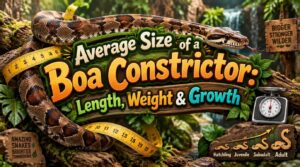
Most people picture boa constrictors as massive snakes pushing 15 feet, but a healthy adult usually measures 10 to 13 feet and weighs 20 to 40 pounds. That’s still a substantial snake, but far from the giants popular media often portray.
Knowing the average size of a boa constrictor before you bring one home shapes every practical decision. Enclosure dimensions, feeding schedules, and handling safety all depend on realistic expectations. A female that keeps growing through her first decade is a different commitment than a male who finishes his length gains by five.
Subspecies, geography, and genetics pull that final number in different directions.
Table Of Contents
- Key Takeaways
- Average Boa Constrictor Length and Weight
- Male Vs. Female Boa Constrictor Size
- Boa Constrictor Growth by Age
- Boa Constrictor Size by Subspecies and Locality
- What Determines a Boa Constrictor’s Maximum Size?
- Frequently Asked Questions (FAQs)
- Which is larger, boa or python?
- How big is a full grown boa?
- Are boas aggressive snakes?
- What is the lifespan of a boa?
- How does temperature affect boa constrictor growth rate?
- Can boas stop growing if stressed or mishandled?
- Do boa constrictors grow throughout their entire lifespan?
- What age do boas reach their full size?
- How do captive boas compare to wild boas?
- How long do boa constrictors typically live?
- Conclusion
Key Takeaways
- Adult boa constrictors typically measure 10 to 13 feet and weigh 20 to 40 pounds, though island dwarf localities may stay under 5 feet and large females can exceed 14 feet.
- Females consistently outgrow males, reaching nearly twice their bulk, and keep gaining length and girth through their first decade while males plateau by four to six years.
- Growth is fastest between six and twelve months, with hatchlings (12–18 inches at birth) reaching 3 to 4 feet by age two or three and full size by roughly 3 to 5 years.
- Maximum size depends mainly on genetics, sex, prey availability, and temperature, with captive boas generally growing larger than wild ones due to consistent feeding and stable conditions.
Average Boa Constrictor Length and Weight
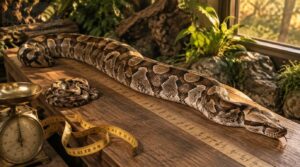
Boa constrictors vary more in size than most people expect, and knowing what’s typical helps you plan ahead. Adult length and weight differ between sexes, localities, and whether you’re working with a wild-type or captive specimen. Here’s what the numbers look like across life stages.
For a closer look at how size shifts from hatchling to full-grown adult, boa constrictor length and growth by life stage breaks down the numbers in a way that makes planning your setup much easier.
Adult Length and Weight
Adult boa constrictors generally reach 10 to 13 feet in length and weigh 20 to 40 pounds, though some individuals in prime habitats exceed 60 pounds.
Females consistently grow longer and heavier than males, with some topping 14 feet. Size varies by locality, prey availability, and genetics, so you’ll rarely see two boas from different regions match each other’s dimensions.
Hatchling Size
Boa constrictors deliver live babies rather than eggs, one of their most distinctive features. Their physical characteristics at birth include an average length of 12 to 18 inches and a weight of 10 to 20 grams.
Most mainland populations tend to cluster near 14 to 16 inches, so you’ll notice size differences based on where your particular boa’s lineage originates.
Male Vs. Female Boa Constrictor Size
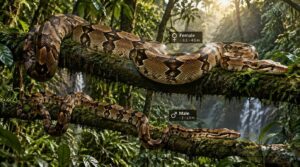
The size gap between sexes is one of the most distinctive features of Boa constrictors. Females consistently outsize males in both length and weight, and that difference isn’t small or incidental in any population.
In fact, females can run nearly twice a male’s bulk by adulthood, as detailed breakdowns of male vs. female boa constrictor size differences make clear.
| Trait | Male | Female |
|---|---|---|
| Average length | 1.2–2.0 m | 1.5–2.4 m |
| Maximum length | ~2.4 m | 3.0+ m |
| Average weight | 1–7 kg | 2–9 kg |
Reproductive biology drives this pattern. Females invest heavily in somatic growth to support large litters, so their bodies keep expanding well past the point where males begin to plateau. A male Boa constrictor generally reaches near-maximum size by four to six years, while females continue gaining significant girth and length through their first decade of life. If you’re handling an unfamiliar Boa Constrictor, a noticeably heavier and broader-bodied animal is almost certainly female. That sex-based size difference reflects biology, not diet or individual prey access alone.
Female boa constrictors keep growing for a decade; males plateau at four to six years
Boa Constrictor Growth by Age

Boa constrictors don’t grow at a constant rate; their pace changes considerably from hatchling to adulthood. Knowing when and how quickly your boa grows helps you track health and plan care. The sections below cover early rapid development and what happens once your boa reaches sexual maturity.
Early Growth Timeline
A hatchling Boa constrictor fits easily in your palm, measuring just 12 to 24 inches and weighing as little as 14 grams.
By their second birthday, these compact hatchlings can surpass 4 feet—track the full journey with this boa constrictor growth timeline by year.
Growth is fastest between six and twelve months, when proper temps of 78 to 90°F and weekly feedings push length to 2.5 times its birth size.
By age two or three, your boa reaches 3 to 4 feet.
Growth After Maturity
After maturity, a Boa Constrictor’s growth slows but doesn’t fully stop. Their muscular bodies gain weight seasonally, not length. With a 25 to 30 year lifespan and an Average Life Span In The Wild near 20 years, you’ll find four main factors shaping post-maturity size: You can trace how these factors play out across their long lives in the Animal Diversity Web’s detailed Boa constrictor profile.
- Prey surplus above maintenance needs
- Reproductive hormone shifts
- Seasonal fasting cycles
- Environmental stress or drought
Boa Constrictor Size by Subspecies and Locality
Boa constrictor size varies considerably depending on subspecies and geographic origin. Where a boa comes from often matters as much as its species designation when predicting adult length.
The breakdowns below cover the two main size categories you’ll encounter: mainland boas and island or dwarf populations.
Mainland Boa Sizes
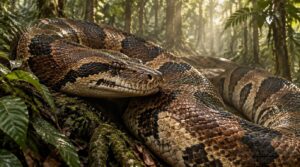
Mainland populations vary more than most keepers expect. Adult females average 8 to 12 feet and males 6 to 9 feet, though impressive females can push 12 to 14 feet.
If you’re selecting a locality-specific animal, know that habitat preference matters a lot: Boa Constrictors from tropical lowlands grow larger than those from arid zones, where limited prey caps realized size.
Island and Dwarf Boas
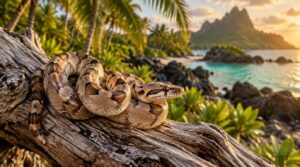
Isolated island populations diverge noticeably. A Boa Constrictor from the Hog Island locality rarely exceeds 1.5 meters, far shorter than most mainland relatives. Key morphological traits driving this include:
- Limited prey diversity
- Earlier growth plate closure
- Leaner snake anatomy
- Founder effects reducing size
These constraints persist across a 25 to 30-year lifespan, so expect your island morph to stay compact.
What Determines a Boa Constrictor’s Maximum Size?

Females in some Boa constrictor populations can exceed males in maximum length by 20% or more, making sex one of the strongest individual growth drivers you’ll encounter in this species.
| Factor | Effect on Maximum Size |
|---|---|
| Genetics | Sets the upper growth limit |
| Prey availability | Drives mass and length gains |
| Temperature | Modulates metabolic rate |
| Reproductive cycles | Temporarily slows somatic growth |
In tropical rainforest habitat, reliable prey capture keeps metabolism elevated, allowing boas to reach their genetic ceiling. Seasonal or cooler environments slow that tempo a lot.
Your boa’s biological classification and lineage set hard limits too. Even ideal conditions won’t push a genetically smaller subspecies past its ceiling. Studying your animal’s natural history gives you the clearest picture of what size to expect.
Frequently Asked Questions (FAQs)
Which is larger, boa or python?
You’ll find pythons larger overall. Reticulated pythons exceed 20 ft, while Boa constrictor tops out near 14 ft. But boas still qualify as large snakes, and females routinely outgrow males within their own species.
How big is a full grown boa?
A full grown Boa constrictor usually measures 10 to 13 feet long and weighs 15 to 25 pounds, though females usually outsize males and rare individuals can exceed 40 pounds across a 25 to 30year lifespan.
Are boas aggressive snakes?
The coiled boa is a symbol of restraint, not rage. You’ll find these nonvenomous constrictors shy; they’d rather flee than fight. Bites happen when you startle or mishandle them. If bitten, apply snake bite first aid and seek care.
What is the lifespan of a boa?
You can expect your Boa Constrictor to live 20 to 30 years in the wild, but captive snakes often reach 40 years or more with stable temperatures, proper humidity, regular feeding, and low stress.
That kind of longevity is absolutely achievable when you follow a solid boa constrictor care guide from the start.
How does temperature affect boa constrictor growth rate?
You control your boa’s growth rate through reptile thermoregulation. Keep a temperature gradient of 80–85°F, with nights above 75°F. Warm boas digest faster and grow quicker; cold enclosures slow metabolism and stall development.
Can boas stop growing if stressed or mishandled?
Can stress really shrink your boa’s growth? Yes. Chronic stress and rough handling suppress appetite and hormones, slowing development. Watch for stress signs like refusing food, then improve your reptile husbandry; calm, consistent care lets growth resume.
Do boa constrictors grow throughout their entire lifespan?
Like a slow-burning candle, your boa keeps growing its whole lifespan. You’ll see rapid gains early, then growth tapers to just inches yearly after maturity, continuing indefinitely in reptile ecology.
What age do boas reach their full size?
A boa’s growth rings tell its story: most reach full size between 3 and 5 years old. You’ll see rapid gains early, then growth slows sharply after age 4, though sexual maturity often arrives first.
How do captive boas compare to wild boas?
You’ll find captive boas grow larger than wild ones, often hitting 8–12 feet versus 6–9 feet.
Consistent reptile nutrition with frozen rodents, plus proper Pet Boa Constrictor Care, drives this; wild snakes face seasonal prey shortages and stress.
How long do boa constrictors typically live?
You can expect your Boa Constrictor to live 20 to 30 years in captivity, and some individuals exceed 40 years. In the wild, predation and disease shorten the snake lifespan considerably.
Conclusion
That 10 to 13 foot range covers most adults, but your individual snake may land anywhere from 6 feet as a dwarf locality to over 14 feet as a large female.
The average size of a boa constrictor is a starting point, not a promise.
Track your snake’s growth, plan your enclosure for the female’s decade-long climb, and feed for condition, not maximum bulk.
Realistic expectations keep you prepared, and your boa thrives.