This site is supported by our readers. We may earn a commission, at no cost to you, if you purchase through links.

Your thermostat runs your HVAC system for hours every day, whether you’re home or not. Most homeowners set it once and forget it, leaving 5-15% in savings on the table each month. That gap adds up fast over a year.
The good news: thermostats for energy savings have gotten smarter, cheaper, and far easier to install than they were even a few years back. Radar sensors, geofencing, and room-by-room zoning now come standard on models under $200.
Below, you’ll find nine models worth your money, plus the HVAC compatibility details and rebate programs that decide whether you break even in one year or three.
Table Of Contents
- Key Takeaways
- Best Thermostats for Energy Savings
- 1. Ecobee Smart Thermostat Premium
- 2. Ecobee Smart Thermostat Essential
- 3. Google Nest Smart Thermostat
- 4. Amazon Smart Thermostat with Alexa
- 5. Google Nest Learning Thermostat Silver
- 6. Honeywell T9 Smart Thermostat
- 7. Sensi Touch 2 Smart Thermostat
- 8. Sensi Smart Wi-Fi Thermostat ST55
- 9. Sensi Lite Smart WiFi Thermostat
- How Smart Thermostats Save Energy
- Energy-Saving Features to Compare
- Match Thermostats to Your HVAC
- Costs, Rebates, and Long-Term Value
- Frequently Asked Questions (FAQs)
- Can a thermostat make your electric bill go up?
- Does having the AC on 72 instead of 70 make it cheaper?
- How long do smart thermostats typically last?
- Can renters install smart thermostats in apartments?
- Do smart thermostats work during power outages?
- Whats the average payback period for installation?
- Are there government rebates for smart thermostats?
- Can smart thermostats work during a power outage?
- Do utility companies offer rebates for smart thermostats?
- Are smart thermostats compatible with older home wiring?
- Conclusion
Key Takeaways
- Smart thermostats typically cut heating and cooling costs by 5–26% through automatic setbacks, occupancy sensing, geofencing, and learning schedules.
- Compatibility matters more than features: check your C-wire, HVAC system type, and ductwork before buying, since a mismatched thermostat won’t deliver savings.
- ENERGY STAR certification and utility rebates (often $50–$125) can shrink your payback period down to one to three years.
- Budget models like the Sensi Lite handle basic scheduling and geofencing well, while premium options like the Ecobee Premium add room-by-room sensing and air quality tracking for a higher price.
Best Thermostats for Energy Savings
Not every smart thermostat earns its price tag, but these nine do. Each one brings something different to the table, from air quality tracking to dead-simple installs. Here’s how they stack up.
If you’re leasing rather than owning, check out these smart thermostats designed for renters before installing anything permanent.
1. Ecobee Smart Thermostat Premium
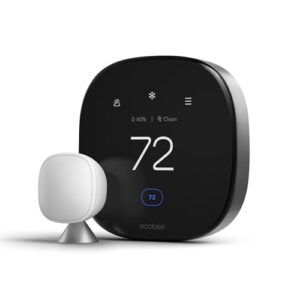
If you want top-tier control, this is the one to beat. Built-in radar sensors catch occupancy room by room, even when people sit still, cutting wasted HVAC runtime.
Air quality alerts, humidity balancing, and Smart Recovery keep comfort steady while trimming costs up to 26% annually. Alexa and Siri support (Siri needs a separate hub) round out the smart home tie-ins. It’s pricier, but for households chasing precision and savings, it earns its keep fast.
| Best For | Homeowners who want precise, room-by-room comfort control and are willing to pay more upfront for long-term energy savings. |
|---|---|
| Remote Control | Smartphone, tablet, voice |
| Energy Savings | Up to 26% yearly |
| Smart Home Integration | HomeKit, Google, Alexa, SmartThings |
| DIY Installation | PEK included for no C-wire |
| Scheduling | Automated vacation scheduling |
| Mobile App Support | ecobee app |
| Additional Features |
|
- Radar-based occupancy sensing adjusts comfort room by room, even when people are sitting still
- Can cut heating and cooling costs by up to 26% annually
- Strong smart home integration with Alexa, Apple HomeKit, Google Assistant, and SmartThings
- Siri support requires purchasing a separate Apple home hub
- Outdoor temperature readings depend on internet weather data, which can be inaccurate in rural areas
- Installation can get complicated for homes with older wiring or unique HVAC setups
2. Ecobee Smart Thermostat Essential
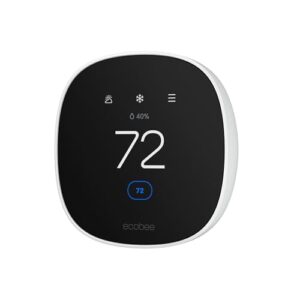
Not everyone needs radar sensors and air quality alerts. If you want solid savings without the premium price tag, this model covers the basics well.
You get two-stage heating and cooling support, a built-in occupancy sensor for Smart Home and Away, and Smart Recovery to hit your target temp on schedule. Humidity control helps cut that sticky, muggy feeling.
No C-wire? It often works anyway, though performance improves with one. Simple, dependable, budget-friendly.
| Best For | Homeowners who want reliable energy savings and smart scheduling without paying for extra sensors or premium features they may not need. |
|---|---|
| Remote Control | ecobee mobile app |
| Energy Savings | Up to 23% annually |
| Smart Home Integration | HomeKit, Google, Alexa |
| DIY Installation | Built-in leveling tools |
| Scheduling | Smart scheduling |
| Mobile App Support | ecobee app |
| Additional Features |
|
- Smart scheduling and remote app control help cut energy costs automatically
- Works with Apple HomeKit, Google Assistant, and Amazon Alexa for easy voice control
- DIY-friendly installation with built-in leveling tools and guided app setup
- Doesn’t include remote sensors or air quality monitors in the base package
- Homes without a C-wire may need an extra Power Extender Kit
- Needs a stable Wi-Fi connection for remote features to work properly
3. Google Nest Smart Thermostat
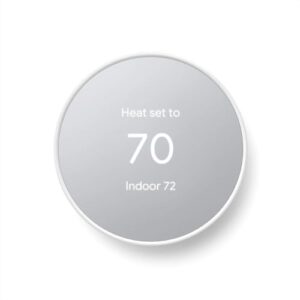
Prefer Google’s setup? This one’s built for it.
You get Energy Star certification, remote control via Google Home app, and HVAC monitoring that flags system issues before they become costly repairs. Matter-certified, so it plays nice with other smart home gear.
The catch: no simultaneous 2-stage heating and cooling support. Also skips the Savings Finder tool found on pricier Nest models. Solid pick if you want simple, reliable savings tied into Google’s assistant—not the most feature-packed option here.
| Best For | Homeowners already using Google Home who want an easy way to cut energy costs without juggling extra apps or hubs. |
|---|---|
| Remote Control | Google Home app |
| Energy Savings | Reduce monthly bills |
| Smart Home Integration | Google Assistant, Matter |
| DIY Installation | Requires C wire or accessory |
| Scheduling | Automated scheduling |
| Mobile App Support | Google Home app |
| Additional Features |
|
- Energy Star certified, so it’s built to help lower your monthly energy bills
- Remote control and scheduling right from the Google Home app, with pre-heating or cooling before you get home
- HVAC monitoring alerts you to system issues before they turn into expensive repairs
- Doesn’t support simultaneous 2-stage heating and 2-stage cooling
- May need a C wire or power accessory depending on your HVAC setup
- Tied to the Google Home app, so it won’t work with the legacy Nest app
4. Amazon Smart Thermostat with Alexa
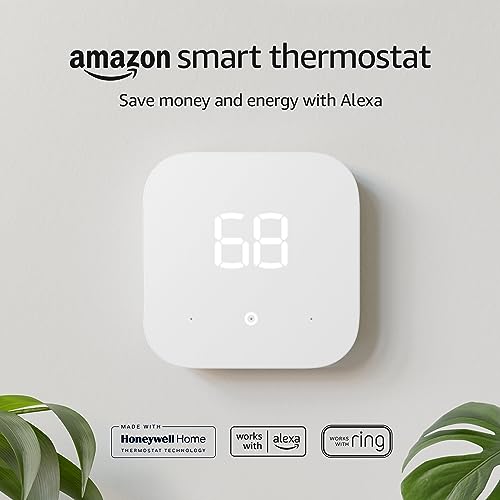
Already deep into the Alexa setup? This one fits right in.
It’s ENERGY STAR certified, built for DIY install, and hooks into Ring plus other Alexa gear for one connected setup. You get temperature holds in 1-degree steps, on-device buttons for quick changes, and an energy dashboard tracking daily use.
The catch: scheduling sticks to four fixed profiles, and it strictly needs a C-wire. Fan control sometimes needs the app instead of voice. Solid budget pick if Alexa already runs your home.
| Best For | Households already using Alexa devices who want an easy DIY thermostat that fits into their existing smart home setup. |
|---|---|
| Remote Control | Alexa app |
| Energy Savings | Average $50 yearly |
| Smart Home Integration | Alexa, Ring app |
| DIY Installation | Guided via Alexa app |
| Scheduling | Programmable scheduling |
| Mobile App Support | Alexa app |
| Additional Features |
|
- ENERGY STAR certified with an energy dashboard to track daily usage and savings
- DIY installation with Alexa app guidance and an optional wall plate for a clean finish
- Integrates smoothly with Ring and other Alexa-connected devices
- Requires a C-wire, and some systems may need a 24-volt transformer
- Scheduling is limited to four fixed temperature profiles
- Some voice commands, like fan circulation, need app control instead
5. Google Nest Learning Thermostat Silver
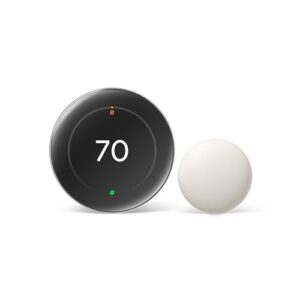
Want something that just looks good and works quietly in the background? This one does both.
With smart thermostats built for large homes, occupancy sensors can quietly adjust temperatures room by room, keeping every space comfortable without wasting energy.
The polished silver ring and color LCD display keep it easy to read, while motion sensing wakes the screen only when you walk up. It builds a Learning Smart Schedule from your routine, adjusts for weather, and includes a room sensor for balanced comfort.
Setup works with common C-wire configurations, and it’s ENERGY STAR certified. A style-focused pick with real energy tracking built in.
| Best For | Homeowners who want a stylish, low-maintenance thermostat that quietly learns their schedule while keeping energy costs down. |
|---|---|
| Remote Control | Google Home app |
| Energy Savings | Up to 31% savings |
| Smart Home Integration | Alexa, Siri, Google Assistant |
| DIY Installation | DIY for most homes |
| Scheduling | Learning algorithms |
| Mobile App Support | Google Home app |
| Additional Features |
|
- Learns your routine automatically and builds a smart schedule around it, adjusting for weather along the way
- Includes a room sensor to even out hot and cold spots for more consistent comfort
- ENERGY STAR certified with real energy tracking, plus a polished silver design that fits right into any room
- Requires a 24V system, so it won’t work with every home’s setup
- Some configurations may still need a C-wire despite most installs not requiring one
- Best results depend on placing the sensor thoughtfully, which adds a small extra setup step
6. Honeywell T9 Smart Thermostat
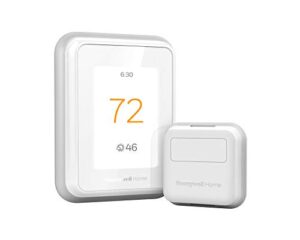
Multi-story homes with hot and cold spots need this one. The T9 uses remote room sensors to balance temperature across rooms, prioritizing where you actually spend time.
Geofencing tracks your phone’s location, cutting heating or cooling when everyone’s out. Seven-day scheduling gives you four periods a day, and auto-changeover switches between heat and cool without you touching a thing.
It’s ENERGY STAR certified, works with dual-band Wi-Fi, and holds your schedule even if the connection drops.
| Best For | The Honeywell T9 is best for owners of multi-story or large homes who deal with uneven heating and cooling and want smart, room-by-room control. |
|---|---|
| Remote Control | Resideo app |
| Energy Savings | ENERGY STAR certified |
| Smart Home Integration | Alexa, HomeKit, Google Assistant |
| DIY Installation | Guided process with adapter |
| Scheduling | Auto Home/Away scheduling |
| Mobile App Support | Resideo app |
| Additional Features |
|
- Remote room sensors eliminate hot and cold spots by balancing temperature across the areas you actually use
- Auto Home/Away scheduling and occupancy detection help cut energy waste without any manual effort
- Works seamlessly with Alexa, HomeKit, and Google Assistant, plus supports both 2.4GHz and 5GHz Wi-Fi
- Won’t work with 120-240V electric baseboard heat systems
- Needs a C-wire or the included power adapter, which adds a step to installation
- Advanced settings can only be changed on the thermostat itself, not through the app
7. Sensi Touch 2 Smart Thermostat
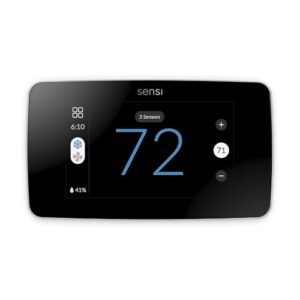
Style matters here. The Touch 2 packs a 4.3-inch color touchscreen into one of the thinnest profiles you’ll find on a wall thermostat, with brightness that auto-adjusts to your room’s lighting.
Pair it with Sensi room sensors (up to 15) and you get temperature and humidity balancing across every zone. Geofencing, 7-day scheduling, and usage reports round things out. It needs a C-wire, but install runs just 15-20 minutes with basic tools.
| Best For | homeowners who want smart, whole-home temperature control and are comfortable with a straightforward DIY install. |
|---|---|
| Remote Control | Mobile app |
| Energy Savings | Approx. 23% savings |
| Smart Home Integration | Alexa, Google, SmartThings |
| DIY Installation | Bluetooth-enabled instructions |
| Scheduling | Remote access scheduling |
| Mobile App Support | Sensi app |
| Additional Features |
|
- Energy savings of around 23% on HVAC usage, backed by ENERGY STAR certification
- Works with Alexa, Google Assistant, and Samsung SmartThings for flexible voice and app control
- Geofencing and room sensor compatibility keep every zone comfortable automatically
- Requires a C-wire, which some older homes may not have
- Sensi Room Sensors are sold separately, adding to the overall cost
- Certain add-on services and third-party utility programs may involve extra data collection
8. Sensi Smart Wi-Fi Thermostat ST55
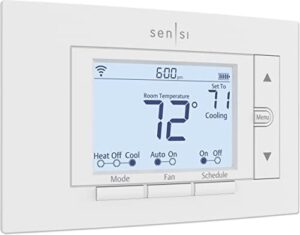
No auto-learning here, but that’s not the point. The ST55 gives you reliable Wi-Fi control without a steep price tag.
Battery or C-wire power means it fits almost any home, even older ones lacking a common wire. You get 7-day scheduling, geofencing, and Alexa or Google Assistant compatibility. The color display shows temperature, humidity, and time at a glance.
Reports lack granular timestamps, and settings take a few seconds to sync. For straightforward, dependable savings around 23%, it’s a solid, no-frills pick.
| Best For | Homeowners who want reliable, budget-friendly Wi-Fi thermostat control without needing a common wire or advanced auto-learning features. |
|---|---|
| Remote Control | Mobile app |
| Energy Savings | Approx. 23% savings |
| Smart Home Integration | Alexa, Google, SmartThings |
| DIY Installation | App guidance and wall level |
| Scheduling | Flexible scheduling |
| Mobile App Support | Sensi app |
| Additional Features |
|
- Works with 2 AA batteries or a C-wire, making it easy to install in older homes
- Delivers roughly 23% energy savings through flexible 7-day scheduling
- Compatible with Alexa, Google Assistant, and Samsung SmartThings for easy voice control
- No auto-learning capabilities or built-in camera support
- Usage reports lack detailed, time-stamped data for daily cycles
- Settings can take a few seconds to sync within the app
9. Sensi Lite Smart WiFi Thermostat
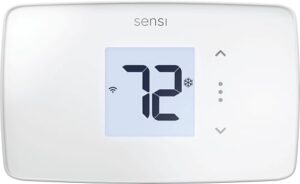
Budget-friendly and no-nonsense, this model skips the bells and whistles to focus on what matters: easy install, real savings. Most setups don’t need a common wire, so older homes work fine here.
You get 7-day scheduling, geofencing, and Alexa or Google Assistant control. Real-time energy data helps you spot patterns and cut waste.
ENERGY STAR certified, with a built-in level for straight mounting. If you want smart features without a big price tag, the Sensi Lite delivers dependable performance without overcomplicating things.
| Best For | Homeowners with older HVAC systems who want an easy, budget-friendly DIY install with reliable smart features like scheduling and geofencing. |
|---|---|
| Remote Control | Mobile app |
| Energy Savings | Approx. 23% savings |
| Smart Home Integration | Alexa |
| DIY Installation | Step-by-step instructions |
| Scheduling | Flexible scheduling |
| Mobile App Support | Sensi app |
| Additional Features |
|
- DIY installation is simple thanks to a built-in level and clear step-by-step instructions
- Energy Star certified, helping cut HVAC energy costs by around 23%
- Works with Alexa voice control and lets you adjust temps remotely from the mobile app
- Needs a C-wire for heat pump systems and some heat/cool setups
- Only works on 2.4GHz WiFi, so it won’t connect to 5GHz networks
- Some users have reported spotty WiFi connections and occasional touchscreen issues
How Smart Thermostats Save Energy

Smart thermostats don’t just look nice on the wall, they actively work to cut your energy bills. Behind that sleek screen, a handful of smart features team up to trim wasted heating and cooling. Here’s exactly how they pull that off.
Automatic Temperature Setbacks
Your thermostat doesn’t need you awake to save you money. Nighttime setback efficiency kicks in automatically, dropping setpoints 3-8°F while you sleep, cutting HVAC use 5-15%.
Occupancy sensors and seasonal range optimization fine-tune this further, easing off when rooms sit empty. Recovery rate management balances comfort and savings, warming things gradually instead of blasting energy. Smart temperature swing balance keeps you comfortable without waste. Implementing effective temperature setbacks can really help reduce your annual heating and cooling costs.
Learning Schedules and Routines
Setbacks handle the clock. Learning algorithms handle you.
Smart scheduling watches your daily patterns and builds a routine without any programming on your part.
- Learning temperature preferences over time
- Automated habit formation from real behavior
- Predictive climate control before you even ask
- Managing schedule disruptions without losing efficiency
Routine consistency shapes energy usage patterns, cutting waste while keeping comfort steady.
Geofencing for Empty Homes
Your phone knows when you’ve left, and your thermostat can too. Geofencing technology draws a virtual boundary around your home; cross it, and away mode kicks in automatically.
You can adjust the geofence radius for accuracy, though GPS limits and battery drain are real tradeoffs. Some brands offer location privacy controls. Either way, proximity-based automation means no more forgetting to adjust settings before you walk out the door.
Reduced HVAC Runtime
Cutting how often your system runs matters more than any single setting. Adaptive setbacks trim runtime by up to 15%, while occupancy-based cooling skips empty rooms entirely.
Zoning adds another layer, cutting runtime 5-20% depending on your layout. Pair that with seasonal setpoint optimization, and you’re looking at real, measurable HVAC efficiency gains across the whole year.
Remote App Control
None of that runtime savings works if you can’t check in from your phone.
Remote temperature management puts you in charge, no matter where you are. Real-time status monitoring shows current temp and humidity instantly.
Three things to look for:
- Remote override capabilities for schedule changes
- Automated maintenance alerts for filters
- User profile management for shared households
Mobile security protocols, like two-factor login, keep that access locked down tight.
Energy-Saving Features to Compare

Not every smart thermostat covers the same ground, and the extras matter more than you’d think. Some models track humidity, air quality, and even multiple rooms, while others stick to the basics. Here’s what to look for before you decide.
Room Sensors and Zoning
Room sensors fix the "one thermostat, whole house" problem. Wireless satellite sensors track temperature and occupancy sensing room by room, feeding data to the hub for smarter damper coordination.
Placement matters: skip drafts and direct sun. Battery life runs 1-3 years, and mesh networking keeps readings reliable even through walls—no dead zones, no manual recalibration headaches.
Humidity-aware Adjustments
Humidity control keeps comfort steady without cranking the thermostat. Most units target 30 to 50 percent indoor humidity, using latent heat cooling to pull moisture out—cutting energy use versus straight temperature-based cooling.
Sensors hold ±3% accuracy, though drift happens seasonally. This humidity-based adjustment also helps with mold prevention by triggering ventilation or dehumidification before moisture becomes a problem, boosting energy efficiency and long-term climate control.
Air Quality Monitoring
Ever wonder what’s floating in the air you breathe indoors? Some thermostats now double as an air quality monitor, tracking VOCs and CO2 alongside PM2.5 and PM10.
Premium models flag:
- VOC detection from paints and cleaners
- Particulate matter spikes
- Indoor air index shifts
Pollutant alert systems notify you before levels become unsafe, working alongside humidity-based temperature adjustment for complete indoor air quality control.
Voice Assistant Compatibility
Alexa, set it to 70" only works if your thermostat actually listens. Compatibility varies by brand and brand restrictions are real.
| Thermostat | Alexa | Google/Siri |
|---|---|---|
| Ecobee Premium | Yes | Yes |
| Nest Learning | Yes | Limited Siri |
| Amazon Smart | Deep Alexa/Ring | No Siri |
Cloud vs local processing affects voice privacy risks. Check natural language support before buying.
Matter Smart Home Support
Matter changes the buy-brand-hop-brands headache. This standard gives you cross-brand interoperability, so your thermostat talks to other ecosystems without a hub for each one.
Local control means it still works if Wi-Fi drops. Thread networking adds a reliable mesh connection, plus Matter security encryption keeps things locked down.
- Works across Google, Alexa, Apple
- No cloud dependency for basic function
- Simple, unified device onboarding
Match Thermostats to Your HVAC
The best thermostat on paper won’t save you a dime if it can’t talk to your HVAC system. Compatibility issues trip up more homeowners than any other step in this process. Here’s what to check before you buy.
Central Air Compatibility

A smart thermostat won’t fix bad ductwork. Check duct sizing and sealing first—leaks and static pressure issues cancel out any savings. Get ductwork right, and heating and cooling performance follows naturally.
A smart thermostat can’t fix bad ductwork—get the duct sizing and sealing right first, or you’ll cancel out every bit of savings
Your equipment should be AHRI-matched, with cooling capacity sized to your home’s actual load, not guesswork. Confirm electrical voltage matches across indoor and outdoor units too.
Heat Pump Support

Heat pumps run differently than standard AC systems, so your thermostat needs to speak their language. Look for reversing valve control, auxiliary heat settings, and support for variable speed compressors.
These features manage heat pump zoning and low ambient operation, keeping output steady even in cold snaps. Good HVAC compatibility here means real energy savings, not just basic heating and cooling control.
C-wire Requirements
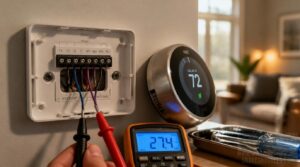
C-wire power keeps your thermostat’s Wi-Fi and screen running nonstop. No C-wire? Try a power extender kit or Cwire adapter instead of new wiring.
Check by looking for a labeled C terminal, or test with a multimeter between R and C for steady 24 volts. Older homes often need retrofitting; wire color (blue, black, sometimes purple) helps confirm proper thermostat wiring and HVAC compatibility.
High-efficiency System Limits

Sound wiring doesn’t help if your HVAC itself is fighting the thermostat. High-efficiency systems, think 20 SEER units, need compressor capacity matched to seasonal load. Oversized cooling hurts dehumidification. Mismatched sizing means short cycling, wasted energy, and comfort issues.
Duct leakage above 10% cuts efficiency fast, and high-efficiency gear often demands dedicated electrical capacity to handle startup current safely.
Professional Install Situations

Some jobs just aren’t DIY-friendly. Baseboard heat, dual-fuel systems, or anything sniffing of high-voltage systems means calling a licensed electrician, no exceptions.
Good reasons to get pro help:
- C-wire retrofitting in older homes
- HVAC compatibility testing before you buy
- Avoiding code compliance risks that void warranties
A pro also verifies HVAC performance afterward, catching wiring mistakes before they become costly.
Costs, Rebates, and Long-Term Value

A smart thermostat is more than a gadget—it’s a money decision. You’ll want to know what you’re paying upfront, what comes back through rebates, and how long the payoff takes. Here’s what actually affects your bottom line.
ENERGY STAR Certification
That little blue ENERGY STAR mark isn’t just branding—it means the EPA has verified real performance. Certified thermostats meet strict EPA performance standards, backed by third-party verification for accuracy.
Certification isn’t a one-time badge, either: it requires periodic certification renewal to stay valid. For you, that’s assurance the device actually delivers on energy efficiency and consistent energy consumption monitoring, not just marketing hype.
Utility Rebate Programs
Ever check if your utility offers cash back for going smart? Many do. Local utility credits and utility rebates often cover part of the purchase, sometimes requiring demand-response enrollment or efficiency certification requirements to qualify.
Some utilities offer on-bill financing, spreading costs over your bill. Check for regional subsidy stacking—combining utility incentives with state programs. A quick call to your utility company can reveal savings you didn’t know existed.
Demand-response Incentives
Why not get paid for the energy you don’t use? Demand response programs reward you for cutting back during peak usage times, often through your smart thermostat’s automated adjustments.
Utilities verify reductions using smart meter connectivity, then issue energy discounts or bill credits. Programs like ecobee’s Community Energy Savings offer up to $125. Benefits include grid reliability support and real peak load shifting—confirm rebate verification methods before enrolling.
Payback Period Estimates
How fast do you get your money back? Most smart thermostats hit payback within one to three years, factoring purchase price against annual savings.
Simple math works fine here: divide cost by yearly savings. That’s a liquidity check, not a full cost-benefit analysis—it ignores later returns. Factor in utility rebates upfront, and your investment recovery timeline shrinks even faster.
Budget Versus Premium Models
Cheap and premium thermostats both track temperature, but that’s where the similarity ends.
- Build quality: metal housings versus plastic, tighter tolerances
- Sensor accuracy: multi-room sensing versus single central reading
- Warranty length: 2-5 years versus basic coverage
- Software support: longer update lifecycles
- Energy savings: deeper analytics, faster payback
Budget models work fine for simple setups. Premium buys long-term durability and better energy efficiency.
Frequently Asked Questions (FAQs)
Can a thermostat make your electric bill go up?
Yes—like the boy who cried wolf, a faulty sensor or improper placement near sunlight can trick your thermostat. Add aggressive setpoints, short cycling, or manual mode inefficiencies, and your energy bills climb fast, undercutting real smart thermostat savings.
Does having the AC on 72 instead of 70 make it cheaper?
Two degrees cuts compressor runtime, shortening cycles on hot days. Savings depend on insulation, electricity rates, and humidity comfort. Well-sealed homes see less benefit; poor insulation sees more. It won’t erase your bill, but it helps.
How long do smart thermostats typically last?
Like a good pair of boots, a smart thermostat’s lifespan depends on care. Most last 7 to 10 years—Nest and Ecobee lead, budget models trend shorter. Watch for slow response or connectivity drops as replacement triggers.
Can renters install smart thermostats in apartments?
Renting doesn’t rule out smart thermostats. Get written landlord approval first, choose non-invasive models to sidestep C-wire issues, and keep the original thermostat for restoring at move-out.
DIY install works fine for approved, reversible upgrades that still cut heating and cooling costs.
Do smart thermostats work during power outages?
Your device keeps schedules safe thanks to nonvolatile memory retention, and local control still runs basic heating or cooling without Wi-Fi.
Battery backup or a C-wire keeps settings alive short-term; once power returns, it reconnects and resumes automatically—no manual reset needed.
Whats the average payback period for installation?
Slow and steady wins the race, and that’s exactly how payback works here. Most models earn back their cost in 3 to 7 years, with ENERGY STAR picks and rebates trimming that timeline through better efficiency and lower net installation costs.
Are there government rebates for smart thermostats?
Yes. Federal tax credits through the Inflation Reduction Act, plus state energy initiatives, low-income incentives, and local utility company rebates all boost energy savings.
Check rebate eligibility criteria first, since requirements vary by region and model.
Can smart thermostats work during a power outage?
Lights out, screen dark — but your thermostat isn’t helpless. Backup battery reliability and C-wire power keep schedules stored, local control still adjusts heating and cooling, and most units handle post-outage recalibration automatically once power and Wi-Fi reconnect.
Do utility companies offer rebates for smart thermostats?
Many local utilities offer rebates worth $50 to $120 for ENERGY STAR models. Check your provider’s site for eligibility rules, submit proof of purchase, and consider demand-response enrollment for extra credits toward peak usage programs.
Are smart thermostats compatible with older home wiring?
Old wiring won’t necessarily stop you. Most homes have a C-wire solution available, whether existing or added through a power extender kit. A quick wiring assessment and professional installation confirm compatibility before you buy.
Conclusion
Worried the upfront cost won’t pay off? Run the math: most models recoup their price within a single year through lower monthly bills, sometimes even faster still.
The best thermostats for energy savings aren’t always the flashiest ones; they’re simply the ones matched carefully to your HVAC system and daily habits. Pick based on compatibility first, features second.
Set it, trust it, and let it work quietly. Your thermostat should feel invisible; your savings shouldn’t.