This site is supported by our readers. We may earn a commission, at no cost to you, if you purchase through links.

Your ball python isn’t moving much, hasn’t eaten in two weeks, and spends most of its time pressed against the glass—classic signs that nighttime temperatures have dropped too low. Many snake keepers assume their pets don’t need warmth after dark, but most species require consistent thermal support around the clock to maintain critical metabolic functions, from digestion to immune response.
The difference between a thriving snake and one struggling with chronic health issues often comes down to what happens inside that enclosure between sunset and dawn. Choosing effective nighttime heating solutions for snakes means understanding your species’ specific thermal requirements, evaluating heat sources that won’t disrupt natural day-night cycles, and implementing fail-safes that prevent dangerous temperature swings.
Table Of Contents
- Key Takeaways
- Factors Affecting Nighttime Snake Heating
- Risks of Inadequate Nighttime Heating
- Comparing Nighttime Heat Source Options
- Key Features in Nighttime Heating Equipment
- Top Nighttime Heating Products for Snakes
- Practical Tips for Safe Nighttime Heating
- Frequently Asked Questions (FAQs)
- Can you leave the heating pad on all night for a snake?
- Do snakes need a heat source at night?
- What temperature is too cold for snakes to be out at night?
- What can I use instead of a heat lamp for reptiles?
- Can snakes survive without any nighttime heating?
- How often should heat sources be replaced?
- Do baby snakes need different nighttime temperatures?
- What are signs of overheating in snakes?
- Should humidity levels change at night too?
- Conclusion
Key Takeaways
- Your snake’s nighttime temperatures must stay within species-specific ranges (typically 70-80°F) because inadequate heating triggers a cascade of health problems, including slowed digestion, compromised immunity, and respiratory infections that stem from metabolic disruption.
- Ceramic heat emitters outperform standard heat lamps for overnight use because they deliver consistent infrared warmth without visible light that would disrupt your snake’s natural circadian rhythm and nocturnal behavior patterns.
- A reliable thermostat isn’t optional—it’s the critical safety component that prevents both dangerous temperature spikes that cause burns and temperature drops that induce cold stress, making it essential for any nighttime heating setup.
- Effective thermal management requires positioning heat sources to create a proper gradient (warm zone to cool zone), placing temperature probes at snake level rather than near the heat source, and conducting weekly equipment checks to catch failures before they compromise your animal’s health.
Factors Affecting Nighttime Snake Heating
Getting your snake’s nighttime temperatures right isn’t as simple as picking a heat source and calling it done.
Many keepers wonder whether ball pythons need heating pads or if alternatives like ceramic emitters work better for overnight warmth.
Your home’s ambient temperature, your enclosure setup, and your specific species all play major roles in determining what heating approach will actually work.
Let’s break down the key factors you’ll need to take into account before you make any equipment decisions.
Ambient Room Temperature and Seasonal Changes
Throughout seasonal shifts, your home’s ambient temperature fluctuates considerably—from 22 to 28°C summer nights down to 16 to 20°C in winter when heating systems cycle off. These thermal fluctuations directly impact your snake’s nighttime heat retention and temperature regulation needs.
You’ll need to monitor nighttime temperatures closely during climate adaptation periods, adjusting supplemental heat sources while maintaining humidity control for ideal reptile thermoregulation. Snakes are especially sensitive to outdoor temperature fluctuations, which can affect their health and activity.
Enclosure Size, Insulation, and Materials
Your enclosure’s physical design plays a decisive role in nighttime temperatures. Larger floor areas demand higher wattage heat sources, while tall enclosures naturally create thermal gradients through air stratification—warm air rises near emitters, cooler zones settle below.
Insulation types matter: rigid foam boards or polyurethane panels minimize heat loss through walls. Composite materials with internal foam cores outperform plain plywood, and proper sealing with weather stripping prevents drafts that undermine thermal barriers.
Species-Specific Thermal Requirements
Insulation and dimensions shape your setup, but species-specific reptile thermoregulation needs define success. Ball pythons thrive with nighttime temperatures around 75°F, while corn snakes tolerate 70°F without stress—each species possesses distinct thermal optima that determine their heat tolerance and temperature acclimation capacity.
- Tropical species demand warmer nights than temperate desert specialists
- Narrow thermal gradients increase sensitivity to minor fluctuations
- Temperature regulation shifts with life stage and seasonal physiology
Understanding is essential for creating heating solutions that support both health and natural behavior.
Substrate and Heat Retention Considerations
Your substrate choice directly impacts heat retention through thermal mass and insulation properties. Fine-grained materials like coconut fiber store heat more effectively than loose sands, extending warmth 2–4 hours into cooler nights.
Substrate depth of 2 to 4 inches creates stable thermal gradients, while moisture levels influence heat storage—damp substrates hold temperature longer but require careful ventilation to prevent mold in your reptile heating setup.
Risks of Inadequate Nighttime Heating
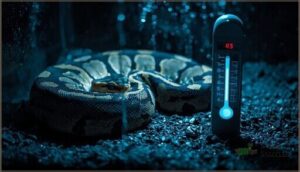
When your snake’s enclosure drops too cold at night, you’re not just risking discomfort—you’re opening the door to serious health problems that can escalate quickly.
Cold stress doesn’t announce itself with obvious symptoms right away, which makes it particularly dangerous for keepers who aren’t monitoring temperatures closely. Let’s look at the specific ways inadequate nighttime heating compromises your snake’s health, so you know exactly what warning signs to watch for.
Cold Stress and Health Complications
When nighttime temperatures drop too low, your snake faces cold stress—a cascade of health problems that can quickly become serious. Thermal regulation failure forces reptile thermoregulation needs into crisis mode, slowing snake metabolism to dangerous levels.
When nighttime temperatures drop too low, cold stress triggers a dangerous cascade that slows your snake’s metabolism and forces its body into crisis mode
Temperature fluctuations below species-specific thresholds create hypothermia risk, triggering cold induced illness that manifests as respiratory infections, lethargy, and compromised organ function.
Impact on Digestion and Immunity
Metabolic balance depends on stable nighttime temperatures—without them, your snake’s digestion and immune system begin to fail. Temperature regulation disruptions trigger a domino effect through reptile thermoregulation needs.
The consequences of this disruption are far-reaching and include:
- Slowed enzyme activity impairs protein breakdown in the digestive tract
- Gut microbiome shifts reduce nutrient absorption efficiency
- Thermal stress suppresses immune response, leaving snakes vulnerable to pathogens
- Compromised digestive health creates systemic inflammation affecting overall vitality
Behavioral Signs of Thermal Stress
Thermal stress reveals itself through unmistakable shifts in snake behavior. You’ll notice restless pacing or constant escape attempts when nighttime temperatures stray from ideal ranges.
Cold stupor makes your animal lethargic and unresponsive, while excessive heat triggers frantic heat-seeking or avoidance patterns. Watch for unusual posturing—tight coiling suggests chilling, while stretched-out positioning indicates overheating.
These behavioral cues demand immediate adjustment to restore proper reptile thermoregulation and metabolism.
Comparing Nighttime Heat Source Options
Choosing the right nighttime heat source means understanding how each option delivers warmth without disrupting your snake’s natural rest cycle.
Some methods provide consistent heat without light, while others require careful placement to avoid overheating or cold spots. Let’s compare the most effective heating solutions so you can decide what works best for your setup.
Heat Lamps Vs. Ceramic Heat Emitters
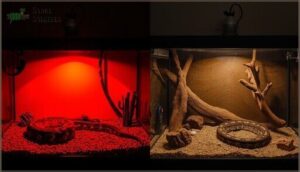
When comparing reptile heating options, your Heat Source Comparison comes down to light versus darkness. Heat lamps emit visible light alongside warmth, which can disrupt nocturnal behavior, while ceramic heat emitters provide pure infrared heat without any glow—making them ideal for nighttime temperatures.
Consider these key differences in your Ectotherm Heating Systems:
- Lamp Wattage Options generally run hotter and require careful Thermal Gradient Control to prevent overheating
- Ceramic heat emitters offer better Emitter Safety Features with longer lifespan and consistent temperature control
- CHEs won’t disturb your snake’s sleep cycle, whereas standard heat lamps need dimmers or filters for nighttime use
Benefits and Drawbacks of Heat Mats
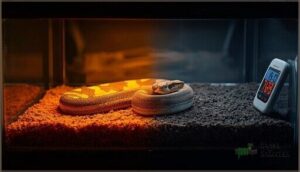
You’ll find Heat Mat Efficiency shines through steady belly heat and Energy Savings compared to overhead lamps, making heat mats an attractive nighttime heating solution for reptile heating.
Proper Mat Placement under thin substrate creates a reliable Thermal Gradient for temperature control in snake care. However, thick bedding reduces Heat Consistency, and without thermostats, surface temps can spike dangerously high.
Radiant Heat Panels and Other Alternatives

Radiant heat panels offer outstanding Thermal Efficiency by warming enclosure surfaces directly through infrared radiation, making them ideal nighttime heating solutions for temperature regulation. Panel Placement on walls or ceilings ensures Heat Distribution without occupying floor space, while Heat Panel Safety improves when paired with thermostats.
Consider these advantages for reptile heating:
- Lower electricity consumption than bulb-based heat sources
- Minimal light output preserves natural cycles
- Even Heat Distribution across vertical surfaces
- Reduced air convection maintains stable humidity
Avoiding Light Disturbance During Nighttime

While heat sources maintain your nighttime temperature and thermal gradient, preserving dark environments remains equally important for proper temperature regulation.
Ceramic heat emitters excel at this task because they produce zero ambient illumination, unlike traditional bulbs that disrupt circadian rhythms.
Light blocking strategies prevent thermal shadows and maintain nighttime visibility for caretakers without stressing nocturnal species that depend on darkness for normal behavior patterns.
Key Features in Nighttime Heating Equipment
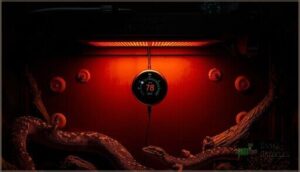
You can’t just pick any heating device and hope for the best—your snake’s safety depends on choosing equipment with the right built-in protections and monitoring capabilities.
The difference between adequate nighttime heating and a potential disaster often comes down to three critical features that work together to maintain stable, safe temperatures. Let’s examine what separates reliable heating equipment from risky alternatives.
Thermostat Compatibility and Safety Controls
When selecting nighttime heating solutions, you’ll need thermostats rated for your heat source’s total wattage to prevent overloads and electrical failures.
Digital monitoring systems track temperature regulation continuously, while safety interlocks provide automatic shutoffs if enclosure temperatures exceed safe thresholds.
Temperature alarms alert you to sensor faults or dangerous drift, and calibration features guarantee your heat source maintains precise temperature control without rapid on-off cycling that stresses both equipment and snake.
Placement for Effective Thermal Gradients
Proper gradient placement transforms temperature control from guesswork into science. Position your heat source along the back wall, 2 to 5 cm above substrate level, to establish a clear thermal gradient from the warm zone to the cooler end.
This horizontal arrangement lets your snake shuttle between temperatures naturally, self-regulating metabolic needs without fighting hotspots or cold corners in the enclosure.
Digital Temperature Monitoring Tools
Once your heat is in place, temperature control shifts from manual checks to precision data. Digital sensors with data logging track nighttime thermal patterns automatically—thermocouples span minus 200 to 1350°C, while RTDs deliver tighter accuracy inside your terrarium’s narrow band.
Modern systems offer thermal mapping across zones, temperature alarms for drift, and heat analytics that reveal insulation gaps before cold stress appears.
- Sensor calibration ensures readings stay within ±0.5 to ±2.0°C, preventing false alarms and missed problems.
- Real-time dashboards display current temperatures and trends, so you spot heater failures immediately.
- Threshold alerts via SMS or email notify you when nighttime conditions slip outside safe ranges.
Top Nighttime Heating Products for Snakes
Selecting the right nighttime heating equipment requires evaluating compatibility with your enclosure setup, thermostat integration, and species-specific thermal needs.
The following products represent proven solutions across different heating approaches, from ceramic emitters to mat-and-thermostat combinations that maintain stable overnight temperatures. Each option tackles specific husbandry challenges while prioritizing safety and reliable temperature control.
1. Exo Terra Reptile Dome Light Fixture
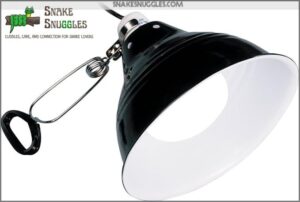
Think of the Exo Terra Reptile Dome as your thermostat’s partner for nighttime warmth. Its extra-long aluminum reflector maximizes heat distribution while boosting UVB output—critical when you’re pairing it with ceramic heat emitters that won’t disrupt your snake’s sleep cycle.
The heat-resistant ceramic socket accommodates bulbs up to 160W, and the 6-foot power cord with an integrated switch gives you flexibility in placement. You’ll appreciate the compatibility with multiple bulb types, letting you customize heating based on your species’ specific overnight temperature requirements.
| Best For | Reptile owners who need reliable nighttime heating without disrupting their pet’s natural day-night cycle, especially for species requiring precise temperature control. |
|---|---|
| Wattage | 150 watts |
| Material | Aluminum and porcelain |
| Primary Use | Reptile heating/lighting |
| Temperature Control | Adjustable positioning |
| Installation | Adjustable clamp |
| Brand | Exo Terra |
| Additional Features |
|
- Aluminum reflector design maximizes heat distribution and UVB output for better calcium absorption
- Heat-resistant ceramic socket handles up to 160W bulbs with multiple bulb type compatibility
- 6-foot cord with integrated switch makes placement flexible and convenient
- Fixture gets extremely hot during use, requiring careful handling and positioning
- Clamp mechanism can be tricky to adjust and secure properly
- Higher price point compared to basic dome fixtures on the market
2. Fluker’s Reptile Daylight Bulb
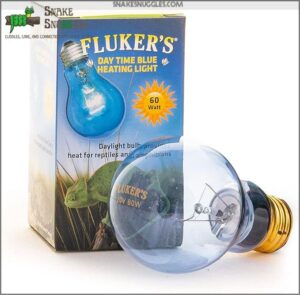
This 60-watt option from Fluker’s uses neodymium glass to produce natural-looking daylight that stimulates feeding behavior and promotes healthy basking temperatures during active hours.
While marketed as a daytime bulb, you shouldn’t rely on it for nighttime heating—its visible light spectrum disrupts your snake’s circadian rhythm, and it lacks the heat-only output needed for overnight temperature maintenance. Pair it with a ceramic heat emitter or heat mat for nighttime warmth, using the daylight bulb strictly during the 12-hour photoperiod to maintain proper metabolic function.
| Best For | Ball python owners who need reliable daytime heating and light to maintain proper basking temperatures and encourage natural feeding behavior during active hours. |
|---|---|
| Wattage | 60 watts |
| Material | Standard bulb |
| Primary Use | Reptile heating/lighting |
| Temperature Control | Manual control |
| Installation | Standard socket |
| Brand | Fluker’s |
| Additional Features |
|
- Neodymium glass creates natural-looking daylight that stimulates normal feeding behavior in reptiles
- Provides adequate basking heat at 60 watts for maintaining healthy daytime temperatures
- Easy to use with timers to maintain a consistent 12-hour photoperiod for proper circadian rhythm
- Not suitable for nighttime use since the visible light disrupts your snake’s sleep cycle
- Some users report durability issues with bulbs burning out after just a few months
- Requires pairing with additional heat sources like ceramic emitters or heat mats for overnight warmth
3. iPower Reptile Heat Mat Thermostat Combo
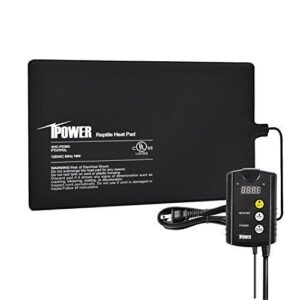
This 16-watt mat pairs with an integrated digital thermostat, giving you precise control from 40°F to 108°F without the light pollution that disrupts nocturnal behavior.
The controller’s LED display shows real-time temperatures, while the probe monitors your warm zone gradient—vital for species like ball pythons that need belly heat between 88-92°F at night. You’ll appreciate the 3M adhesive backing that secures the mat beneath glass terrariums, though some users report temperature fluctuations around 4°F, so verify probe placement for accuracy.
| Best For | Reptile owners who need precise nighttime temperature control without bright lights, especially for nocturnal species like ball pythons that require consistent belly heat. |
|---|---|
| Wattage | 16 watts |
| Material | PTC heating material |
| Primary Use | Terrarium heating |
| Temperature Control | Digital thermostat 40-108°F |
| Installation | Adhesive mounting |
| Brand | iPower |
| Additional Features |
|
- Digital thermostat with LED display gives you precise temperature control from 40°F to 108°F so you can dial in exactly what your pet needs
- 3M adhesive backing sticks firmly under glass terrariums and transfers heat efficiently to create proper warm zones
- Energy-efficient 16-watt design reaches target temps faster while keeping your electric bill low
- Temperature can fluctuate by about 4°F, so you’ll need to double-check your probe placement for accuracy
- Some users report the adhesive doesn’t always stick well or the mat heats slower than expected
- Won’t work well if you need temps above 75°F for certain species or applications
4. Zoo Med Reptile Cave Shelter
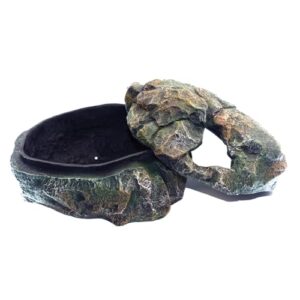
While ceramic hides don’t generate heat themselves, Zoo Med’s 3-in-1 Repti Shelter functions as a strategic microclimate anchor when you position it near your warm zone.
The removable lid grants quick access to inspect moisture levels—critical when you fill it with sphagnum moss to boost humidity during shed cycles. At 6″ × 12″ × 11″, the large variant accommodates adult ball pythons comfortably, and the smooth ceramic surface tolerates repeated cleaning with reptile-safe disinfectants between uses.
| Best For | Reptile owners who need a versatile hide that can double as a humidity chamber during shedding periods. |
|---|---|
| Wattage | N/A |
| Material | Ceramic |
| Primary Use | Reptile hide/shelter |
| Temperature Control | Passive shelter |
| Installation | Place in terrarium |
| Brand | Generic/RC-32 |
| Additional Features |
|
- Removable lid makes it easy to add moss or check humidity levels without disturbing your reptile
- Large size fits adult ball pythons, corn snakes, and other medium-to-large species comfortably
- Smooth ceramic surface cleans up easily with reptile-safe disinfectants
- Ceramic material chips or breaks more easily than plastic alternatives
- Lid fits loosely, so stronger reptiles can push it off
- Some users report it arrives smaller than the 6″ × 12″ × 11″ dimensions suggest
5. Reptile Deep Dome Lamp Fixture
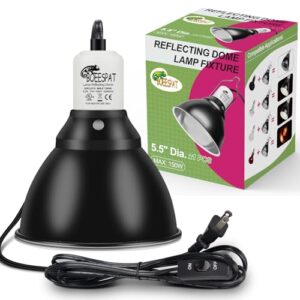
BOEESPAT’s 5.5-inch deep dome concentrates radiant heat downward through its UV-reflective aluminum interior, making it compatible with ceramic emitters up to 250 watts when you need focused nighttime warmth. The E26 socket accepts most standard heat bulbs, and 67-inch cord lets you position the fixture away from active climbing zones.
Top ventilation prevents dangerous heat buildup, though you’ll want to verify the independent switch functions smoothly—some units arrive with loose contacts that fail within weeks of installation.
| Best For | Reptile owners who need an affordable, focused heat source for terrariums and want flexibility to swap between UVA/UVB bulbs and ceramic emitters. |
|---|---|
| Wattage | 250 watts max |
| Material | Aluminum alloy |
| Primary Use | Reptile lighting fixture |
| Temperature Control | Manual control |
| Installation | Independent switch |
| Brand | BOEESPAT |
| Additional Features |
|
- Deep dome design with reflective aluminum interior directs heat efficiently downward to basking areas
- 250-watt capacity handles powerful ceramic emitters and heat bulbs with a long 67-inch cord for flexible placement
- Built-in ventilation holes prevent overheating while the independent switch offers convenient on/off control
- On/off switch often arrives loose or fails within weeks, requiring careful inspection upon delivery
- Build quality is inconsistent—some units show dents or break easily despite the aluminum construction
- Short 12-month warranty doesn’t inspire confidence given the reported defect rate
Practical Tips for Safe Nighttime Heating
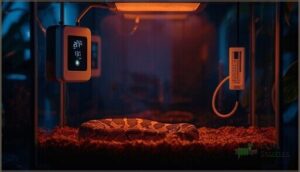
Getting the equipment right is just the start—you also need to use it safely and effectively. Temperature control isn’t a one-time setup; it requires ongoing attention to prevent health problems and equipment failures.
The following tips will help you maintain stable nighttime conditions while avoiding common mistakes that put your snake at risk.
Setting and Maintaining Nighttime Temperature Ranges
Your thermostat becomes the gatekeeper of nighttime thermoregulation, holding ambient levels between 65 and 80 degrees for most species. Thermal monitoring requires placing digital sensors at snake level, away from direct heat source placement, to capture accurate gradient creation data.
Review overnight logs each morning—if readings drift beyond ±2 degrees of your target nighttime temperature, recalibrate your temperature control system immediately.
Preventing Overheating and Burns
Protecting your snake from thermal stress starts with positioning heat sources to prevent direct contact—install protective guards around ceramic heat emitters and raise mats away from substrate layers that trap excess warmth. Set your thermostat with high-limit cutoffs specific to your species’ tolerance, then verify surface temperatures using a handheld infrared thermometer before introducing your animal to the enclosure.
Critical burn prevention measures include:
- Using reflective barriers to prevent hotspots where rocks or decorative hides concentrate radiant heat
- Placing temperature probes at snake level, away from direct heat source placement, to capture true ambient readings
- Inspecting cords monthly for frayed insulation that creates electrical burn risks
- Providing cool retreats on the gradient’s opposite end so your snake can self-regulate away from warmth
Regular Equipment Checks and Maintenance
Beyond installing safe nighttime heating solutions, you’ll need weekly inspection frequency checks covering electrical safety risks like frayed cords and loose thermostat connections.
Clean your enclosure monthly to prevent dust from compromising ceramic heat emitters, verify sensor calibration quarterly against a reference thermometer, and maintain a parts inventory with replacement bulbs and backup equipment—this schedule keeps your reptile heating equipment reliable year-round.
Adapting Heating Solutions for Different Species
Once you’ve established a solid maintenance routine, species research becomes your next priority in snake care. Different snakes have unique thermal biology needs that demand customized temperature control.
Here’s how to match heating solutions to specific species:
- Ball pythons thrive with warm hides around 29 to 32 Celsius and cooler zones near 22 to 25 Celsius at night
- Corn snakes require a heat gradient keeping retreats at 26 to 28 Celsius while surrounding areas drop 6 to 8 degrees cooler
- Boa constrictors benefit from basking spots maintained around 30 Celsius during nighttime temperature cycles
- Garter snakes prefer compact warm zones between 25 to 28 Celsius with more evenly distributed enclosure temperatures
- Tropical arboreal species need vertical heat gradients with elevated warm retreats placed 20 to 25 cm above substrate level
Understanding snake behavior patterns helps you position heat sources effectively. Desert species seek surface warmth, while burrowing snakes rely on substrate insulation for temperature regulation. Adjust your reptile heating setup based on whether your species climbs, burrows, or stays ground-level—this species-specific approach prevents thermal stress and promotes healthy metabolism year-round.
Frequently Asked Questions (FAQs)
Can you leave the heating pad on all night for a snake?
Yes, you can leave a heat pad on all night, but only with a reliable thermostat.
Without temperature control, continuous heat poses burn risks and overheating dangers that compromise your snake’s safety.
Do snakes need a heat source at night?
Most snakes require a nighttime heat source when ambient room temperatures drop below 70°F (21°C), as proper thermal regulation depends on maintaining species-specific temperature ranges for metabolic function, digestion, and immune health.
What temperature is too cold for snakes to be out at night?
Picture a ball python coiled motionlessly in a 58°F corner—that’s cold stress in action.
Most snakes can’t sustain normal reptile thermoregulation and metabolism below 60°F at night, though tropical species struggle even at 65°F.
What can I use instead of a heat lamp for reptiles?
You can rely on ceramic heat emitters, radiant heat panels, under tank heaters, or deep heat projectors paired with a thermostat—each offering consistent warmth without visible light that disrupts your reptile’s natural cycles.
Can snakes survive without any nighttime heating?
Can survival trump thriving? While some species tolerate cooler nights near their cold adaptation limits, prolonged exposure below nocturnal behavior basking zones causes thermal shock, compromising snake physiology through weakened temperature regulation and metabolic slowdown.
How often should heat sources be replaced?
Most reptile heating equipment needs replacement every one to three years.
Heat lamp bulbs decline after six to twelve months, while ceramic heat emitters and heat mats show reduced heat output around the two-year mark.
Do baby snakes need different nighttime temperatures?
Like a delicate thermostat, in a growing body, hatchling thermoregulation demands precision—baby snake care requires warmer gradients than adults, with neonate temperature needs maintaining 80-85°F warm zones for proper juvenile heating and infant thermal needs.
What are signs of overheating in snakes?
Watch for lethargy, rapid breathing with mouth gaping, excessive cool-seeking behavior, and pale or flushed skin.
Heat stroke causes coordination loss—thermal stress demands immediate intervention to prevent irreversible reptile health complications.
Should humidity levels change at night too?
Your snake’s habitat isn’t a set-it-and-forget-it operation.
Overnight humidity rise usually occurs as temperatures drop, but species humidity needs determine whether you’ll adjust environmental control for respiratory health or maintain stable day-night cycle conditions.
Conclusion
Before the advent of digital thermostats, keepers lost countless snakes to preventable thermal failures—a tragedy you can avoid with proper nighttime heating solutions for snakes.
Your equipment choices directly determine whether your animal thrives or merely survives. Install redundant monitoring systems, verify temperature gradients weekly, and never assume room temperature suffices after dark.
The difference between metabolic efficiency and chronic stress often measures just three degrees—precision matters when you’re responsible for an ectothermic life.