This site is supported by our readers. We may earn a commission, at no cost to you, if you purchase through links.
A ball python curled on a cold substrate looks calm. It isn’t. Below 75°F, it stops digesting, refuses meals, and slides toward a respiratory infection.
So do ball pythons need heating pads? Sometimes, but a pad alone rarely does the job. Your snake needs an 88–90°F warm side, a 76–80°F cool side, and a gradient to move between them. One unregulated heater can also scorch a belly or ignite bedding.
If you’re planning the layout from scratch, these snake vivarium design ideas show how to place hides, heat sources, and décor so your ball python’s gradient works naturally.
The right setup mixes overhead heat, a thermostat, and smart backup. Here’s how to build it, plus five products worth your money.
Table Of Contents
- Key Takeaways
- Do Ball Pythons Need Heating Pads?
- What Temperatures Do Ball Pythons Need?
- How to Heat a Ball Python Safely
- Top 5 Ball Python Heating Products
- Frequently Asked Questions (FAQs)
- How long can ball pythons survive without heat?
- Does my ball python need a heat mat?
- How cold is too cold for a ball python at night?
- Do ball pythons need heat overnight?
- How much heat do ball pythons need?
- What is the best heating method for a ball python?
- Can ball pythons survive without any heat source?
- How often should heating equipment be replaced?
- Do baby ball pythons need different temperatures?
- Whats the ideal nighttime temperature for ball pythons?
- Conclusion
Key Takeaways
- You don’t need a heating pad to keep a ball python healthy, since overhead heat like a halogen bulb or ceramic emitter should be your main source, with a pad serving only as backup belly heat.
- You need a gradient with an 88–90°F warm side and a 76–80°F cool side, because below 75°F your snake stops digesting, refuses meals, and risks a respiratory infection.
- You should run every heater through a thermostat, with the probe at snake level, because an unregulated pad can hit 140°F and cause severe burns or even start a fire.
- You’ll keep your setup accurate by using separate digital thermometers for each side, checking them daily, and keeping nights at 70–78°F with lightless backup heat if your room runs cold.
Do Ball Pythons Need Heating Pads?

Why do so many keepers assume a heating pad is mandatory? Because it’s cheap, easy to find, and sold in nearly every pet store. But you don’t need one to keep a ball python healthy.
If you do go with a pad, choosing the right ball python heating pad means looking at safety features and placement, not just price.
Overhead radiant heat, like a halogen bulb, deep heat projector, or ceramic emitter, is now the standard for primary reptile heating. It warms your snake the way the sun would, and it actually lifts the air temperature.
Undertank heaters still have a place. Use one as a backup to fine-tune the warm hide, or as the main source in a tub or quarantine setup. Always run it through a thermostat, because temperature control isn’t optional. An unregulated pad can cause severe burns.
What Temperatures Do Ball Pythons Need?
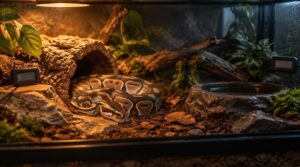
Heat source aside, your snake cares about one thing: the numbers. Get them wrong and appetite, digestion, and immunity all suffer.
Aim for a warm side of 88–90°F, with the basking temperature on a surface under overhead heat reaching 90–104°F. Keep the cool side at 76–80°F. That temperature gradient lets your python choose where to be, so both zones must exist at once.
At night, let temperatures settle at 70–78°F. If the room dips below 72°F, add lightless heat, like a heat mat on a thermostat.
Never let air temperature pass 95°F. Pair these temperatures with a 60–80% humidity range to help your python shed cleanly.
Temperature monitoring matters. Use separate digital probes for each side, place the thermostat probe at snake level, and check daily. Bulbs fade, rooms change, old readings prove nothing.
For heat mats, a step-by-step guide on how to use a thermostat with a reptile heat mat can help you confirm your setup keeps the surface safely within range.
How to Heat a Ball Python Safely
Now that you know your targets, here’s how to hit them without hurting your snake. Good reptile heating starts with one rule: every heating pad, cable, emitter, and bulb runs through a thermostat. No exceptions.
An unregulated heating pad can hit 140°F, and pythons won’t flee until the damage is done. Temperature control protects against three dangers:
An unregulated heating pad can reach 140°F, and a python won’t flee until the damage is already done
- A scorched belly from a mat running wild
- A melted plastic socket above a ceramic emitter
- A bedding fire sparked by trapped heat
Set the thermostat probe on the substrate above the pad, where your snake actually lies. For overhead heaters, put it at snake level, never on the heater itself. Cover only half the floor with the pad, leaving a cool retreat.
If your ball python still spends most of its time tucked away even with the temperatures dialed in, this guide to why ball pythons hide so much can help you tell normal behavior from a setup problem.
Top 5 Ball Python Heating Products
You’ve got the temps and the safety rules down, so now it’s time to gear up. The five products below cover everything from the heat source itself to the controller that keeps it in check. Here’s what’s worth buying for your ball python’s setup.
1. iPower Reptile Heat Pad
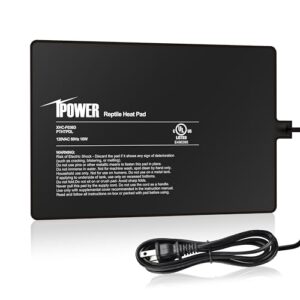
Every keeper has a story about a heat pad that ran too hot. The iPower Reptile Heat Pad is built to avoid that one.
Its PTC ink raises resistance as it warms, so the pad limits itself. Still, you need a thermostat for real temperature control. Mount it on one side of the glass, never the whole base, and your snake keeps a cooler zone.
2. Inkbird Digital Temperature Controller Thermostat
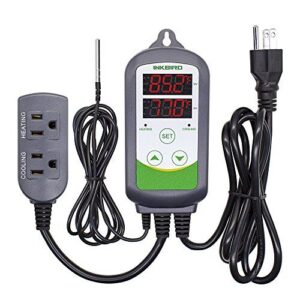
Most heat pads run hot without a brake, and that’s a risk you don’t need. The Inkbird Digital Temperature Controller is the thermostat that fixes it. Plug your heater into the heating relay, set your target, and let it manage temperature control.
Its dual LED display shows current and set temps together, ideal for temperature monitoring. Safer reptile heating follows.
For first-time keepers, this beginner’s guide to choosing a reptile thermostat explains which features matter most for keeping temperatures steady.
3. Zoo Med Reptile Heat Cable
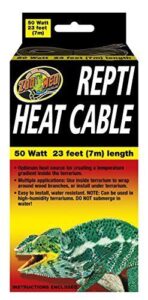
Rack setups are where the Zoo Med Reptile Heat Cable shines. Run it along the outside back glass, keep runs 1¼ inches apart, and never coil or cross it. Pair it with a thermostat for real temperature control, because it runs full wattage nonstop.
Even heat distribution builds a proper thermal gradient. Keep substrate depth modest and raise the glass.
4. Flukers Ceramic Heat Emitter
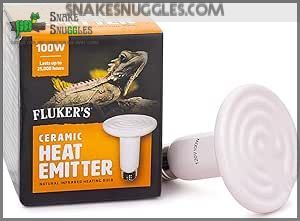
Picture a tiny, invisible sun glowing inside a dome, warming the air without a flicker of light. That’s your Flukers Ceramic Heat Emitter. This ceramic heat emitter builds a steady thermal gradient, supporting natural reptile thermoregulation day and night.
Pair it with a thermostat for reliable temperature control. Use a ceramic socket, keep 12 inches of clearance, and skip the plastic.
5. Zilla Reflector Dome Light Fixture
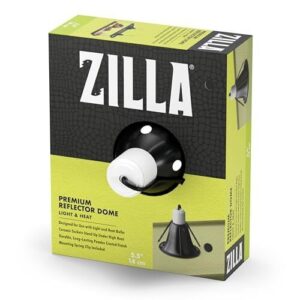
A bare bulb throws heat everywhere, like a campfire with no ring of stones. The Zilla Reflector Dome aims it down, giving you tighter basking zone coverage and better temperature control.
- Match the dome to your wattage: 60W or 150W.
- Pair it with a thermostat.
- Keep heat source placement safety in mind: screen top only.
- Use the inline switch.
Frequently Asked Questions (FAQs)
How long can ball pythons survive without heat?
Your snake is a living battery, and without heat it drains fast. A healthy adult can handle a four to six hour outage at 68 to 72 F, but don’t call that safe.
Below 65 F, hypothermia risk climbs quickly.
Does my ball python need a heat mat?
Probably not. A heat mat is optional, not required, and it shouldn’t be your only source of belly heat. It warms just the floor, so pair it with overhead heat, and always run it through a thermostat for safe heating practices.
How cold is too cold for a ball python at night?
Below 70°F, your ball python is basically living in a freezer, and that’s dangerous. Use thermostat-backed temperature control, keep the nighttime temperature drop gentle (72–78°F), and follow a temperature monitoring routine to catch temperature swings.
Do ball pythons need heat overnight?
Not always. A mild nighttime temperature drop is fine, but keep it above 70°F. If your room dips lower, add lightless heat on a thermostat for temperature control. A heating pad only supplies belly heat.
How much heat do ball pythons need?
Is warm room air enough? No.
Build a thermal gradient: ideal basking temperature of 88 to 95 F, cool side 75 to 80 F. Belly heat from a heat mat works, but needs temperature control.
What is the best heating method for a ball python?
Picture a keeper whose heat mat leaves the enclosure chilly.
Fix it overhead. A halogen bulb on a thermostat gives true temperature control; a heating pad only supplements, and deep substrate depth blunts its warmth.
Can ball pythons survive without any heat source?
A snake without heat is a clock without a spring. Your ball python can coast briefly, but not forever. Skip the heat mat, thermostat, temperature control, thermal gradient, and substrate insulation, and cold slowly wins.
How often should heating equipment be replaced?
Ceramic emitters burn out after 10,000 to 20,000 hours, two years of nonstop use. That’s your equipment lifespan standard.
Swap a heating pad or heat mat at hot spots. Test your thermostat for temperature control.
Do baby ball pythons need different temperatures?
Think of baby ball pythons as tiny furnaces that stall when cold. They need the same temperature gradient as adults, but tighter: a 90–92°F basking spot, nights above 75°F, thermostat-controlled heat, and strict enclosure safety.
Whats the ideal nighttime temperature for ball pythons?
Your ideal nighttime temperature runs 70 to 78°F. Allow nighttime cooling of 5 to 10°F, but protect temperature gradient maintenance: keep the cool side temperature above 75°F, with thermostat probe placement in the warm hide.
Conclusion
Below 75°F, your ball python stops digesting, and 88–90°F is where it thrives.
So, do ball pythons need heating pads? Only as one piece of the setup. Pair overhead heat with a reliable thermostat, and treat every unregulated heater like a lit match.
Build the gradient, verify it with a digital thermometer, and keep a backup ready for outages. Get it right and your python will eat, shed, and settle in for years without drama.