This site is supported by our readers. We may earn a commission, at no cost to you, if you purchase through links.

A heat mat with no thermostat doesn’t hold a temperature. It climbs, and your snake has nowhere to escape it.
Reptiles are ectothermic, so they regulate body heat by moving between warm and cool zones. Take away that gradient and they can’t cope. Unregulated heaters also swing 5°F to 7°F, enough to stress a healthy animal and, in the worst case, start a fire.
The right reptile thermostats for beginners cut power at your set point and fail safe when something goes wrong. Here’s how to match one to your heater, place the probe correctly, and verify every reading yourself.
Table Of Contents
- Key Takeaways
- Why Reptile Thermostats Are Essential for Safe Snake Heating
- How to Choose a Reptile Thermostat for Your Heat Source
- Top 10 Reptile Thermostats for Beginners
- 1. BN Link Reptile Thermostat Controller
- 2. Inkbird Digital Temperature Controller Thermostat
- 3. Hydrofarm Digital Thermostat Controller
- 4. Vivosun Digital Heat Mat Thermostat Controller
- 5. Willhi Digital Temperature Controller Thermostat
- 6. iPower Digital Heat Mat Thermostat Controller
- 7. Bayite Digital Temperature Controller Thermostat
- 8. VivoHome Digital Heat Mat Thermostat Controller
- 9. Zoo Med Reptile Thermostat Controller
- 10. Zacro Digital Heat Mat Thermostat Controller
- How to Set Up Your Reptile Thermostat and Position The Probe Safely
- How to Verify Enclosure Temperatures and Troubleshoot Your Reptile Thermostat
- Frequently Asked Questions (FAQs)
- What is the best thermostat for a reptile enclosure?
- What is the best thermostat for reptile heating elements?
- What is the easiest thermostat to use?
- How to use a thermostat for a reptile enclosure?
- What is the easiest thermostat to set up?
- What are the different types of thermostats for reptiles?
- What should my Bearded Dragons thermostat be set at?
- Do I need a thermostat for a reptile enclosure?
- What are the different types of reptile thermostats?
- How to set up a thermostat for a reptile?
- Conclusion
Key Takeaways
- A heat mat without a thermostat keeps climbing in temperature and can swing 5°F to 7°F, which stresses your snake, can cause burns, and can even start a fire.
- Match the thermostat type to your heater: on/off for heat mats and ceramic emitters, pulse proportional for heat tape and under-tank heaters, and dimming for basking bulbs.
- Check that your heater’s wattage stays about 20% under the thermostat’s rating, and choose an ETL-listed unit with probe failure detection, auto shutoff, and a temperature alarm.
- Don’t trust the display alone: place the probe on top of the substrate where your snake rests, then verify the basking spot, cool end, and hide with a separate infrared thermometer.
Why Reptile Thermostats Are Essential for Safe Snake Heating
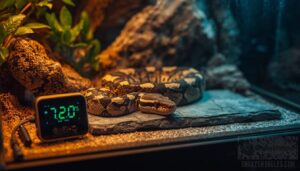
Why do so many snake keepers trust a bare heat mat? Because it looks simple, and that’s exactly the problem. Unregulated heaters run until something fails, and your snake can suffer thermal burns long before you notice.
A thermostat paired with a probe placed on the mat’s surface keeps temperatures steady, and this guide to how hot a reptile heat mat should get explains the safe range for each setup.
A bare heat mat looks simple, but unregulated heat runs until something fails, and your snake can suffer burns before you notice
Reptile Thermostats fix this. Reliable temperature control cuts power at your set point, so enclosure heating stays steady instead of swinging 5°F to 7°F and stressing digestion. Pulse proportional models hold the line most tightly. Because reptiles are ectothermic, they depend on a proper thermal gradient to move between warmer and cooler areas and regulate their body temperature.
A thermostat also protects you during illness and seasonal shifts. Sick snakes seek extra warmth, and a cold room changes everything overnight. Thermostat accuracy matters, and a built-in safety relay adds a fail-safe layer against runaway heat and fire. Skip it, and you’re gambling with your snake’s health.
How to Choose a Reptile Thermostat for Your Heat Source
Picking the right thermostat starts with your heat source, not the price tag. Below, we’ll walk through three decision points so you can match the control to your heater, check its ratings, and spot the safety features that matter. Get these right, and your snake stays warm without the guesswork.
On/Off, Pulse Proportional, and Dimming Thermostats
Every thermostat type controls heat differently, so match yours to your heater.
- On/Off Thermostats suit heat mats and ceramic emitters.
- Pulse Proportional Thermostats hold steadier temperatures with heat tape and UTHs.
- Dimming Thermostats are the only safe pick for basking bulbs.
- Pulsing visible-light bulbs shortens their life.
Use a reptile thermostat compatibility calculator, then confirm your temperature gradient stays safe.
Heater Compatibility and Electrical Ratings
Once you’ve picked a type, check the numbers. Add up your heater’s wattage and keep it under your thermostat’s wattage capacity, with about 20% to spare. Amps matter too: watts divided by volts. Choose an ETL safety listed unit with voltage spike protection, a ground prong, and dual outlets if you’re running two heaters. Never guess. Never exceed the rating.
Safety Features and Beginner-Friendly Controls
Ratings keep your gear alive. Safety features keep your snake alive.
Look for probe failure detection first. If the probe unplugs, the unit should cut power at once. Add auto shutoff safety for overheating, plus a temperature alarm system that beeps when readings drift. Stick with ETL safety listed models offering voltage spike protection. Big buttons and backlit displays help.
Top 10 Reptile Thermostats for Beginners
You’ve got a lot of thermostat options, and not every one belongs near a living animal.
The ten controllers below are the ones we’d genuinely trust to get a beginner started, with a focus on reliable temperature control and simple setup.
Read each entry closely before you buy, because the right match depends on your heat source.
1. BN Link Reptile Thermostat Controller
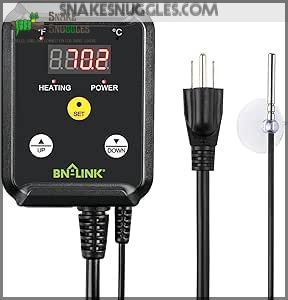
Think a thermostat has to be complicated to be safe? The BN Link proves otherwise.
It controls heating devices only, so don’t pair it with cooling gear. You set 40–108°F using three simple buttons, and you can switch between Fahrenheit and Celsius on the bright display. LED indicators show when it’s heating and powered.
Keep your total heat load under 1000W. The 4.92 ft probe gives you flexible placement, but never submerge it or the controller in water. Not negotiable.
| Best For | Hobbyists such as reptile keepers, home brewers, and indoor gardeners who need simple, reliable temperature control for a heating device up to 1000W. |
|---|---|
| Temperature Range | 40–108°F |
| Max Power | 1000W |
| Probe Length | 4.92 ft |
| Heating/Cooling | Heating only |
| F/C Switching | Yes |
| Reported Lifespan | N/A |
| Additional Features |
|
- Simple 3-button interface with a bright digital display and an easy switch between Fahrenheit and Celsius
- Wide 40–108°F temperature range works for terrariums, seed germination, fermentation, and incubators
- Includes a 4.92 ft temperature probe and a 3.94 ft power cord, giving flexible placement, plus LED heating and power indicators
- Works with heating devices only, so it can’t control cooling systems
- Total connected heating power can’t exceed 1000W
- Neither the controller nor the probe can be submerged in water, which limits use in wet setups
2. Inkbird Digital Temperature Controller Thermostat
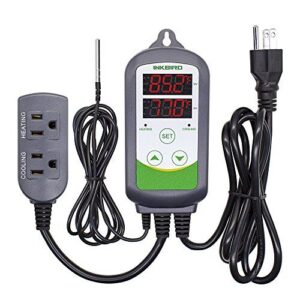
The Inkbird ITC308 gives you dual-outlet temperature control, so one unit can run a heat source and a cooling fan. Two displays show the live reading and your setpoint side by side, which makes temperature monitoring easy.
Use probe calibration to correct any sensor offset, then confirm with a separate thermometer. The safety relay design adds a compressor delay, plus high and low alarms and sensor fault warnings. Each receptacle helps 10A, so check your heater’s wattage first. Genuinely beginner-friendly.
| Temperature Range | N/A |
|---|---|
| Max Power | N/A |
| Probe Length | N/A |
| Heating/Cooling | N/A |
| F/C Switching | N/A |
| Reported Lifespan | N/A |
| Additional Features |
|
3. Hydrofarm Digital Thermostat Controller
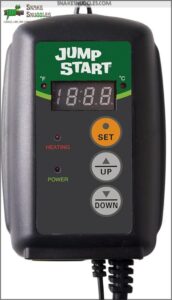
Picture a ball python hatchling on a heat mat overnight, and you asleep down the hall. That’s where the Hydrofarm Digital Thermostat Controller earns its place. It’s ETL certified, covers 68°F to 108°F, and switches between Fahrenheit and Celsius on its digital display. The 6-foot probe is water-resistant, so slide it 1 to 1.5 inches into the substrate.
Don’t trust it blindly, though. Readings can drift up to 15°F, so always verify with a separate thermometer. It controls one heater.
| Best For | Hobbyists who need to hold a steady, moderate temperature for seed starting, reptile enclosures, or small homebrewing projects and are willing to double-check readings with a separate thermometer. |
|---|---|
| Temperature Range | 68–108°F |
| Max Power | N/A |
| Probe Length | 6 ft |
| Heating/Cooling | Heating (one heater) |
| F/C Switching | Yes |
| Reported Lifespan | Some fail within two years |
| Additional Features |
|
- ETL certified for safety compliance
- Wide 68°F to 108°F range with a digital display that switches between Fahrenheit and Celsius
- Works for seed germination, reptile terrariums, and fermentation, and includes a 6-foot probe with cord
- Probe readings can be off by up to 15°F, so a second thermometer is needed to verify
- The unit turns on only after the temperature falls 8–10°F below the set point
- Some users report it failing within two years
4. Vivosun Digital Heat Mat Thermostat Controller
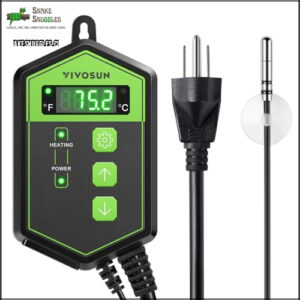
Think of this thermostat as a basic light switch with a thermometer attached: it clicks your heat mat on and off, nothing fancier.
It holds 40°F to 108°F, and three buttons (SET, UP, DOWN) handle every adjustment. The included probe, hanging tab and wall mount keep setup tidy.
That simplicity has limits. Some users report inaccurate readings or units failing within a year, so verify the enclosure with a thermometer. It’s a single outlet and on/off only, so expect swings.
| Best For | Gardeners and hobbyists who want a simple, affordable way to keep seed trays or a kombucha brew at a steady temperature using a heat mat. |
|---|---|
| Temperature Range | 40–108°F |
| Max Power | N/A |
| Probe Length | N/A |
| Heating/Cooling | Heating (heat mat) |
| F/C Switching | Yes |
| Reported Lifespan | Some fail within a year |
| Additional Features |
|
- Holds a wide range of 40-108°F, with three-button controls and a Fahrenheit/Celsius switch
- Works with any heat mat and North American outlets
- Includes a sensor probe, hanging tab, wall mount, and angled socket to keep cords neat
- Some users report inaccurate readings or a failure to reach the set temperature
- Several customers say the unit failed within a year of regular use
- Its single outlet may require a power strip or splitter for multiple devices
5. Willhi Digital Temperature Controller Thermostat
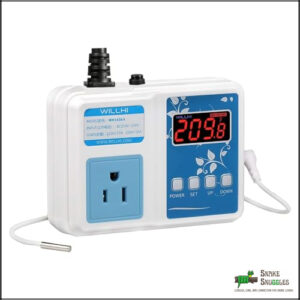
Want a controller that doesn’t fuss? The Willhi controls 1,100 watts at 110V, which covers most heat mats and ceramic emitters in a beginner setup.
Its 3-meter waterproof probe is genuinely useful. Place it where your snake actually rests, not beside the heater.
Switch between heating and cooling mode, and trust the ±0.5°F accuracy. A built-in time delay prevents rapid cycling.
Know the limits. It’s 110V only, has no Wi-Fi, and its relay may click audibly. Plan around all three.
| Best For | Beginner reptile keepers, home brewers, and seedling growers who want a simple, reliable plug-and-play thermostat for heat mats or ceramic emitters on a standard 110V outlet. |
|---|---|
| Temperature Range | N/A |
| Max Power | 1,100W |
| Probe Length | 3 m |
| Heating/Cooling | Heating and cooling modes |
| F/C Switching | N/A |
| Reported Lifespan | N/A |
| Additional Features |
|
- Handles up to 1,100 watts at 110V, enough for most heat mats and ceramic emitters in a beginner setup
- Has a 3-meter waterproof probe that can be placed right where your animal rests or your project needs the heat
- Switches between heating and cooling mode with ±0.5°F accuracy
- Works only with 110V outlets, so it is not compatible with 220V or two-hot-line setups
- Has no Wi-Fi connectivity or smart home integration
- Its mechanical relay may click audibly when switching
6. iPower Digital Heat Mat Thermostat Controller
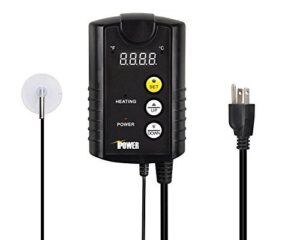
If the Willhi felt like professional gear, the iPower brings things back to basics, and that’s a good thing.
It’s built for one heat mat under a ball python or corn snake enclosure. It controls temperatures from 40°F to 108°F, helps up to 1,000 watts, and uses a grounded three-prong plug. Red and green LEDs show whether power is on and the heater is running. No guesswork.
Know the limit, though. It’s on/off, not proportional, so expect 2-4°F temperature swings.
| Best For | Reptile keepers, seed starters, and homebrewers who need a simple, affordable on/off thermostat for a single heat mat and can tolerate small temperature swings. |
|---|---|
| Temperature Range | 40–108°F |
| Max Power | 1,000W |
| Probe Length | N/A |
| Heating/Cooling | Heating (heat mat) |
| F/C Switching | N/A |
| Reported Lifespan | N/A |
| Additional Features |
|
- Wide temperature range of 40°F to 108°F (5-42°C) covers reptile enclosures, seed germination, and fermentation
- Red and green LED lights clearly show whether power is on and the heater is running
- Grounded three-prong plug and a 1,000-watt capacity handle a typical heat mat safely
- On/off control only, so it cannot adjust heating power and causes 2-4°F temperature swings
- Not a proportional thermostat, making it less suited to animals or plants that need very steady temperatures
- Probe must stay out of liquid and very wet soil, which limits how and where it can be placed
7. Bayite Digital Temperature Controller Thermostat
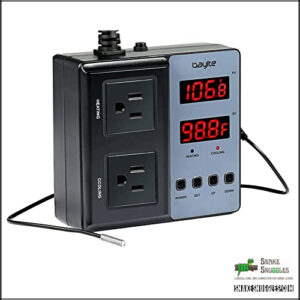
The iPower keeps things simple. The Bayite goes further, giving you control over heating and cooling from one unit.
Its dual relay output runs a heater and a cooling fan at the same time, so you don’t need two controllers. The dual display shows current and set temperatures together, and it holds within ±2°F.
Know the downsides, though. Several owners report probe failures within a year, and the setup instructions confuse some people. Always check readings with a separate thermometer.
| Best For | Hobbyists such as home brewers, seedling growers, and incubator or aquarium keepers who need one controller to run both a heater and a cooling device. |
|---|---|
| Temperature Range | N/A |
| Max Power | N/A |
| Probe Length | 3 m |
| Heating/Cooling | Heating and cooling |
| F/C Switching | N/A |
| Reported Lifespan | Probe failures within a year |
| Additional Features |
|
- Dual relay output runs heating and cooling equipment at the same time, so you don’t need two controllers.
- Dual display shows the current and set temperatures together, and it holds within ±2°F.
- Includes a 3m waterproof probe, calibration, and compressor delay protection.
- Several customers report probe failures within a year of use.
- Some users find the setup instructions unclear or hard to follow.
- Accuracy can vary, so it isn’t suited to work that needs laboratory precision.
8. VivoHome Digital Heat Mat Thermostat Controller
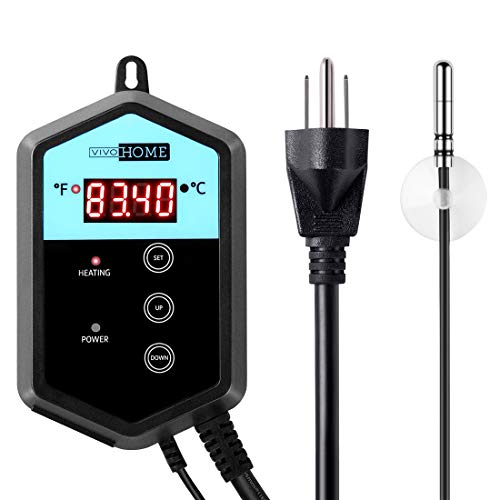
The Bayite does two jobs. The VivoHome does one, and it does it simply.
If you run a heat mat, this controller covers the basics. It holds a 40-108°F range, and the LED screen stays genuinely readable in any light. Three buttons handle setup and calibration, with no menus. The 6.4 ft probe cord gives you room to place the sensor where it counts.
Some users report readings running high. Keep a separate thermometer nearby and check probe placement monthly.
| Best For | Anyone running a single heat mat for seed germination, reptile enclosures, or bread proofing who wants a simple, no-menu thermostat. |
|---|---|
| Temperature Range | 40–108°F |
| Max Power | N/A |
| Probe Length | 6.4 ft |
| Heating/Cooling | Heating (heat mat) |
| F/C Switching | Yes |
| Reported Lifespan | Failures after 9-15 months |
| Additional Features |
|
- Holds a wide 40-108°F (5-42°C) range and shuts the heat mat off automatically once it hits your set temperature.
- Easy-to-read LED screen switches between Celsius and Fahrenheit, with just three buttons for setup and calibration.
- The 6.4 ft probe cord and included suction cup let you place the sensor right where it matters.
- Some users report temperature readings that run higher than the actual temperature, so a separate thermometer is a good idea.
- Multiple reports of the device failing after 9-15 months of use.
- Neutral wire corrosion has been seen in some units, leading to a loss of power output.
9. Zoo Med Reptile Thermostat Controller
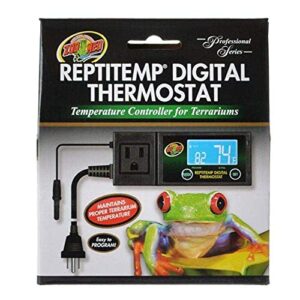
The VivoHome keeps things simple. The Zoo Med steps up when your setup needs more.
It controls heaters up to 600 watts and cooling devices up to 150 watts, so you can control both heating and cooling from one unit.
The 6-foot probe gives you flexible placement, and built-in memory keeps your settings through a power failure. Alarms also flag dangerous highs and lows.
Know the limits: one outlet, a bright night display, and some units failed after six months.
| Best For | Reptile and amphibian keepers who need one unit to control both a heater and a cooling device and want alarms for dangerous temperature swings. |
|---|---|
| Temperature Range | N/A |
| Max Power | 600W heat / 150W cooling |
| Probe Length | 6 ft |
| Heating/Cooling | Heating and cooling |
| F/C Switching | N/A |
| Reported Lifespan | Some fail after six months |
| Additional Features |
|
- Controls heaters up to 600 watts and cooling devices up to 150 watts, so one unit handles both heating and cooling
- The 6-foot remote probe allows flexible placement, and built-in memory keeps your settings through a power failure
- Alarms alert you when temperatures reach dangerous highs or lows
- Has only one outlet, so it can’t directly run multiple devices at once
- The display can be too bright at night for some users
- Reliability feedback is mixed, with some units failing after about six months
10. Zacro Digital Heat Mat Thermostat Controller
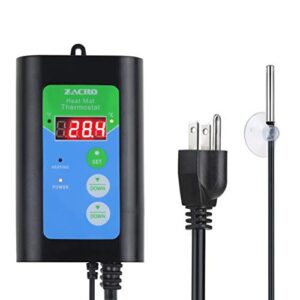
Zacro is the budget pick. If you’re starting out and don’t want to spend big, it covers the basics.
It holds temperatures from 41°F to 108°F, which suits beginner heat mat setups, and the LED display is easy to read. It controls up to 1,000 watts, so pair it with heat mats. Keep both controller and probe dry.
Know the limits: it may switch on 1° below and off 1° above your set point. Check with an infrared thermometer.
| Best For | Beginner growers, home brewers, and reptile keepers who want a low-cost thermostat to keep a heat mat setup at a steady temperature. |
|---|
- Affordable option that covers the basics for people just starting out
- Holds temperatures from 41°F to 108°F, which suits beginner heat mat setups, and the display can show Celsius or Fahrenheit
- Handles up to 1,000 watts, so it works with a range of heat mats for germination, fermentation, and terrariums
- May switch on 1° below and off 1° above your set temperature, so readings can drift slightly
- Controller and probe must be kept dry and cannot be immersed in water
- Cannot increase the heating power of connected equipment, so it is only as capable as the mat you pair it with
How to Set Up Your Reptile Thermostat and Position The Probe Safely
Start your enclosure setup by wiring the heat source into the thermostat, then plugging the thermostat into a grounded outlet. That order keeps the power path safe: heat source, thermostat, wall. Match the thermostat’s wattage rating to your heater, because an overloaded unit is a fire risk. Once the heating is sorted, pair it with a stable, shallow dish from these reptile water bowls for bioactive setups so humidity and spills stay away from your cords.
Good probe placement matters most. Follow these rules:
- Place the probe on the basking surface, where your snake actually absorbs heat.
- Keep it on top of the substrate, never buried.
- Secure it with zip ties or cable clips so it can’t move.
- Keep cords away from water and heavy humidity.
- Use a silicone-coated probe in humid enclosures.
Inspect probes for fraying, since probe failure detection protects snakes. Add temperature monitoring and probe calibration.
How to Verify Enclosure Temperatures and Troubleshoot Your Reptile Thermostat
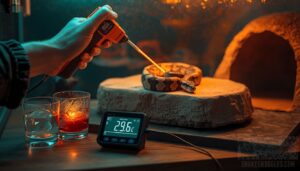
How do you know your thermostat is telling the truth? Don’t trust the display alone. Take surface readings with an infrared thermometer at the basking spot, cool end, and hide. Then run probe calibration checks using ice water (0°C/32°F) and boiling water (100°C/212°F).
Remember, infrared guns read surface temperature only, and basking materials can skew results. Good temperature monitoring means using a second probe in a different zone.
If readings swing wildly, check for:
- Loose wiring or a damaged heating element
- A probe touching the heat source or sitting against glass
- Drafts, direct sunlight, or poor ventilation around the thermostat
Change the set point by hand. If the heater doesn’t respond, replace the unit. Choose models with probe failure detection and a temperature alarm system. Your snake’s safety depends on solid enclosure temperature control.
Frequently Asked Questions (FAQs)
What is the best thermostat for a reptile enclosure?
The best reptile thermostat matches your heat source. Choose an onoff thermostat for heat mats, or a pulse proportional model for bulbs. Always look for accuracy 05F, a safety relay, and genuinely reliable temperature control.
What is the best thermostat for reptile heating elements?
For most heat sources, the Inkbird ITC308 is your best pick. It’s a dependable onoff thermostat that suits a heat mat, offers a wide temperature range, and stays accurate when your probe placement is right.
What is the easiest thermostat to use?
Think of the Inkbird ITC308 as training wheels for heating. It’s the easiest thermostat to use: plug in your heat mat, place the probe, set a temperature.
OnOff Thermostats like this reptile thermostat stay simple.
How to use a thermostat for a reptile enclosure?
Plug your heat source into the thermostat, then the thermostat into the outlet.
Probe placement matters: set it under the heat source in your reptile enclosure.
Choose a safety relay model for reliable temperature control.
What is the easiest thermostat to set up?
You’ll be up and running in literally minutes. The BNLINK Digital Heat Mat Thermostat and Inkbird ITC306A are plug-and-play: connect your heat mat, set your temperature, done. ONOFF Thermostats and WILLHI WH1436A work well too.
What are the different types of thermostats for reptiles?
A thermostat is your snake’s gatekeeper. ONOFF Thermostats flip power fully, Pulse Proportional Thermostats cycle it rapidly, and Dimming Thermostats ease it smoothly. Verify with a digital infrared thermometer and watch your snake’s thermoregulation behavior.
What should my Bearded Dragons thermostat be set at?
Can one thermostat setting heat the whole tank? No. Set your bearded dragon’s basking lamp to 104–107°F at the surface.
Keep the cool side near 77°F for a thermal gradient. Nights can drop to 70–75°F.
Do I need a thermostat for a reptile enclosure?
A heat lamp without a thermostat is a stove burner with no knob. Yes, you need one. Without it, your reptile enclosure can overheat within hours, burning your animal. A thermostat keeps temperature regulation safe.
What are the different types of reptile thermostats?
A reptile thermostat is your snake’s quiet guardian.
Three types exist: on/off, pulse proportional thermostat, and Dimming Thermostats. Match the type to your heater, like a ceramic heat emitter, then verify with a temperature gun.
How to set up a thermostat for a reptile?
Plug your heat mat into the WILLHI WH1436A, then place the waterproof probe where the basking lamp hits. Set your temperature range, then verify it with an infrared thermometer before your reptile ever moves in.
Conclusion
Think a thermostat is overkill for a cheap heat mat? It’s the cheapest insurance you’ll buy. Even the simplest of the reptile thermostats for beginners holds your set point and cuts power when something fails.
Set it up, place the probe on the warm-side substrate, and check every reading with your own thermometer. Don’t trust the display alone. Do that, and your snake gets a steady gradient while you get control and peace of mind.