
This site is supported by our readers. We may earn a commission, at no cost to you, if you purchase through links.
A crested gecko can handle a cool night. It can’t handle 86°F for a few hours, and the damage happens long before you notice anything wrong.
Most keepers trust the thermostat display and move on. That’s the mistake. A thermostat only reads the spot where its probe sits, so a drifting basking lamp, a shifted piece of decor, or a failing heat mat can wreck your gradient while the screen looks perfectly fine.
So how often should you check reptile temperatures? Twice daily is the floor, and certain moments demand more. Here’s the schedule, the timing, and the tools that keep your animal safe.
Table Of Contents
- Key Takeaways
- How Often Should Reptile Temperatures Be Checked?
- Increase Temperature Checks After Enclosure Changes
- Time Daily Checks Around Heating Cycles
- Check Temperatures Across Species-Specific Enclosure Zones
- Use Reliable Tools for Reptile Temperature Checks
- Frequently Asked Questions (FAQs)
- What happens if reptile temperatures fluctuate too drastically?
- What are signs my reptile is too hot?
- How do cold temperatures affect reptile health?
- How does feeding schedule affect reptile temperature needs?
- Are heat rocks safe for reptiles?
- Should temperatures be adjusted during reptile breeding season?
- Conclusion
Key Takeaways
- Check your reptile’s temperatures at least twice a day, morning and evening, and add extra checks after any enclosure change like new heating gear, rearranged decor, or a move to a bigger tank.
- Never trust the thermostat alone, because it only reads where its probe sits, so back it up with an independent digital probe thermometer and an infrared temp gun to track both air and surface temperatures.
- Measure the warm zone, cool zone, and basking spot against your species’ targets every time, and time your readings around heating cycles, since a gradient that’s off by even a few degrees can cause real harm.
- Use a data logger with phone alerts to catch overnight drift you’d otherwise miss, and review the logs weekly to spot slow problems before they hurt your animal.
How Often Should Reptile Temperatures Be Checked?

Your reptile’s heat setup only works if you know what it’s actually doing. The right check schedule depends on how much you trust your gear and how stable your enclosure runs. Here are the two routines worth building, starting with the bare minimum and moving up to full tracking.
Understanding how reptiles seek out heat can help you judge whether your readings match what your animal is actually doing in the enclosure.
At Least Twice Daily
Always check your reptile’s temperatures at least twice a day, once in the morning and once in the evening. The morning check shows whether your heat source held steady overnight and kicked on properly. The evening check confirms the basking spot and warm side stayed where they should all day.
Catching problems early matters because temperature extremes can cause heat stress and dehydration when it runs too high, or hypothermia and a weakened immune response when it runs too low.
Skip a day, and a failed bulb can go unnoticed.
Continuous Monitoring and Temperature Logs
Twice-daily checks leave a big gap, and that’s where data loggers earn their keep. A logger records temperature every 5 to 15 minutes, so you see what happened at 3 a.m. without being there.
If you’re monitoring a classroom enclosure, this guide to reptile thermometers for classroom habitats helps you choose reliable sensors to pair with your logger.
Pair it with a phone app that alerts you when readings leave your target temperature range. Review the logs weekly to spot patterns, like a slow overnight drop.
Increase Temperature Checks After Enclosure Changes
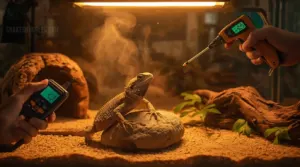
Your routine only holds until you change something. Swap the substrate, move a hide, or tweak a heat lamp, and the numbers you trusted yesterday can be wrong today.
Each change has its own watch window. After adjusting heating equipment, check every 30 minutes for 2 hours, then keep a closer eye on it for 24 hours. Rearranged decor gets hourly checks for 24 hours, since a new log or rock can trap heat or block airflow. New substrate means 4 checks daily for 72 hours. Humidity system changes need the same 4 daily checks for 48 hours.
Resizing is the big one. Check 6 times daily for the first week.
Measure at several zones every time, and test both air and surface temperatures.
Time Daily Checks Around Heating Cycles
Once your routine is set, timing matters as much as frequency. A reading taken at noon tells you something very different from one taken at 7 a.m.
If you’re unsure how to interpret what the display is telling you at each check, this guide on how to read a terrarium thermometer makes those morning and evening numbers easier to act on.
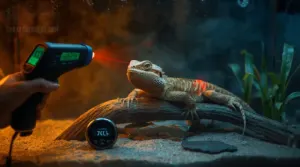
Check 30 to 60 minutes before the lights come on. That’s your overnight low, and it shows whether the thermostat is doing its job before the day starts.
Take your next reading 2 to 4 hours after the lights activate. By then the basking surface has stabilized, so you’re seeing the real peak, not a number that’s still climbing.
Check again 30 to 60 minutes before heating shuts off, to confirm the evening drop matches what your species needs.
On long days, add a mid-cycle check every 4 to 6 hours. That’s how you catch a slow drift before it turns into a problem.
Check Temperatures Across Species-Specific Enclosure Zones
Where you measure matters as much as how often you do it. A single reading from the middle of the tank tells you almost nothing, because every species needs its own temperature gradient, and each zone has its own target.
Bearded dragons need a 100-110°F basking spot with a cool side near 75-80°F. Crested geckos want 78-82°F on the warm side and 70-75°F on the cool side, and anything above 85°F can kill them. Corn snakes sit comfortably with 85°F ambient warm, 75°F cool, and a 90°F basking spot.
Check the warm zone, the cool zone, and the basking spot every time. If the gap between warm and cool is under 10°F, your thermal gradient has failed. Upsize the enclosure.
Use Reliable Tools for Reptile Temperature Checks
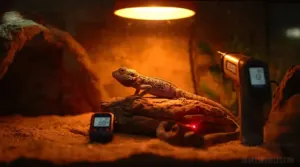
A guess about your enclosure’s temperature isn’t a measurement, and your reptile pays for the difference. The right tools tell you what’s really happening inside the tank, not what you hope is happening. Here are three things to get right so your readings actually mean something.
Trust your thermometer over your hunch, because the tank’s true temperature is what your reptile feels, not the one you imagine
Measuring Air Versus Surface Temperatures
Your basking rock can read 105°F while the air an inch above it sits at 88°F. Both numbers are real. They just measure different things.
An infrared temp gun reads surface heat, which tells you what your reptile absorbs while basking. A digital probe thermometer reads the air it breathes. Keep the probe shaded, or it’ll lie to you. You need both tools.
Pairing Thermostats With Independent Thermometers
Picture a bearded dragon keeper whose thermostat reads a calm 105°F at the basking spot. The dragon sits there, lethargic and gaping. The probe had slipped under a rock, so the lamp kept blasting the real surface. A separate digital probe thermometer would’ve caught it in minutes.
Never trust the thermostat alone. It only knows what its probe feels.
Verifying Sensor Placement and Accuracy
Say your thermostat reads 88°F at the basking spot, but your infrared thermometer shows the rock at 108°F. That gap means the probe is hanging in the wrong place.
Check sensor placement monthly, and after any enclosure change. Keep the probe 2-3 inches below the heat source, secured and away from walls. Compare it against a separate digital thermometer every few months.
Frequently Asked Questions (FAQs)
What happens if reptile temperatures fluctuate too drastically?
Reptiles are cold-blooded, not cold-proof. Let temperatures swing and you’ll get suppressed immunity, stalled digestion, dehydration, kidney strain, and chronic stress. Juveniles get stunted growth and deformed bones. Skip the guesswork.
What are signs my reptile is too hot?
Watch for open-mouth panting, glass surfing, and a reptile that dodges its basking spot. Add heavy soaking, bellies pressed to cool glass, or regurgitation in snakes. Tremors, limpness, or stargazing mean emergency. Call a vet immediately.
How do cold temperatures affect reptile health?
Your reptile isn’t being dramatic when it stops eating in a chilly room. Cold temperatures slow digestion, weaken immunity and impair breathing. Food sits undigested, infections creep in, and a lethargic animal quietly declines.
How does feeding schedule affect reptile temperature needs?
Feed at least 2-3 hours before lights-off, so your reptile has time to bask and digest. Food sitting in a cool gut ferments and rots. In winter, feed earlier and raise basking temperatures 2-5°F.
Are heat rocks safe for reptiles?
No, not really. A heat rock only warms the skin surface, and it creates hot spots that burn. Your reptile may stay put on it anyway. Use a thermostat-controlled mat or a basking lamp instead.
Should temperatures be adjusted during reptile breeding season?
Think of breeding season as a switch your reptile’s body flips only when the room tells it to. Yes, adjust temperatures, but only for species that need it, and do it gradually, a few degrees weekly.
Conclusion
How often should you check reptile temperatures? Twice a day, every day, with extra checks after any enclosure change. Treat the thermostat as a suggestion, not proof.
Back it up with an independent thermometer, check both air and surface readings, and log what you find. A gradient that looks fine on a screen can still be cooking your animal. Trust your readings, catch the drift early, and your reptile never has to pay for it.