This site is supported by our readers. We may earn a commission, at no cost to you, if you purchase through links.

bearded dragon at 68°F stops eating. ball python at 72°F won’t digest its food properly.
When a child’s bedroom doubles as a reptile habitat, that temperature dial isn’t just about comfort—it’s about survival.
Most parents focus on the animal itself: the enclosure, the substrate, the feeding schedule. The thermostat gets treated like an afterthought.
But a faulty one, or the wrong one, means cold reptiles, wasted electricity, and worst-case scenarios nobody wants to think about at 2 AM. The right reptile thermostats for kids’ rooms balance precise control, certified safety standards, and features that protect both the animal and the child sharing that space.
Table Of Contents
- Key Takeaways
- Top 10 Reptile Thermostats Reviewed
- 1. BN LINK Digital Heat Mat Thermostat
- 2. Inkbird Dual Relay Temperature Controller
- 3. Hydrofarm JumpStart Heat Mat Thermostat
- 4. VIVOSUN Digital Heat Mat Thermostat
- 5. WILLHI 10A Sous Vide Thermostat
- 6. iPower Digital Heat Mat Thermostat
- 7. Bayite Dual Stage Temperature Controller
- 8. VIVOHOME Heat Mat Controller
- 9. Zoo Med ReptiTemp Thermostat
- 10. Zacro Digital Heat Mat Thermostat
- Safest Thermostat Features for Bedrooms
- Match Thermostats to Heat Sources
- Choose The Right Control Type
- Check Wattage and Electrical Safety
- Set Up Probes Correctly
- Compare Value by Budget Tier
- Frequently Asked Questions (FAQs)
- What should the thermostat be set to for a kids room during winter?
- How to keep reptiles warm in a cold room?
- Do I need a thermostat for a reptile enclosure?
- Where to place a reptile thermostat?
- Where to place a thermostat in a reptile tank?
- Can you use a thermostat with a basking bulb?
- What is a 3H and 2C thermostat?
- How to regulate temperature in a reptile enclosure?
- Can thermostats control both heat mats and lamps?
- How often should thermostat batteries be replaced?
- Conclusion
Key Takeaways
- Temperature precision isn’t a luxury—a single degree off can stop a bearded dragon from eating or prevent a ball python from digesting properly.
- Always match thermostat type to your heat source: dimming controllers for basking lamps, on/off or pulse proportional for heat mats and ceramic emitters.
- In a child’s bedroom, safety certifications (ETL or UL listing), auto shutoff, and high/low alarms aren’t optional extras—they’re the baseline.
- Budget shapes your protection level: $15–$28 covers basic heat mat control, while $35–$60 unlocks dual‑stage control, smartphone alerts, and tamper‑resistant keypads.
Top 10 Reptile Thermostats Reviewed
Not every thermostat manages a kid’s room the same way, so the picks below were chosen with safety, simplicity, and solid temperature control in mind. Each one covers a different need — from basic heat mat control to dual‑stage setups for more demanding reptiles.
If you’re still narrowing down your options, this roundup of reptile heating mats safe for kids and families pairs well with any of the thermostats covered here.
Here are the 10 best options worth your attention in 2026.
1. BN LINK Digital Heat Mat Thermostat
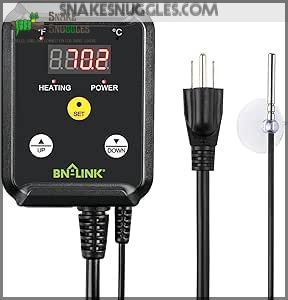
The BN-LINK Digital Heat Mat Thermostat is a solid starting point for any kid’s reptile setup. It holds temperatures between 40–108 °F and supports up to 1,000 W, covering most common heat mats with room to spare.
The 4.92 ft probe gives you flexible placement, and the bright LCD shows both current and set temperatures at a glance.
At around $28, it’s ETL‑listed, which means it’s passed independent safety testing — worth noting when it’s running overnight in a child’s bedroom.
| Best For | Parents setting up a beginner reptile enclosure for their child who need a reliable, affordable thermostat that runs safely overnight. |
|---|---|
| Temp Control Range | 40–108°F (4–42°C) |
| Max Load | 1000W |
| Input Voltage | 120V AC, 60Hz |
| Display Type | LCD with LED indicators |
| °C/°F Toggle | Yes |
| Control Mode | Heating only |
| Additional Features |
|
- Wide temperature range (40–108 °F) handles most common reptile and small pet heating needs with ease
- ETL-listed safety certification gives peace of mind when the unit is running unattended in a kid’s room
- The 4.92 ft probe and compact design make it easy to position exactly where you need it
- Heating only — it can’t cool a tank down if temperatures creep too high
- Tops out at 108 °F, so it won’t work for species that need higher basking or ambient temperatures
- Only works with standard 120 V outlets, so there’s no flexibility for travel or off-grid use
2. Inkbird Dual Relay Temperature Controller
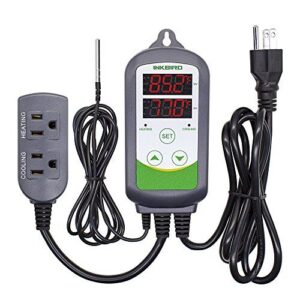
The BN-LINK manages basic setups well, but if your child’s reptile needs both heating and cooling — think a ball python enclosure during summer — the Inkbird ITC-308 steps up. It runs two independent relays, one for heating, one for cooling, so you’re not juggling two separate controllers.
It holds ±0.5 °F accuracy, includes high/low alarms, and manages up to 1,100 W. At around $35, that’s solid coverage for most enclosures.
| Best For | Anyone who needs independent heating and cooling control in a single device — especially reptile keepers, homebrewers, or greenhouse hobbyists who want reliable temperature management without buying two separate controllers. |
|---|---|
| Temp Control Range | –58°F to 248°F (–50°C to 120°C) |
| Max Load | 1100W |
| Input Voltage | 100–240V AC, 50/60Hz |
| Display Type | Dual-window LED display |
| °C/°F Toggle | Yes |
| Control Mode | Heating and cooling |
| Additional Features |
|
- Dual independent relays let you run a heater and a cooler at the same time, no extra hardware needed
- Clear dual-display shows both current temp and set point at a glance, with switchable °C/°F readout
- Built-in compressor delay protection prevents short-cycling, which helps extend the life of your refrigeration unit
- The 1,100 W max load won’t cut it for larger heaters or high-draw appliances
- No built-in Wi-Fi or smart-home support — remote monitoring requires a separate module
- Relay lifespan can take a hit if your setup cycles on and off frequently, so heavy-use applications may wear it out faster
3. Hydrofarm JumpStart Heat Mat Thermostat
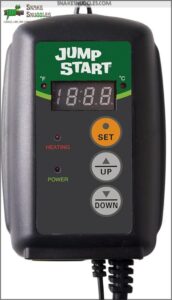
The Inkbird manages heating and cooling in one unit. But if your child’s setup is simpler — just a heat mat under a leopard gecko tank — the Hydrofarm JumpStart keeps things straightforward.
It controls heat mats up to 1,000 W, with a 6 ft water-resistant probe and a clear digital display in °F or °C. The ETL listing makes it one of the safest options available. Temperature range tops out at 108 °F, which suits most common reptiles.
| Best For | Anyone who just needs simple, reliable heat mat control for a reptile, amphibian, or plant propagation setup without the complexity of a multi-function controller. |
|---|---|
| Temp Control Range | 68–108°F (20–42°C) |
| Max Load | 1000W |
| Input Voltage | 120V AC |
| Display Type | Digital LED display |
| °C/°F Toggle | Yes |
| Control Mode | Heating only |
| Additional Features |
|
- ETL-certified safety thermostat — one of the safest options on the market
- Easy-to-read digital display with both °F and °C options, plus a 6 ft water-resistant probe
- Handles heating elements up to 1,000 W, covering virtually all standard heat mats
- Temperature swings 1–2 °F due to on/off operation (not a proportional controller)
- Tops out at 108 °F, so it won’t work for applications needing higher heat
- The probe’s suction cup can lose grip over time and may need a backup mounting solution
4. VIVOSUN Digital Heat Mat Thermostat
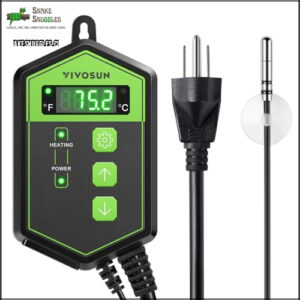
The Hydrofarm manages simplicity well — but the VIVOSUN Digital Heat Mat Thermostat is worth a look if you want similar ease at a slightly lower price point.
It controls heat mats up to 1,000 W and holds temperatures between 40–108 °F, covering corn snakes, leopard geckos, and crested geckos without issue. The 6 ft sensor probe monitors the root zone directly. Three buttons manage all setup. One outlet only — grab a splitter if your child runs two mats.
| Best For | Budget-conscious growers, reptile keepers, and hobbyists who want straightforward temperature control without paying extra for features they don’t need. |
|---|---|
| Temp Control Range | 40–108°F (4–42°C) |
| Max Load | 1000W |
| Input Voltage | 120V AC, 60Hz |
| Display Type | Digital LCD display |
| °C/°F Toggle | Yes |
| Control Mode | Heating only |
| Additional Features |
|
- Wide temperature range (40–108 °F) covers most reptiles, seedlings, and fermentation projects with room to spare
- The 6 ft sensor probe gives you flexibility in where you place it, making root-zone or terrarium monitoring easy
- Dead-simple three-button setup means you’re up and running in minutes with no learning curve
- Only one outlet, so running multiple heat mats means you’ll need a splitter or power strip
- Some units have LCD issues — incomplete digits or a spotty Fahrenheit readout that forces you to convert manually
- The probe must stay dry, which limits placement options in humid or wet setups
5. WILLHI 10A Sous Vide Thermostat
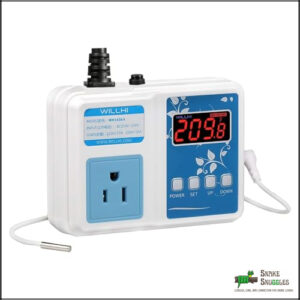
The WILLHI WH1436A wasn’t built for reptiles — but it earns a spot here because of its ±0.5 °F accuracy and a 9.8 ft waterproof probe that reaches anywhere in a large enclosure.
It supports up to 1,100 W, making it one of the few controllers that can manage long heat tape runs safely.
High/low alarms and auto shut-off add real peace of mind in a kid’s room.
Just note: it’s on/off only, so skip it for basking lamps.
| Best For | Reptile keepers who need a reliable, accurate thermostat for heat tape or under-tank heaters in large enclosures. |
|---|---|
| Temp Control Range | –58°F to 230°F (–50°C to 110°C) |
| Max Load | 1100W |
| Input Voltage | 110V AC, 50/60Hz |
| Display Type | Digital LED display |
| °C/°F Toggle | Yes |
| Control Mode | Heating and cooling |
| Additional Features |
|
- Tight ±0.5 °F accuracy keeps temperatures consistent and safe for temperature-sensitive reptiles
- The 9.8 ft waterproof probe gives you plenty of reach inside large tanks or terrariums
- High/low alarms and auto shut-off provide real peace of mind, especially in a child’s room
- On/off relay only — no PID control means temperature can overshoot, so it’s not ideal for basking lamps
- 1,100 W max load rules out high-powered heating appliances
- North American 110 V only; international users will need an adapter
6. iPower Digital Heat Mat Thermostat
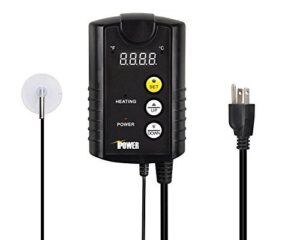
The iPower Digital Heat Mat Thermostat keeps things simple — and in a kid’s room, simple often means safer. It controls heat mats within a 40–108 °F range and supports up to 1,000 W, covering most standard setups easily.
For setups where flexibility matters, pairing it with options from this guide to boa constrictor racks and reptile heating solutions can help you dial in the right configuration.
The metal-tipped probe reads surface temps reliably, and LED status lights let you confirm it’s working at a glance.
Temperature variance runs ±2–5 °F, so it’s best paired with a secondary thermometer for peace of mind.
| Best For | Parents, hobbyists, and small-scale growers who want a straightforward, affordable way to regulate heat mats for seed starting, reptile enclosures, fermentation, or brooding setups. |
|---|---|
| Temp Control Range | 40–108°F (5–42°C) |
| Max Load | 1000W |
| Input Voltage | 120V AC, 60Hz |
| Display Type | Digital LED display |
| °C/°F Toggle | Yes |
| Control Mode | Heating only |
| Additional Features |
|
- Simple set/reset controls and LED status lights make it easy to use and monitor at a glance
- Wide compatibility — handles up to 1,000 W, covering most standard heat mats and pads
- Supports both Celsius and Fahrenheit display, making it flexible for different users
- Temperature can vary ±2–5 °F, so precision-sensitive setups may need a backup thermometer
- Only functions as an on/off switch — it won’t boost the heat output of your device
- The probe must stay dry, limiting use in humid or wet environments like soil or aquatics
7. Bayite Dual Stage Temperature Controller
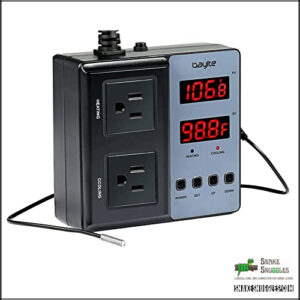
If your setup needs both heating and cooling control, the Bayite Dual Stage Controller controls both in one plug-in unit. It regulates loads up to 1,100 W and monitors temps across a wide –58 °F to 230 °F range with ±0.1 °F accuracy.
Its dual display shows real-time temperature and your setpoint side by side. High/low alarms add a reliable safety net for overnight use in a kid’s room.
| Best For | Hobbyists and small-scale growers who need automated heating and cooling in a single, no-wiring-required unit — great for aquariums, fermentation setups, incubators, and seedling mats. |
|---|---|
| Temp Control Range | –58°F to 230°F (–50°C to 110°C) |
| Max Load | 1100W |
| Input Voltage | 110–240V AC |
| Display Type | Dual-window LED display |
| °C/°F Toggle | Yes |
| Control Mode | Heating and cooling |
| Additional Features |
|
- Controls both heating and cooling simultaneously with one plug-in device, no electrical expertise needed
- Dual display shows live temperature and setpoint at the same time, making monitoring quick and easy
- Built-in high/low alarms and compressor delay protection add a useful safety layer for unattended setups
- Limited to a single setpoint, so multi-zone or more complex temperature schedules aren’t possible
- The housing isn’t waterproof, so you’ll need to be careful about placement in wet or saltwater environments
- Settings and alarms can be finicky — some users find a power cycle is needed before changes actually take effect
8. VIVOHOME Heat Mat Controller
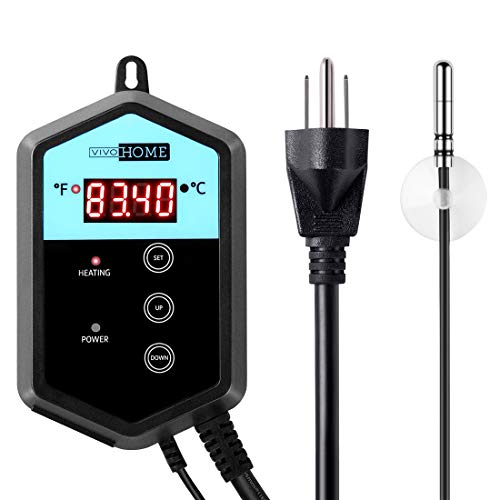
The VIVOHOME Heat Mat Controller keeps things simple — and for a single-mat setup in a kid’s room, simple is exactly what you want. It supports 40°F to 108°F with a 6.4 ft probe and a bright LED display showing real-time temps at a glance.
Auto shutoff protection cuts power if readings go out of range, which matters overnight. It’s rated for up to 1,000 W, covering most standard heat mats comfortably.
| Best For | Anyone who needs a no-fuss single-mat temperature controller for seed starting, reptile enclosures, or fermentation projects. |
|---|---|
| Temp Control Range | 40–108°F (5–42°C) |
| Max Load | Not specified |
| Input Voltage | 120V AC |
| Display Type | LED digital display |
| °C/°F Toggle | Yes |
| Control Mode | Heating only |
| Additional Features |
|
- Wide temperature range (40°F–108°F) covers everything from delicate seedlings to reptile basking zones
- Long probe cord (6.4 ft) and power cord (5.8 ft) give you plenty of reach for flexible placement
- Bright LED display makes it easy to check real-time temps at a glance, no guessing required
- Only controls one heat mat at a time — multiple mats mean buying extra units or a power strip workaround
- Some users have reported reliability issues over time, including cord corrosion and circuit failures
- Switching between °C and °F can be unintuitive and may not match the printed instructions
9. Zoo Med ReptiTemp Thermostat
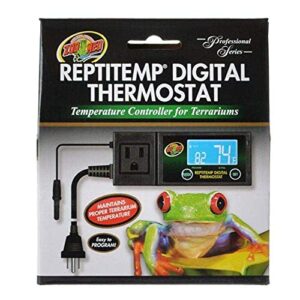
Zoo Med is one of the most trusted names in reptile care — and the ReptiTemp Thermostat earns that trust in a kid’s room.
It controls heating up to 600 W and cooling up to 150 W, with a temperature range of 50°F to 122°F.
The 6 ft sensor cable keeps the probe away from heat sources for accurate readings.
Visual and audible alarms alert you when temps drift, and built-in memory retains your settings after a power outage.
| Best For | Reptile and amphibian owners — especially parents setting up a kid’s first terrarium — who want reliable, plug-and-play temperature control with safety alerts built in. |
|---|---|
| Temp Control Range | 50–122°F (10–50°C) |
| Max Load | 600W heating / 150W cooling |
| Input Voltage | Not specified |
| Display Type | Backlit digital display |
| °C/°F Toggle | Yes |
| Control Mode | Heating and cooling |
| Additional Features |
|
- Handles both heating and cooling in one unit, with a wide 50°F–122°F range that suits most common reptiles and small aquatic setups
- Built-in memory and alarm system give you peace of mind during power outages or equipment failures
- The 6 ft sensor cable makes accurate temperature readings easy without placing the probe near a heat source
- Only one outlet, so running multiple devices means adding a power strip and carefully watching your total wattage
- The backlit display can’t be dimmed, which may bother nocturnal animals sensitive to light
- The audible clicking when heating or cooling cycles on and off can be noticeable in a quiet bedroom
10. Zacro Digital Heat Mat Thermostat
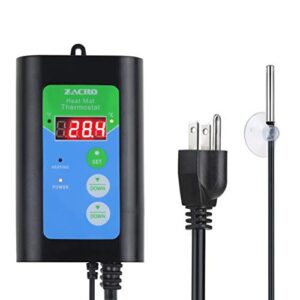
The Zacro Digital Heat Mat Thermostat keeps things simple — and that’s exactly what a kid’s room setup needs.
It holds temperatures between 68°F and 108°F with ±0.1°F precision, so your reptile’s warm side stays consistent hour after hour. The digital display shows both setpoint and actual temperature at a glance.
At 1,000 W capacity, it supports any standard heat mat. Just keep the probe dry, and you’re set.
| Best For | Reptile keepers, gardeners, and home brewers who want reliable, affordable heat mat temperature control without the premium price tag. |
|---|---|
| Temp Control Range | 41–108°F (5–42°C) |
| Max Load | 1000W |
| Input Voltage | 120V AC, 60Hz |
| Display Type | Bright numeric digital display |
| °C/°F Toggle | Yes |
| Control Mode | Heating only |
| Additional Features |
|
- Precise ±0.1°F regulation keeps enclosures and grow setups at a steady, consistent temperature
- Works with any standard 120V heat mat up to 1,000W, so no need to buy new equipment
- Easy-to-read digital display shows both the setpoint and actual temperature at a glance
- Can overshoot the target temperature by up to ~2°F depending on load and environment
- Probe and controller must stay completely dry — not ideal for high-humidity setups without careful placement
- Only works on 120V/60Hz power, so it’s not usable internationally without a voltage converter
Safest Thermostat Features for Bedrooms
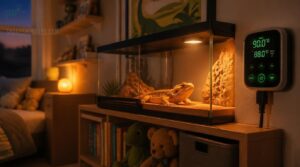
Not every thermostat on the market belongs in a child’s bedroom — some lack the protections that make overnight use genuinely worry-free. The right features can mean the difference between a safe setup and one that puts your kid or their pet at risk. Here’s what to look for before you buy.
Auto Shutoff Protection
When a thermostat’s auto shutoff kicks in, it cuts power to your heater within seconds of hitting the target temperature. If the probe fails or reads outside safe limits, sensor fault detection immediately interrupts heating and triggers an alert.
After a power outage, auto recovery logic checks current temps before restarting — no manual reset needed.
High and Low Alarms
Auto shutoff stops the heat — but alarms warn you before things go wrong.
High and low alarms watch both ends of the temperature range. If readings climb too high or drop too low, the thermostat beeps and flashes a warning. Debounce timers filter brief spikes, so one false reading won’t wake the house at 2 a.m.
ETL or UL Listing
Alarms catch problems early — but a safety certification tells you the thermostat was built right from the start.
Look for ETL or UL listing on any unit you place in a child’s room. Both marks mean an independent lab tested the device for shock, fire hazards, and insulation faults.
- ETL safety listed products are verified by Intertek through the NRTL network
- You can confirm authenticity by searching the listing number in Intertek’s online database
- UL and ETL listings carry equal weight — either satisfies North American safety standards
Tamper-resistant Controls
A certification confirms quality build — but it doesn’t stop small hands from adjusting the dial.
Tamper-resistant controls add a second layer of protection. Child safety screws require uncommon tools to remove covers. Locked casings block access to wiring terminals. Tamper-evident seals show any unauthorized opening instantly.
Some units include anti-tamper alert switches that trigger an immediate notification if the panel opens unexpectedly.
Quiet Overnight Operation
When everyone’s asleep, the last thing you need is a thermostat clicking away at 2 a.m.
Low noise relays and standby sleep mode limit switching activity during calm overnight hours, keeping temperature swings within 1–2 °C.
Silent alarm integration sends mobile alerts when readings drift — no loud beeps, just a quiet notification so you stay informed without waking anyone.
Match Thermostats to Heat Sources
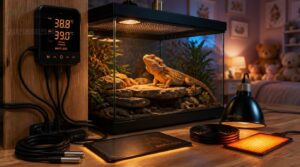
Not every thermostat works with every heat source — using the wrong one can mean temperature swings that stress your reptile or worse, a safety hazard in your kid’s room.
The type of heater you’re running should be the first thing you match to your thermostat choice.
Here’s how each common heat source pairs up.
Heat Mats
Heat mats are the quietest heaters you can run in a kid’s room. They sit flat under the enclosure and use carbon fiber elements to spread warmth evenly across the substrate.
A moisture-resistant coating protects the wiring from humidity. Always pair one with an external reptile thermostat — the mat itself won’t prevent overheating without it.
Ceramic Heat Emitters
Unlike heat mats, ceramic heat emitters radiate infrared heat directly onto your reptile’s body without producing any light — making them ideal for nighttime light pollution-free setups in kids’ rooms. That radiant warmth creates a focused thermal gradient, your reptile can move through naturally.
Pair one with a digital thermostat, and its overheating protection keeps temperatures locked and safe overnight.
Enjoy the benefits of over 90% efficient heating.
Basking Lamps
Basking lamps run hotter and brighter than any other heat source in your reptile setup.
Halogen basking lamps warm a tight spot fast, while mercury vapor lamps add UVB — supporting bone health without a second bulb.
Always pair them with a dimming thermostat. It gradually reduces power as temperatures climb, preventing dangerous overheating and bulb flicker overnight.
Heat Tape
Thin and flexible, heat tape slips under tanks or behind enclosures where bulkier heaters won’t fit. Self-regulating heat tape adjusts its own output as surface temperatures rise, reducing hot spot risk.
Most models deliver 3–23 W per foot, so always verify your thermostat’s wattage rating covers the full run.
Use clean, dry surfaces and avoid overlapping — both cause uneven heat and early failure.
Radiant Heat Panels
A radiant heat panel works like a gentle sun — warming your reptile and the surfaces around it, not just the air. Panels run at 60–120°F surface temperatures, keeping burn risk low for curious hands.
Their aluminum or ceramic faces distribute heat evenly, and paired with a digital thermostat with overheat protection, they stay reliably safe overnight.
Choose The Right Control Type
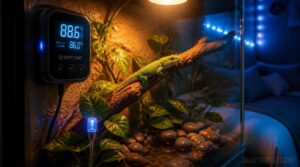
Not all thermostats work the same way, and the right control type makes a real difference for your reptile’s health. Each type regulates temperature differently — some switch power on and off, others adjust it gradually. Here’s a breakdown of the five main control types so you can pick the one that fits your setup.
On/off Thermostats
An on/off thermostat works through simple bang-bang control — the heater switches fully on or fully off based on probe readings. A built-in hysteresis range prevents rapid cycling, keeping temperature swings around ±3–5 °F.
Most units include a thermal fuse safety cutoff. Always match your electrical load to the thermostat’s wattage rating to stay safe.
Dimming Thermostats
Where on/off models flip a switch, dimming thermostats modulate power gradually — reducing output in small increments as your enclosure approaches the set point. This keeps temperatures within ±1–2 °F and prevents the filament stress that shortens bulb lifespan.
They’re the only safe choice for incandescent basking lamps, and some models support smart home integration for remote scheduling.
Pulse Proportional Control
Dimming thermostats work great for lamps, but they’re not built for heat mats or ceramic emitters. That’s where pulse proportional control steps in.
- Delivers power in rapid on/off bursts
- Duty cycle efficiency increases as temp drops
- Keeps readings within ±0.5–1 °F
- Cuts thermal overshoot without flickering
Real-time feedback means your heater responds every few seconds — steady, quiet, and safe.
PID Temperature Control
Pulse control is precise, but PID temperature control takes accuracy further.
It uses proportional, integral, derivative calculations to anticipate changes before they happen — not just react. That means temperature stability within ±1 °F, even with heat mats or ceramic emitters.
It also prevents integral windup, so your heater doesn’t overcorrect and spike temperatures while your kid’s reptile is sleeping.
Dual-stage Controllers
When precision really matters, dual-stage controllers step up.
- They use coarse-fine coordination to handle big temperature swings first, then dial in accuracy within ±1 °F
- Cascade loop stability prevents overshoot while your child’s reptile sleeps
- Sensor fusion combines two feedback readings for one reliable temperature
The result: consistent, safe regulation with no sudden spikes.
Check Wattage and Electrical Safety
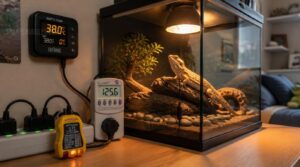
Getting the wattage right isn’t optional — it’s the difference between a safe setup and a real hazard. A thermostat that’s underpowered for your heater can overheat, trip a breaker, or worse. Here’s what to check before you plug anything in.
Getting the wattage wrong isn’t a minor mistake — it’s the difference between a safe setup and a real hazard
Total Heater Wattage
Before you plug anything in, add up every watt. List your heat mat, ceramic emitter, and any basking lamp — then total them. A heat mat might draw 50 W, a ceramic emitter 100 W. Together that’s 150 W. Your thermostat’s wattage capacity must exceed that number.
Underestimating means unstable temperatures. Overestimating wastes energy and risks overheating your reptile’s space.
Safe Load Margins
Once you know your total wattage, add a 15–25% safety buffer on top. So a 150 W setup needs a thermostat rated for at least 175–190 W minimum — round up to the nearest safe capacity.
- Seasonal swings raise heat demand
- Drafts force heaters to work harder
- Aging components draw inconsistent power
That buffer prevents unexpected circuit trips.
Surge Protector Use
A power surge can fry your thermostat and heater in seconds — without warning.
Always connect your reptile equipment to a surge protector rated 300+ joules. Check that it has a visible protection indicator light.
Don’t daisy-chain strips together; one protector per outlet keeps electrical load safe.
For added coverage, a whole-house surge protector at your main panel catches large external spikes first.
Cord Placement Safety
A dangling cord in a kid’s room is an accident waiting to happen.
- Run cords along walls or under furniture to cut tripping risks
- Use cord clips or organizers to keep wires flat and out of reach
- Install GFCI outlets near your thermostat to stop moisture from becoming a fire hazard
Never route cords under rugs — snags and crushing damage insulation fast.
Avoiding Overloaded Outlets
Too many heaters on one outlet are a slow-burning risk. Never exceed 80% of your breaker’s capacity — on a 15-amp circuit, that’s roughly 1,440 watts.
Use a watt meter to check real-time draw, spread heat mats and basking lamps across separate circuits, and always use a UL-listed surge protector rated above your total combined wattage.
Set Up Probes Correctly
Where you place the probe makes or breaks your thermostat’s accuracy. A probe in the wrong spot means your reptile’s actual temperature could be several degrees off from what the display shows. Here’s how to get each placement right.
Warm-side Probe Placement

Place the temperature probe on the warm-side floor, directly above your heat source. Keep it within 0.25 inches of the enclosure floor for true substrate placement accuracy.
- Position it at the heat mat’s center
- Avoid placing it under hides
- Use a clip to prevent probe displacement prevention
- Align with heat tape’s midpoint
- Confirm with a second thermometer for thermal zone verification
Basking Spot Readings
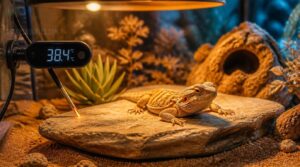
Once your warm-side probe is locked in, shift your attention to the basking spot itself.
| Reading Type | Tool | Target Range |
|---|---|---|
| Surface temp | Digital thermometer | 95–105 °F (bearded dragons) |
| Ambient temp | Infrared thermometer | 88–92 °F (ball pythons) |
| Cool zone temp | Second probe | 75–80 °F |
Watch your reptile — stretched limbs and calm eyes confirm the zone is dialed in.
Under-mat Probe Security
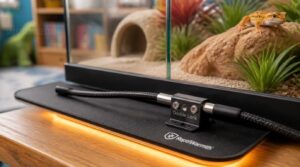
The probe sitting under your heat mat is only useful if it stays put. Slide it 1–3 mm from the mat edge and secure it with a double‑locking mount that needs a small tool to release.
That alone stops curious fingers from shifting it. A heat‑resistant sleeve protects the cable through repeated heating cycles, keeping readings accurate.
Child-safe Cord Routing
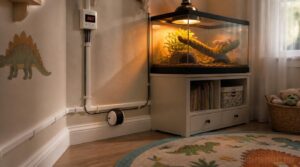
Once the probe is locked in, turn your attention to the cord itself. Cable raceways along baseboards hide thermostat leads and heater cords from small hands.
Secure every cord with organizational clips every 12–18 inches to eliminate dangling loops. Use a cord winder to manage excess length — loose coils invite tugging, which can yank a probe out of position.
Second Thermometer Checks
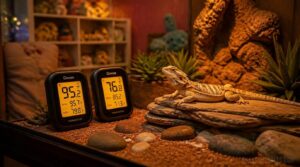
A secondary thermometer gives you a true confidence check on your thermostat’s readings.
Place it on the warm side, at least 6 inches from the heat source, to avoid skewed numbers.
Log readings every 4–6 hours to catch diurnal fluctuation. If the two units disagree by more than 2°F, recalibrate your probes immediately.
Compare Value by Budget Tier
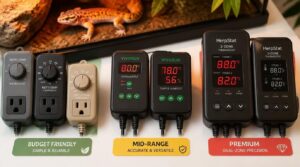
Not every budget buys the same level of protection, and that gap matters when a thermostat lives in your kid’s bedroom. The picks below are sorted by price tier so you can spot the right fit without overspending — or undershooting on safety. Here’s what each budget level actually gets you.
Budget Bedroom Picks
You don’t need to spend $60 to keep your kid’s enclosure safe.
Budget heat mat thermostats — usually priced around $15–$28 — handle most bedroom setups reliably.
The BN-LINK is ETL-listed and handles 1,000 W, enough for standard heat mats. The VIVOSUN adds 1-degree increment control. Both keep temperatures steady without overloading a bedroom circuit.
Mid-range Safer Options
Spending $25–$35 unlocks features that genuinely matter in a child’s room.
Mid-range digital thermostats deliver stable basking zones within ±1–2°F and dual-stage cycling that cuts down on disruptive on/off switching overnight.
Models like the Inkbird ITC-308 carry ETL certification, include audible alarm benefits for high/low breaches, and feature durable probes rated for repeated use near heat sources.
Premium Alarm Features
Premium thermostats in the $35–$60 range earn their price through serious alarm systems. Here’s what you actually get:
- 85 dB audible siren plus a flashing beacon triggers the moment a fault is detected
- Smartphone push alerts arrive within 2 seconds of any breach
- Battery backup keeps alarms running for 4 hours during outages
- Tamper-resistant keypad locks block kids from disabling settings
- Weekly automated sensor self-tests verify probe health without your involvement
Best for Snake Enclosures
Snakes need steady warmth — not dramatic swings.
A pulse proportional thermostat like the Inkbird ITC-308 ($35) holds snake enclosure temperatures within ±0.5 °F, reducing snake stress and avoiding respiratory infections. Its dual-relay design manages both heating and humidity retention balance.
Pair it with a heat mat and secure latching mechanisms to keep your setup sealed and safe.
Best for Growing Collections
Growing a reptile collection means your temperature control needs evolve too. A digital thermostat like the Inkbird ITC-308 ($35) scales well — its dual-relay design manages multiple enclosures as you diversify species.
Document each habitat’s acquisition history and settings for consistent automatic temperature regulation. One reliable temperature controller, properly cataloged, protects your whole growing collection.
Frequently Asked Questions (FAQs)
What should the thermostat be set to for a kids room during winter?
Set your child’s room to 20°C (68°F) overnight in winter. Don’t let it drop below 18°C (64°F). A programmable digital thermostat holds that target automatically, preventing cold spikes that disrupt sleep.
How to keep reptiles warm in a cold room?
A cold room threatens your reptile’s health fast. Place a heat mat on one side with a digital temperature controller to build a thermal gradient, keeping the warm zone at target temps even when the air dips.
Do I need a thermostat for a reptile enclosure?
Think of a thermostat as a reptile’s personal climate manager. Yes, you need one. It manages temperature control automatically, prevents heat burns, promotes metabolic health, and creates a safe thermal gradient — a true beginner husbandry essential.
Where to place a reptile thermostat?
Place the probe at basking height, away from the heat source itself. This avoids false high readings. Use a second thermometer to verify accuracy. Secure cords along enclosure edges to prevent chewing.
Where to place a thermostat in a reptile tank?
Where does your probe actually go? Place it at the basking zone, never inside hides or under substrate. Keep it away from heat shadows cast by rocks to maintain accurate temperature control.
Can you use a thermostat with a basking bulb?
Yes, you can. A dimming thermostat works best with basking bulbs — it gradually reduces power instead of cutting out completely, preventing flicker, filament stress, and sudden heat spikes.
What is a 3H and 2C thermostat?
A 3H 2C thermostat controls three heating stages and two cooling stages. It’s built for complex heat pump systems, not reptile enclosures — wrong tool entirely for your pet setup.
How to regulate temperature in a reptile enclosure?
Use a digital thermostat for precise habitat temperature control. Position your heat source at one end to create a gradient — warm side near 95–105°F, cool side around 75–80°F. Verify probe accuracy with a second thermometer.
Can thermostats control both heat mats and lamps?
Some thermostats act like a two-lane highway — one channel runs your heat mat, another drives the basking lamp. A dimming thermostat with dual outlet manages both, but always calculate combined wattage carefully.
How often should thermostat batteries be replaced?
Replace batteries once a year as a baseline. Lithium batteries can stretch to 24 months. Don’t wait — a flashing low battery icon means you have roughly 4–8 weeks left.
Conclusion
single degree off can cost a bearded dragon its appetite—or worse. That’s not paranoia; that’s reptile biology.
The best reptile thermostats for kids’ rooms don’t just regulate heat; they stand between a thriving animal and a preventable crisis sharing your child’s bedroom wall. Pick one with certified safety ratings, alarm functions, and the right control type for your heat source. Get the temperature right, and everything else in that enclosure follows.