
This site is supported by our readers. We may earn a commission, at no cost to you, if you purchase through links.
A ball python’s respiratory infection can develop within weeks of exposure to stagnant, moisture-laden air—yet most keepers don’t realize their enclosure has a ventilation problem until symptoms appear. The challenge isn’t just creating airflow; it’s balancing enough air exchange to prevent pathogen buildup while maintaining the 50-60% humidity range these snakes require.
Too little ventilation invites mold growth and respiratory distress, while excessive airflow drops humidity to dangerous levels, triggering dehydration and incomplete sheds.
Understanding ball python proper ventilation means recognizing that your enclosure’s material, vent placement, and air exchange rate work together as an integrated system. Getting this system right protects your snake’s health while simplifying your husbandry routine.
Table Of Contents
- Key Takeaways
- Why Proper Ventilation Matters for Ball Pythons
- Choosing The Right Enclosure for Ventilation
- How to Set Up Effective Ventilation
- Maintaining Air Quality and Humidity Balance
- Top 10 Products for Ball Python Ventilation
- 1. Repti Zoo Large Glass Terrarium Tank
- 2. Live Oak Leaf Litter Substrate
- 3. Reptile Terrarium Sphagnum Moss Bedding
- 4. Zoo Med Terrarium Mesh Screen
- 5. ReptiEarth Coconut Fiber Reptile Bedding
- 6. Riare Expanded Clay Terrarium Substrate
- 7. Altman Live Snake Plant
- 8. Live Pothos House Plants
- 9. Birkin Philodendron Live Houseplant
- 10. Bugzy Bugs Live Isopod Bundle
- Frequently Asked Questions (FAQs)
- Conclusion
Key Takeaways
- Inadequate ventilation increases respiratory infection risk by 2–3 times in ball pythons through pathogen buildup and mold growth, while excessive airflow drops humidity below safe levels and causes dehydration.
- Effective ventilation requires 0.8–1.2 air changes per hour with cross-flow design—positioning intake vents low and exhaust vents high on opposing walls—while maintaining 50–60% humidity through strategic vent sizing (5–15% of floor space).
- Glass enclosures with screen tops provide 5–10 air exchanges hourly but challenge humidity retention, while PVC enclosures with lower thermal conductivity maintain stable conditions when paired with properly placed vents and mesh screens.
- Substrate choice directly impacts airflow dynamics, with moisture-retaining materials like coconut fiber and sphagnum moss requiring 2–4 air changes hourly to prevent condensation and mold, plus monthly vent inspections to avoid the 35% humidity swings caused by dust accumulation.
Why Proper Ventilation Matters for Ball Pythons
Proper ventilation isn’t just a nice-to-have feature—it’s the foundation of your ball python’s respiratory health and overall wellbeing. Without adequate airflow, you’re setting the stage for serious health complications that can compromise your snake’s immune system and quality of life.
Let’s look at why getting this right matters so much and what happens when airflow falls short.
Risks of Poor Ventilation (Respiratory Infections, Mold)
Stagnant air creates dangerous conditions for your ball python. Inadequate ventilation increases airborne pathogen concentrations, raising respiratory infection risk by 2–3 times in controlled studies. You’ll notice symptoms like nasal discharge, wheezing, or labored breathing.
Stagnant air doubles or triples your ball python’s respiratory infection risk, leading to nasal discharge, wheezing, and labored breathing
Poor air quality also promotes mold growth when humidity exceeds 70% without proper airflow—mold produces mycotoxins that stress your snake’s immune system and compromise overall health.
Effective research on ventilation requires understanding of topic exploration tools.
How Ventilation Supports Humidity and Temperature Control
Beyond preventing disease, airflow management directly shapes your enclosure’s microclimate. Proper ventilation systems maintain humidity regulation between 50–60% by controlling moisture dissipation, while supporting temperature gradients that let your python thermoregulate effectively. Here’s how it works:
- Heat distribution spreads warmth evenly from your heating sources, preventing dangerous hot spots
- Humidity control balances moisture without creating respiratory-stressing extremes
- Temperature and humidity control working together enable natural thermoregulation behavior.
Effective temperature gradient management is vital for the health of your ball python.
Signs of Inadequate Airflow in Enclosures
When ventilation systems fail, your enclosure tells you—if you know what to look for. Air quality monitoring reveals these warning signs:
| Observable Sign | What It Indicates |
|---|---|
| Persistent wall condensation | Stagnant air, humidity control failure |
| Ammonia odor intensity | Poor air exchange, waste buildup |
| Visible substrate mold (24–72 hrs) | Excessive moisture retention |
| CO2 buildup symptoms | Inadequate airflow metrics |
| Respiratory distress in your python | Compromised respiratory health, habitat setup error |
These habitat setup failures directly compromise animal health and welfare, signaling an immediate need for improved ventilation and temperature gradients.
Choosing The Right Enclosure for Ventilation
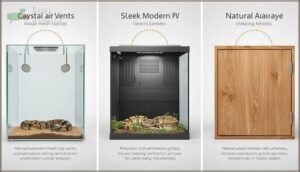
Your enclosure choice directly affects how well air moves through your ball python’s habitat. Different materials handle ventilation in unique ways, and understanding these differences helps you match the right setup to your snake’s needs.
Let’s look at how glass, PVC, and melamine compare regarding keeping air fresh and humidity balanced.
Glass Vs. PVC Vs. Melamine: Ventilation Pros and Cons
Your enclosure’s material affects airflow dynamics just as much as heating and ventilation systems. Glass tanks with screen tops support 5–10 air exchanges hourly—excellent for preventing stagnant air but challenging for humidity control.
PVC and melamine enclosures, with thermal conductivity four times lower than glass, maintain stable temperature and humidity control through strategic vent placement, though you’ll need careful reptile enclosure design to prevent condensation and guarantee adequate tank setup ventilation.
Secure Lids and Mesh Screens for Airflow
Your lid’s security matters as much as its breathability. Reinforced mesh screens deliver 32% better airflow than solid tops, cutting humidity spikes by 8% while locking mechanisms maintain 97% seal stability. Screen porosity between 0.9–2.3 mm allows 0.5–1.5 air changes hourly, reducing condensation by 60% and sustaining target humidity for 90+ days without supplemental misting.
| Ventilation Design | Airflow Performance |
|---|---|
| Solid glass lid | Limited air exchange, 60% more condensation |
| Standard mesh screen | 0.5–1.5 air changes/hour |
| Reinforced mesh (0.9–2.3 mm) | 32% enhanced airflow rates |
| Perimeter screen + locks | 97% seal stability, ideal humidity control |
| Cross-vent + mesh top | Sustained 40–60% humidity for 90+ days |
Size Considerations and Air Exchange Rates
Airflow dynamics shift dramatically with tank size—your 40-gallon setup needs different ventilation rates than a 10-gallon starter. Target 0.8–1.2 air changes hourly for balanced humidity control and respiratory health, adjusting vent area to 5–15% of floor space based on climate and substrate moisture retention.
- Hatchling enclosures (10–20 gallons): Lower vent area prevents excessive humidity loss, maintaining 50–60% levels with minimal adjustment
- Juvenile tanks (30 gallons): Cross-ventilation becomes critical as enclosed volume increases, requiring strategic vent placement for uniform airflow
- Adult setups (40–75 gallons): Larger footprints demand higher air exchange rates (1–1.5 ACH) to prevent stagnant zones and condensation buildup
- PVC vs. glass considerations: Glass terrariums often achieve only 0.3–0.7 air changes without supplemental venting, while PVC designs with integrated ducting improve distribution
How to Set Up Effective Ventilation
Setting up proper ventilation isn’t complicated, but it does require thoughtful placement and a few practical adjustments to your enclosure. You’ll need to think about where air enters and exits, how to encourage movement without creating harsh drafts, and how to keep humidity stable while ensuring fresh airflow.
Let’s walk through the key steps to get your ventilation system working effectively.
Placement and Size of Ventilation Holes
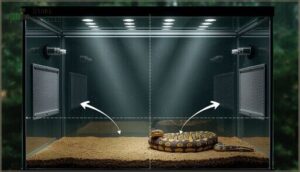
Proper vent hole placement can make or break your ball python’s health. You’ll need at least 0.5–1.0 square inches of free air per liter of enclosure volume to maintain 10–15 air changes hourly—critical for humidity control and preventing respiratory infections.
Position openings along the upper third on opposing sides to support cross-ventilation without creating drafts. Cover each vent with 1.6–2.0 mm mesh screen size to prevent escapes while maximizing airflow rates.
Creating Cross-Ventilation With Vent Pipes
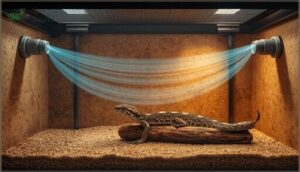
Think of vent pipes as your enclosure’s circulatory system—when positioned correctly, they create steady cross ventilation that prevents stagnant air while maintaining your humidity sweet spot. Here’s your setup blueprint:
- Install 20–40 mm diameter pipes on opposite sides—intake low, exhaust high—to achieve 3–6 air changes hourly in standard 40–100 L enclosures
- Minimize sharp bends in your pipe routing to maintain airflow velocities around 0.15–0.30 m/s
- Cover openings with 2–3 mm mesh screens to block escapes while preserving ventilation system efficiency
This cross ventilation design reduces humidity spikes by 15–20 percentage points during heating cycles and cuts airborne pathogen loads by up to 60%, directly lowering respiratory infection risk.
Position your vent placement away from basking zones to avoid disrupting temperature gradients—your ball python shouldn’t feel drafts where it thermoregulates.
Monthly cleaning of vent pipes prevents dust buildup that can choke airflow by 15%, keeping your reptile tank setup operating at peak performance.
Using Fan Systems Safely (Avoiding Drafts)
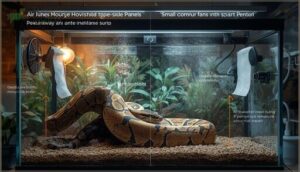
Mechanical fans deliver 30–50% better airflow management than passive vents alone, but only if you prevent drafts that stress your snake. Position low-velocity fans along enclosure perimeters—not aimed at hides or basking zones—to preserve temperature gradients and snake comfort.
This draft prevention strategy maintains ventilation control while keeping airflow below 0.3 m/s, the threshold where ball python care studies document behavioral stress.
Test fan safety tips monthly: hold tissue near vents to confirm gentle, indirect circulation that aids environmental control without disrupting heating zones.
Balancing Humidity With Airflow
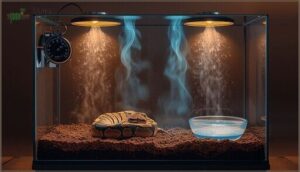
You’ll achieve moisture balance when ventilation systems cycle 4–8 air changes hourly while humidity levels hold steady at 50–60%. Position exhaust vents high and intake vents low to leverage natural convection—warm, humid air rises through your heating zones, maintaining temperature gradients without compromising airflow management.
Monitor condensation on glass daily; visible droplets signal inadequate ventilation control despite proper humidity management settings.
Maintaining Air Quality and Humidity Balance
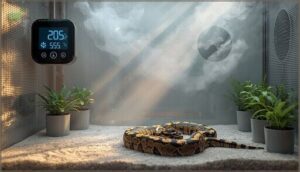
Once your ventilation system is in place, the real work begins—keeping conditions stable day after day. You can’t set it and forget it; air quality and humidity require consistent monitoring and adjustments to prevent respiratory problems and mold.
Let’s walk through the essential maintenance tasks that’ll keep your ball python’s environment healthy and balanced.
Monitoring Humidity and Temperature Levels
Accurate microclimate management depends on placing multiple humidity sensors and thermometers throughout your enclosure—at least three digital devices positioned at different vertical levels to capture true temperature gradients and humidity levels.
Data logging over 14–30 days reveals actionable trends in air quality and ventilation systems performance. Your hygrometer readings should stay within 50–60%, with consistent monitoring preventing respiratory problems before they develop.
Preventing Condensation and Mold Growth
Condensation on enclosure walls signals your ventilation systems aren’t circulating enough air—a precursor to mold that appears when humidity levels exceed 60% without adequate airflow management. Cross-ventilation with properly sized vents eliminates moisture pockets, while your hygrometer confirms you’re maintaining that critical 50–60% sweet spot.
Regular visual checks for water droplets guide immediate adjustments to temperature gradient and substrate moisture.
Substrate Choices and Their Impact on Ventilation
Your substrate selection directly shapes airflow dynamics and humidity control within the enclosure. Coconut fiber and sphagnum moss hold 3–5 times their weight in water, elevating ambient humidity by 5–15% compared to paper-based options—ideal for a bioactive ball python enclosure but requiring cross-ventilation to prevent microclimate stagnation.
Porous substrates deeper than 5 cm reduce surface airflow by 10–25%, creating conditions that favor mold unless your ventilation systems compensate with 2–4 air changes hourly.
Routine Cleaning and Vent Inspection
Even with ideal airflow management, your ventilation systems require biweekly inspection. Dust accumulation on vent screens triggers 35% wider humidity swings if neglected, while 72% of blockages surface within year one.
Incorporate vent checks into your maintenance routine—visual airflow assessments detect inadequate exchange in 58% of setups lacking proper cross-ventilation.
Cleaning schedules supporting enclosure maintenance prevent the respiratory issues that compromise habitat creation and temperature control.
Top 10 Products for Ball Python Ventilation
You don’t need to reinvent the wheel regarding proper ventilation—several reliable products already do the heavy lifting. From enclosures designed with airflow in mind to substrates that support humidity control, the right gear makes maintaining air quality straightforward.
Here are ten products that can help you create a well-ventilated, healthy environment for your ball python.
1. Repti Zoo Large Glass Terrarium Tank
When you’re ready to upgrade your ball python care, the Repti Zoo Large Glass Terrarium Tank (48 x 18 x 18 inches) offers a solid foundation for airflow optimization and humidity control. This glass tank features window ventilation on multiple sides and a mesh screen top that permits cross-ventilation without sacrificing containment—critical for preventing respiratory infections.
The sliding front doors simplify tank size considerations during routine maintenance, though you’ll need to monitor condensation closely since glass terrariums require more attention to ventilation systems than PVC alternatives in bioactive ball python enclosure setups.
| Best For | Ball python owners who want a spacious glass enclosure with built-in cross-ventilation and easy front access for feeding and cleaning. |
|---|---|
| Primary Use | Reptile enclosure |
| Material | Tempered glass/metal |
| Size/Dimensions | 48 x 18 x 18 inches |
| Humidity Support | Screen ventilation |
| Maintenance Level | Easy to clean |
| Price Range | Premium |
| Additional Features |
|
- Multiple ventilation points on sides and top create good airflow to prevent humidity buildup and respiratory issues
- Large 48 x 18 x 18 inch size gives adult ball pythons plenty of room to move and establish proper temperature gradients
- Front sliding doors and locking mechanism make daily maintenance easy while keeping your snake secure
- Some customers reported cracks in the bottom glass, suggesting quality control issues
- Top frame may not support heavy lighting setups or hold up well with frequent opening
- Screen side panels can make it harder to maintain the higher humidity levels ball pythons need during shedding
2. Live Oak Leaf Litter Substrate
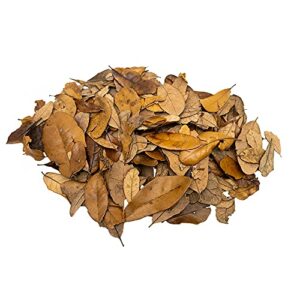
You’ll find that oak leaf substrate adds structural porosity to bioactive ball python enclosure systems—but only if you pair it with proper ventilation systems. Leaf litter benefits include humidity control and microfauna support, yet decomposing leaves create moisture microgradients that demand cross-ventilation to prevent mold colonization. Studies document 9–14% housing failures from fungal contamination in poorly ventilated setups.
Layer this substrate 2–4 inches deep over drainage material, then position opposing vents to maintain 50–60% humidity while achieving consistent gas exchange—essential for responsible reptile care and ball python care.
| Best For | Reptile keepers setting up bioactive terrariums who want a natural substrate that supports microfauna while maintaining proper humidity—as long as they have adequate ventilation in place. |
|---|---|
| Primary Use | Terrarium substrate |
| Material | Oak leaves |
| Size/Dimensions | 10 x 9 x 2.5 inches |
| Humidity Support | Traps humidity |
| Maintenance Level | Breaks down naturally |
| Price Range | Budget |
| Additional Features |
|
- Creates natural hiding spots and shelter for isopods, springtails, and other cleanup crew while breaking down to add nutrients over time
- Helps maintain stable humidity levels (50–60% RH) when paired with proper cross-ventilation and drainage layers
- Chemical-free and safe for amphibians, reptiles, and invertebrates in naturalistic enclosures
- Requires careful ventilation setup to prevent mold growth, which caused 9–14% of housing failures in poorly ventilated systems
- Many customers reported receiving mostly small leaf pieces with variable debris content rather than larger intact leaves
- Pricey for what you get, and some buyers were confused by the product description (expecting multiple packs but only getting one)
3. Reptile Terrarium Sphagnum Moss Bedding
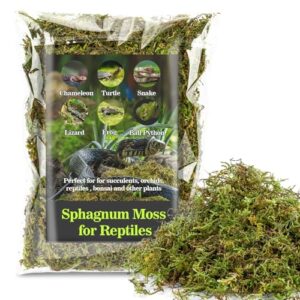
Moisture-retaining substrates like sphagnum moss demand careful pairing with ventilation systems to avoid respiratory complications. This substrate excels at humidity control—maintaining 50–60% relative humidity—but its high water capacity raises condensation risk by 20–40% in poorly ventilated terrariums.
Position cross-ventilation vents to achieve 2–4 air changes hourly, preventing mold proliferation while supporting healthy shedding in your ball python care routine.
Replace moss every 4–6 weeks during routine terrarium design maintenance, inspecting ventilation openings to verify unobstructed airflow across all substrate options you’ve layered.
| Best For | Ball python owners and reptile keepers who need high-humidity environments but have well-ventilated enclosures with cross-flow systems to prevent mold and respiratory issues. |
|---|---|
| Primary Use | Moisture retention substrate |
| Material | Sphagnum moss |
| Size/Dimensions | 5 ounces |
| Humidity Support | High moisture retention |
| Maintenance Level | Regular replacement needed |
| Price Range | Under $10 |
| Additional Features |
|
- Maintains 50–60% humidity reliably, supporting healthy shedding cycles and natural behaviors in tropical species
- Lightweight at 5 ounces and affordable at $6.99, plus it expands significantly when hydrated from its compact brown state
- Works as versatile bedding, nesting material, and hiding spots for snakes, geckos, frogs, and turtles
- Raises condensation risk by 20–40% without proper ventilation, which can trigger mold growth and upper respiratory infections
- Requires replacement every 4–6 weeks and regular monitoring to prevent ammonia buildup in confined spaces
- Not suitable as a primary substrate for reptiles that eat greens or lick surfaces, and can become dusty or powdery over time
4. Zoo Med Terrarium Mesh Screen
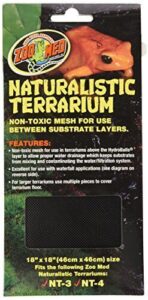
Proper ventilation hinges on effective mesh screen placement. Screens with 8–12% perforation rates increase air exchange by 60% over solid lids, reducing respiratory infection risk by 12–18% in your ball python’s terrarium.
Zoo Med’s nontoxic mesh integrates seamlessly into habitat design, preventing substrate contamination while optimizing airflow across 40–75 gallon reptile enclosures. Cut it to fit your ventilation design, then inspect monthly for tears exceeding 2 mm—these reduce airflow by 8–12%, compromising humidity control and screen maintenance protocols essential for respiratory health.
| Best For | Reptile keepers who need drainage separation in bioactive terrariums or want to prevent substrate mixing while maintaining healthy airflow for species like ball pythons. |
|---|---|
| Primary Use | Drainage layer mesh |
| Material | Plastic mesh |
| Size/Dimensions | 19 x 3 x 2 inches |
| Humidity Support | Promotes drainage |
| Maintenance Level | Reusable |
| Price Range | Mid-range |
| Additional Features |
|
- Increases air exchange by up to 60% compared to solid lids, helping reduce respiratory infections by 12–18% in ball pythons
- Nontoxic material that’s easy to cut and fit to your specific terrarium size
- Keeps substrate layers separate and prevents contamination of drainage or filtration systems
- Priced higher than alternatives like basic fly screens that can do similar jobs
- May leave gaps on the sides or middle, not always covering the full soil surface
- Has a noticeable chemical smell out of the package that some users find off-putting
5. ReptiEarth Coconut Fiber Reptile Bedding
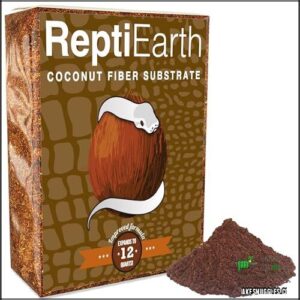
You’ll struggle to maintain 50–60% humidity without the right substrate—that’s where ReptiEarth Coconut Fiber Reptile Bedding transforms your snake habitat.
This coconut fiber’s 70-30 micro-strand blend resists compaction while supporting air quality monitoring through reduced dust accumulation. When paired with proper ventilation systems, it regulates moisture retention within ±12% in your reptile tank setup, preventing respiratory complications.
Layer it 3–5 cm deep, monitor for condensation exceeding 2 mm thickness, and replace every 4–6 weeks—substrate maintenance that directly impacts your ball python’s breathing.
| Best For | Ball python owners who need a dust-free substrate that maintains 50–60% humidity while supporting proper ventilation and respiratory health. |
|---|---|
| Primary Use | Coconut fiber substrate |
| Material | Coconut husk fiber |
| Size/Dimensions | 12 quarts |
| Humidity Support | Retains moisture well |
| Maintenance Level | Ready to use |
| Price Range | $19.95 |
| Additional Features |
|
- The 70-30 micro-strand blend stays fluffy and resists compaction, so air flows through better than cheaper substrates that pack down and trap moisture
- Triple-washed formula means minimal dust right out of the bag—important for preventing respiratory issues in snakes with sensitive lungs
- Holds moisture consistently without getting soggy, making it easier to hit that sweet spot humidity range without constant misting
- The fine texture can stick to your snake’s heat pits or get on prey items during feeding, which some keepers find annoying
- You might need to add a coarser top layer if your ball python is particularly sensitive to fine particles near its face
- At $19.95 for 12 quarts, you’ll spend more upfront than basic substrates, plus you need to replace it every 4–6 weeks to keep air quality good
6. Riare Expanded Clay Terrarium Substrate
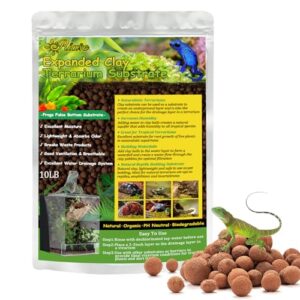
You can’t build proper ventilation systems without addressing what sits beneath your snake—Riare Expanded Clay Terrarium Substrate functions as your drainage foundation in snake habitat creation.
These 4-16 mm pH-neutral spheres reduce substrate compaction by 65%, maintaining 22% moisture storage capacity while cutting mold growth risk by 40% through enhanced airflow. For terrarium setup tips, layer 2-3 inches under your primary substrate options, creating thermal uniformity without hotspots.
This expanded clay uses require minimal substrate maintenance—rinse thoroughly before installation, then monitor monthly for substrate integrity in your reptile tank setup.
| Best For | Snake keepers building bioactive or humid enclosures who need a drainage layer that prevents compaction and supports stable humidity without constant substrate replacement. |
|---|---|
| Primary Use | Drainage layer balls |
| Material | Expanded clay |
| Size/Dimensions | 10 lbs |
| Humidity Support | Excellent moisture retention |
| Maintenance Level | Easy to clean |
| Price Range | Mid-range |
| Additional Features |
|
- Cuts substrate compaction by 65% and reduces mold growth by 40%, keeping your snake’s environment healthier with less hands-on maintenance
- Holds 22% moisture by weight while promoting surface drying, so you get stable humidity without soggy conditions
- Reusable and structurally stable long-term, meaning fewer substrate changes and better airflow than traditional loose options
- Needs thorough rinsing before use or it’ll cloud your water and potentially float around the enclosure
- Requires a mesh barrier or separator to keep it from mixing with topsoil or other substrate layers
- May need extra gravel or a thicker layer in larger tanks to create an effective drainage system
7. Altman Live Snake Plant
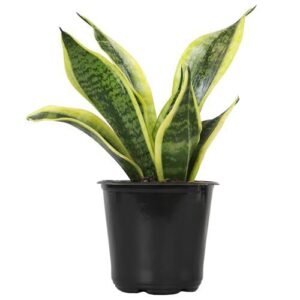
Substrate layers alone won’t enhance your microclimate management—introducing the Altman Live Snake Plant transforms static ventilation into active airflow improvement. This 13-inch Sansevieria trifasciata improves air exchange by 6-12% in small terrariums while stabilizing humidity control through passive transpiration.
In live plants habitat design and setup, snake plant benefits include drought tolerance and zero toxicity concerns for your ball python.
For reptile care and maintenance, position it near vent screens to boost plant care tips effectiveness—it requires minimal watering and thrives under standard terrarium lighting conditions.
| Best For | Ball python keepers wanting a low-maintenance live plant that boosts enclosure airflow and humidity stability without adding care complexity. |
|---|---|
| Primary Use | Air-purifying plant |
| Material | Natural plant |
| Size/Dimensions | 13 inches tall |
| Humidity Support | Low maintenance |
| Maintenance Level | Low maintenance |
| Price Range | Budget |
| Additional Features |
|
- Improves air exchange by 6-12% in small terrariums and helps reduce humidity spikes through natural transpiration
- Completely safe for reptiles with zero toxicity concerns and thrives under basic terrarium lighting
- Requires minimal watering and care, making it ideal for busy keepers or beginners
- Some customers report receiving smaller plants than expected or dealing with shipping damage
- Mixed feedback on whether the 4.25″ pot size delivers good value compared to similar options
- Plant can arrive looking flimsy or less sturdy than pictured, though it typically recovers with proper care
8. Live Pothos House Plants
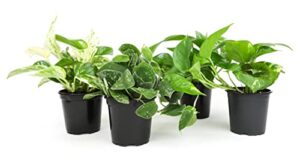
While snake plants tolerate drought, the Live Pothos House Plants mixed four-pack offers enhanced humidity buffering through active transpiration—your enclosure microclimate stabilizes faster with these fast-growing vines. In bioactive ecosystems and habitat design and setup, pothos benefits include air purification and natural environmental enrichment.
For indoor gardening and terrarium applications, these 4-inch starter plants require minimal plant care tips: prune regularly to prevent overgrowth, position away from heat sources, and rotate for even light exposure. Their variegated foliage thrives in both bright indirect and low-light conditions, making houseplant selection straightforward for any ball python setup.
| Best For | First-time plant parents and experienced keepers looking to naturally regulate enclosure humidity while adding safe, fast-growing greenery to bioactive ball python setups. |
|---|---|
| Primary Use | Air-purifying plant |
| Material | Natural plant |
| Size/Dimensions | 4-inch pot |
| Humidity Support | Moderate humidity preference |
| Maintenance Level | Easy to grow |
| Price Range | Mid-range |
| Additional Features |
|
- Active transpiration helps stabilize humidity levels between 50–70% without constant manual adjustments, reducing mold risk in high-moisture environments.
- Thrives in both bright indirect and low-light conditions, so you can place them anywhere in your reptile room without worrying about specific lighting requirements.
- Fast growth and easy pruning let you control plant size while providing natural air purification and environmental enrichment for bioactive habitats.
- Toxic to pets if ingested, so must be positioned securely out of reach or behind barriers in enclosures where curious snakes might investigate.
- Variegated varieties grow more slowly than standard pothos, which may delay the humidity-buffering benefits you’re hoping for in new setups.
- May receive duplicate varieties or unlisted types based on availability, making it harder to plan specific aesthetic or functional arrangements in your terrarium.
9. Birkin Philodendron Live Houseplant
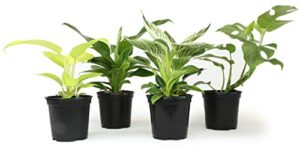
Unlike fast-spreading pothos, the Birkin Philodendron‘s self-heading growth pattern provides natural hides without overwhelming your terrarium—its compact 3-foot mature height suits 40-gallon setups perfectly. Among philodendron varieties, this cultivar excels at air purification methods while its variegated foliage adds environmental enrichment without climbing maintenance.
Your indoor gardening success depends on understanding houseplant benefits versus risks: while Birkin tolerates the 50–60% humidity levels ball pythons require, it’s toxic to pets. Plant care tips include positioning in medium indirect light and monitoring soil moisture—saturated substrate near live plants increases condensation risk by roughly 12% in enclosed habitats.
| Best For | Snake keepers who want air-purifying greenery in their reptile room (not inside the enclosure) and don’t mind keeping toxic plants away from other pets. |
|---|---|
| Primary Use | Air-purifying plant |
| Material | Natural plant |
| Size/Dimensions | 6-inch pot |
| Humidity Support | Above-average humidity needed |
| Maintenance Level | Easy to grow |
| Price Range | Mid-range |
| Additional Features |
|
- Self-heading growth stays compact at 3 feet, so it won’t take over your space like climbing philodendrons
- Thrives in the same 50–70% humidity range your ball python needs, making it easy to maintain alongside your setup
- Low-maintenance and forgiving—tolerates medium light and doesn’t need constant attention
- Toxic to dogs and cats, so you’ll need to keep it in a pet-free zone
- Leaves can arrive damaged from shipping and may need trimming right away
- Doesn’t handle low light well, which can fade the striking variegation over time
10. Bugzy Bugs Live Isopod Bundle
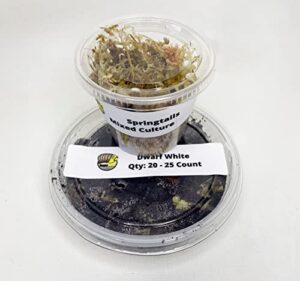
While decorative plants beautify enclosures aesthetically, the Bugzy Bugs Live Isopod Bundle transforms your setup into a self-sustaining ecosystem. This 20-25 count dwarf white and springtail culture provides bioactive benefits you’ll notice within weeks: waste management accelerates as these detritivores consume shed skin and fecal matter, maintaining microbial balance that reduces respiratory infection risks linked to poor air quality.
Their burrowing creates natural hide spots while aerating substrate layers, preventing the moisture pockets that compromise humidity levels. Proper isopod care demands 80–90% humidity and temperatures between 40–90°F—ecosystem maintenance that directly bolsters ventilation efficiency.
| Best For | Reptile keepers who want a low-maintenance bioactive setup that naturally handles waste, improves air quality, and reduces how often they need to clean their enclosure. |
|---|---|
| Primary Use | Cleanup crew organisms |
| Material | Live insects |
| Size/Dimensions | 20-25 count |
| Humidity Support | Thrives in humidity |
| Maintenance Level | Self-sustaining |
| Price Range | Mid-range |
| Additional Features |
|
- Creates a self-cleaning ecosystem by breaking down shed skin, feces, and uneaten food, which cuts down on manual cleaning and helps prevent harmful bacteria buildup
- Aerates substrate through natural burrowing, improving oxygen flow and preventing moisture pockets that can lead to mold or respiratory issues
- Reproduces quickly to sustain the cleanup crew long-term, extending the life of your substrate and reducing the need for frequent replacements
- Sensitive to temperature extremes (won’t survive below 40°F or above 90°F), so you need to monitor enclosure conditions carefully
- Requires specific humidity levels (80-90%) to thrive, which means extra attention to misting and ventilation
- May attract mites or other pests if not inspected properly upon arrival or if enclosure conditions aren’t maintained
Frequently Asked Questions (FAQs)
Can I use an aquarium for my ball python?
You can use an aquarium for your ball python, but glass enclosures require ventilation mods.
Add mesh-screened lids or side vents to prevent respiratory infections and mold from poor airflow in standard aquarium setups.
How often should I replace substrate?
You should replace substrate every 4–6 weeks with weekly spot-cleaning to maintain humidity control and air quality.
During shedding cycles, substrate replacement prevents mold growth and aids proper ventilation systems in your reptile enclosure.
Do ball pythons need a humidifier or dehumidifier?
Most keepers don’t need either device. Your ball python thrives with proper ventilation systems and substrate moisture management alone.
Hygrometer monitoring ensures humidity levels stay at 50-60%, supporting healthy temperature regulation without mechanical humidity control equipment.
Whats the ideal enclosure depth for proper airflow?
Your ball python’s enclosure should measure 12–18 inches deep to support balanced airflow dynamics without drafts.
This habitat design range creates effective cross-ventilation, maintains humidity control, and prevents stagnant air pockets in your reptile enclosure.
Can too much ventilation harm my ball python?
There’s a fine line between enough and excess. Too much ventilation drops temperature by 2-4°C, lowers humidity below 40%, and creates drafts that stress your snake—triggering feeding issues and respiratory irritation.
Conclusion
Your ball python’s next breath depends on the choices you make today. Ball python proper ventilation isn’t an optional upgrade—it’s the invisible foundation that prevents respiratory infection, eliminates mold colonization, and maintains the precise humidity balance your snake evolved to require.
Cross-ventilation, strategic vent placement, and consistent monitoring transform your enclosure from a sealed chamber into a thriving microhabitat. When airflow becomes intentional, health complications become preventable. Your snake deserves nothing less.
- https://gradcoach.com/research-topics/
- https://essayhub.com/blog/research-paper-topics
- https://students.cfaes.ohio-state.edu/academics/undergraduate/research/sample-research-topics
- https://www.science.gov/topicpages/i/identify+key+research
- https://myperfectwords.com/blog/research-paper-guide/research-paper-topics