This site is supported by our readers. We may earn a commission, at no cost to you, if you purchase through links.

Your monitor lizard’s enclosure spans six feet, but somehow half of it stays cold while the other side overheats—a thermal management problem that can’t be solved with standard pet store heat lamps. Large enclosures require heating equipment designed for industrial-scale thermal distribution, not the 40-watt bulbs marketed for 20-gallon tanks.
The difference between adequate and inadequate heating determines whether your reptile develops metabolic bone disease, respiratory infections, or thrives with proper digestion and immune function.
Selecting heat lamps that deliver consistent warmth across expansive spaces, maintain precise temperature gradients, and integrate with thermostatic controls separates successful large-enclosure setups from expensive failures.
Table Of Contents
Key Takeaways
- Large enclosures require industrial-grade heating equipment with wattages ranging from 75 to 250 watts, not standard pet store bulbs designed for small tanks, to prevent dangerous temperature fluctuations that cause metabolic bone disease and respiratory infections.
- Ceramic heat emitters deliver 10,000+ hours of reliable 24/7 warmth without light emission, making them superior to infrared bulbs that lose effectiveness after 6-12 months, though they require ceramic sockets and thermostat control to prevent burns.
- Proper thermal management demands multiple heat sources positioned at varying heights to create distinct basking zones (38-42°C) and cool areas (24-28°C), with digital thermostats and regular monitoring preventing the cold spots and dangerous hotspots that undermine reptile health.
- Safety protocols—including GFCI outlets, metal guards around heat lamps, IP-rated fixtures for humidity protection, and species-specific temperature ranges—separate successful large-enclosure setups from fire hazards and veterinary emergencies.
Best Heat Lamps for Large Enclosures
When you’re heating a large enclosure, you need equipment that delivers consistent warmth across significant space without creating dangerous hot spots or cold pockets. The right heat lamp combines adequate wattage, durable construction, and efficient heat distribution to maintain the thermal gradient your animals require.
Here are four proven options that handle the demands of spacious habitats while keeping your setup safe and effective.
1. Ceramic Reptile Heat Emitter Bulb
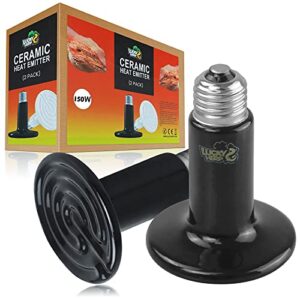
Ceramic heat emitters deliver powerful thermal output without any light emission, making them ideal reptile heating solutions for nighttime warmth in your terrarium heating setup. These ceramic elements reach operating temperature in just 4 minutes and last up to 10,000 hours, providing reliable heat emission from durable ceramic construction.
You’ll find them particularly effective in larger enclosures where consistent radiant heat matters most for reptile care.
Just remember emitter safety basics: use quality ceramic lamp holders, maintain 30cm clearance from animals, and pair your ceramic heat emitters with thermostats for controlled reptile heat lamps performance.
| Best For | Reptile owners who need reliable 24/7 heat without disrupting their pet’s sleep cycle, especially for nocturnal species or larger enclosures requiring consistent warmth. |
|---|---|
| Maximum Wattage | 150W |
| Socket Type | E26 |
| Material | Ceramic |
| Heat Dissipation | Special ceramic design |
| Switch Control | External required |
| Target Animals | Reptiles, amphibians, pets |
| Additional Features |
|
- Heats up in just 4 minutes and lasts up to 10,000 hours, giving you long-term reliability without constant replacements
- Produces zero light emission, so your reptiles can maintain natural day-night cycles without sleep disruption
- Works for multiple animals beyond reptiles—amphibians, chickens, and even small pets like cats and dogs benefit from the radiant heat
- Requires a quality ceramic lamp holder and careful positioning since it gets extremely hot to the touch
- You need to maintain at least 30cm distance from pets to prevent burns or overheating injuries
- Frequent switching on and off can shorten its lifespan, so it’s best used with a thermostat for controlled operation
2. Reptile Dual Light Fixture Combo
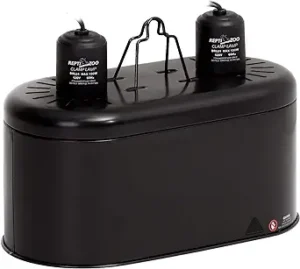
When you need both warmth and illumination, a reptile dual light fixture combo delivers both in one housing. These units pair a ceramic heat emitter with a UVB or full-spectrum bulb, supporting thermoregulation and lighting needs simultaneously.
You’ll find wattages ranging from 60 to 150 watts for large enclosures, with clamp-on or dome-style mounting options. This dual lamp design streamlines your reptile lighting setup, reduces clutter on screen tops, and ensures your animals receive essential heat and spectrum coverage in one fixture.
| Best For | Reptile owners who want to simplify their setup by combining heat and UVB lighting in one fixture, especially for turtles, bearded dragons, geckos, iguanas, and chameleons. |
|---|---|
| Maximum Wattage | 150W per socket |
| Socket Type | E26 |
| Material | Metal/Ceramic |
| Heat Dissipation | Ventilation holes |
| Switch Control | Dual independent switches |
| Target Animals | Reptiles, amphibians |
| Additional Features |
|
- Two independent switches let you control heat and light separately without unplugging anything
- Solid ceramic sockets with ventilation holes handle up to 150W per bulb and help prevent overheating
- Compact dual design saves space on your enclosure screen and reduces cord clutter
- Some units arrive dented or with bent fixtures during shipping
- Switches and sockets may fail or buzz after a few months of regular use
- Not ideal for very large enclosures that need higher wattages or multiple heat zones
3. GVWRATW Reptile Heat Lamp Fixture
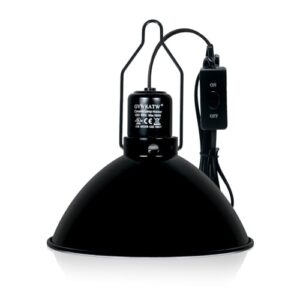
The GVWRATW fixture brings together versatility and control in one aluminum-dome package. You can run any reptile bulb up to 160 watts—basking spots, UVB tubes, or ceramic emitters—through its heat-resistant ceramic socket and E26 base.
The extra-deep reflector boosts heat distribution patterns across larger terrarium spaces, while the built-in dimming thermostat lets you fine-tune temperatures without adding external controllers.
A six-foot cord and on/off switch simplify placement, though some keepers report occasional shipping damage. Inspect the ceramic socket durability and lamp fixture materials upon arrival to verify safe reptile thermoregulation.
| Best For | Reptile keepers who need flexible temperature control and strong UV distribution across mid-to-large terrariums without buying separate dimmers or reflectors. |
|---|---|
| Maximum Wattage | 160W |
| Socket Type | E26 |
| Material | Aluminum |
| Heat Dissipation | Deep dome reflector |
| Switch Control | On/off switch on cord |
| Target Animals | Reptiles |
| Additional Features |
|
- Built-in dimming thermostat saves you from buying external controllers and gives precise heat adjustments on the fly.
- Extra-deep aluminum dome pushes more light and heat into basking zones, covering larger enclosure footprints.
- Handles bulbs up to 160W—ceramic emitters, UVB compacts, or basking spots—so you can swap setups as your reptile’s needs change.
- Some units arrive with damaged sockets or incomplete parts, so you’ll need to inspect everything right out of the box.
- 160W cap might fall short for very large or cold-climate setups that need higher wattage.
- No waterproof rating mentioned, which limits use in high-humidity enclosures or near misting systems.
4. Reptile Deep Dome Heat Lamp Fixture
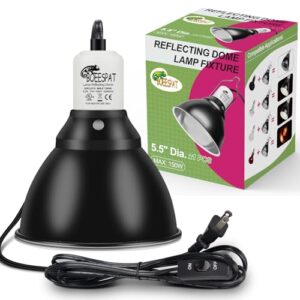
If you’re running enclosures that span three feet or more, a Deep Dome fixture channels concentrated thermal output exactly where your reptiles need it. The spherical reflector design funnels heat into defined basking spots, and you can dial wattage from 75 up to 250 watts depending on your species’ thermoregulation demands.
This unit accepts standard E26 bulbs—UVA, UVB, or ceramic—so you’re not locked into proprietary terrarium lighting.
Just watch the on/off switch; some keepers find it loose after a few months of daily use.
| Best For | Keepers with enclosures three feet or larger who need focused basking heat and the flexibility to swap between UVA, UVB, or ceramic bulbs without committing to proprietary systems. |
|---|---|
| Maximum Wattage | 250W |
| Socket Type | E26 |
| Material | Aluminum alloy |
| Heat Dissipation | Top ventilation holes |
| Switch Control | Independent switch on cord |
| Target Animals | Reptiles |
| Additional Features |
|
- Deep dome reflector design concentrates heat into a tight basking zone, so you get efficient warm-up even in distant corners of large enclosures.
- Accepts any standard E26 bulb—ceramic heat emitters, basking lamps, or UVB—giving you total control over your heating and lighting setup.
- Affordable entry point with wattage options up to 250 watts, making it scalable for everything from bearded dragons to larger monitors.
- The on/off switch tends to loosen or fail after a few months of daily cycling, which means you might need to hardwire a separate controller or replace the unit.
- Quality control is hit-or-miss—some units arrive dented or non-functional, and durability reports suggest the fixture may not hold up under continuous high-wattage use.
- No built-in thermostat or temperature failsafe, so you’ll need to budget for an external controller to prevent overheating and maintain stable basking temps.
Key Features to Consider in Heat Lamps
When you’re heating a large enclosure, not all lamps deliver the same performance or value over time. The right heat lamp balances longevity, efficient heat spread, and compatibility with your existing setup.
Let’s look at the core features that separate reliable heating solutions from those that fall short.
Lamp Lifespan and Durability
You’ll want your heat lamp to last thousands of hours without constant replacements, so lamp material and thermal resistance matter more than you might think. Ceramic heat emitters commonly deliver 10,000 to 20,000 hours of reliable operation, while infrared bulbs often lose radiant output after just 6 to 12 months of daily use.
Consider these lifespan factors for your heating supplies:
- Ceramic durability outperforms traditional bulb longevity in high-wattage applications
- LED-based options frequently reach 25,000 to 50,000 hours but provide lower heat output
- Moisture exposure accelerates corrosion, shortening your reptile heat lamps’ service life markedly.
When writing about heat lamps, it’s vital to follow proper research paper guidelines to verify accuracy and clarity.
Heat Distribution and Reflector Design
Reflector geometry determines how efficiently your heat lamp concentrates warmth where your animals need it most. Parabolic or textured aluminum reflectors achieve up to 80% radiant heat concentration at target basking zones, while deep-dome fixtures create broader thermal coverage across large floors.
Proper reflector materials and high-reflectivity coatings—maintaining 90% efficiency after months of use—boost radiant efficiency by 8–12%, ensuring consistent thermal zoning without energy waste.
Understanding the principles of scientific research is essential for optimizing heat lamp setups.
Compatibility With Standard Fixtures
Most reptile heat lamps use E26 or E27 screw bases, letting you drop them straight into typical domed or recessed housings without fuss. Before you buy, double-check that your fixture’s wattage limits match your bulb—overloading standard sockets risks overheating and compromises thermoregulation.
Adjustable clamps and mounting arms fit most enclosure spacings, giving you flexibility to position heat lights exactly where your animals bask.
Optimizing Temperature in Large Enclosures
Managing temperature in a large enclosure requires more than just installing a heat lamp and hoping for the best. You need to understand how heat moves through space, where to position your sources, and how to monitor conditions consistently to keep your animals healthy.
The strategies below will help you create reliable thermal gradients, integrate proper controls, and match heating setups to the specific needs of your species.
Thermostat Integration and Temperature Monitoring
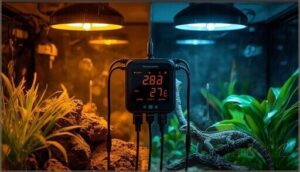
Digital thermostats with dual-stage control let you maintain distinct basking and ambient zones across your reptile enclosure, so your animals can thermoregulate naturally. Place high-temperature rated temperature sensors at representative points in each zone, then calibrate them against a known reference for accuracy.
Smart monitoring systems with data loggers track trends continuously, alert you to out-of-range conditions, and support fail-safes like high-temperature cutoffs—giving you complete zone control and peace of mind.
Placement of Heat Sources for Effective Zoning
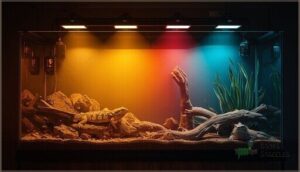
Think of your reptile enclosure as a canvas where you’ll paint distinct thermal zones using multiple heat sources. Position your primary heat lamp at one end to create a targeted basking hotspot, then offset secondary emitters to shape a measurable thermal gradient.
Design your enclosure like a thermal canvas, positioning heat lamps to paint distinct basking zones and gradients your reptile can navigate naturally
Mount fixtures at varying heights to modulate radiant intensity across vertical space, then map temperature regularly with digital thermometers—this precision gives your animals the zone creation and thermoregulation control they need.
Creating Basking and Cool Zones
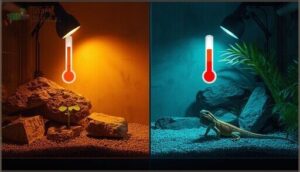
Your heat lamp becomes the cornerstone of a healthy reptile enclosure when you divide it into distinct thermal zones. Set your basking bulb to deliver a hotspot between 38–42°C on one side, while the opposite cooler area stays around 24–28°C—this heat gradient allows natural thermoregulation.
Monitor ambient control with infrared thermometers at multiple heights, confirming your basking spots support thermal cycling and species-specific comfort.
Species-Specific Heating Requirements
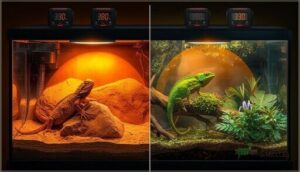
Once you’ve established thermal gradients, match your heat lamp output to your animal’s natural basking behaviors. Desert species like bearded dragons need intense 35–43°C basking spots, while tropical chameleons thrive at 29–35°C with higher humidity. Consider these species’ thermoregulation needs:
- Iguanas require 32–38°C basking zones with 24–29°C cool areas
- Leopard geckos prefer 35–43°C warmth and 24–29°C ambient temperatures
- Hatchlings demand tighter heat cycling at 32–38°C for proper growth
- Nocturnal species need stable 21–27°C nighttime warmth
- Aquatic turtles balance 29–32°C basking with 24–27°C water
Place calibrated thermometers throughout your reptile enclosure to verify temperature control across terrariums.
Safety and Installation Best Practices
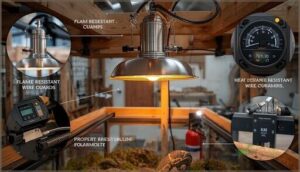
Getting the heat right in your enclosure means nothing if the setup isn’t safe for both you and your animals. Even the best heat lamp can become a fire hazard or burn risk without proper installation and protective measures.
Let’s walk through the essential safety steps that’ll keep your enclosure secure, code-compliant, and worry-free.
Selecting Proper Fixtures and Mounting Solutions
You’ll need fixtures with IP ratings that match your enclosure’s humidity levels, plus corrosion-resistant mounting hardware like stainless steel brackets. Swivel mounts give you precise control over heat distribution across basking zones, while suspension kits should include temperature-rated insulators.
Position fixtures high enough to prevent accidental contact, and always use adjustable arms that work with your thermostat for reliable temperature control throughout the reptile enclosure.
Preventing Burns and Overheating Risks
Once your fixtures are mounted, burn prevention and thermal regulation become your top priorities. Install metal guards or containment screens around every heat lamp to block direct contact, and confirm basking-site temperatures stay between 104–140°F using probe-style thermostats.
Calibrate wattage and lamp distance carefully—mismatched setups create dangerous hotspots that can injure your animals and trigger overheating risks you won’t catch without active temperature monitoring and thermostat control.
Electrical Safety and Moisture Protection
Humidity and electrical components don’t mix, which is why GFCI installation protects every outlet near moist enclosures. Wire management matters just as much—use watertight strain reliefs and gasketed junction boxes to block moisture ingress, and position power strips at least six inches above substrate.
Choose IP-rated fixtures that meet electrical codes, pair your heat lamp wattage with thermostat control, and schedule routine inspections to catch corrosion before it compromises safety standards.
Using Guards and Screens With Heat Lamps
Wire mesh or ceramic-coated guards prevent direct contact with hot surfaces in animal enclosures, creating a protective barrier around heat sources. Screen materials like stainless steel resist corrosion while allowing proper heat distribution across basking zones.
Guard installation requires secure mounting at safe distances, enabling thermostat sensors to monitor temperatures without obstruction.
Safety protocols demand regular inspections for warping or gaps that compromise enclosure design and pet heating effectiveness.
Alternatives and Supplemental Heating Options
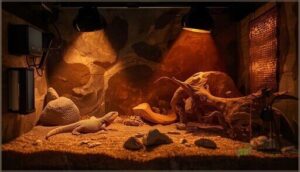
Heat lamps aren’t your only option regarding warming large enclosures, and in many cases, you’ll get better results by combining multiple heat sources. Radiant panels, substrate mats, and strategic lighting work together to create the kind of thermal gradient your animals need to thrive.
Here’s how to mix and match heating methods for ideal enclosure conditions.
Radiant Heat Panels for Broader Coverage
Radiant heat panels emit infrared radiation to warm surfaces directly, delivering more uniform heat distribution across your reptile enclosure than traditional heat sources. Panel efficiency depends on wattage, distance, and insulation, while heat mapping verifies thermal gradients meet your species’ needs.
You’ll often need multiple panels for proper panel sizing in large setups, ensuring consistent radiant output without cold spots and supporting ideal pet temperature control alongside your heating and lighting system.
Substrate Heating Mats for Ground Warmth
Ground warmth matters just as much as overhead heat lamp output in your reptile enclosure. Mat installation beneath substrate types like coconut fiber or reptile carpet delivers consistent thermal output at 28–32°C (82–90°F), supporting reptile health through natural heat distribution.
You’ll pair these mats with your existing heating and lighting system to create ideal zones, giving your pets precise temperature control they need for metabolic activity.
Combining Heat Lamps With UV-B and LED Lighting
You’ll achieve ideal lighting and thermal regulation by layering your heat lamp with UV-B and LED fixtures in distinct zones. Position your heat lamp to create a defined basking spot, then mount UV-B and LED lighting to brighten separate areas—this prevents conflicting lighting cues and maintains proper thermal gradients.
LED provides photoperiod control and visible spectra without raising ambient temperature, while UV-B aids essential vitamin synthesis. Together, they deliver balanced spectral balance and heat distribution your reptile enclosure demands.
Choosing The Right Mix for Animal Health
Getting Thermal Balance right means more than picking a strong Heat Lamp. You’ll need to match your setup to your reptile’s Species Needs, monitor Health Metrics, and factor in Environmental Factors like humidity and airflow.
For true Animal Welfare, blend UVB with smart Lighting and Thermal Regulation—only then will your Reptile Enclosure support long-term Reptile Health and Wellness.
Frequently Asked Questions (FAQs)
How often should heat lamp bulbs be replaced?
You’d think a bulb lasts forever—until your basking zone drops overnight. Most heat lamps need replacement every 6 to 12 months; UVB and ceramic heat emitters follow similar burn time schedules for consistent reptile enclosure energy efficiency.
What wattage is best for my enclosure size?
Your enclosure’s wattage needs depend on its gallon capacity. Enclosures under 20 gallons work well with 25 to 40 watts, while 40 to 60 gallon habitats usually require 75 to 100 watts for proper basking zones.
Can heat lamps run continuously at night safely?
Your heat lights can stay on through the dark hours when paired with a thermostat and proper overnight temperature control—though thermal monitoring and heat lamp maintenance remain non-negotiable for nighttime heat safety.
Do different bulb colors affect reptile behavior?
Yes, bulb colors influence reptile behavior through photoreceptor sensitivity and color perception. Infrared and red wavelengths support thermal signaling without disrupting circadian rhythms, while visible spectra can alter basking patterns and environmental enrichment responses.
Conclusion
Getting the temperature right isn’t rocket science—it just requires the right tools and thoughtful placement. Heat lamps for large enclosures work best when paired with thermostats, strategically positioned for proper gradients, and matched to your animal’s biological needs.
Your reptile won’t tell you when something’s wrong until symptoms appear, so proactive thermal management protects their health before problems develop. Invest in quality equipment now, and you’ll avoid costly veterinary visits later.
- https://www.arcadiareptile.com/lighting/guide/
- https://academichelpexpress.blog/2024/08/please-use-the-bulleted-points-and-the-rubric-below-to-guide-your-work-your-pa/
- https://www.linkedin.com/posts/bohdanlukianets_tasks-study-research-activity-7373377539521667072-UTEi
- https://www.writingclearscience.com.au/category/writing-guides/writing-research-papers/page/2/
- https://www.sciencedirect.com/science/article/pii/S0749208123000268