This site is supported by our readers. We may earn a commission, at no cost to you, if you purchase through links.
Most people picture a snake as a living reflex—strike, swallow, repeat. That picture doesn’t hold up under scrutiny.
Researchers studying pit vipers in controlled environments found that individuals could recall and re-navigate concealed escape routes weeks after a single exposure—a memory performance that rivals small mammals.
Snakes build scent-anchored spatial maps, update behavioral strategies when outcomes change, and detect thermal differences as small as 0.001°C to model their environment in real time.
How intelligent snakes are depends largely on how you define intelligence—and once you apply the same framework scientists use for mammals, the answer shifts considerably from what most people expect.
Table Of Contents
- Key Takeaways
- How Intelligent Are Snakes?
- What Can Snakes Learn?
- How Do Snakes Remember Places?
- Can Snakes Solve Problems?
- How Do Snakes Use Senses?
- Do Snakes Have Personality?
- Which Snakes Seem Smartest?
- Frequently Asked Questions (FAQs)
- Will snakes recognize their owners?
- What snake has the highest IQ?
- Do snakes have intelligence?
- What is the most intelligent snake?
- Are snakes smart?
- Are snakes intelligent reptiles?
- Are snakes smarter than dogs?
- How do you know if a snake is intelligent?
- Are snakes highly intelligent?
- Are snakes smart enough to open doors?
- Conclusion
Key Takeaways
- Snakes aren’t just running on instinct — they form spatial memories, adapt their behavior, and can recall escape routes weeks after a single exposure.
- Your snake’s sensory toolkit (tongue, pit organs, and thermal detection) doesn’t just react to the world — it actively builds a real-time map of it.
- Individual snakes differ in boldness, learning speed, and social behavior, which means personality in reptiles is real, measurable, and scientifically documented.
- The reason snakes seem "dumb" is mostly a measurement problem — traditional cognition tests were built for mammals, so snake intelligence was invisible until researchers started asking better questions.
How Intelligent Are Snakes?
Most people assume snakes just react — strike, flee, feed, repeat. But research keeps poking holes in that idea, and what’s emerging is surprisingly complex.
From synchronized courtship dances to defensive bluffing, snake social and mating behaviors reveal a level of behavioral nuance most people never expect.
Here’s what science actually says about how a snake’s mind works.
What “intelligent” Means in Animals
Animal cognition isn’t just about raw intelligence — it’s a spectrum. Cognitive ability spans problem-solving, behavioral flexibility, spatial memory, and social learning.
Researchers don’t measure it with a single test. Instead, they look for cognitive flexibility: can an animal adapt when the rules change? Strategic planning, tool use, and cultural transmission all count.
Snake learning and memory fit squarely into this broader picture. Sea otters illustrate tool use in sea otters, employing rocks as anvils to break open hard‑shelled prey.
Instinct Versus Learning
Snakes aren’t purely hardwired machines. Yes, instinctual triggers handle immediate survival—strike, flee, shelter.
But behavioral flexibility and associative learning layer on top of that genetic predisposition. Think of instinct as the factory settings and learning as the updates.
Neuroplasticity timing matters too: younger snakes often adapt faster.
These evolutionary trade-offs shaped a cognitive flexibility of ectotherms that quietly rivals many warm-blooded species.
Why Snake Intelligence is Often Underestimated
Cultural perception has long painted snakes as cold, unthinking predators — a myth reinforced by media representation and historical neglect in comparative neuroscience. Traditional tests were built for mammals, introducing experimental bias that masked real cognitive flexibility of ectotherms. Limited funding compounded the gap.
Yet evidence of snake learning and memory, behavioral plasticity in snakes, and spatial navigation in reptiles quietly accumulated, waiting for better questions to be asked.
What Can Snakes Learn?

Snakes aren’t just running on autopilot — they’re actually picking things up as they go. Research shows they can form associations, respond to rewards, and even learn at different speeds depending on the individual.
Here’s a closer look at how that learning actually works.
Classical Conditioning
Classical conditioning works through a simple but powerful mechanism — pair a neutral cue with something that already triggers a response, and eventually the cue alone does the job. In snakes, this associative memory shapes how they respond to scents, sounds, and visual signals tied to feeding or danger.
Contiguity effects matter here: tight pairing timing between stimuli drives faster learning.
Behavioral plasticity and cognitive flexibility allow snakes to generalize across similar cues — though generalization gradients show response strength fading as cues diverge.
Operant Conditioning
Where classical conditioning links cues passively, operant conditioning puts the snake in the driver’s seat.
Through positive reinforcement and contingency management in learning experiments, snakes demonstrate real goal-directed action:
- Perform a behavior
- Receive a reward
- Repeat it more reliably
- Generalize it to new contexts
Shaping techniques, reinforcement schedules, and extinction processes confirm snake intelligence isn’t reflexive — it’s adaptive.
Learning Speed and Individual Differences
Not every snake learns at the same pace — and that’s not a flaw, it’s biology. Genetic Variation, Developmental Experience, and Sensory Modulation all shape individual differences in learning speed. Motivational State and Attention Allocation matter too: a hungry snake pays closer attention.
| Factor | Effect on Learning | Example |
|---|---|---|
| Genetic Variation | Sets baseline cognitive capacity | Fast vs. slow maze learners |
| Motivational State | Hunger boosts engagement | Food-reward task performance |
| Developmental Experience | Early exposure shortens trial count | Familiar environments accelerate acquisition |
How Do Snakes Remember Places?

Snakes don’t just just wander — they remember. Research shows they hold onto spatial information far longer than most people expect, from the location of a meal to the fastest way out of an unfamiliar space.
Here’s what science has uncovered about how snakes map and recall their world.
Food and Shelter Location Memory
Snakes are surprisingly skilled cartographers of their own territory. Through olfactory cue integration, they bind scent signatures from prey and dens to precise locations, building a kind of scent-anchored spatial memory.
Seasonal food mapping strengthens with each successful hunt, while den site fidelity reflects genuine memory consolidation duration — sometimes weeks.
Multisensory landmarking, combining thermal, visual, and chemical input, makes navigation to shelters reliable and adaptive behavior remarkably efficient.
Route Recall and Escape Paths
When threatened, a snake doesn’t guess — it remembers. Through habitat route memory and cue-driven retention, your snake encodes escape corridors using thermal cue integration, olfactory signals, and terrain transitions.
Risk assessment mapping filters out exposed shortcuts. Escape path optimization favors concealment over speed.
These cognitive mechanisms — spatial memory, spatial learning, and reliable navigation to shelters — sharpen after each successful evasion, strengthening memory recall over time.
Landmark-based Navigation
Think of it as a mental map — and snakes are surprisingly skilled cartographers.
Through spatial learning and cognitive ecology, they anchor routes using Visual Reference point Cues like fixed terrain features.
Reference point visibility matters: snakes rely on consistent reference points, and memory recall weakens when those cues shift.
Key reference points snakes use for spatial navigation:
- Distinctive rock formations
- Temperature-gradient boundaries
- Substrate texture transitions
- Scent-marked corridor edges
- Light exposure patterns
Can Snakes Solve Problems?
Most people assume snakes just react — strike, flee, hide, repeat.
But research keeps turning up something more deliberate going on behind those unblinking eyes.
Here’s what scientists have found when they actually put snakes to the test.
Maze and Puzzle Tasks
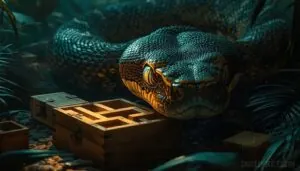
Maze tasks reveal something unexpected: your corn snake isn’t just reacting — it’s planning.
Using working memory to hold route decisions and spatial updating to track position, snakes in lab settings consistently reduce errors across repeated trials.
| Cognitive Process | Role in Maze Solving |
|---|---|
| Inhibitory Control | Resists impulsive dead-end detours |
| Cue Integration | Links landmarks to correct path choices |
| Spatial Memory | Recalls verified routes under adaptive problem solving in reptiles |
Cognitive tests confirm these aren’t flukes.
Goal-directed Behavior
Beyond route memorization, snakes demonstrate genuine goal-directed action — holding a goal representation and adjusting plans when outcomes shift. Motivational weighting drives them toward higher-value rewards faster. Outcome evaluation then refines future choices.
Watch a corn snake in cognitive tests:
- Pausing before a junction, evaluating options
- Abandoning a dead-end without repeated attempts
- Redirecting toward reward after unexpected change
- Persisting through uncertainty management until success
Prey Capture Strategies
Prey capture is where goal-directed thinking gets real. Through ambush predation, snakes apply reptile foraging strategies with surprising precision — using tail coiling strategies to lure prey, constriction mechanics to subdue it, and venom delivery timed to the target’s size.
Aquatic strike tactics and ambush positioning reflect genuine situational assessment, not reflexive.
Learning and memory shape every hunt.
How Do Snakes Use Senses?
Snakes don’t experience the world the way you do — they taste the air, feel heat signatures, and build a surprisingly detailed picture of their surroundings without relying on sight or sound. It’s a sensory toolkit that’s genuinely strange when you stop to think about it, and it plays a direct role in how they hunt, navigate, and make decisions.
Snakes taste the air, feel heat, and map their world without sight or sound
Here’s how each piece of that system actually works.
Tongue Flicking and The Jacobson Organ
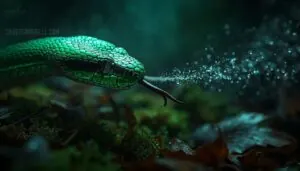
Every flick of a snake’s forked tongue is a precise act of Chemical Sampling Dynamics — not random twitching. The tongue deposits particles onto the Jacobson Organ Structure, a paired chemosensory chamber in the mouth’s roof, converting chemistry into navigation.
- Tongue Flicking Rhythm accelerates during active hunting
- Chemosensory Signal Integration blends vomeronasal and olfactory inputs
- Odor Trail Tracking guides movement through complex terrain
Heat Sensing for Hunting
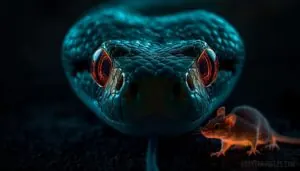
Where the tongue reads chemistry, pit organs read heat. Certain snakes — especially pit vipers — possess specialized facial receptors enabling Infrared Target Detection with exceptional precision. These organs detect Thermal Prey Cues from warm‑blooded animals nearby, supporting Nighttime Heat Tracking even in total darkness.
| Feature | Function | Ecological Benefit |
|---|---|---|
| Pit organs | Detect infrared radiation | Locate prey without light |
| Thermal Contrast Enhancement | Amplifies heat difference | Improves strike accuracy |
| Adaptive Heat Vision | Adjusts to ambient temperature | Works across varied environments |
| Bilateral sensing | Compares left/right signals | Estimates prey direction |
| Neural processing | Integrates thermal data | Guides coordinated strikes |
Research in behavioral ecology confirms this system enables precise, goal‑directed predation — a clear expression of snake cognition in action.
Sensory Input in Decision Making
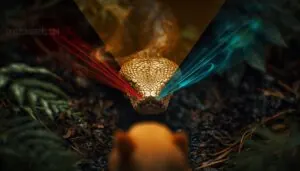
When all three senses fire at once, a snake doesn’t just react — it weighs. Multisensory weighting lets it prioritize heat over a faint scent trail when pursuing warm prey.
Hunger-driven bias sharpens that focus further, while stress-induced sensitivity heightens alertness to movement. Temporal cue integration aligns these signals in real time.
This is contextual cue modulation — the quiet engine behind every calculated strike.
Do Snakes Have Personality?
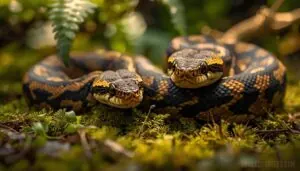
It turns out snakes aren’t as cookie-cutter as most people think — each one has its own way of moving through the world. Some are bold explorers, others hang back and play it safe, and how they handle stress or company varies just as much.
Here’s what the science actually shows about snake personality.
Boldness and Exploration Styles
Not all snakes behave the same — and that’s not random. Boldness variation among individuals is well-documented in cognitive ethology.
Bold snakes show lower neophobia levels, faster exploration pace, and broader habitat utilization, crossing exposed clearings where cautious snakes won’t venture. This risk taking isn’t reckless; it’s a stable personality trait.
Understanding personality and boldness in snakes reshapes how we think about animal cognition and learning and memory.
Social Responses to Other Snakes
solitary indifference is actually nuanced social cognition at work. Through chemical communication and signal modality — tongue flicks, body postures, subtle head tilts — snakes navigate surprisingly complex social interaction.
Den cohabitation reveals nonrandom social network structure, with gartersnakes showing consistent preferred associates across seasons.
Territorial displays remain ritualized rather than violent. Social flexibility, not isolation, defines social behavior in snakes.
Stress Reactions and Behavioral Plasticity
Even bold snakes have bad days. When acute stress hormones spike, behavioral phenotypes shift fast — decision-making accelerates but loses precision, a classic stress-induced decision shift.
Chronic stress effects run deeper, dulling learning and memory over time. What keeps snakes resilient?
- Neural plasticity mechanisms rewire responses after repeated challenges
- Contextual stress modulation shapes how social flexibility holds under pressure
- Environmental adaptation links association of stimuli and outcomes to survival
Which Snakes Seem Smartest?
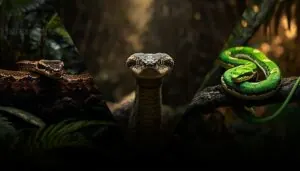
Some snake species stand out more than others when researchers put them through their paces. The evidence points to a handful of species that keep showing up in studies on learning, navigation, and social smarts.
Here’s what science has found about the ones that seem to lead the pack.
Corn Snake Learning Studies
Corn snakes (Pantherophis guttatus) have become quiet stars in comparative animal cognition research.
In structured arena trials, they demonstrated clear escape latency reduction across just four days — finding a hidden shelter faster with every session. Training session effects were consistent: errors dropped, paths shortened, and shelter cue association strengthened individual learning curves.
environmental cue integration reveals memory and navigation strategies that rival those documented in far more "celebrated" vertebrates.
Gartersnake Social Behavior
Gartersnakes don’t just tolerate each other — they organize. Butler’s gartersnakes form kinship networks anchored by female leadership, where older females guide younger individuals to refuges and foraging sites.
Age-based cohesion shapes who follows whom.
Seasonal group shifts track courtship and nesting cycles, while territorial overlap between related individuals reveals that gartersnake social behavior reflects genuine comparative animal cognition — not accidental proximity.
Pit Viper Navigation Skills
Pit vipers take snake cognition further still. Using stereo pit integration, their paired facial organs detect thermal contrasts as small as 0.001°C — effectively building a thermal landscape mapping system in real time.
Heat cue pathfinding and thermal gradient following guide them across kilometers to hibernation dens they’ve used before.
Pit-based orientation isn’t instinct alone. It’s navigational memory shaped by sensory precision.
Frequently Asked Questions (FAQs)
Will snakes recognize their owners?
Yes — through scent-based recognition, movement pattern familiarity, and temperature cue influence, your snake builds a profile of you over time. Species-specific variation means some bond faster than others.
What snake has the highest IQ?
No snake has a measurable IQ — that’s not how reptile cognition works. King Cobra cognition stands out most, given its purposeful hunting, nest-guarding behavior, and flexible problem-solving in complex environments.
Do snakes have intelligence?
Absolutely. Snakes demonstrate genuine snake intelligence through memory consolidation, ecological decision-making, and learning transfer across tasks — revealing that animal cognition in reptiles runs far deeper than most people expect.
What is the most intelligent snake?
No single species wins the crown.
King Cobra tactics, Reticulated Python planning, and Burmese Python, each reflect distinct ecological adaptation—making species cognitive ranking less about hierarchy and more about specialized, context-driven snake intelligence.
Are snakes smart?
Smart isn’t the right word — capable is.
Snakes show genuine cognitive flexibility, spatial memory, and problem-solving transfer across tasks.
Science confirms their minds are quietly refined, shaped by millions of years of evolutionary adaptations.
Are snakes intelligent reptiles?
Yes — through Behavioral Flexibility, spatial memory, and sensory integration, snakes demonstrate genuine animal cognition. Their Evolutionary Cognition reflects Environmental Complexity, making them far more capable than most people assume.
Are snakes smarter than dogs?
Comparing snakes to dogs is like measuring a scalpel against a Swiss Army knife — different tools, different jobs.
Their brain size and neural architecture reflect distinct evolutionary tradeoffs shaped by ecological demands, not a ranking of worth.
How do you know if a snake is intelligent?
You look for behavioral flexibility — does it adapt, remember, and transfer learning across new situations?
Cognitive testing, problem transfer, and learning generalization reveal far more about snake intelligence than simple reactions ever could.
Are snakes highly intelligent?
rocket scientists — but don’t sell them short.
Snakes demonstrate genuine cognitive flexibility, from remembering shelter sites to solving maze tasks. Their animal cognition quietly rivals many vertebrates that people assume are far smarter.
Are snakes smart enough to open doors?
Snakes won’t turn a knob like a raccoon might, but through gap exploitation and escape persistence, some do manipulate unsecured latches—a quiet demonstration of behavioral adaptation that surprises most keepers.
Conclusion
The animal you’ve spent years fearing may have spent that same time quietly mapping your yard, remembering where you stood, and updating its escape routes accordingly.
That’s the quiet irony at the heart of how intelligent snakes are—we underestimated a mind built from sensation, memory, and adaptive strategy.
Strip away the reflex-driven myth, and what remains is a predator doing exactly what intelligence demands: learning its world, retaining what matters, and responding with precision.
- https://docs.google.com/forms/d/1GAQr3Kn1cURCVHUA82hAga1Wv8DCH0IuqDLRUrOpN7M/viewform?ts=63f4f653&entry.1515682415=https://www.merriam-webster.com/dictionary%2Fintelligent
- https://unabridged.merriam-webster.com/check-redirect-premium?utm_source=mw&utm_medium=inline-def&utm_campaign=evergreen&headword=intelligent
- https://dictionary.cambridge.org/dictionary/english/acuity?topic=intelligence