This site is supported by our readers. We may earn a commission, at no cost to you, if you purchase through links.
Your bearded dragon sits motionless in the corner of its enclosure, refusing food for the third day straight. You check the thermometer—it reads 78°F when it should be closer to 95°F in the basking zone. This scenario plays out more often than you’d think, and the culprit is almost always inadequate temperature control.
Unlike us, reptiles can’t generate their own body heat, so they depend entirely on their environment to maintain the precise temperatures their bodies need to digest food, fight off infections, and simply move. Even a few degrees off can trigger a cascade of health problems, from respiratory infections to complete metabolic shutdown.
Getting your temperature control system right isn’t just good husbandry—it’s the difference between a thriving reptile and one that’s barely hanging on.
Table Of Contents
- Key Takeaways
- Importance of Temperature Control for Reptiles
- Types of Reptile Thermostats Explained
- Setting Up Temperature Control in Enclosures
- Top Digital Thermostat Controllers for Reptiles
- Tips for Safe and Effective Temperature Management
- Frequently Asked Questions (FAQs)
- How to regulate temperature in a reptile enclosure?
- What temperature is too hot for reptiles?
- Which controller is best for temperature control?
- Do reptiles need a heat lamp 24-7?
- Where can I buy reptile temperature controls online?
- What is the best temperature controller for reptiles?
- What is a reptile thermostat?
- Are your reptile thermostats causing problems?
- What are the best thermostats for reptiles?
- Can a reptile thermostat control humidity?
- Conclusion
Key Takeaways
- Reptiles depend entirely on external heat sources to power digestion, immunity, and movement, making precise temperature control the difference between a thriving animal and one facing metabolic shutdown or respiratory infection.
- Your thermostat choice matters—on/off models suit heat mats and tolerant species, pulse proportional units deliver tight control for sensitive reptiles, and dimming thermostats pair with basking lamps for smooth adjustments without temperature swings.
- Proper probe placement trumps expensive equipment—position sensors two to four inches from heat sources at basking level, monitor both air and surface temps, and calibrate every six months to catch drift before it harms your animal.
- Creating a thermal gradient with warm basking zones (90-120°F) on one end and cooler retreats on the other lets your reptile regulate its body temperature by moving, mimicking natural habitat conditions that prevent stress and disease.
Importance of Temperature Control for Reptiles
Your reptile’s survival depends on temperatures that mirror its natural habitat—not just close, but precise. Unlike mammals, reptiles can’t generate body heat internally, so they rely entirely on their environment to fuel digestion, immunity, and even basic movement.
Getting this precision right starts with proper sizing, so measuring your enclosure’s square footage against a snake heating pad size guide helps you avoid overheating one side while leaving the other too cold.
Setting up the right heat gradient requires choosing between under-tank heating pads, ceramic emitters, or overhead lamps—each with pros and cons depending on your snake’s species and enclosure size.
Reptiles survive only when enclosure temperatures precisely replicate their native habitat, powering every biological process from digestion to immunity
Let’s look at why getting this right isn’t optional and what happens when temperatures drift off target.
Why Reptiles Need Precise Temperature Regulation
Unlike mammals, your reptile can’t generate internal warmth—it’s entirely dependent on external heat to reach active metabolic rates. Temperature regulation drives everything from digestion to immune defense. Small shifts outside the target range trigger rapid metabolic stress and altered reptile behavior.
- Thermal gradients let your pet shuttle between warm basking zones and cooler retreats
- Precise thermal regulation facilitates consistent growth and nutrient uptake
- Temperature control prevents health risks like respiratory infections and dehydration
- Stable temps reduce stress behaviors and promote natural reptile care and maintenance
For more details on the importance of, see expert guidance on creating a safe enclosure.
Effects of Improper Temperatures on Reptile Health
When temperature control slips, metabolic damage unfolds fast. Cold slows digestion and triggers gut stasis, while excessive heat drives dehydration and kidney stress.
Temperature stress weakens immune defenses, raising reptile mortality from respiratory infections. You’ll see lethargy, appetite loss, and delayed healing—clear health consequences of thermal trauma.
Consistent reptile temperature management protects your pet’s health and wellness, preventing these serious risks in reptile care and maintenance. To effectively safeguard their health, creating a thermal gradient for reptiles so they can regulate their body temperature effectively is vital.
Understanding Thermal Gradients and Basking Zones
Your reptile won’t thrive in a uniformly heated box—it needs thermal choice. A thermal gradient offers a warm basking zone on one end and a cooler retreat on the other, letting your pet regulate its body temperature by moving.
Basking zones under heat sources hit 90 to 120°F, while microclimates across the enclosure create those life-saving temperature differences. Map both surface and air temps to guarantee proper temperature management.
Types of Reptile Thermostats Explained

Not all thermostats work the same way, and picking the wrong one can leave your reptile stuck in the cold—or worse, overheated.
The technology inside these controllers determines how they respond to temperature changes, which heat sources they pair with, and how stable your enclosure stays. Let’s break down the three main types so you can match the right thermostat to your setup.
On/Off Thermostats and Their Ideal Uses
When you’re keeping a basking bearded dragon or a corn snake that tolerates wider temperature swings, ONOFF thermostats deliver reliable reptile temperature control without overcomplicating your setup.
Here’s what makes them work:
- A simple relay system flips your heat source fully on or off when temperatures drift outside your set range
- Hysteresis control creates a stable band rather than second-by-second adjustments
- Fewer electronic components mean rock-solid reliability over years of daily cycling
- Ideal thermostat selection for beginners who want straightforward temperature management
You’ll appreciate how binary switching protects against the overcompensation issues that plague fancier controllers.
On–off thermostats deliver this reliability without risking the temperature swings that can disrupt your boa constrictor’s heating setup.
Pulse Proportional Thermostats for Sensitive Species
When you’re caring for delicate geckos or species prone to stress during shedding, pulse proportional thermostats deliver smooth temperature stability your animals actually feel.
Pulse control sends brief on-off cycles to your heat source—ceramic emitters work beautifully here—preventing the sharp swings that unsettle sensitive reptiles. After thermostat calibration, you’ll maintain precise reptile temperature control without the overshoot that simpler temperature controller models can’t avoid.
Dimming Thermostats and Heat Lamp Compatibility
Dimming controls let you fine-tune your basking zone by reducing bulb power in smooth steps from zero to full output, which keeps temperature stability locked in without abrupt shutoffs.
Use only dimmable heat lamps—halogen and infrared models work best—since regular bulbs lose heat output when dimmed. Proper thermostat selection and installation, along with careful heat lamp safety checks, prevent overheating and give you precise temperature control for reptiles.
Key Differences Between Thermostat Types
Your heat source dictates which control method works best. On/off models cycle power completely and suit heat mats or tape, while pulse proportional units send rapid energy bursts for ceramic emitters.
A dimming thermostat smoothly adjusts bulb intensity for basking lamps. Thermostat accuracy and proper sensor placement drive reliable temperature ranges, so matching controller to equipment prevents overheating and keeps your reptile comfortable.
Setting Up Temperature Control in Enclosures
Setting up temperature control isn’t just about buying a thermostat and plugging it in. You need to match your equipment to your heat sources, position your probes correctly, and verify that your readings reflect what your reptile actually experiences.
Let’s walk through the essential steps to build a reliable temperature control system that keeps your animal safe and healthy.
Choosing The Right Thermostat for Your Setup
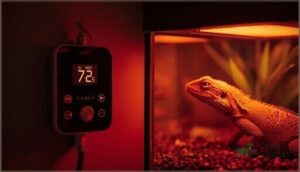
You’ll want to match your thermostat selection to both your heat source and your reptile’s temperature ranges. On/off models work great for heat mats and ceramic emitters, while a dimming thermostat pairs best with incandescent lamps.
Always verify the controller’s wattage rating covers your setup, and remember that pulse proportional units deliver the tightest control for species that can’t handle swings.
Proper Placement of Thermostat Probes
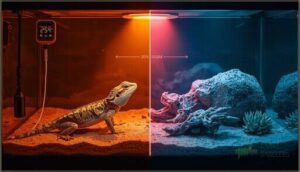
Probe placement makes or breaks your temperature control systems. Position your sensor two to four inches from the heat source on the warm side, at the animal’s basking level—not buried in substrate or pressed against glass.
Your cool-side probe should sit mid-height, away from water dishes. This thermal mapping approach gives you accurate enclosure monitoring and prevents false readings that throw off your entire gradient.
Monitoring Both Air and Surface Temperatures
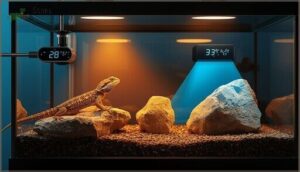
Your digital thermometer should track both readings—air and surface—because they tell different stories.
Air temperature sensors measure ambient conditions at basking height, while heat mapping with infrared tools checks actual surface temps where your reptile sits.
A temperature controller with data logging reveals drift before problems develop, giving you reliable reptile temperature management across every microclimate in your enclosure. Probe placement in multiple zones creates accurate thermal gradients.
Calibrating Equipment for Accuracy
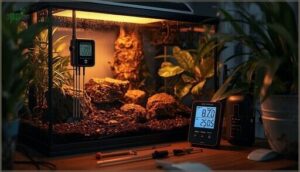
Even the best temperature controller won’t deliver reliable reptile thermostats performance without periodic calibration. Compare your sensors against a traceable reference standard every six months—NIST-certified thermometers work perfectly.
Place temperature probes where your reptile actually basks, then record as-found and as-left readings. Uncertainty analysis catches drift before it harms your animal, keeping your thermostat selection and installation decision validated long-term.
Top Digital Thermostat Controllers for Reptiles
After you’ve mapped out your enclosure’s heat zones and placed your probes correctly, you need a reliable thermostat to maintain those precise temperatures your reptile depends on.
The market offers dozens of digital controllers, but not all deliver the accuracy and durability serious keepers require. We’ve tested the top models that consistently hold tight temperature ranges, resist calibration drift, and won’t fail when your animal needs stable conditions most.
1. Digital Temperature Controller Thermostat
You can convert a standard freezer into a reliable reptile refrigerator or fine-tune your vivarium’s climate with a digital temperature controller thermostat. These units use sensors and microprocessors to compare your enclosure’s actual temperature against your setpoint, then send control signals to heaters or cooling elements.
Most offer adjustable hysteresis to prevent rapid cycling—vital for equipment longevity. Look for accuracy within ±0.5 to ±2.0 degrees Celsius, intuitive digital displays, and compatibility with heat mats or lamps.
| Best For | Hobbyists and home users who want to repurpose freezers for reptile care, fermentation projects, or greenhouses and need dual heating/cooling control without a steep learning curve. |
|---|---|
| Temperature Range | Not specified |
| Voltage | 110-240V |
| Max Power | Not specified |
| Probe Included | Yes |
| Display Type | Digital (°C/°F) |
| Material | Plastic |
| Additional Features |
|
- Handles both heating and cooling equipment at once, so you can maintain precise temperature ranges for reptiles, brewing, or plant propagation
- Built-in compressor delay and high/low alarms protect your gear and prevent costly temperature swings
- Compact design with Celsius/Fahrenheit switching makes it versatile for different projects and easy to mount anywhere
- Temperature probe can’t be replaced if it fails, meaning you’d need to buy a whole new unit
- Menu labels and instructions are often confusing, so many users end up watching YouTube tutorials to get it working
- Ships with Celsius as the default, which adds an extra setup step if you prefer Fahrenheit
2. Willhi Digital Temperature Controller Thermostat
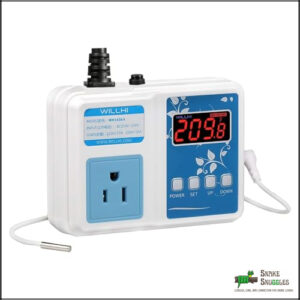
The Willhi WH1436A delivers reliable control without breaking the bank. This 10-amp unit controls heat mats, small ceramic emitters, and low-wattage lamps across a wide minus 58 to 230°F range.
You get fine 0.1-degree resolution and ±0.5°F accuracy—tight enough for basking zones. The 9.8-foot waterproof probe reaches deep into enclosures, so you can monitor surface temps directly.
We appreciate the heating and cooling modes, customizable hysteresis, and settings that survive power outages. Just confirm your equipment stays under 1100 watts.
| Best For | Reptile keepers who need precise temperature control for basking spots, heat mats, or ceramic emitters in small to medium enclosures without exceeding 1100 watts. |
|---|---|
| Temperature Range | -58 to 230°F |
| Voltage | 110V |
| Max Power | 1100W |
| Probe Included | Yes (3m waterproof) |
| Display Type | Digital (°C/°F) |
| Material | Plastic |
| Additional Features |
|
- Wide temperature range (-58 to 230°F) with tight 0.1-degree resolution handles everything from cool-side monitoring to basking zone control
- Long 9.8-foot waterproof probe lets you measure surface temps exactly where your reptile sits, not just ambient air
- Dual heating and cooling modes plus memory backup mean your settings survive power outages and you can adapt to seasonal needs
- 10-amp limit (1100W at 110V) won’t handle high-wattage heat lamps or multiple devices without an additional relay
- Sensor placement takes trial and error—direct sunlight or ground contact throws off readings fast
- Plastic case yellows over time, and the interface isn’t the most intuitive if you’re new to digital controllers
3. Vivosun Digital Heat Mat Thermostat Controller
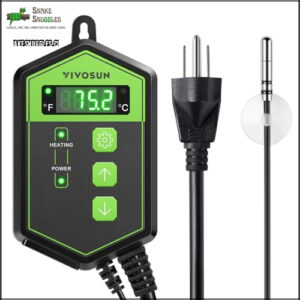
If you’re looking for simple control, the VIVOSUN thermostat controls heat mats from 40 to 108°F with straightforward three-button operation. You’ll appreciate the fortified plastic build and included sensor probe that tracks substrate temps in real time.
The 1000-watt capacity covers most under-tank heaters, and auto-restart kicks in after power blips. Just know that readings can swing 4 to 5°F around your set point—fine for seedlings, but tighter basking zones may need supplemental monitoring.
| Best For | Home gardeners and reptile owners who need affordable temperature control for seedlings, propagation, or basic terrarium heating and don’t mind a few degrees of fluctuation. |
|---|---|
| Temperature Range | 40 to 108°F |
| Voltage | 110V |
| Max Power | 1000W |
| Probe Included | Yes |
| Display Type | LCD |
| Material | Plastic |
| Additional Features |
|
- Three-button interface makes setup quick and uncomplicated, even for first-time users
- Sensor probe gives you direct substrate readings instead of just ambient air temperature
- Auto-restart function means you won’t lose your settings after brief power outages
- Temperature can drift 4–5°F from your target, which may not work for species with strict heat requirements
- Some users experienced LCD failures or inaccurate readings over time
- Controls only one heat mat per unit, so multiple setups require buying additional thermostats
4. Bayite Digital Temperature Controller Thermostat
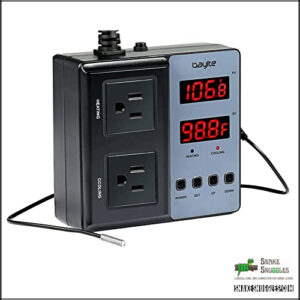
The Bayite BTC201 brings dual-relay muscle to your setup—one channel heats, the other cools, so you’re covered from 40°F night drops to 95°F basking peaks.
You’ll see both current and target temps on the twin display, and the 1100-watt capacity accommodates most heat mats or ceramic emitters without breaking a sweat.
High and low alarms catch runaway temps before they stress your gecko, though you’ll want to cross-check readings with an infrared gun since some keepers report 2 to 3°F drift.
| Best For | Keepers who need both heating and cooling control in one unit and want visual confirmation of current versus target temps at a glance. |
|---|---|
| Temperature Range | -58 to 230°F |
| Voltage | 110-240V |
| Max Power | 1100W |
| Probe Included | Yes |
| Display Type | Dual display |
| Material | Plastic |
| Additional Features |
|
- Dual relay lets you run a heat source and cooling device from a single controller, perfect for fluctuating room temps
- Twin display shows real-time and set-point side by side, so you’re never guessing whether the system is working
- High and low alarms catch dangerous temperature swings before they harm your gecko
- Only one set point means you can’t program different day and night temps—you’ll adjust manually or add a timer
- Some users report 2–3°F drift from actual temps, so verify with an infrared thermometer gun before trusting it completely
- No WiFi or app connectivity, so remote monitoring requires a separate smart plug or camera setup
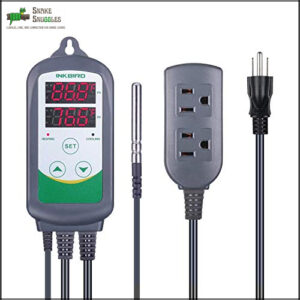
5. Inkbird Heat Mat Temperature Controller
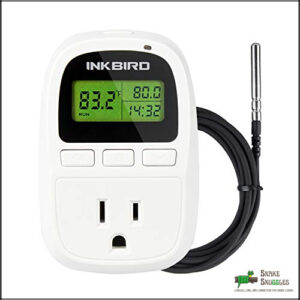
The Inkbird IPT-2CH delivers dual outlets that let you run two heat mats independently—each up to 250 watts—so you can dial in separate temperatures for a basking zone and a cooler retreat.
Two probes track conditions in real time, and the straightforward plug-and-play setup means you’re heating within minutes. The waterproof build tolerates humid enclosures without flinching, and optional Wi-Fi alerts you to temperature swings before they become problems.
Some models log data hourly, giving you a window into overnight trends.
| Best For | Reptile keepers running multiple heat mats who need independent temperature zones for basking and cooling areas. |
|---|---|
| Temperature Range | -58 to 212°F |
| Voltage | 110V |
| Max Power | 1500W |
| Probe Included | Yes (waterproof IP68) |
| Display Type | Triple display |
| Material | Not specified |
| Additional Features |
|
- Dual outlets let you control two heat mats separately, each handling up to 250 watts for custom heating zones
- Waterproof probes hold up in humid terrariums without degrading or shorting out
- Wi-Fi alerts catch temperature problems before they harm your animals
- Setup instructions can be confusing and take trial-and-error to get right
- Some units fail prematurely or arrive defective, requiring replacements
- The 1500-watt total cap limits you to smaller heating equipment only
6. Hydrofarm Digital Thermostat Controller
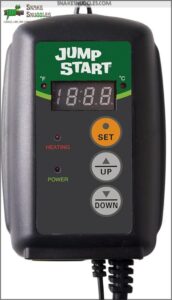
The Hydrofarm MTPRTC spans 68 to 108°F, covering everything from cool-side retreats to warm germination spots. You get a water-resistant stainless steel probe that reads surface and substrate temperatures accurately, plus an LED indicator that glows when the mat’s heating.
Setup takes minutes—plug in your heat mat, position the probe near your reptile’s belly zone, and set your target. The compact design tucks under terrariums without hogging space, and ETL certification means it won’t turn into a fire hazard.
| Best For | Reptile owners, plant growers, and homebrewers who need precise temperature control between 68°F and 108°F without breaking the bank. |
|---|---|
| Temperature Range | 68 to 108°F |
| Voltage | 110V |
| Max Power | Not specified |
| Probe Included | Yes (6′ water-resistant) |
| Display Type | Digital LED (°C/°F) |
| Material | Plastic |
| Additional Features |
|
- Wide temperature range (68-108°F) works for everything from cool zones to warm germination setups
- Water-resistant probe and ETL safety certification mean you can trust it near moisture and heat
- Dead-simple setup—plug in, position the probe, set your temp, and you’re done in minutes
- Bulky design doesn’t win any beauty contests and can look clunky under smaller terrariums
- Heavy cord tends to pull the unit off surfaces if you don’t secure it properly
- Probe placement is finicky—put it in the wrong spot and your readings will be off
Tips for Safe and Effective Temperature Management
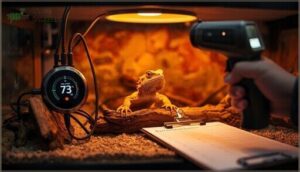
Once you’ve picked the right thermostat and set up your equipment, the real work is keeping your reptile safe day in and day out. Even the best gear won’t protect your animal if you skip routine checks or ignore warning signs.
We’re covering the essential habits that prevent burns, manage complex setups, and keep everything running smoothly for years.
Preventing Overheating and Burns
Overheating Control starts with Heat Source Safety fundamentals you can’t skip. Place heating elements on nonflammable surfaces and install protective guards to prevent direct contact burns.
Your Reptile Thermostats should include remote alarms that alert you when temps spike beyond safe thresholds. For Burn Prevention, monitor surface temps twice daily using dual thermometers—air and substrate readings together reveal dangerous hot spots before they harm your animal.
Managing Multiple Heat Sources
When you’re running basking lamps alongside Ceramic Heat Emitters or heat mats, Heat Source Prioritization keeps your Reptile Thermostats from fighting each other. Set your primary source—say, a basking lamp—to handle daytime warmth, then let secondary units kick in only during peak demand.
Multi Zone Control and Thermostat Calibration prevent overlap that causes temperature swings. Stagger your Heating and Cooling Solutions for true Energy Efficiency Optimization across Climate Control Systems.
Integrating Humidity and Lighting Control
Your Climate Control Systems work best when Humidity Sensors and Lighting Cycles sync up in one Automation System. We absolutely love centralized Environmental Control Systems that coordinate misting with daytime photo periods—your reptile sees natural climate cues without you flipping switches.
Place Humidity Management sensors mid-height away from misters, calibrate them monthly, and let Environmental Monitoring track patterns. Automated Habitat Control prevents overwatering while Temperature Control Systems hold steady gradients.
Regular Maintenance and Troubleshooting
Even the best Temperature Control Systems need regular care. Check your Thermostat probes every two weeks—dust throws off readings fast. Log daily temperatures to catch drifts beyond ±2 degrees, and test Sensor Troubleshooting routines monthly.
Inspect cords for fraying during Electrical Safety Checks, calibrate sensors quarterly, and document everything. Power Outage Protocols and smart Maintenance Scheduling keep Reptile Thermostats reliable year-round.
Frequently Asked Questions (FAQs)
How to regulate temperature in a reptile enclosure?
You’ll need a quality thermostat connected to your heat source, with the probe positioned near the basking spot to monitor surface temps and maintain a thermal gradient across your reptile enclosure.
What temperature is too hot for reptiles?
Prolonged exposure above 120°F can cause reptile burns and heat damage. Most species face heat stress beyond 105°F without a cooler zone.
Your thermostat prevents these thermal limits from being exceeded in any enclosure.
Which controller is best for temperature control?
Imagine a conductor orchestrating perfect harmony—that’s your thermostat’s job.
Pulse proportional models win for sensitive species because they deliver gradual power adjustments, maintaining temperature accuracy within tenths of a degree without harsh cycling.
Do reptiles need a heat lamp 24-7?
No, you don’t need a heat lamp running constantly.
Most reptiles thrive with day-night thermal cycles—basking zone warmth during the day, then cooler nighttime temps managed by your thermostat controller.
Where can I buy reptile temperature controls online?
The right gear is just a click away. You’ll find reptile thermostats at specialized reptile stores, major ecommerce platforms, pet supply sites, and manufacturer sites—brands like VIVOSUN and ReptiTemp Digital Thermostat ship directly.
What is the best temperature controller for reptiles?
The best temperature controller for reptiles depends on your heat source.
Inkbird models offer Wi-Fi monitoring and alarms, while Vivosun excels with heat mats. Pulse proportional thermostats suit sensitive species best.
What is a reptile thermostat?
A reptile thermostat is a temperature controller that uses sensors to regulate heat sources in your enclosure, automatically adjusting output to maintain safe, species-specific ranges your reptile needs for health.
Are your reptile thermostats causing problems?
When your setup suddenly overheats or cycles erratically, suspect probe placement errors, calibration drift, or incompatible heat sources—common thermostat malfunctions that demand immediate sensor calibration and equipment checks.
What are the best thermostats for reptiles?
You’ll find excellent temperature controller options in the Willhi, Inkbird, and Vivosun models—each offers reliable heat source regulation with clear displays and accurate temperature sensors that simplify thermostat selection and installation.
Can a reptile thermostat control humidity?
Most standard reptile thermostats monitor temperature only—they won’t control humidity.
You’ll need a separate hygrometer and hygrostat to manage moisture levels, though some sophisticated units combine both functions in one device.
Conclusion
Here’s the truth: your reptile temperature control setup is crucial. There’s no margin for error when a cold-blooded animal can’t regulate its own warmth.
The thermostat you choose, the probe placement you verify, and the gradients you maintain—these aren’t optional extras. They’re lifelines.
Get the temperatures right, and everything else falls into place. Miss the mark by even five degrees, and you’re fighting an uphill battle you didn’t need to face.