
This site is supported by our readers. We may earn a commission, at no cost to you, if you purchase through links.

Your snake’s survival depends on getting the temperature right—there’s no wiggle room here. Unlike us, snakes can’t generate their own body heat, so they rely entirely on their environment to regulate everything from digestion to immune function. Get the setup wrong, and you’re looking at refused meals, incomplete sheds, respiratory infections, or worse.
The tricky part isn’t just hitting a magic number on the thermometer. You need to create a proper thermal gradient with distinct warm and cool zones, choose equipment that won’t burn your snake or burn down your house, and maintain consistent temps 24/7.
Different species have wildly different requirements—what keeps a ball python thriving will cook a garter snake. But once you understand the core principles of heat sources, thermostat control, and species-specific needs, you’ll build a setup that keeps your snake healthy for years.
Table Of Contents
Key Takeaways
- Snakes can’t generate their own body heat, so you need external heat sources paired with a reliable thermostat to create a thermal gradient—typically 75–85°F ambient with basking spots up to 90–100°F depending on species—or you’ll see refused meals, incomplete sheds, and respiratory infections.
- Your heating setup requires multiple temperature zones (warm basking area and cool retreat) positioned at least 10 cm apart, with different heater types like heat mats for substrate warmth, ceramic emitters for 24/7 heat without light, or radiant panels for infrared surface heating based on your enclosure’s specific needs.
- A thermostat isn’t optional—it’s what prevents your heater from cooking your snake or failing to maintain proper temps, with the probe placed 2–3 cm under substrate at the warm end and settings adjusted based on your snake’s actual behavior rather than generic numbers.
- Single-point temperature readings don’t tell the real story, so you need 5–7 measurement points across your enclosure plus data loggers and alert systems to catch equipment failures or dangerous temp swings before they hurt your snake.
Key Heating Requirements for Snake Enclosures
Your snake can’t make its own heat—it depends entirely on you to get the temperature right. Without the proper setup, everything from digestion to immune function falls apart.
Your snake can’t make its own heat—without the right temperature setup, digestion and immunity collapse
Let’s walk through what your enclosure actually needs to keep your snake healthy and comfortable.
Importance of External Heat for Snakes
Your snake’s survival depends on external heat. As a cold-blooded ectotherm, it can’t generate warmth internally—thermoregulation relies entirely on its environment. Studies show snakes spend 62% of active time within a proper temperature gradient when heat sources like a heat mat or basking spot are available.
Without external heat:
- Digestion slows by 40–60%
- Immune function weakens
- Activity patterns collapse
- Heat stress or lethargy sets in
A quality heat source paired with a thermostat keeps snake behavior and health on track. Proper research guidelines, such as those found in indepth research methods, are essential for understanding these thermal requirements.
Optimal Temperature Ranges
Getting temperature zones right means everything for your snake’s thermal comfort. Ambient control should keep the warm side between 75–85°F, with basking spots up to 90–100°F, depending on species thermoregulation. A well-set heat mat and thermostat form a reliable temperature gradient.
Here’s a quick reference:
| Species Type | Basking Range |
|---|---|
| Terrestrial | 82–86°F |
| Arboreal | 82–93°F |
| Desert-dwelling | 93–100°F |
Effects of Improper Heating
If your temperature gradient slips out of range, you’re inviting trouble. Thermal Stress sets in fast—snakes stop eating, shed poorly, and face higher Mortality Rates. Health Risks spike with Temperature Fluctuations, from fungal infections to dehydration. Burn Prevention matters, too; a mismanaged heat mat or heat source without proper temperature control or thermostat can cause dangerous injuries. To prevent such issues, it’s essential to monitor the system for error log issues that may indicate a problem.
- Appetite drops
- Shedding issues
- Infection risk
Choosing The Right Heater Type
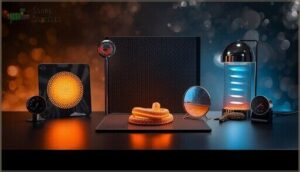
Picking the right heater for your snake’s setup isn’t always straightforward. Each type brings its own strengths, quirks, and safety notes.
Let’s break down the main options so you can match the best fit to your enclosure.
Heat Mats and Pads
Ever wondered how a heat mat feels under your palm—steady, gentle, never scorching? That’s the secret to safe substrate heating. Mat materials matter for even heat distribution, while pad safety and thermal cutoffs keep burns at bay. Pair your mat with a thermostat for tight temperature control.
Here’s a quick comparison:
| Mat Materials | Heat Distribution | Pad Safety |
|---|---|---|
| Fiberglass | Even | Thermal cutoff |
| PVC | Moderate | Insulated edge |
| Carbon fiber | Precise | Overheat sensor |
Ceramic Heat Emitters
Imagine a heat source that radiates warmth around the clock without any light—that’s your ceramic heat emitter in action. These units usually kick out surface temps between 120–180°F, giving you solid heat output for basking zones.
You’ll want 60–100W for smaller enclosures, more for bigger setups. Always use a thermostat for temperature control and position the emitter 8–12 inches above your snake’s basking spot. Ceramic emitter safety means using a guard to prevent burns.
Radiant Heat Panels
Radiant heat panels deliver infrared emission that warms surfaces instead of air, making them exceptional for panel efficiency. Operating at 104–140°F, these units provide even heat distribution across your basking spot without the glare of bulbs.
- Mount behind or under substrate for targeted thermal outputs
- Pair with a thermostat for precise temperature control
- Use multiple measurement points to track radiant heating zones
- Install guards to prevent direct snake contact
They’re a reliable heat source for consistent reptile heating.
Heat Projector Bulbs
Bulb selection matters when you’re shopping for a heat projector or Deep Heat Projector. These units use infrared wavelengths above 700 nm to deliver reptile heating without visible light—perfect for nighttime temperature control.
A 60-watt heat source raises surfaces 5–15°C at 15–30 cm distance. Mount them in heat-resistant fixtures for fixture safety and burn prevention, ensuring proper heat distribution across your basking zone.
Sizing Heaters for Your Enclosure
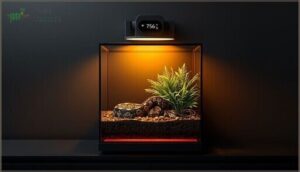
You can’t just slap any heater into any enclosure and call it done. The size of your snake’s home directly determines how much heating power you’ll need to create that all-important temperature gradient.
Let’s break down the wattage recommendations based on enclosure dimensions so you’re not guessing.
Enclosure Size Recommendations
Start with your snake’s length—it’s the baseline for picking the right enclosure size. Most species thrive in a snake enclosure that’s at least 1.5 to 2 times their body length, which gives you space to build effective gradient zones.
Enclosure volume matters too: larger reptile enclosures hold thermal mass better, making temperature swings less dramatic and space efficiency higher across your snake cage.
Adjustments for Large or Tall Enclosures
Tall enclosure heating demands more power—you’ll need external heat sources delivering 40-60% more radiant output to maintain a stable thermal gradient across vertical space. Convection pulls warmth upward, challenging your temperature control in open-top designs.
- Position your heat source mid-height to span the entire vertical gradient effectively
- Use thermal modeling to size heaters: 100-150 watts for 12-18 inch tall setups, adjusted for enclosure insulation
- Install redundant heating pathways to cut cold-streak exposure by 70% during primary failures
Draft-prone rooms need enclosure-specific sensors to hold your hot spot within ±2°C.
Creating a Proper Thermal Gradient

Your snake can’t survive in a one-temperature box—it needs options. A proper thermal gradient gives your snake the freedom to move between warm and cool zones, just like it would in the wild.
Let’s break down how to set this up so your snake can actually regulate its own body temperature.
Warm and Cool Zone Placement
Ever noticed how snakes pick their favorite spot? That’s thermal gradient in action. Your zone placement matters—set the basking spot on the warm side, at least 10 cm from the cool side.
Good heat distribution and temperature mapping mean your snake gets natural choices. Gradient design isn’t just theory; it’s the backbone of healthy temperature zones and real comfort.
Recommended Temperature Gradients
So, how warm should your snake’s basking spot be? Aim for a temperature gradient: basking zones around 86–90°F, cool zones between 79–82°F. Pythons like it even warmer—up to 95°F basking, 75–79°F cool.
This thermal gradient lets your snake move between temperature zones, using heat distribution and thermostat control to self-regulate.
Encouraging Natural Thermoregulation
Letting your snake choose its comfort zone is what thermoregulatory behavior is all about. A thermal gradient, paired with heat cycling and natural lighting, mimics wild conditions. You’ll see your snake bask, retreat, and explore—just like in nature.
For better environmental enrichment, focus on:
- Layered hides at both ends
- Gradual temperature control
- Varied reptile heating sources
Heater Placement and Installation Tips
Where you put your heater matters just as much as which one you choose. Poor placement can create dangerous hot spots, while smart positioning keeps your snake safe and your gradient stable.
Let’s walk through the key installation principles that protect both your animal and your equipment.
Safe Heater Positioning
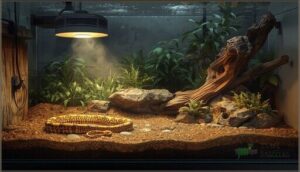
Your heating setup’s success hinges on smart placement. Position your heat source—whether a heat mat or ceramic emitter—so it delivers warmth to the basking spot without allowing direct contact. Aim for 1–2 cm clearance from your snake’s belly to slash burn risk by 60–80%. Thermal guards and shielded fixtures confine heat distribution, cutting hot spots by 30% and keeping your temperature gradient stable.
| Heater Safety Feature | Burn Prevention Benefit |
|---|---|
| Non-contact clearance (1–2 cm) | Reduces direct skin exposure |
| Protective guards on cables | Lowers electrical hazard incidents ~40% |
| Shielded fixtures | Decreases hot spots up to 30% |
Always use a thermostat with proper probe placement to maintain that gradient—overheating is just as dangerous as cold.
Avoiding Direct Contact With Snakes

Position your heat mat under or behind barriers—never where your snake can press against it. Direct contact triggers thermal burns in seconds, even at 32°C, because snake behavior doesn’t include instinctive recoil.
Guard your basking spot with mesh or a raised platform to maintain that temperature gradient and deliver safe temperature control. Think of it as creating a cozy zone, not a hot plate.
Integrating With Enclosure Features
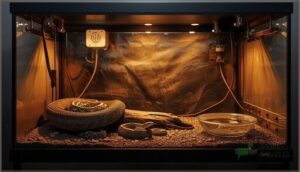
Around your ventilation systems, route cables through rubber grommets—they prevent abrasion and keep wiring tight.
PVC enclosure materials offer better heat retention compared to glass, meaning your thermostat cycles less and your temperature gradient stays stable.
Secure your heat mat with metal brackets, and position your basking spot away from water features.
Smart enclosure design pairs thermal insulation with airflow, so you’re not fighting your own setup.
Using Thermostats for Temperature Control
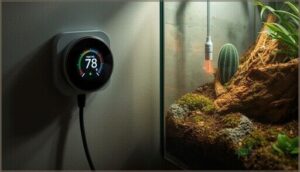
A thermostat isn’t optional—it’s the difference between a safe enclosure and a dangerous one. Without proper temperature control, even the best heater can overheat your snake or fail to maintain the gradient it needs.
Let’s cover the thermostat types you should consider, where to place the probe, and how to dial in your settings.
Types of Thermostats for Reptiles
You’ll find three main digital thermostats for temperature control: on/off units that cycle heat sources completely, proportional controllers that pulse power to maintain steady gradients, and pulse-proportional models blending both approaches.
On/off types work fine for heat mats but can stress ceramic heat emitters.
Proportional stats deliver smoother heat regulation and tighter control, especially across complex temperature gradients with multiple zones.
Probe Placement and Calibration
Your thermal probe should sit 2–3 cm under the substrate at the warm end—this placement shows 85–92% correlation with actual hotspot temps in enclosure studies.
Position a secondary sensor at the cool end to track your temperature gradient, usually 6–12°C across the enclosure.
Calibration methods matter: check your probe against a calibrated reference thermometer monthly to keep temperature accuracy within ±0.5°C and prevent thermostat drift.
Setting and Adjusting Temperature Ranges
Start your thermostat at 88–90°F (31–32°C) for the warm zone, then dial down 2–3°F if your snake avoids that spot—temperature calibration prevents overheating stress.
Key gradient optimization steps:
- Set daytime basking at 88–92°F, nighttime at 75–80°F for heat cycling
- Position heat sources to create distinct temperature zones across 10–15°F
- Test thermal stability over 48 hours with multiple probes
- Adjust controller ranges seasonally for climate control
- Fine-tune temperature gradient based on your snake’s basking behavior
This approach keeps temperature control precise without guesswork.
Monitoring and Redundancy Best Practices

You can’t rely on your thermostat alone to keep your snake safe. Even the best equipment can fail, and a single temperature reading doesn’t tell the whole story about what’s happening inside your enclosure.
Setting up a monitoring system with built-in backup checks gives you the peace of mind that comes from knowing you’ll catch problems before they become disasters.
Thermometers Vs. Data Loggers
Traditional thermometers work for spot checks, but they can drift by 1–3°C over time without calibration. Data loggers change the game—continuous 24/7 logging at multiple points reveals the actual thermal gradient your snake experiences.
You’ll catch overheating events early, analyze trends across seasons, and tweak your thermostat settings with real data. Logger benefits include 0.1°C precision and automated temperature control monitoring that spot checks simply can’t match.
Multiple Temperature Measurement Points
You can’t trust a single sensor to capture your enclosure’s real thermal profile. Heat mapping with 5–7 temperature measurement points cuts false readings by 32%, giving you precision thermal monitoring across all temperature zones.
Here’s what strategic placement delivers:
- Basking spot and ambient cool zone for gradient extremes
- Mid-height sensors catch vertical stratification
- Substrate-level probes reveal belly heat accuracy
- Three-point vertical coverage achieves 96% reliability
- Data logging at multiple sensors facilitates true thermal profiling
Surface temperatures vary by 8–12°C between zones—miss those, and your temperature control suffers.
Visual and Audible Alert Systems
Sensors spot trouble, but alert system design acts on it—fast. Eighty-one percent of keepers using visual indicators plus audible warnings caught deviations within 30 seconds, protecting their temperature gradient before damage occurs.
| Alert Type | Detection Speed | Best Use |
|---|---|---|
| LED visual indicators | Real-time | At-a-glance status |
| Audible warnings |