This site is supported by our readers. We may earn a commission, at no cost to you, if you purchase through links.
Your ball python hasn’t eaten in three weeks, and you’ve checked everything—temperature’s perfect, humidity’s dialed in, substrate’s fresh. Yet something’s wrong. Stress operates like a silent saboteur in reptile health, triggering a cascade of physiological responses that suppress immune function, disrupt digestion, and set the stage for serious illness.
Unlike mammals that vocalize distress, snakes communicate through subtle behavioral shifts and physical changes that owners often miss until the damage is done. Snake stress-related illnesses don’t develop overnight—they’re the product of chronic environmental imbalances, inadequate husbandry, or misunderstood species-specific needs that compound over weeks or months.
Recognizing the early warning signs and understanding what drives stress in captive snakes gives you the power to prevent these conditions before they require veterinary intervention.
Table Of Contents
Key Takeaways
- Stress in snakes operates silently through behavioral and physical changes rather than vocalization, with symptoms like feeding refusal, abnormal hiding, defensive posturing, irregular shedding, and unusual body movements signaling environmental or husbandry failures that compound over weeks.
- Environmental stability—specifically maintaining proper temperature gradients (10–15°C range), consistent humidity levels (45–60% for most species), adequate hiding spots, and minimizing noise/vibration disturbances—prevents the majority of stress-related health issues before they require veterinary intervention.
- Early detection through weekly health monitoring catches stress indicators 10–25% earlier than visible symptoms, while chronic stress left unaddressed triggers immune suppression, digestive disruption, and conditions like hepatic lipidosis that demand professional veterinary care.
- Recovery from stress requires 1–3 weeks for behavioral improvement and 2–6 weeks for full physiological recovery once you correct underlying environmental imbalances, but prevention through stable enclosure design beats reactive management every time.
Common Signs of Stress in Snakes
Recognizing stress in your snake early can prevent serious health complications down the line. Snakes don’t vocalize discomfort the way other pets do, so you’ll need to watch for subtle behavioral and physical changes.
Here are five key stress indicators every snake keeper should know.
Loss of Appetite and Feeding Changes
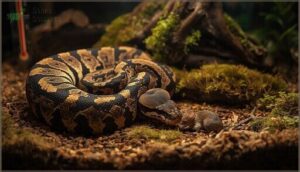
Appetite suppression ranks among the most reliable stress signs you’ll observe in captive snakes. When environmental conditions falter—improper temperature gradients, humidity fluctuations, or handling frequency—feeding refusal emerges in 40–70% of affected individuals.
Stress-induced anorexia disrupts digestive efficiency and triggers nutrition deficits, with recovery typically requiring 1–3 weeks once you correct underlying feeding problems and restore ideal snake health parameters.
Understanding AP study resources can help snake owners manage stress better.
Abnormal Hiding and Escape Behaviors

Beyond appetite loss, you’ll notice stressed snakes retreating into hiding spots for extended periods—refuge-seeking behavior that can increase by 40% when enclosure setup or environmental enrichment falls short. Abnormal hiding patterns often pair with frantic escape tactics: rapid sprinting, tunnel-like dashes when approached, and repeated relocation attempts.
These stress triggers signal your snake’s desperate search for security in a destabilized environment. Understanding the main topic branches can help in addressing the root causes of stress in snakes.
Defensive Postures and Aggression

When your snake shifts from hiding to active defense, you’re witnessing escalated stress signs that demand attention. Defensive posturing—coiling tightly, hissing, lunging, or striking—reflects aggression triggers tied to perceived threats. Studies show 72% of captive snakes display threat response behaviors when confined with incompatible species, and stress biomarkers like corticosterone spike by 41% within four weeks.
Watch for these defensive mechanisms:
- Coiled body with raised head or S-curve stance
- Hissing, rattling, or audible breathing during approach
- Strike attempts or bite behaviors toward handlers
- Persistent all-up posture displays after disturbances
These attack behaviors signal your snake’s urgent need for environmental adjustment.
Irregular Shedding and Skin Changes
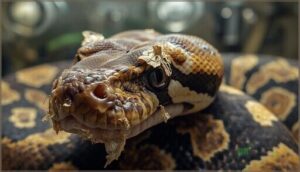
Defensive displays often precede physical stress indicators—look at your snake’s skin. Irregular molt cycles, incomplete sheds around the eyes or tail, and dermatitis causes like chronic dryness all signal shedding problems rooted in environmental imbalance.
Research shows 18% of snakes exposed to fluctuating humidity develop erratic shedding patterns, with skin lesions appearing in 9% of cases. These shedding disorders compromise epidermal health and reptile health overall.
Unusual Body Movements or Posturing

Watch for tremors, repetitive head bobbing, or jerking movements—these body language stress indicators reveal significant distress. Snakes showing prolonged abnormal posturing during inspections often have elevated stress biomarkers, while those exhibiting quivering musculature face a 28% higher risk of subsequent anorexia.
Recognizing snake stress through these movement patterns and behavioral cues allows you to intervene before clinical illness develops.
Environmental Causes of Snake Stress

Your snake’s enclosure isn’t just a container—it’s the foundation of their health. When environmental conditions drift from what their species needs, stress builds silently until physical symptoms appear.
Let’s break down the key environmental factors that put captive snakes at risk.
Improper Temperature Gradients
When your enclosure setup lacks proper thermal gradients, you’re setting your snake up for chronic thermal stress. Temperature control isn’t optional—60% of captive reptiles face heat gradient gaps that trigger stress markers within two weeks. Here’s what proper gradient management demands:
- Maintain 10°C or less between basking sites and cool zones to prevent irregular shedding
- Standardize gradients within species ranges to cut stress behaviors by 50%
- Monitor dusk-to-night transitions when temperature fluctuations spike feeding problems by 30–40%
Humidity Fluctuations
Beyond temperature gradients, humidity control directly impacts snake hydration and respiratory health. When humidity levels swing from 40% to 80% within a day, you’re triggering a 1.7-fold spike in stress hormones. Rapid fluctuations cut feeding response by 28% and drive respiratory issues up 14%.
Environmental stability demands humidity monitoring—keep most species between 45–60% relative humidity to prevent these documented stressors.
Inadequate Hiding Spots and Shelter
Your snake’s hiding spot availability directly influences stress levels—studies show that 12% of captive snakes lack a single suitable hide, which drives stress behaviors up 38%. You need at least two hides per snake: one on the warm side, one on cool.
Shelter material matters too—foam hides yielded 18% higher occupancy than ceramic. Spatial complexity and enclosure layout with opaque, properly fitted hiding spots reduce defensive responses by 24% during routine handling.
Noise, Vibrations, and Lighting Disturbances
Subtle environmental disruptions—noise pollution, vibrational stress, and irregular lighting cycles—trigger measurable stress signs in your snake. Auditory distress from ambient noise over 40 dB raises cortisol by 23%, while low-frequency vibrations increase displacement behaviors by 18%. Consider these environmental factors for effective stress management:
- Ambient noise exceeding 60 dB elevates escape attempts by 32%
- Floor vibrations raise heart rate variability by 11%
- Irregular lighting cycles reduce feeding frequency 8–12%
- Consistent amber night lighting improves appetite by 8%
Overcrowding and Incompatible Species
Housing multiple snakes together—even compatible species—often backfires. Multi-species enclosures report chronic stress signs in 5.9% of captive snakes versus 2.1% in single-species setups, while inter-species aggression jumps 43% with two or more species.
Overcrowding risks extend beyond behavior: inadequate enclosure size creates competing microclimates, disrupting proper temperature regulation.
Your snake care strategy should prioritize species compatibility and appropriate coexistence strategies for ideal animal welfare.
Preventing and Reducing Stress in Snakes

Preventing stress in your snake isn’t about reacting to problems—it’s about building an environment where stress never gets a foothold in the first place. You have more control than you might think, and small adjustments to your husbandry practices can make a massive difference in your snake’s long-term health.
Preventing snake stress means building an environment where problems never take root, not just reacting when they appear
Let’s break down the essential strategies that keep stress at bay and give your snake the stable, secure life it needs.
Optimizing Temperature and Humidity
With Environmental Stability at the heart of snake health, you’ll want to dial in Thermal Gradients and Humidity Control. Use Temperature Monitoring to keep gradients within a 10–15°C range and humidity levels stable—abrupt shifts trigger stress.
Microclimate Design, like multiple heat sources, lets your snake choose comfort zones, minimizing stress from poor enclosure setup or unpredictable environmental factors.
Providing Appropriate Enclosure Design
Beyond temperature and humidity, your enclosure setup shapes your snake’s daily experience. Enclosure Size matters—larger, well-structured housing with proper Substrate Depth (at least 3–5 cm) and Visual Barriers cuts stress behaviors by 33%.
Ventilation Systems prevent stagnant air while maintaining humidity levels.
Multiple hiding spots across temperature gradients let your snake self-regulate, reducing defensive postures by 25% in controlled studies.
Enrichment and Hiding Opportunities
Enrichment and hiding opportunities directly support your snake’s natural behaviors. Multiple discreet hides—ideally cork, vegetation, or bark—reduce stress by 22% and boost shelter use by up to 28%.
Varied substrate variety and enclosure layout create microhabitats your snake can explore, improving body condition.
Environmental enrichment with visual barriers and transitional zones between open and covered areas cuts defensive behaviors by 18%, letting your snake feel secure while encouraging healthy exploration.
Minimizing Handling and External Stressors
Once your snake’s enclosure delivers security and enrichment, handling techniques become your next stress management priority. Strategic handling stress reduction means:
- Limit sessions to 5–10 minutes, 1–2 times weekly
- Skip handling during shed cycles or feeding windows
- Use slow, deliberate movements—no sudden reaches
Staff training on proper handling techniques cuts acute stress responses by 15–20%, protecting your snake’s long-term health and calming methods that actually work.
Routine Observation and Health Monitoring
Weekly health checks catch stress indicators before they escalate into serious health issues. Track feeding response, shed quality, and activity patterns in a simple log—changes in snake behavior often signal trouble 10–25% earlier than visible symptoms.
Monitoring tools like digital thermometers and humidity gauges provide objective data, while recognizing snake stress through routine observation promotes better reptile health outcomes and timely veterinary guidance when patterns shift.
When to Seek Veterinary Care for Stress

You can manage most stress in snakes through environmental adjustments and proper husbandry, but some situations demand professional veterinary intervention.
Recognizing when stress has progressed beyond your ability to correct it at home protects your snake from serious health complications. Watch for these red flags that signal it’s time to consult a reptile veterinarian.
Persistent Behavioral or Physical Symptoms
When behavioral changes or physical symptoms persist beyond 2–3 weeks, you’re likely dealing with chronic stress that won’t resolve on its own. Watch for these health issues that demand veterinary attention:
- Continuous refusal to feed spanning multiple weeks
- Ongoing defensive postures despite environmental corrections
- Repeated regurgitation or digestive disturbances
- Persistent abnormal shedding cycles
- Sustained lethargy paired with physiological responses like elevated respiration
Unexplained Weight Loss or Anorexia
Weight loss beyond 5–15% of body mass within a month signals serious trouble. Anorexia causes tied to stress indicators like improper temperatures or humidity can trigger feeding problems that spiral into hepatic lipidosis—especially in pythons and boas with high fat reserves. Weight management demands immediate intervention when appetite suppressants (environmental stressors) persist, since nutrition therapy can’t work until the underlying health issues are corrected.
| Timeframe | Weight Loss (%) | Clinical Action |
|---|---|---|
| 1–2 weeks | 3–5% | Monitor closely, adjust temps |
| 3–4 weeks | 5–10% | Veterinary consult recommended |
| 1–2 months | 10–15% | Urgent care; nutritional support |
| 2–3 months | 15–20% | Critical; risk of hepatic disease |
| >3 months | >20% | Severe; guarded prognosis |
Chronic Illnesses or Repeated Shedding Problems
Persistent conditions don’t resolve themselves—they demand professional intervention. Chronic anorexia affects 22–60% of stressed captives, while shedding disorders plague up to 30%. You can’t ignore stress biomarkers when immune suppression opens the door to respiratory or skin infections.
Effective reptile care and management requires veterinary expertise to address:
- Recurrent incomplete sheds linked to environmental deficiencies
- Ongoing weight loss despite stress reduction techniques
- Elevated cortisol (1.5–3-fold baseline increases)
- Persistent infections from immune suppression
- Nutritional imbalances affecting snake health and wellness
Frequently Asked Questions (FAQs)
Can stress in snakes be reversed completely?
Complete stress reversal in snakes isn’t guaranteed—recovery depends on species, stress duration, and environmental enrichment. Early intervention optimizes reptile welfare, yet chronic stress can leave lasting physiological traces despite thorough stress reduction techniques.
Do different snake species react differently to stress?
Yes, stress thresholds and behavioral responses vary markedly by taxon. Ball pythons react more quickly to thermal shifts than corn snakes, while boas show longer recovery times after handling compared to colubrids.
How long does recovery from stress typically take?
Recovery timeframes for snake stress vary by species and severity. Most snakes show behavioral improvement within 1–3 weeks after environmental adjustments, while full physiological recovery often requires 2–6 weeks with proper stress management.
Are baby snakes more vulnerable to stress than adults?
Hatchlings aren’t just small adults—they’re wired differently. Juvenile development involves heightened stress thresholds, elevated corticosterone levels, and accelerated telomere shortening.
Growth impacts compound when environmental factors, hiding spots, or defensive behaviors trigger persistent shedding problems.
Can stressed snakes transmit illness to other reptiles?
Stress doesn’t directly transmit illness between snakes. However, immune suppression from chronic stress increases vulnerability to opportunistic infections.
Strict biosecurity measures—quarantine protocols, dedicated equipment, and proper husbandry—prevent disease vectors from spreading in multi-reptile environments.
Conclusion
Think of stress prevention as building a fortress rather than fighting battles—once snake stress-related illnesses manifest, you’re managing damage instead of maintaining health. Your observation skills determine whether subtle behavioral shifts become chronic conditions or brief adjustments.
Monitor thermal gradients weekly, document feeding patterns, and resist the urge to “check on” your snake daily. The most successful keepers create environments so stable their animals forget they’re captive. That’s the standard worth achieving.