This site is supported by our readers. We may earn a commission, at no cost to you, if you purchase through links.
A snake doesn’t shiver when it’s cold. It slows down, stops eating, and eventually dies. That single biological fact makes snake enclosure temperature control the most critical skill you’ll develop as a keeper.
Snakes are ectotherms. They rely entirely on their environment to regulate body temperature, digest food, and fight off infection. Get it wrong by even 5°F, and you’re not stressing your snake a little. You’re compromising its immune system, halting digestion, and inviting respiratory infections.
The difference between a thriving animal and a sick one often comes down to where you place a probe and what thermostat you’re running.
Table Of Contents
- Key Takeaways
- Set Species-Specific Temperature Targets
- Create a Safe Thermal Gradient
- Choose and Size Heat Sources
- Install and Configure a Thermostat
- Monitor and Fine-Tune Enclosure Temperatures
- Prevent Burns, Overheating, and Equipment Failures
- Frequently Asked Questions (FAQs)
- How to cool down a snake enclosure?
- How to regulate temperature in a reptile enclosure?
- What is the best thermostat for a snake enclosure?
- Is there a terrarium heater with a thermostat available?
- How to control the temperature in a snake’s enclosure?
- How do you heat a snake enclosure?
- How do you protect a snake enclosure from overheating?
- How do you keep a snake warm?
- How do I choose the right heating solution for my snake?
- How do you care for a snake enclosure?
- Conclusion
Key Takeaways
- Your snake can’t shiver or complain when it’s cold — it just slows down and gets sick, which makes precise temperature control the single most critical skill in keeping snakes healthy.
- Every enclosure needs a clear warm-to-cool thermal gradient with distinct basking and cool zones, because snakes self-regulate body temperature by moving between them — blur those zones and their biology breaks down.
- A thermostat isn’t a nice-to-have: it’s the only reliable way to hold safe temperatures, prevent burns, and protect your snake from the silent damage caused by even small, persistent fluctuations.
- Temperature management is ongoing, not a one-time setup — seasonal changes, equipment wear, and ambient shifts all cause drift, so regular monitoring with digital probes, infrared guns, and data loggers is what separates a thriving snake from a sick one.
Set Species-Specific Temperature Targets
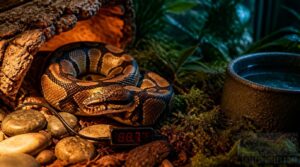
Before you plug in a single heat source, you need to know exactly what temperatures your snake requires. Guessing here is how snakes end up stressed, sick, or burned—there’s no wiggle room on species-specific numbers.
A solid starting point is this guide to snake cage heat source setup, which breaks down exactly which temperatures different species need and why getting it wrong costs more than just a vet bill.
Let’s walk through the exact targets, zone by zone, starting with the most popular pet species.
Warm, Cool, and Basking Zones
Before you buy a single bulb, understand the three temperature zones your snake needs. A proper thermal gradient runs warm side to cool zone, with a basking spot above both. Snakes can’t regulate body heat internally, so they move between zones, a behavior called thermoregulation. Think of it as a thermostat with legs. Get these zones wrong, and everything else fails.
For most diurnal reptiles, the warm side temperature range usually sits at 28-35°C, while the cool side stays around 22-26°C, so the heat source should be positioned at one end to establish a directional gradient.
Ball Python Temperature Range
Ball pythons need precision. Set the warm zone at 88-92°F (31-33°C), with a basking spot near 95°F (35°C). Keep the cool zone at 75-80°F (24-27°C). No wiggle room here.
Why so strict? A ball python relies on that thermal gradient to digest meals properly. Skip the basking spot, and you’ll see regurgitation and refusal to eat.
- Warm hide surface: high 80s to low 90s°F
- Basking surface: about 95°F
- Cool zone: 75-80°F
- Nighttime drop: 70-75°F, humidity held steady
Measure surface temperatures, not guesses. Temperature control keeps your snake feeding and thriving.
Corn Snake Temperature Range
Corn snakes are more forgiving, but don’t get lazy.
Set the basking spot at 85-90°F (29-32°C), measured right on the substrate.
Since a spot far hotter than that can burn a snake that won’t move away, it helps to compare ball python heat source options before settling on a setup.
Keep the cool zone at 72-78°F.
That thermal gradient drives healthy digestion and thermoregulation.
Nights can drop to 65-72°F safely; juveniles stay above 70°F.
Secure your thermostat probe at substrate level and verify with an infrared gun.
Tropical and Desert Species
Not every snake gives you that much wiggle room. Tropical species like tree boas need daytime temps of 75-88°F with nighttime drops to 70°F. A ceramic heat emitter steadies these humid zones effectively.
Desert snakes flip everything. Your temperature gradient needs a basking spot above 100°F, with cool nights near 60°F. Set your thermostat to those targets and don’t guess.
Risks of Incorrect Temperatures
Get the temperature wrong and your snake pays for it physically. The risks aren’t abstract:
- Respiratory infections develop quickly in cold, damp conditions
- Digestive dysfunction sets in when gut temps drop too low
- Thermal burns cause lasting tissue damage at heat contact points
- Immune function weakens, leaving your snake exposed to secondary infections
Temperature fluctuations accelerate all four.
Create a Safe Thermal Gradient
Getting the temperature right isn’t just about hitting a number — it’s about giving your snake room to move between warm and cool as it needs. A proper thermal gradient puts your snake in control of its own body temperature, which is exactly how it’s wired to work. Here’s how to build that gradient the right way.
When shopping for a heat mat, checking for safety certifications and cord durability is just as important as wattage — this guide to choosing the right ball python heating pad walks you through exactly what to look for.
Heat One Enclosure End

Think of the heated end as ground zero for your thermal gradient. Place a heat mat or ceramic heater here to build the basking spot your snake needs, running 2-5°C above ambient temperature. Keep that surface clear of loose bedding so heat transfers directly.
Your probe placement belongs at substrate level, monitoring this warm zone accurately and in real time.
Position Warm and Cool Hides
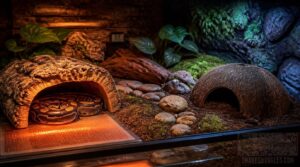
Place your warm hide directly over the heat mat, tucked into the basking zone. Your snake needs that retreat close enough to absorb heat without fully exposing itself.
On the opposite end, anchor a cool-side hide at substrate level. Both must be opaque and snug-fitting — snakes don’t feel safe in loose, open spaces. Secure them so they won’t shift during nighttime activity.
Separate Zones for Thermoregulation

Your snake isn’t just picking a spot randomly. When zones blur together, thermoregulation breaks down completely.
Use distinct substrate textures on each end, place hides on opposite sides, and aim for a temperature drop of 8 to 12 F between zones. That clear separation lets your snake self-regulate like it would in the wild.
Balance Ventilation and Insulation
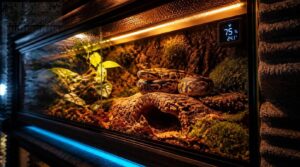
Good ventilation and solid insulation aren’t opposites. They work together to lock in your thermal gradient.
Too much airflow bleeds heat. Too little traps humidity. Strike the balance with these steps:
- Seal enclosure edges to block drafts that flatten your gradient
- Use humidity sensors to guide ventilation adjustments
- Add insulation panels on exterior walls to stabilize warmth
Adjust Day and Night Temperatures
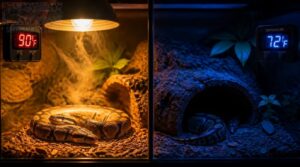
Day-night thermal cycling separates a thriving snake from a stressed one. Your thermostat and probe placement manage the overnight drop your animal depends on.
Keep your basking spot at 88-92°F during the day, then ease the temperature gradient down to 70-75°F by night. No wiggle room here: swings beyond 10 degrees within 24 hours cause real metabolic stress.
Choose and Size Heat Sources
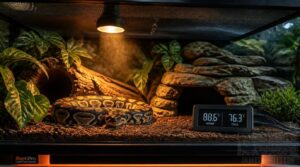
Not all heat sources work the same way, and picking the wrong one can leave your snake either shivering or scorched. Your enclosure’s size, your snake’s species, and your setup’s layout all determine which heating option actually does the job. Here’s a breakdown of the main heat sources you’ll need to think about.
Heat Mats and Pads
Heat mats are the most common starting point for new keepers. These flexible silicone sheets sit beneath the enclosure, warming substrate from below to support thermoregulation.
They work best when paired with a thermostat and probe placed directly on the mat’s surface, giving you precise temperature control and preventing dangerous hot spots. Without one, you’re gambling with your animal’s safety.
Ceramic Heat Emitters
Where heat mats warm from below, ceramic heat emitters work overhead, radiating infrared energy directly onto a basking spot without any visible light output. That makes them ideal for 24-hour heating without disrupting your snake’s day-night cycle.
They run very hot though, so always pair one with a thermostat for safe, steady temperature control and a reliable temperature gradient.
Radiant Heat Panels
Unlike CHEs, radiant heat panels mount overhead and run at lower surface temperatures, delivering steady heat distribution without the serious burn risk.
Always pair them with a thermostat and check enclosure insulation to lock in your temperature gradient.
- Mount on the warm-end ceiling
- Match wattage to enclosure size
- Place the probe near the basking zone
- Inspect insulation for heat loss
Deep Heat Projectors
Radiant panels spread warmth across a surface, but deep heat projectors go further, pushing infrared heat emitters into tissue beneath the skin. Screw one into a ceramic socket overhead on the warm end and monitor your temperature measurement points at both basking and mid-enclosure height. Always run one on a thermostat, and keep bedding clear for heat source safety.
| Feature | Deep Heat Projector |
|---|---|
| Socket type | Standard ceramic |
| Light output | Minimal or none |
| Heat penetration | Deep tissue, near-infrared |
| Thermostat required | Yes, always |
| Gradient role | Warm-end overhead heat |
Match Wattage to Enclosure Size
Getting wattage calculation wrong can overheat or chill your snake fast. Your enclosure volume to heat ratio governs the starting point: 2-3 watts per liter for hatchlings, 0.5-1 watt for adults.
Three factors shift that number:
- A heat mat wastes less wattage than radiant panels do.
- Poor insulation demands higher wattage.
- Thermostat probes verify your target temps are actually met.
Install and Configure a Thermostat
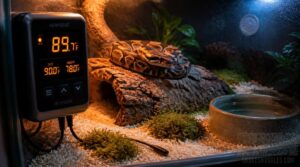
A thermostat isn’t optional — it’s the difference between a stable enclosure and a dangerous one. Getting it right means understanding your control options, matching them to your heat sources, and placing probes where they actually matter. Here’s exactly how to do each step.
A thermostat isn’t optional — it’s the difference between a stable enclosure and a dangerous one
Compare Thermostat Control Types
Not all thermostats are equal. On/off thermostat cycling cuts power when temps peak, then switches back on, creating slight fluctuations. Proportional thermostat control smooths that curve by reducing power gradually. Pulse-proportional regulation fires rapid bursts to stabilize output precisely. Dimming/PID control offers the tightest accuracy. Smart thermostat technology adds scheduling and remote alerts. Know the difference before you buy.
Match Controls to Heat Sources
Pairing the wrong controller to a heat source is a fast path to failure. Proportional thermostat control suits heat mats best, preventing overshoot. Ceramic heat emitters need a proportional thermostat with a relay.
Radiant panels require power modulation to hold 26 to 32°C. Deep heat projectors need 8 to 12 hour pulsing to stay safe. No wiggle room here.
Place and Secure Probes
Probe placement accuracy makes or breaks your thermostat’s reliability. Mount thermostat probes at snake eye level near the basking end, away from radiant heat. Your temperature monitoring devices only work if they’re positioned correctly. Cross-check with a reference thermometer.
- Secure probes to glass with silicone
- Route cables away from water dishes
- Label probes by zone
- Validate with temperature data loggers
Set Safe Temperature Limits
Your thermostat’s high-limit setting is your snake’s your snake’s last line of defense. Never exceed 90°F anywhere in the enclosure. Set your thermostat cutoff a degree or two below that ceiling. A brief temperature spike can cause tissue damage before you even notice. No wiggle room here, for either ball pythons or corn snakes.
Add Alarms and Backup Controls
Your thermostat is only as good as your ability to catch its failures fast.
Enable the built-in temperature alarm to get an immediate alert whenever temps drift outside safe range.
Battery backup modules keep alarms active for at least two hours during a power outage, while a UPS preserves thermostat memory for up to 30 minutes.
Never skip surge protection.
Monitor and Fine-Tune Enclosure Temperatures
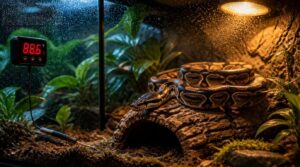
Getting the temperature right isn’t a one-time setup — it’s something you actively manage. Your enclosure can shift with the seasons, equipment wear, and even small changes in your home’s ambient conditions. Here’s how to stay on top of it all.
Use Multiple Digital Thermometers
One thermometer tells you almost nothing. Place at least two digital probes inside every enclosure, one near the warm hide, one toward the cool end. That split gives you real gradient data, not a guess.
Calibrate each probe within 0.5°C of a reference thermometer before trusting it. Drift happens, so compare both probes monthly to catch false readings early.
Measure Surfaces With Infrared Guns
Digital probes track air temperature well, but they miss what your snake actually touches. An infrared gun reads surface temps directly, scanning the basking slate, substrate, and hide floor in seconds.
Set emissivity to 0.95 for most bedding and hides. Point closer for tighter spot readings on curved surfaces. Shiny plastic deflects infrared, so check those spots twice.
Map Air and Surface Temperatures
Once you have both air and surface readings, pull them into a temperature gradient map. Sketch a simple grid scaled to your enclosure size, label each measurement point, and log the numbers. That thermal profile shows whether warm and cool zones hit your species’ targets.
Check the basking spot last. Any gap outside the correct range needs correcting now.
Track Trends With Data Loggers
Your snapshot readings show a moment. Data loggers show the whole pattern over time. Place one in the warm zone and one in the cool zone, set your sampling interval to every 15-30 minutes, and let both run overnight. Export the CSV the next morning and check for temperature dips or spikes your handheld thermometer simply wasn’t there to catch.
Recheck After Seasonal Changes
When the seasons shift, your enclosure doesn’t adjust itself. Ambient changes cause subtle temperature drift. This throws your thermal gradient mapping off without any obvious warning.
Recheck both zones, increase your thermostat calibration frequency, and confirm heating elements still hit target ranges. Seasonal temperature adjustment isn’t optional. Good thermal cycling protection means catching those creeping changes before your snake notices.
Prevent Burns, Overheating, and Equipment Failures
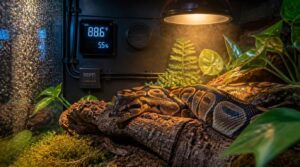
Getting the temperature right is only half the battle—keeping your equipment safe and your snake burn-free is the other half. A single frayed cord or an overheating element can undo everything you’ve worked to set up. Here’s what you need to address to lock down a safe, reliable enclosure.
Guard Bulbs and Heating Elements
An unguarded bulb is a burn waiting to happen. Heat bulb guards create the critical separation your snake needs.
Use this heating element placement strategy:
- Maintain at least 2 inches between guards and any flammable surfaces
- Choose ceramic or glass protective barriers
- Inspect monthly for cracks or looseness
- Replace bulbs to match target temps
Heat source safety barriers are non-negotiable.
Keep Heaters Clear of Bedding
Bedding creeping toward a heater is one of the most overlooked fire hazards in snake keeping. Keep at least 6 inches between substrate and your heat source at all times.
A heat mat thermal cutoff won’t trigger fast enough if bedding smothers the mat first. Use protective barriers like ceramic tiles to hold substrate back, and always check heat source placement after every cleaning.
Inspect Cords and Connections
A frayed cord is a fire waiting to happen. Run your hand along every heating cord monthly:
- Inspect insulation for fraying or cuts along the entire length
- Check plugs and connectors for bent pins or burn marks
- Test strain relief by gently tugging near connectors
Replace any damaged cord immediately with one rated for your enclosure’s wattage and moisture exposure.
Correct Hot and Cold Spots
Hot and cold spots won’t correct themselves. When your infrared gun catches an irregular reading at any of your temperature measurement points, trace the cause before your snake does.
Shift hides, reposition decor, or adjust substrate depth to restore the thermal gradient setup. Your basking spot should stay consistently warm, and cool zones should remain distinct, giving your snake a real choice.
Prepare for Power Outages
Power cuts don’t warn you. Surge protection thermostats guard your equipment, while power failure thermostat memory automatically restores your exact temperature settings after any outage.
- Keep a certified portable power bank ready for your critical heat sources
- Follow emergency cooling protocols if enclosure temps drop fast overnight
- Use remote thermostat monitoring and temperature logging features to catch problems early
Frequently Asked Questions (FAQs)
How to cool down a snake enclosure?
A sponge soaked in heat will only hold so much before it overflows. Boost ventilation on the cool end, reduce heat source wattage, and use reflective covers. Lock your cool zone between 75 and 80°F.
How to regulate temperature in a reptile enclosure?
Regulate reptile enclosure temperature by building a temperature gradient with a thermostat-controlled heat mat on one end. This helps natural basking behavior and gives your reptile full temperature control over its comfort.
What is the best thermostat for a snake enclosure?
A PID or dimming thermostat gives you the tightest temperature control. On/off thermostats work for basic setups, but probe accuracy is what separates stable conditions from dangerous swings.
Is there a terrarium heater with a thermostat available?
Yes, thermostat-integrated heaters exist across multiple formats, from heat mats and radiant heat panels to ceramic emitters. Many reptile brands sell units with built-in dimming or pulse controls for precise temperature zones.
How to control the temperature in a snake’s enclosure?
Control hinges on a thermal gradient — a warm basking spot (85-90°F) at one end, a cool zone at the other. A thermostat paired with a heat mat locks temperatures in place automatically.
How do you heat a snake enclosure?
Want your snake to thrive? The secret is enclosure design: place a heat mat at one end, connect it to a thermostat, and let the temperature gradient do the work. Your snake moves between basking spots.
How do you protect a snake enclosure from overheating?
Overheating is a thermal burn prevention failure waiting to happen. Install a thermal cutoff, configure temperature alarm systems, and actively verify heat distribution uniformity across the full enclosure to catch dangerous spikes before they strike.
How do you keep a snake warm?
Think of a snake as a solar panel with scales. It captures heat rather than making it. A heat mat and thermostat create the temperature gradient, basking spots, and the warmth your enclosure size demands.
How do I choose the right heating solution for my snake?
Your heat source choice depends on your snake’s biology and enclosure size. Heat mats deliver belly warmth, while ceramic emitters raise ambient temperature. Size wattage correctly, and always pair any heater with a reliable thermostat.
How do you care for a snake enclosure?
Caring for a snake enclosure sounds refreshingly simple. Just nail your temperature gradient, sync the thermostat, arrange basking spots, mount radiant heat panels for steady temperature control, and suddenly you’re a reptile technician. You are.
Conclusion
Temperature doesn’t forgive ignorance, and it won’t warn you before it harms your animal. Think of your enclosure as a living system where every single degree either helps or slowly undermines your snake’s biology.
Mastering snake enclosure temperature control means knowing your species, trusting a quality thermostat, and verifying everything with real data.
A well-mapped thermal gradient isn’t just comfort for your snake. It’s the foundation all good husbandry depends on.
Get the heat right.