This site is supported by our readers. We may earn a commission, at no cost to you, if you purchase through links.

Most escaped snakes don’t bolt for freedom, they slip through a gap you’d swear was too small to matter, a quarter-inch seam at a lid corner or a loose panel edge. That’s how a $200 ball python ends up behind the dishwasher. Enclosure security isn’t the only piece, though. Temperature swings, humidity crashes, and the wrong substrate cause more health problems than any daring escape ever will.
Building a safe setup means matching every accessory to your species’ needs, from thermostat placement to hide dimensions to UVB output. Get the checklist right once, and maintenance becomes routine instead of guesswork.
Table Of Contents
- Key Takeaways
- Snake Enclosure and Security Essentials
- Snake Cage Heating and Monitoring Equipment
- Safe Substrate and Snake Hides
- Water and Humidity Accessories
- Snake Cage Lighting and Enrichment
- Frequently Asked Questions (FAQs)
- What are the different types of snake cage accessories?
- How to choose a snake cage?
- How do I choose the best pet snake supplies?
- How do I choose a pet snake enclosure?
- What do you put in a snake cage?
- How do I customize my PVC snake cage?
- What should I have in my snake enclosure?
- What does a snake need in its cage?
- How to decorate a snake enclosure?
- What do you need to set up a snake tank?
- Conclusion
Key Takeaways
- Most escapes happen through tiny overlooked gaps, so check lid seams, panel edges, and substrate-to-wall transitions regularly, not just latches and locks.
- Temperature and humidity control matter as much as security, meaning a thermostat-regulated heat source, a warm-side and cool-side thermometer, and a digital hygrometer work together to keep your snake healthy.
- Every enclosure needs species-matched substrate, warm and cool hides sized to fit your snake snugly, and a dedicated humid hide to support safe, stress-free shedding.
- Good husbandry also includes enrichment like climbing branches, cork bark, and non-toxic plants, since these encourage natural behavior and reduce stress alongside the basic safety essentials.
Snake Enclosure and Security Essentials
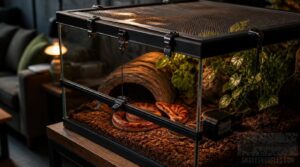
A snake that gets loose isn’t just an inconvenience—it’s a safety issue for your pet and your household. Before you worry about heat lamps or hides, your enclosure needs to hold its own against a determined escape artist. Here’s what your setup needs to lock down tight, starting with the basics of size and security.
Check that latches, screen clips, and lid seams are snake-proof by following this complete guide to housing a snake securely.
Species-Appropriate Enclosure Size
A cramped tank stresses your snake fast. Match housing to species: hatchlings need 10-15 gallon tanks, adults 40-75 gallons or more. Retics demand 200-300 gallon setups. Plan for enclosure growth, sizing up as your snake adds roughly 10% body length yearly.
Floor space should hit 2.5x body length, with 12+ inches vertical height for climbing. Greater enclosure complexity and structural design gives animals more control and choice over their environment, supporting better welfare and health.
Lockable Lids and Doors
Once size is sorted, security comes next, and snakes are notorious escape artists.
Tamper-resistant latches and keyed access locks keep lids shut against pressure or curious pets. Reinforced hinges resist prying, while rubber gasket seals lock in humidity. A safety catch stops lid slippage if the enclosure gets jostled during handling.
Escape Gap Inspections
Locks only work if there’s no gap for a snake to squeeze through first. Measure every opening against your species’ safe width, then check:
- Lid seams for full contact, no loose edges
- Panel edges for movement under gentle pressure
- Substrate-to-wall transitions for crawl-through routes
- Documented gap dimensions for ongoing monitoring
That’s real cage security, not guesswork.
Cage Clips and Keyed Locks
With gaps sealed, hardware becomes your next line of defense. Choose spring-loaded clasps or keyed cam locks in marine-grade stainless steel for corrosion resistance.
| Type | Best For | Security Level |
|---|---|---|
| Twist latch | Quick access | Moderate |
| Keyed cam lock | Daily security | High |
| Padlock hasp | Max protection | Highest |
Lubricate clips monthly and check alignment, escapeproof cage materials only work when properly maintained.
Childproof Access Controls
Because curious hands (and paws) test every latch eventually, childproofing snake enclosures means going beyond basic clips. Choose child-resistant housings needing two distinct motions to open, twist-and-pull designs work well.
It’s also worth checking that your latch upgrades don’t compromise ventilation or the ideal boa constrictor temperature range your enclosure needs to maintain.
Add tamper resistant fasteners like Torx screws, position latches beyond typical reach, and keep a locked key log. Monthly testing catches worn components before they become escapeproof lock failures.
Snake Cage Heating and Monitoring Equipment
Once your enclosure is locked down tight, the next non-negotiable is temperature control, since snakes rely entirely on their environment to regulate body heat. Getting this wrong isn’t just uncomfortable for your snake, it’s dangerous, so you’ll want the right combination of heat sources and monitoring tools working together. Here’s exactly what belongs on your setup list.
Species-Safe Heat Source
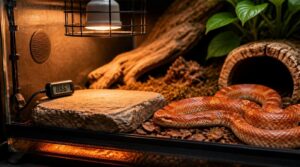
Not every heat source belongs in every tank. Undertank heaters (4-24 watts) suit belly-warming nocturnal species; ceramic heat emitters radiate light-free warmth; infrared mats reduce direct contact risk.
Whichever you choose, shield it from chewing or contact, targeting a warm-zone surface temperature of 28-32°C. Never let cords sit exposed.
Essential Thermostat Control
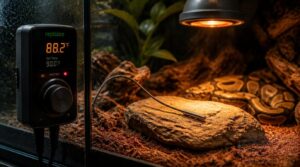
Since heat lamps and ceramic emitters can’t self-regulate, thermostat-controlled heating is non-negotiable. Place the probe directly in the warm zone, never guessing at placement, for accurate readings.
Run temperature calibration checks monthly. Programmable models allow schedule programming matching active periods.
Overheat protection and high-limit shutoffs prevent runaway heat if the primary system fails, safeguarding your snake around the clock.
Warm-Side Probe Thermometer
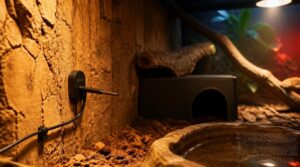
A thermostat controls the heat, but a probe thermometer tells you the truth.
Mount it on the warm-side wall or under the hide, away from airflow, at snake level.
Verify accuracy monthly against a known reference.
Route wires clear of water bowls and branches.
Watch for drift, it signals a failing sensor needing replacement.
Cool-Side Digital Thermometer
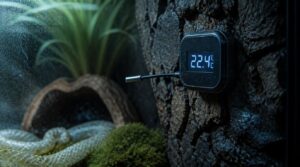
The cool side needs its own reliable digital thermometer, since gradient accuracy depends on both ends. Place the probe mid-wall, away from vents, for accurate temperature gradient monitoring.
Check battery life every 12 months and confirm water resistance holds up (IP44+) in humid enclosures. Precision to 0.1°C and auto power off after 10-60 minutes keep readings reliable without draining power.
Automatic Lighting Timer
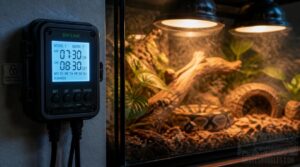
Manual on-off switching gets forgotten, and inconsistent lighting stresses your snake’s internal clock. A digital timer fixes that with programmable schedules, some offering astronomical adjustment tied to sunrise and sunset.
Look for:
- Battery backup for outages
- Water resistance for humid tanks
- Childproof design against tampering
This keeps your lighting schedule, UVB, and full-spectrum daylight bulbs running reliably, no guesswork required.
Safe Substrate and Snake Hides
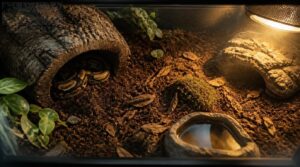
Once your heating and monitoring gear is locked in, the ground beneath your snake matters just as much. What you line the enclosure with, and where you place each hide, shapes how secure and comfortable your snake feels day to day. Here’s what your setup needs to get right.
Species-Appropriate Substrate
Substrate isn’t just bedding, it’s the foundation of your snake’s microclimate. Match it to species: coconut husk retains moisture for burrowing boas, cypress mulch suits humid tropical species, while sand-fiber blends drain fast for desert dwellers.
Keep depth at 2-3 inches, test for pesticides, and skip pine or cedar entirely, their fumes damage respiratory tissue.
Warm-Side Snug Hide
Once your substrate’s dialed in, your snake needs somewhere to disappear. A warm-side snug hide should fit body length with just 0.5-1.0 inches of clearance, no more. Use inert, non-toxic material like PVC or resin, whether premade or custom-built.
Balance ventilation to avoid trapped humidity, and choose smooth, non-absorbent interiors for quick cleaning between sheds.
Cool-Side Snug Hide
Every reptile needs a retreat from the heat, and the cool zone deserves the same thermal gradient design as its warm counterpart.
Look for high-heat-resistant plastic, a non-slip base, and a secure locking mechanism for stability.
- Peace of mind knowing your snake self-regulates safely
- Confidence in a hide compatible with coconut fiber substrate
- Relief from easy, dishwasher-safe cleaning maintenance
Moist Shedding Hide
Shedding poses its own challenge, one a standard hide can’t solve alone.
A moist shedding hide creates a humidity regulation hide maintaining 70-90% dampness through soaked substrate or sponge, with low ventilation preventing mold. Sized snug for full-body entry, it offers a secure retreat that eases stress while your snake works free of old skin.
Toxic Substrates to Avoid
What’s underneath your snake matters as much as what’s around it. Cedar shavings and pine shavings are classic beginner mistakes, releasing aromatic hydrocarbons and phenols that trigger respiratory irritation. Skip aromatic oil hazards like sandalwood or juniper too.
Safe substrate alternatives? Cypress mulch and aspen shavings, chosen by species and humidity needs, keep airways clear and enclosures genuinely safe.
Water and Humidity Accessories
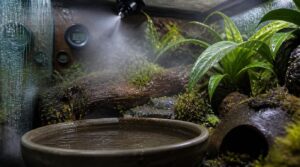
Water isn’t just for drinking here—it’s the backbone of healthy shedding and stress-free breathing for your snake. Getting the humidity right takes more than a bowl in the corner; it calls for the right combination of tools working together. Here’s what your setup needs to keep moisture levels exactly where your species requires them.
Stable Soaking Water Bowl
A wobbly bowl won’t cut it. Choose a wide, stable base holding 200–500 mL, filled 1–2 inches with dechlorinated water.
Place it on the warm side for soaking support during sheds. Clean weekly with mild soap or dilute hydrogen peroxide, and check daily for cracks, slime, or sharp edges before your snake climbs in.
Accurate Digital Hygrometer
Guesswork has no place here. A digital hygrometer with a capacitive sensor gives you ±2-3% RH accuracy, far tighter than analog dials.
Mount it mid-wall, away from heat and vents, and calibrate yearly using a salt-solution method. Watch for sensor drift, and consider models with data logging or wireless connectivity to track trends without opening the enclosure.
Humidity-Friendly Sphagnum Moss
Think of sphagnum moss as a living sponge, soaking up 16 to 26 times its dry weight in water. That capacity makes it a natural humidifier, releasing moisture slowly and stabilizing your enclosure’s microclimate for hours after misting.
Layer it into humid hides or mix it with bark substrate. Its loose structure boosts moisture absorption while resisting mold, keeping humidity gauges steady between checks.
Misting or Moistening Supplies
A fine mist beats a heavy soak every time. Choose an adjustable nozzle bottle for daily misting, or add a humidity dome to direct moisture upward and cut substrate splash.
Electric ultrasonic humidifiers work well for larger setups, especially with distilled water.
Whatever you pick, pair it with a hygrometer, damp moss checks, and a full water bowl for reliable coverage.
Species-Specific Humidity Range
No two snakes drink the air the same way.
Desert species like ball pythons need only 20 to 40 percent, while tropical dwellers such as green tree pythons demand 70 to 90 percent for healthy sheds.
Match your species-specific humidity range, check hygrometer placement mid-wall, and expect spikes to 65-85 percent during shedding.
Snake Cage Lighting and Enrichment
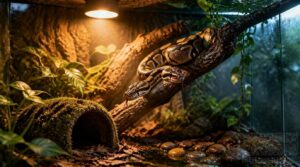
A snake’s cage isn’t just a place to sleep—it’s the only world it’s got, so the light and layout inside matter more than most owners realize.
A snake’s cage isn’t just a place to sleep, it’s the only world it’s got
Beyond keeping your snake healthy, the right lighting and enrichment items encourage natural behaviors like climbing, exploring, and basking.
Here’s what your setup needs to get both right.
Day-Night Lighting Setup
A snake’s internal clock runs on light, not habit. Set timers for a 12 to 14 hour day and 10 to 12 hour night, using 5000-6500K daylight bulbs for basking and dim red or blue lights after dark. Gradual dusk-to-dawn transitions reduce stress.
Watch for pacing or head flicking, and never substitute a ceramic heat emitter for proper lighting.
Species-Appropriate UVB Lighting
Not every species basks under full sun, so UVB needs shift by Ferguson zone. Zone 1 snakes want low, filtered UVB; Zone 3-4 baskers need stronger tubes 12-18 inches from the platform.
Linear T5 bulbs outperform CFLs for vitamin D3 synthesis. Replace bulbs every 6-12 months, since output fades before brightness does.
Pairing that fresh linear T5 bulb with a properly sized bioactive habitat—like the setup outlined in this corn snake bioactive enclosure guide—keeps both lighting and floor space on point.
For a deeper look at choosing and maintaining the right setup, UVB lighting systems for small enclosures covers replacement schedules and meter testing in practical detail.
Secure Climbing Branches
Once bulbs are sorted, give arboreal species something to actually climb. Use branches at least 1.5 inches thick, rounded and smooth, anchored with rust-resistant stainless hardware.
Vary heights for multiple grip points, and space branches irregularly to curb tail-grab risk. Inspect monthly for cracks or loose connectors, since decoration stability keeps climbers safe.
Cork Bark and Stable Rocks
Branches cover height, but rocks and wood at ground level round out the terrain. Cork bark, pulled from Quercus suber, gives grip through its textured, irregular surface while staying lightweight and moisture-resistant.
Pair it with inert, sterilized rocks checked for wobble.
- Cork texture grip aids traversal
- Rock stability safety prevents shifting
- Non-toxic material check before placement
- Surface cleaning with damp cloth
- Inspect for cracks or sharp edges
Non-Toxic Live Plants
Foliage does more than decorate. Non-toxic live plants like spider plant and pothos support humidity control while offering visual enrichment and stress reduction.
Calathea and maranta build bioactive microhabitats; Boston fern hides without odor. Check substrate safety, place foliage away from baskers, and you’ve got air purification and cover in one package.
Frequently Asked Questions (FAQs)
What are the different types of snake cage accessories?
Six essentials keep your snake secure: escape-proof locks, species-safe heating, safe substrate selection, hiding spots on both sides, humidity control tools, and stable water access. Together, these snake cage accessories checklist items protect health, safety, and comfort.
How to choose a snake cage?
Material safety, size, security: three checkpoints, one decision. Match cage material selection and dimensions to your snake’s adult length, confirm escapeproof locks, and verify sturdy ventilation before buying, since a cramped or leaky enclosure invites stress and disease.
How do I choose the best pet snake supplies?
Match supplies to your species’ needs first: substrate, hides, secure lid, thermometer, and thermostat. Compare brands for quality and safety, choose budget-friendly starter kits when needed, and consult a vet for species-specific guidance.
How do I choose a pet snake enclosure?
Think of a growing python outgrowing a shoebox: cramped quarters stunt confidence. Pick an enclosure sized two-thirds your snake’s length, with solid floor space, balanced ventilation, a thermal gradient, secure lid, and no sharp edges.
What do you put in a snake cage?
Every enclosure needs proper substrate selection, warm and cool hiding spots, a soakable water bowl, an accurate thermometer, a secure lid, and climbing decor, plus cleaning supplies and feeding tools on hand for daily care.
How do I customize my PVC snake cage?
Start with panel extensions for length, add ventilation placement on opposing walls, upgrade door hinges for durability, and install thermostat-controlled heating with proper thermometer placement across warm and cool zones for accurate gradients.
What should I have in my snake enclosure?
Use safe substrate, snug hiding spots, a soakable water bowl, heat mats with thermostat control, a thermometer, locks sealed with Escape Proof Sealant, an Enclosure Ventilation Check, plus Feeding Tongs Safety and Handling Gloves Use basics.
What does a snake need in its cage?
Your snake needs secure hiding spots, a stable water bowl, species-matched substrate type with moisture control, safe ventilation, escape-proof latches, a thermostat-managed temperature gradient, and placed enrichment so the enclosure stays secure, functional, and low-stress.
How to decorate a snake enclosure?
Like a woodland floor, combine naturalistic terrain, secure climbing branches, snug hiding spots, textured backgrounds, and non-toxic live plants with anchored rocks and wood, preserving access, temperature gradients, and enclosure security always over looks alone.
What do you need to set up a snake tank?
A proper setup blends security, heating, and humidity control: a lockable enclosure, thermostat-driven heat lamps, warm and cool thermometers, a hygrometer, snug hiding spots, species-correct substrate depth, a soaking bowl, and a consistent lighting timer.
Conclusion
Picture a snake settling into a warm hide, tongue flicking, completely unaware of the locked lid, calibrated thermostat, and humid corner working quietly to keep it alive. That’s what good husbandry looks like: invisible when done right.
A solid snake cage accessories checklist turns anxious guesswork into calm routine, one probe reading and one latch check at a time. Master the fundamentals once, and your enclosure stops being a chore. It becomes a thriving, self-sustaining habitat your snake can trust completely.