This site is supported by our readers. We may earn a commission, at no cost to you, if you purchase through links.
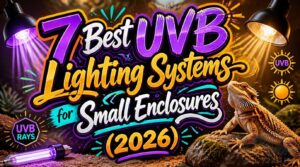
Your bearded dragon can sit beneath a bright lamp for twelve hours and still receive too little UVB to make vitamin D3. In a 20-gallon enclosure, an inch of mounting height, a mesh lid, or the wrong bulb can turn a safe basking zone into a nutritional dead end.
Falling calcium levels often precede weak grips, soft jaws, bowed limbs, and metabolic bone disease. Visible light guides daytime behavior; UVB drives D3 production.
The best uvb lighting systems for small enclosures match your reptile’s Ferguson Zone, fixture distance, and required coverage. These seven options make the tradeoffs easier to judge before you mount a lamp.
Table Of Contents
- Key Takeaways
- Why UVB Lighting Matters for Small Enclosures
- How to Choose The Right UVB Bulb Strength
- Top 7 UVB Lighting Systems for Small Enclosures
- UVB Fixture Installation and Maintenance Tips
- Fixing Common UVB Lighting Problems
- Frequently Asked Questions (FAQs)
- What size UVB bulb for a 20 gallon tank?
- Is a basking light the same as an UVB light?
- How much of an enclosure should UVB cover?
- Is UV light the same as UVB light?
- Can I use UVB lighting for nocturnal reptiles?
- How do I measure UVB output accurately?
- Are mercury vapor bulbs suitable for small enclosures?
- Whats the difference between UVA and UVB?
- Do LED UVB bulbs work as well as fluorescent?
- What accessories pair best with UVB lighting systems?
- Conclusion
Key Takeaways
- UVB wavelengths between 290–320 nm are what actually trigger vitamin D3 synthesis in your reptile’s skin — visible light, no matter how bright, does nothing for that process.
- Match your bulb strength (5.0 for forest species, 10.0 for desert dwellers) to your reptile’s Ferguson Zone and mount it 12–18 inches above the basking surface, because distance and species ecology together determine whether your animal gets a useful dose or none at all.
- UVB output fades invisibly before the bulb burns out, so replace compact fluorescents every 6–8 months and T5 HO tubes every 10–12 months — and verify levels weekly with a calibrated Solarmeter, not by eye.
- Mesh lids can block 5–25% of UVB transmission, so always measure UV Index at the animal’s basking height after installation rather than assuming the fixture rating tells the whole story.
Why UVB Lighting Matters for Small Enclosures
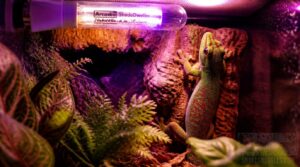
UVB lighting isn’t optional for most captive reptiles — it’s the difference between a thriving animal and one quietly declining from preventable deficiencies.
Choosing the right UVB lights for apartment-dwelling reptiles helps replicate the sunlight their bodies depend on.
For most captive reptiles, proper UVB lighting separates thriving health from preventable decline
Getting it right in a small enclosure takes more thought than people expect, because space constraints change everything from bulb choice to mounting height.
Here’s what you need to know before we get into the best systems available right now.
Vitamin D3 Synthesis in Captive Reptiles
Without UVB, your reptile simply can’t trigger the skin chemistry that builds vitamin D3. Reptile skin contains 7-dehydrocholesterol, a compound that converts to pre-vitamin D3 only when exposed to UVB wavelengths between 290 and 320 nm. In a small enclosure, the distance from bulb to basking zone largely determines how much of that critical wavelength actually reaches your animal’s skin.
Research on UVB lamps and vitamin D3 synthesis in bearded dragons found that the Arcadia lamp produced the highest UVB irradiance among tested compact fluorescent lamps, yielding measurably higher 25(OH)D3 and calcium concentrations compared to control groups receiving no UVB exposure.
Prevention of Metabolic Bone Disease
That vitamin D3 synthesis connects directly to something more serious. When calcium phosphorus balance breaks down, bones lose density and strength, showing up as bowed limbs, spinal curvature, or a reptile that barely moves.
UVB intensity at the basking zone is what keeps this from happening. Consistent output in the 290-315 nm range, positioned 12-18 inches above the basking surface, helps vitamin D3 synthesis and downstream mineral homeostasis. The upside: mineral deficiencies caught early are reversible once you fix the lighting.
Behavioral and Sleep Cycle Benefits
Beyond bones, UVB exposure helps circadian entrainment and behavioral and sleep cycle benefits in small tanks.
- Circadian Rhythm Support: morning light drives activity.
- Sleep Cycle Regulation: darkness permits restorative rest.
- Stress Reduction Cues: consistent timing limits pacing.
- Behavioral Learning Patterns and Social Interaction Enhancement: routines.
Use timers, maintain basking height optimization, and make each photoperiod adjustment gradually.
UVB Vs Visible Light Differences
A timer controls routine, but visible light is not UVB. Visible wavelengths, 400–700 nm, support sight and daytime behavior; they do not drive vitamin D synthesis.
UVB occupies 280–315 nm and acts mainly at the skin surface, where it helps vitamin D3 production. Its intensity and UVB coverage ratio matter far more than brightness.
Use a UVB fixture sized for safe exposure. UVB causes surface damage when excessive, while visible spectrum effects are primarily visual.
How to Choose The Right UVB Bulb Strength
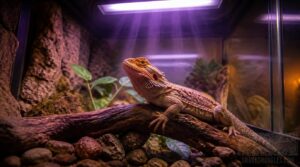
Bulb strength must match your reptile’s species, Ferguson Zone, and the limited distance available in a small enclosure.
A 5.0 lamp suits low-UVB forest species, while many desert baskers need 10.0 or stronger output.
The systems below offer practical options for building safe, usable UVB coverage without overwhelming the tank.
UVB 5.0 Vs 10.0 Compared
UVB Output Comparison is about dose, not brightness: 5.0 UVB 50 gives moderate UVB intensity; 10.0 or UVB 100 produces roughly double the UVB output at equal distance.
- 5.0 suits filtered, shaded basking.
- 10.0 requires controlled Basking Distance.
- small enclosures increase Enclosure Size Impact.
- Reflectors tighten coverage.
Species Suitability determines choice. Replacement Frequency matters: visible light may outlast useful UVB.
Species-Specific UVB Requirements
Match lighting to ecology, not appearance. In a small enclosure, desert dwellers need strong UVB output at a 6–12 inch basking site; bearded dragons commonly need 10.0 strength. Forest dwellers need gentler gradients and shade. Arboreal species need overhead exposure; ground dwellers need even substrate coverage. Aquatic turtles need dry waterline basking access. Use UVB distance guidelines and Ferguson zones.
Ferguson Zones for Captive Reptiles
Ferguson Zones give you a starting point for setting UVB intensity in small enclosures. Zone 1 species bask in full sun and need high output with access. Zone 2 uses dappled light, so provide moderate exposure and shade.
Zone 3 fits open-woodland reptiles. Zones 4 need low UVB in humid shade; Zone 5 needs strong output. Replace UVB fixture lamps routinely.
UVB Coverage for Small Tanks
Think in zones, not blanket illumination. In small enclosures, choose a UVB fixture that spans at least half the tank length, covering the warm basking zone and nearby travel area while leaving a shaded retreat.
Mount it 6–12 inches above perch, adjusting for mesh lid effects. Long tanks need strips; curved tanks may need diagonal placement. Meter UVB intensity.
Top 7 UVB Lighting Systems for Small Enclosures
Small enclosures leave little room for UVB placement errors, so fixture choice matters as much as bulb strength.
The systems below suit different tank sizes, mounting setups, and Ferguson Zone needs.
Start with the option that best matches your reptile’s enclosure and target UVI.
1. Exo Terra Daylight LED Bulb
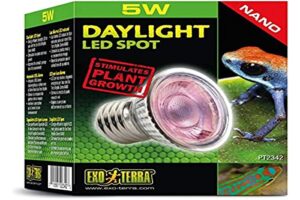
Bright daylight, not UVB. The Exo Terra Daylight LED Bulb, model PT2342, is a 5-watt visible-light lamp for compact planted terrariums. It produces a bright, roughly 6500K daylight spectrum that makes moss, live plants, and coloration easier to see while adding little heat.
Its 2.36 x 2.36 x 3.35-inch body and 2.12-ounce weight suit Exo Terra NANO and MINI setups for amphibians, invertebrates, hatchlings, or reptiles with no UVB requirement. Its low energy draw helps protect small enclosures from the temperature creep that can occur with hotter bulbs.
Do not treat it as a vitamin D3 source. This bulb emits no UVB, so it cannot meet the needs of Zone 3 or 4 reptiles, or species needing UV exposure. Use it for daylight and plant growth, then provide proper species-appropriate UVB lighting separately when required.
| Best For | Keepers of small NANO or MINI planted terrariums who want bright, low-heat daylight for live plants, moss, amphibians, invertebrates, or reptiles that do not require UVB. |
|---|---|
| UVB Output | None |
| Wattage | 5W |
| Brand | Exo Terra |
| Fixture Type | LED Bulb |
| Mount Type | Dome Socket |
| Species Target | Amphibians/Plants |
| Additional Features |
|
- Bright daylight spectrum supports plant and moss growth while enhancing natural coloration.
- Low 5-watt energy use adds minimal heat to compact enclosures.
- Lightweight, compact design fits Exo Terra Reptile Dome NANO fixtures.
- Provides no UVB, so it is not suitable as a sole light source for UV-dependent reptiles.
- Some users report premature bulb failure and inconsistent durability.
- Single-bulb package may be insufficient for larger terrarium setups.
2. Zoo Med Reptisun LED Terrarium Hood
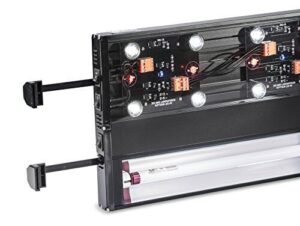
The Zoo Med Reptisun LED Terrarium Hood isn’t just a light, it’s a complete lighting system in a single unit. It combines a high-output T5 UVB bulb with 6500K daylight LEDs, red plant growth LEDs, and blue moonlight LEDs, each controlled by independent switches. You can run daylight alone, pair UVB with daylight, or layer in plant growth and moonlight as needed.
The 6500K output renders your animals and live plants accurately, and the adjustable mounting rails fit enclosures from 25.25 to 31.5 inches wide without modification. A built-in heat sink keeps the fixture cool, and a splash guard protects the electronics in humid setups.
This hood works well for bearded dragons, chameleons, and planted vivariums where you need reliable UVB and full-spectrum light without juggling separate fixtures.
| Best For | Reptile keepers and vivarium enthusiasts who want an all-in-one lighting solution that covers UVB, full-spectrum daylight, plant growth, and moonlight without the hassle of multiple separate fixtures. |
|---|---|
| UVB Output | T5 HO UVB |
| Wattage | LED + T5 |
| Brand | Zoo Med |
| Fixture Type | Hood System |
| Mount Type | Adjustable Rails |
| Species Target | Bearded Dragons/Chameleons |
| Additional Features |
|
- Combines UVB, daylight, red plant growth, and blue moonlight LEDs into one unit with independent switches for full control over your lighting setup
- Adjustable mounting rails fit a range of enclosure widths (25.25–31.5 inches) right out of the box, with a built-in heat sink and splash guard for humid environments
- Long 20,000-hour LED lifespan and a low-profile design keep the fixture practical and unobtrusive over the long haul
- No integrated timer means you’ll have to manually switch each lighting zone on and off or buy a separate timer
- Durability is hit or miss — some users have reported early LED or UVB bulb failure, and the UVB bulb connection points have been flagged as flimsy
- The fixture’s footprint can feel bulky in smaller enclosures, potentially restricting airflow, and a few buyers have received units missing the UVB bulb entirely
3. Exo Terra Dome Light Fixture
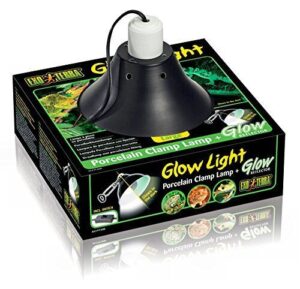
Not every setup needs a multi-channel lighting station. If the Zoo Med hood is the Swiss Army knife of reptile lighting, the Exo Terra Dome Light Fixture (PT2056) is the fixed-blade: simple, dependable, and built specifically for the job.
The extra-long aluminum reflector extends past the bulb face, pushing UVA and UVB output downward rather than scattering sideways. Exo Terra claims up to 100% improvement in UV distribution over standard dome designs.
The heat-resistant ceramic socket controls incandescent bulbs up to 75 watts and compact fluorescents up to 26 watts. A 6-foot cord with on/off switch keeps installation clean. The adjustable clamp secures it to most screen lids without extra hardware.
For leopard geckos or small agamids that need a focused basking point rather than broad-spectrum coverage, this fixture earns its keep.
| Best For | Reptile owners who need a simple, focused basking light for smaller setups like leopard gecko or agamid terrariums without the complexity of a multi-channel system. |
|---|---|
| UVB Output | Fixture Dependent |
| Wattage | Up to 75W |
| Brand | Exo Terra |
| Fixture Type | Dome Fixture |
| Mount Type | Clamp Mount |
| Species Target | Leopard Geckos/Agamids |
| Additional Features |
|
- High-quality aluminum construction with a porcelain socket handles heat up to 250 watts, making it durable and safe for heavy-duty basking bulbs
- Built-in reflector channels UVA and UVB light downward for more efficient heat and light distribution right where your reptile needs it
- Adjustable clamp attaches securely to most terrariums without extra hardware, and the straightforward design makes setup quick and easy
- The glow-in-the-dark coating fades after about an hour once the bulb is off, so it won’t serve as a reliable nighttime guide for long
- The clamp may struggle to hold heavier bulbs securely, which could be a concern if you’re using larger, denser lighting options
- The fixture depth might not accommodate longer UVB bulbs, potentially requiring you to find alternative housing or make awkward adjustments
4. Reptisun Compact UVB Fluorescent Light
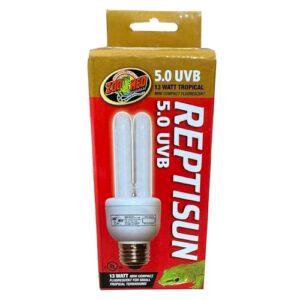
Not every keeper wants a full hood system. Sometimes the simplest solution fits best, and that’s exactly where the Reptisun Compact UVB Fluorescent earns its place.
This 13-watt compact fluorescent screws into any standard socket, no separate ballast, no specialty fixture required. It delivers 5% UVB and 30% UVA through UVB-transmitting quartz glass, giving tropical species like tree frogs, day geckos, and small skinks the D3 support they need without overloading a compact enclosure with heat.
You can mount it vertically or horizontally, which gives you real flexibility when working around hood designs or screen lids.
One honest limitation: replace it every 6-8 months. Output drops well before the bulb burns out, and the pack-of-two format makes scheduling replacements easy.
| Best For | Keepers of tropical reptiles and amphibians who want an easy, no-fuss UVB solution that fits standard fixtures without a dedicated hood or ballast. |
|---|---|
| UVB Output | 5% UVB |
| Wattage | 13W |
| Brand | Zoo Med |
| Fixture Type | CFL Bulb |
| Mount Type | Standard Socket |
| Species Target | Tropical Reptiles |
| Additional Features |
|
- Screws into any standard socket — no special fixture or ballast needed
- Delivers 5% UVB and 30% UVA through quartz glass for solid D3 support
- Low heat output keeps compact enclosures comfortable for tropical species
- UVB output fades before the bulb burns out, requiring replacement every 6-8 months
- Some users report inconsistent brightness or fit issues with certain fixtures
- May not ignite reliably in regions with 100V/50Hz power systems
5. REPTIDLDB 39W T5 UVB 10.0 Reptile Light Fixture
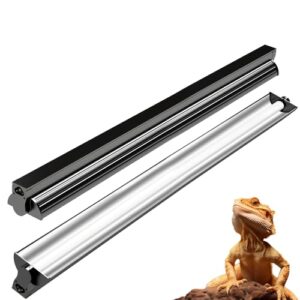
The Reptisun Compact suits tropical species well, but when your reptile needs more UV intensity, the REPTIDLDB 39W T5 UVB 10.0 steps up.
Running at 39 watts through a 34-inch T5 tube, it delivers 10% UVB and 30% UVA, the numbers bearded dragons, tortoises, and other desert species actually need for proper D3 synthesis and calcium metabolism. The aluminum alloy reflector pushes output downward rather than scattering it, so your basking zone gets consistent coverage across a 24 to 36-inch enclosure.
Mount it 12 to 18 inches above the basking surface. The detachable cable keeps wiring tidy. Replace the bulb every 6 to 12 months, because output drops long before the tube goes dark.
For a full walkthrough on lighting placement alongside substrate depth and floor space, this corn snake bioactive enclosure guide breaks down every step for a thriving setup.
| Best For | Keepers of bearded dragons, tortoises, and other desert reptiles needing strong, reliable UVB in a 34-inch enclosure. |
|---|---|
| UVB Support | Yes |
| Plant Growth | No |
| Energy Efficient | Yes |
| Indoor Use | Yes |
| Suitable for Small Enclosures | Yes |
| Multiple Species | Yes |
| Additional Features | Replaceable bulb, alloy reflector, detachable cable |
| Best For | Keepers of bearded dragons, tortoises, and other desert reptiles that need strong, reliable UVB lighting in a 34-inch enclosure. |
|---|---|
| UVB Output | 10% UVB |
| Wattage | 39W |
| Brand | REPTIDLDB |
| Fixture Type | T5 Tube System |
| Mount Type | Lid Surface |
| Species Target | Desert Reptiles |
| Additional Features |
|
- Delivers a powerful 10% UVB and 30% UVA output, giving desert species exactly what they need for D3 synthesis and healthy calcium absorption
- The aluminum alloy reflector focuses light downward for consistent, efficient coverage across the basking zone
- Slim 34-inch profile fits neatly on tank lids or wire mesh tops, and the detachable cable keeps installation clean and simple
- Some buyers have received defective units or bulbs that didn’t work right out of the box
- The reflective coating can peel if the protective film isn’t removed carefully during setup
- At this price point, the build quality has left some users feeling like they didn’t get full value for their money
6. Hygger Zoo T5 UVB Reptile Light Fixture
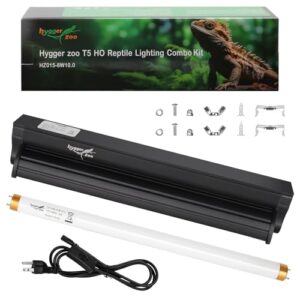
Not every keeper runs a 34-inch tank. If your setup is compact, the Hygger Zoo T5 UVB (model HZ015-T5-8W) is built for exactly that.
At 8 watts and 13.23 inches, it fits smaller enclosures without overwhelming them. The polished curved reflector pushes UVB downward instead of scattering it, delivering consistent 10.0 UVB coverage for D3 synthesis and calcium absorption, what desert lizards and bearded dragons need for healthy bone metabolism. Energy consumption stays low, so you’re not adding unnecessary heat to a compact space.
Mounting is flexible. You can place it on a mesh lid or fix it directly inside the tank, letting you close the distance and offset screen blockage. Target 10 to 12 inches above the basking surface. Some users reported early bulb failure, so mark the installation date and verify output monthly with a Solarmeter.
| Best For | Keepers with compact desert reptile or turtle enclosures who need a low-wattage, flexible-mount UVB fixture. |
|---|---|
| UVB Support | Yes |
| Plant Growth | No |
| Energy Efficient | Yes |
| Indoor Use | Yes |
| Suitable for Small Enclosures | Yes |
| Multiple Species | Yes |
| Additional Features | Curved reflector, mesh lid or inside-tank mounting, replaceable T5 bulb |
| Best For | Keepers with compact desert reptile or turtle enclosures who want a low-wattage, flexible-mount UVB fixture that delivers solid 10.0 UVB output without adding excess heat. |
|---|---|
| UVB Output | 10% UVB |
| Wattage | 8W |
| Brand | Hygger |
| Fixture Type | T5 Fixture |
| Mount Type | Mesh or Inside Tank |
| Species Target | Desert Lizards/Turtles |
| Additional Features |
|
- Polished curved reflector concentrates UVB downward for consistent coverage, supporting D3 synthesis and calcium absorption in desert reptiles
- Flexible mounting options — mesh lid or inside the tank — let you dial in the right distance to offset screen blockage
- Energy-efficient 8W design keeps power consumption low while maintaining strong UVB output in smaller spaces
- Multiple users report premature bulb failure, sometimes within 30 days of installation
- The fixture can be unstable, with some users noting it shifts and won’t stay in place
- Shipping and packaging issues have been reported, with some units arriving damaged after long wait times
7. Hygger Zoo 24W T5 UVB Reptile Light
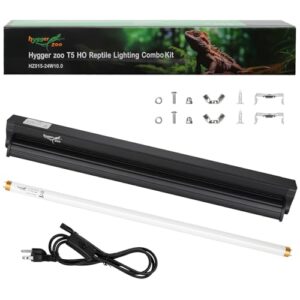
The Hygger Zoo 24W T5 (HZ015-T5-24W) is the stronger sibling of the 8W model, built for keepers who need more reach without jumping to a full-length fixture. At 23.5 inches and 24 watts, it covers enclosures in the 20 to 24 inch range without leaving gaps.
The polished curved reflector drives UVB downward, delivering 10.0 output alongside 30% UVA for desert species like bearded dragons, turtles, and tortoises. That helps with D3 synthesis and calcium metabolism, the real work behind healthy bone density and immune function.
Mount it 12 to 18 inches above your basking zone. Some keepers reported early bulb failure, so mark the installation date and check output monthly with a Solarmeter. The housing isn’t waterproof, so keep it clear of high-humidity enclosures.
| Best For | Owners of medium-sized desert reptile enclosures who need stronger UVB coverage than the 8W model provides. |
|---|---|
| UVB Support | Yes |
| Plant Growth | No |
| Energy Efficient | Yes |
| Indoor Use | Yes |
| Suitable for Small Enclosures | Yes |
| Multiple Species | Yes |
| Additional Features | Curved reflector, dual mounting options, aluminum housing, replaceable T5 HO bulb |
| Best For | Reptile owners with medium-sized desert enclosures (20–24 inches) who need serious UVB output for species like bearded dragons, turtles, or tortoises. |
|---|---|
| UVB Output | 10% UVB |
| Wattage | 24W |
| Brand | Hygger |
| Fixture Type | T5 Fixture |
| Mount Type | Mesh or Inside Tank |
| Species Target | Desert Reptiles/Turtles |
| Additional Features |
|
- High-output 10.0 UVB with a polished curved reflector that focuses light downward for better D3 synthesis and calcium absorption
- Dual mounting options give you flexibility whether you’re working with a mesh top or mounting inside the enclosure
- Aluminum housing helps manage heat and extends the fixture’s lifespan compared to plastic alternatives
- Multiple users have reported premature bulb failure within weeks or months, so longevity can be hit or miss
- Not waterproof or humidity-resistant, making it a poor fit for tropical or high-moisture setups
- Some keepers experienced timer interference and other electrical quirks that affect reliable daily use
UVB Fixture Installation and Maintenance Tips
A quality UVB fixture only works when you mount, maintain, and schedule it correctly.
In small enclosures, distance, screen filtration, and replacement timing can quickly shift exposure outside a safe range.
Use the following installation checks to set each system up for reliable, species-appropriate UVB.
Safe Mounting Heights and Positioning
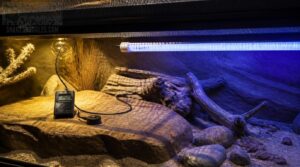
Mount T5 HO tubes 12–18 inches above basking surfaces inside the enclosure, then confirm results with UV Index monitoring. Adjust UVB distance for bulb strength and enclosure height.
Center UVB fixture placement over the heat zone for fixture overlap positioning. This gradient creation method provides UVB exposure and shade. Use UVB timer controls, applying a mesh compensation strategy when mounting above screens externally.
Mesh Lids and UVB Blockage
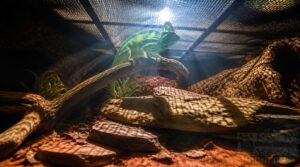
Although mesh lids preserve airflow, they reduce UVB reaching your reptile. Standard screens commonly cut transmission 5–15%, while fine mesh may block up to 25%.
Align the fixture directly over the basking zone, avoiding frame bars that create shade patches. Clean dust from mesh with a soft dry cloth. Confirm the final exposure beneath the screen with UV Index monitoring, not visible brightness.
UVB Bulb Replacement Schedules
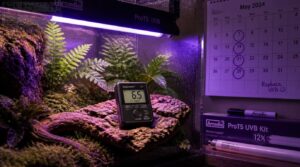
UVB decay is invisible. A lamp may look bright while its usable output has fallen below your reptile’s target UVI. Track bulb lifespan from installation, not from visible brightness. Write the date on the lamp and keep a replacement calendar.
- T5HO tubes: 10–12 months
- Compact fluorescents: 6–8 months
- Mercury vapor bulbs: 8–10 months
- LED UVB: follow manufacturer guidance
Verify at the basking site with a UV meter weekly. Replace early when readings drop, warranty reliability changes, or output degradation signs appear.
Setting Timers for Light Cycles
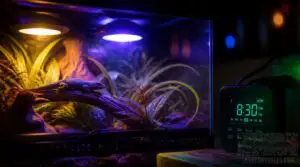
Set photoperiod programming to your local time, usually 12 hours on and 12 off. Synchronize digital timers before setting UVB bulbs.
| Schedule | Use |
|---|---|
| Daily fixed cycle | Stable circadian rhythm |
| Weekend variation | Different household routine |
Use separate timer outlets for heat and UVB lighting systems. Verify settings over 24 hours. After power loss, reset clock and programmed events; small enclosures leave little margin for accidental UVB exposure.
Fixing Common UVB Lighting Problems
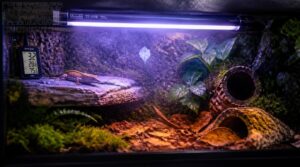
Most UVB problems come down to declining output, poor placement, or a setup that gives your reptile no way to regulate exposure.
In a small enclosure, even a good fixture can become unsafe when heat, distance, and mesh screening work against it.
Use the checks below to pinpoint the issue before it affects your reptile’s health.
Identifying Bulb Dimming and Failure
Dimming is a warning, not a harmless cosmetic change. Track UVB output with a Solarmeter 6.5R, because visible brightness does not confirm usable radiation. Replace compact bulbs at 6–8 months and T5HO lamps at 10–12 months.
Flicker after adjusting the bulb suggests socket contact. Test it in a known-good fixture. If it persists, inspect cables, switch, dimmer compatibility, and driver circuits for voltage-drop or ballast faults.
Preventing Reptile Overexposure and Burns
After checking fading lamps, check the animal. In a small enclosure, prevent UVB overexposure with four controls:
- Keep bulbs at safe distances: T5HO 15–24 inches, mercury vapor 18–36.
- Build a UVB gradient with shade and retreats.
- Separate heat source and UVB for thermal burn prevention.
- Use UVB monitoring: watch for swollen eyes, redness, blistering, lethargy, or hiding.
Replace aging lamps.
Measuring UVB Levels Accurately
Measure exposure at the animal’s height, not at the lid. Use a cosine corrected sensor such as a Solarmeter 6.5R, and record UVI or EUVB readings across basking, middle, and shaded zones.
| Check | Method | Why |
|---|---|---|
| Distance | Keep fixed | Inverse square law |
| Calibration | Verify regularly | Prevent drift |
| Frequency | Test weekly | Catch UVB degradation |
Match spectral response to reptile UVB wavelengths.
Separating Heat and UVB Sources
Keep heat and UVB separate in small enclosures. Independent Fixture Mounting lets you control Thermal Gradient Control without forcing excessive UVB exposure.
Place UVB bulbs, including T5HO fixtures, at the verified UVB Safety Distance over one habitat zone. Aim the Heat Source Placement at a separate basking pocket, using guards and a heat sink where needed.
This Zone Separation Strategy gives your reptile choice, not a trap.
Frequently Asked Questions (FAQs)
What size UVB bulb for a 20 gallon tank?
In a small enclosure, 22–24-inch T5 UVB bulb length matching matters. Confirm lid clearance fit and tank width coverage, with basking zone extension 2–4 inches, for UVB exposure and UVB output balance. Choose 0 or
Is a basking light the same as an UVB light?
No. A basking light supplies heat for thermoregulation, while UVB bulbs emit 290–320 nm wavelengths for vitamin D3 synthesis. Most reptiles need separate fixtures covering the basking zone; combined mercury-vapor lamps provide both, but can overwhelm small enclosures.
How much of an enclosure should UVB cover?
Like sunrise on branches, place UVB coverage across half to two-thirds; prioritize basking zone coverage, UVB gradient placement, shaded retreat balance. In small enclosure, enclosure size impact, species-specific coverage needs, UVB output, and light gradient.
Is UV light the same as UVB light?
UV light covers UVA, UVB, and UVC. UVB spans 280–315 nm, carries more energetic photons than UVA, and drives vitamin D3 synthesis. Choose UVB bulbs by species, distance, enclosure size, and measured UVB output.
For keepers running several setups, matching fixture length to tank width and mounting lights 15–25 cm up is easier with terrarium lighting systems for multiple enclosures.
Can I use UVB lighting for nocturnal reptiles?
Yes, but never at night. Some nocturnal reptiles use limited daytime, cryptic UVB exposure. Choose species-appropriate UVB bulbs, provide shade, and protect circadian rhythm with 8–12 hours of darkness. UVB output must remain off overnight.
How do I measure UVB output accurately?
Use calibrated Solarmeter 5R with UVB spectral response, held perpendicular at basking height. Log stable UVB output, distance, units, and duty cycle weekly. Track bulb degradation: replace T5HO fixtures at 10–12 months, compact fluorescents at 6–
Are mercury vapor bulbs suitable for small enclosures?
Mercury vapor bulbs rarely suit small enclosures: heat buildup, UVB output, and ventilation demands can cause dangerous UVB exposure. Breakage also creates mercury concerns.
Choose T5 fluorescent or LED UVB lighting systems for controlled coverage.
Whats the difference between UVA and UVB?
UVA (320–400 nm) penetrates deeper, influencing pigmentation and behavior.
UVB (290–320 nm) acts nearer the skin surface, drives vitamin D3 synthesis, and causes direct DNA damage.
Broad-spectrum protection covers both; measure UVB output for species-specific needs.
Do LED UVB bulbs work as well as fluorescent?
LED UVB lighting saves energy, runs cooler, and lasts 15,000–25,000 hours versus fluorescent tubes’ 10,000–12,000, with output and mounting. Tubes give coverage; for hatchlings, compact fluorescents work. Allow for transmission loss and replace on schedule.
What accessories pair best with UVB lighting systems?
Pair reflector domes with UVB bulbs; adjustable brackets secure Exo Terra Dome Light Fixture and Zoo Med Reptisun LED Terrarium Hood on shelves.
Timers, compact-fluorescent replacements, splash guards, quartz sleeves, cooling fans, and mesh-lid-safe mounts.
Conclusion
Think of your enclosure like a room with blackout curtains and a bright lamp. Your reptile sees plenty of light but starves for the wavelength that actually matters. The right uvb lighting systems for small enclosures fix that gap precisely.
Match Ferguson Zone, mounting distance, and bulb output. Replace bulbs every six months, track UVI with a meter, and set a consistent photoperiod. That’s the difference between a dragon that survives and one that thrives.