This site is supported by our readers. We may earn a commission, at no cost to you, if you purchase through links.
One tank with a bad light is a hobby problem. Six tanks with six mismatched lights is a full-time job. The gecko in rack three basks under 4,800 K while the skink next door gets a UVB index of 2, and you’re left guessing which one will show trouble first.
Great terrarium lighting systems for multiple enclosures share a few traits: fixtures sized to each tank’s width, UVB tuned between index 5 and 10 at basking height, and timers that run every cycle on one clock. Power draw adds up fast too, and a crowded strip trips breakers.
Here are 10 fixtures worth your shelf space, and the ones that scale.
Table Of Contents
- Key Takeaways
- How to Choose Multi-Enclosure Lighting
- Top 10 Terrarium Lighting Fixtures Compared
- 1. Pawfly Extendable Terrarium Light 11W
- 2. AQUANEAT LED Aquarium Light 18-24 Inch
- 3. 6 Mini LED Grow Light Strips
- 4. AC Infinity IONBEAM S16 LED Grow Light
- 5. Barrina T5 Grow Light 1ft 4-Pack
- 6. Barrina T5 Grow Lights 1ft 4 Pack
- 7. Pawfly 6W Terrarium LED Light
- 8. ReptiKing 5.5 Inch Reptile Light Fixture
- 9. LuminPacific Adjustable UVB Reptile Lamp
- 10. Hygger Zoo T5 UVB Reptile Light Fixture
- LED Bars Vs T5 UVB Systems
- Installing Lights Across Multiple Enclosures
- Photoperiod and Maintenance for Multiple Tanks
- Frequently Asked Questions (FAQs)
- What is the best type of lighting for a terrarium?
- What not to put in a terrarium?
- What is the best type of light for a paludarium?
- What are the best LED lights for reptile enclosures?
- What are common terrarium mistakes to avoid?
- How long should a terrarium light be on?
- What is the best lighting for a terrarium?
- Does a terrarium need a lot of light?
- How does UVB light differ from UV light?
- What causes metabolic bone disease in reptiles?
- Conclusion
Key Takeaways
- You’ll get the best results by sizing each fixture to its tank’s width, mounting it 15–25 cm above the basking spot, and checking that UVB lands between index 5 and 10 there.
- Most LED bars don’t produce UVB, so you’ll need to pair them with T5 UVB tubes, which you should replace every 6 to 12 months, for basking species like geckos and bearded dragons.
- You’ll keep every tank in sync by running all fixtures on one master timer, with 12 to 14 hours of light and a gentle 30 to 60 minute dawn and dusk ramp.
- You’ll avoid tripped breakers by budgeting 60 to 200 W per tank plus 25 to 40 percent headroom, and by watching your power strip limits as you add enclosures.
How to Choose Multi-Enclosure Lighting
Lighting several enclosures at once puts you in control of your whole setup. Five choices shape your multi-enclosure lighting system, from size and spectrum to mounting, timers, and power. Work through them below, and you’ll build a rack that runs like clockwork.
For reptile racks especially, a guide to ball python lighting and heating setups shows how to keep each enclosure’s thermal gradient steady while your timers handle the schedule.
Size Lights for Enclosures
Two numbers matter first: enclosure volume and basking height. Size Lights for Enclosures by matching fixture length to tank width, then mount 15–25 cm up.
Build a modular lighting system with expandable timerenabled strips, and plan fixture heat dissipation. Enclosure size matching gives you:
- Calm, glowing basking spots
- Zero scorched, stressed scales
- Confident, steady control
- Easy expansion
- Proud, thriving animals
Match Spectrum and UVB
Once your fixtures fit, match the light. Use UVB mapping techniques with a meter to check UVB intensity at basking height, aiming for index 5–10 in each tank. Keep visible light at 5,000–6,500 K.
Try a gradient overlap strategy so UVB fades from basking to shade. Your modular lighting system stays consistent, while spectral efficiency optimization keeps tanks within 10%.
Compare Mounting Options
Spectrum sorted? Now pick how those lights hang. Your mount decides spacing, heat, and cleanup across multiple enclosures.
- Rail mounts slide to match tank spacing.
- Clamp arms tilt 360 degrees.
- Telescoping brackets clear lids and hoods.
- Ceiling suspension suits sidebyside racks.
- Magnetic mounts move fast but wobble.
Stacked setups favor surface mounts. Daisychaining fixtures on a modular lighting system simplifies power.
Coordinate Modes and Timers
Hung and aimed? Now make them run on schedule. Timercompatible fixtures let you set one master clock and forget it.
Choose simultaneous mode for simplicity, or stagger cycles by 1 to 4 hours. Add dawn dusk ramping over 30 to 60 minutes. Unified Cycle Management keeps multizone synchronization tight, and monthly logs make photoperiod management drift-proof. Your animals feel it.
Plan Power and Expansion
When you Plan Power and Expansion early, growth stays painless. Budget 60 to 200 W per tank, plus 25 to 40 percent headroom.
Modular LED strips make that headroom usable. Respect power strip load limits, because overloaded circuits trip at the worst possible moment.
Flexible power allocation via a sub-panel isolates enclosures during maintenance. Add voltage drop monitoring on long runs.
Top 10 Terrarium Lighting Fixtures Compared
You’ve got more than one enclosure to light, so you need fixtures that work as a team.
Below, you’ll find ten terrarium lighting fixtures compared side by side, from compact strips to full-size LED bars and UVB systems. Pick the ones that fit your setups, and you’ll run every tank with confidence.
Once your lights are set, pair them with a natural habitat replication guide for snakes so the day-night rhythm, warmth, and humidity all work together.
1. Pawfly Extendable Terrarium Light 11W
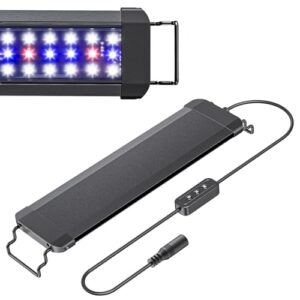
Need one light that works for a small row of nano tanks? The Pawfly Extendable Terrarium Light 11W is your starter pick. Its extendable bracket fits tanks from 12 to 18 inches, so sizing stays simple.
You get full-spectrum output from 6500K white, 450nm blue, and 660nm red LEDs, with 90 CRI and 40 PAR. Six brightness levels cover day and night, though night mode runs blue only. Switching is manual, so add a timer. Draws 11 watts and runs cool.
| Best For | Reptile and small-pet keepers with nano tanks or small acrylic enclosures between 12 and 18 inches who want one full-spectrum light that supports a natural day and night cycle. |
|---|---|
| Light Type | Full spectrum LED |
| Power | 11W, AC 100-240V |
| Material | Aluminum housing |
| Mounting | Extendable bracket |
| Control Method | Manual buttons, 6 levels |
| Fit Size | 12-18 inch tanks |
| Additional Features |
|
- Full-spectrum output from 6500K white, 450nm blue, and 660nm red LEDs, with 90 CRI and 40 PAR
- Extendable bracket fits tanks from 12 to 18 inches, so one light works across a row of small enclosures
- Runs cool at 11 watts thanks to its aluminum housing, with six brightness levels for day and night modes
- Only fits tanks between 12 and 18 inches, so larger or smaller enclosures may not work
- Night mode uses blue light only, with no white or red output after dark
- Modes and brightness are changed by hand, with no remote or timer included
2. AQUANEAT LED Aquarium Light 18-24 Inch
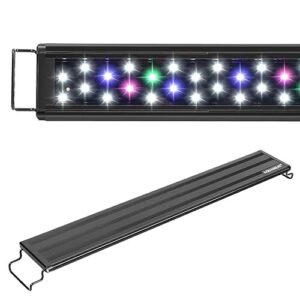
Forty-two LEDs in a bar 0.4 inches thick. That’s the AQUANEAT, and it’s light at 13.76 ounces.
You get 30 white 6500K diodes, plus 6 blue, 3 pink, and 3 green. Extendable brackets fit tanks from 18 to 24 inches, so it adapts as you grow.
Control is simple: on or off, with no timer or dimming. Add a smart plug to set your photoperiod.
It isn’t waterproof, so keep it dry. Some users report LED failure within four months.
| Best For | Hobbyists with a small to mid-size freshwater aquarium or terrarium (18 to 24 inches long) who want a simple, bright, plug-in light and don’t mind adding a smart plug for timing. |
|---|---|
| Light Type | White, blue, pink, green LED |
| Power | N/A |
| Material | Plastic |
| Mounting | Extendable brackets |
| Control Method | On/off switch only |
| Fit Size | 18-24 inch tanks |
| Additional Features |
|
- Extendable brackets fit tanks from 18 to 24 inches long
- 42 LEDs (30 white 6500K, plus blue, pink, and green) give bright light for plant growth and fish visibility
- Slim, light design at 0.4 inches thick and 13.76 ounces, and it works with an external timer via a smart plug
- Only an on/off switch, with no built-in timer, brightness control, or color modes
- Not waterproof, so it must be kept away from splashing water
- Some users report LED failure within 4 months of use
3. 6 Mini LED Grow Light Strips
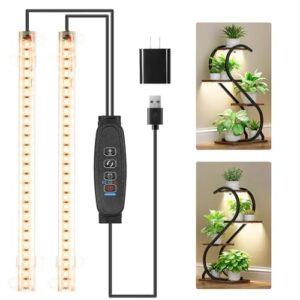
Fifty-two LEDs sit on two 8.6-inch strips, and that’s your whole setup. Tiny, right? For seedling shelves and succulent tanks, it’s plenty.
You get 10 dimmable levels, three switch modes, and a 3/9/12 hour timer that remembers your cycle. The 71-inch cord reaches almost anywhere. Warm 3000K light feeds leaf growth, flowering, and fruiting.
The catch: some units failed after three weeks, dimming only cycles one way, and auto turn-on can misfire. Skip these for UVB-dependent reptiles, and buy spares.
| Best For | Hobbyists growing seedlings, succulents, or small plants on a shelf who want a compact, low-cost light with a built-in timer. |
|---|---|
| Light Type | Full spectrum LED |
| Power | N/A |
| Material | Aluminum |
| Mounting | N/A |
| Control Method | Timer, 10 dim levels |
| Fit Size | Two 8.6-inch strips |
| Additional Features |
|
- 52 full spectrum LEDs on two 8.6-inch strips with 10 dimmable brightness levels and three switch modes
- Auto on/off timer with 3, 9, and 12 hour cycles that remembers your setting
- 71-inch power cord and aluminum construction make it easy to place on shelves, in offices, or in greenhouses
- Multiple units reportedly failed after about three weeks of use
- Brightness control cycles in one direction only through a single button
- The timer’s auto turn-on is not always reliable
4. AC Infinity IONBEAM S16 LED Grow Light
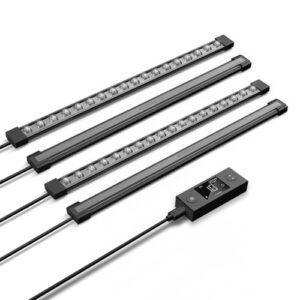
Want light exactly where your plants need it? The S16 delivers. You get four 16-inch LED bars with Samsung LM301H EVO diodes rated at 3.14 µmol/J.
A digital controller gives you ten intensity levels and daily schedules. Magnets and included steel bars mount everything to your tent frame, and an adapter (sold separately) lets you daisy chain other AC Infinity lights.
Know the tradeoffs, though. Cables run pretty short, magnets can hold weakly, and the controller clock drifts over days.
| Best For | Indoor growers with a grow tent who want to add targeted, supplemental light to shaded or hard-to-reach areas of their plant canopy. |
|---|---|
| Light Type | Samsung LM301H EVO LED |
| Power | N/A |
| Material | Aluminum |
| Mounting | Magnetic steel bars |
| Control Method | Digital controller, 10 levels |
| Fit Size | 16-inch bars |
| Additional Features |
|
- Four 16-inch LED bars use Samsung LM301H EVO diodes rated at 3.14 µmol/J for efficient, high-quality light.
- The digital controller offers ten intensity levels and daily schedule programming.
- Magnets and included steel bars make mounting to a tent frame easy, and an adapter (sold separately) allows daisy chaining with other AC Infinity lights.
- The cables are short for some setups, so you may need to buy extensions separately.
- The magnets can hold weakly, and some users report trouble keeping the bars on tent poles or beams.
- The controller clock does not keep accurate time, so schedules can drift over a few days.
5. Barrina T5 Grow Light 1ft 4-Pack
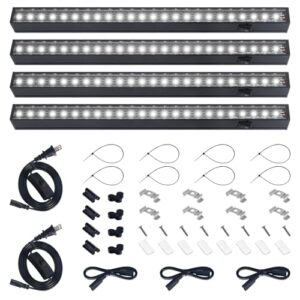
Running a shelf of seedlings or a microgreen cabinet? This pack gives you control light by light.
The 1ft fixtures deliver 5000K full spectrum white light, 96 LEDs in all, and the four-pack draws 20W. Separate on/off switches let you shut off one tray without touching the rest. Link up to 16 fixtures in series to grow your setup.
The black aluminum casing and dark cords stay discreet. The adhesive magnets may not grip wood, and durability reports are mixed.
| Best For | Hobby growers with a shelf of seedlings, a microgreen setup, or an indoor plant cabinet who want to control each light individually. |
|---|---|
| Light Type | 5000K full spectrum LED |
| Power | 20W total |
| Material | Black aluminum |
| Mounting | Magnet, tape, clips |
| Control Method | Individual on/off switches |
| Fit Size | 1 ft length |
| Additional Features |
|
- Separate on/off switches on each fixture let you light one tray without touching the rest
- 5000K full spectrum white light suits seedling, vegetative, and flowering stages
- Up to 16 fixtures can be linked in series to expand your setup
- Adhesive magnets may not adhere well to wood surfaces
- Customer reports on long-term durability are mixed
- Some users have experienced fixture failures over time
6. Barrina T5 Grow Lights 1ft 4 Pack
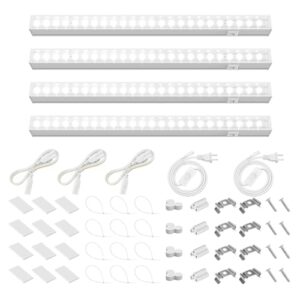
Same pack, different mindset. This Barrina set is built for plant-heavy vivariums, so think bioactive setups with real greenery. You get four 1ft bars with 96 LEDs each, 5000K full spectrum, and 20W per light. Low heat means you can mount them close to leaves without scorching.
Everything you need ships in the box: cords, clips, tape and cable ties. Link up to 16 lights and flip each switch individually. Skip wood or dusty surfaces, and add an external timer.
| Best For | Hobbyists running bioactive vivariums with live plants who want low-heat, full spectrum lighting they can mount close to leaves and control one bar at a time. |
|---|---|
| Light Type | 5000K full spectrum LED |
| Power | 20W per light, AC 100-240V |
| Material | Aluminum with polycarbonate lens |
| Mounting | Adhesive tape and clips |
| Control Method | Individual on/off switches |
| Fit Size | 1 ft length |
| Additional Features |
|
- Low heat output lets you place the lights close to plants without scorching them.
- Each bar has its own on/off switch, and up to 16 lights can be linked together.
- The kit includes everything needed to set up, such as cords, clips, tape, and cable ties.
- There is no built-in timer, so you need to buy an external one for automated scheduling.
- Adhesive mounting may fail on wood, dusty, greasy, or rough surfaces.
- The power cord is short, so you may need an extension cord to reach a wall outlet.
7. Pawfly 6W Terrarium LED Light
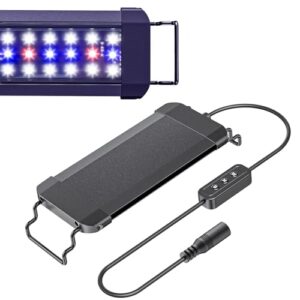
Now shrink the scale. The Pawfly 6W is built for nano tanks and small reptile enclosures, and its extendable bracket fits terrariums from 6" to 10.5" long. Secure it well, because the bracket can slide or collapse.
You get full spectrum lighting with 6500K white, 450nm blue and 660nm red LEDs, plus CRI 90 for true color. Blue and white dim independently across six levels, so day and night modes are yours to control. Heat stays low. It’s not UVB.
| Best For | Keepers of nano tanks and small reptile enclosures who want adjustable full spectrum lighting with low heat. |
|---|---|
| Light Type | Full spectrum LED |
| Power | N/A |
| Material | Aluminum with silicone sealing |
| Mounting | Extendable bracket |
| Control Method | Six intensity levels |
| Fit Size | 6-10.5 inch terrariums |
| Additional Features |
|
- Full spectrum LEDs (6500K white, 450nm blue, 660nm red) with CRI 90 for true color
- Blue and white light dim independently across six levels for day and night modes
- Low heat output suits temperature-sensitive reptiles
- Not a UVB light source, so it does not support vitamin D3 synthesis
- May need supplemental lighting for vivarium plant growth
- Extendable bracket can slide or collapse if not secured properly
8. ReptiKing 5.5 Inch Reptile Light Fixture
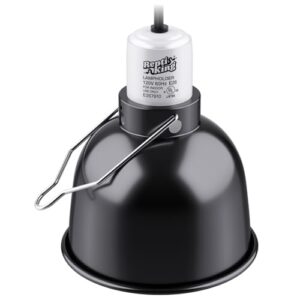
Now you need real heat. The ReptiKing 5.5 inch fixture is a simple dome, and you choose the bulb.
The extra deep aluminum dome pushes more light and UVA onto your basking spot. The ceramic E26 socket takes basking spots, heat bulbs, natural light bulbs, and ceramic heat emitters. The switch sits on a 6 ft cord, so setup is plug and play.
Watch the wattage. At 150W, the switch can overheat or melt, so go lower. Bulb choice matters.
| Best For | Reptile keepers who already have a favorite basking or heat bulb and want a simple, plug-and-play dome fixture with a long cord and an on/off switch. |
|---|---|
| Light Type | Bulb-dependent (E26 socket) |
| Power | 150W max bulb |
| Material | Aluminum dome, ceramic socket |
| Mounting | Dome clamp fixture |
| Control Method | Cord on/off switch |
| Fit Size | 5.5 inch dome |
| Additional Features |
|
- Extra deep aluminum dome directs more light and UVA onto the basking spot
- Heat resistant ceramic E26 socket works with basking spots, heat bulbs, natural light bulbs, and ceramic heat emitters
- On/Off switch on a 6 ft cord makes setup easy and positioning stable
- The on/off switch may overheat or melt with high-wattage bulbs like 150W
- Some units may have a shorter lifespan despite warranty coverage
- Heat output depends entirely on the bulb you choose, not the fixture itself
9. LuminPacific Adjustable UVB Reptile Lamp
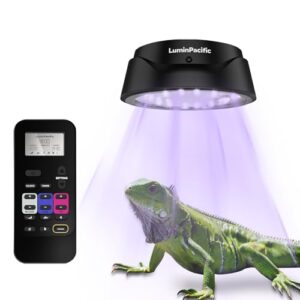
Heat’s handled, so add the light that does the other job. The LuminPacific lamp is a compact 4.53" square panel with an LCD remote, and it gives you independent 10-level control over UVB, UVA, and FR LEDs.
Five presets follow Ferguson Zones F1 to F4, plus one custom slot. Mount it with the mat, the magnet, or a screw-secured magnet on wood.
It helps with vitamin D3 synthesis but makes little heat. Magnets can slip on lidded tanks, and timers falter.
| Best For | Reptile keepers who already have a separate heat source and want a compact, adjustable UVB light with Ferguson Zone presets for supporting vitamin D3 synthesis. |
|---|---|
| Light Type | UVB, UVA, FR LED |
| Power | N/A |
| Material | Polycarbonate housing |
| Mounting | Mat, magnet, or screw |
| Control Method | LCD remote, 10 levels |
| Fit Size | 4.53 x 4.53 inches |
| Additional Features |
|
- Independent 10-level brightness control for the UVB, UVA, and FR LEDs, with five Ferguson Zone presets (F1–F4) plus one custom mode
- Three mounting options (non-slip mat, magnet, or screw-secured magnet for wood), and it can attach to plastic bin lids for temporary setups
- Supports vitamin D3 synthesis to maintain blood calcium levels and help prevent metabolic bone disease
- Produces no significant heat, so it can’t replace a basking or heat lamp
- The magnet may not be strong enough to hold the lamp securely on vertical or lidded enclosures
- Multiple users report the timer is unreliable and fails to turn the light on or off as programmed
10. Hygger Zoo T5 UVB Reptile Light Fixture
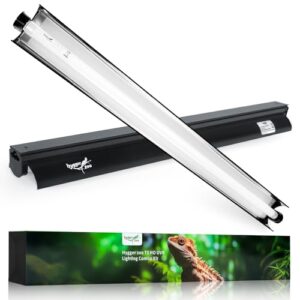
When you’re running several enclosures, the Hygger Zoo T5 UVB fixture earns its spot on your shortlist. It’s a 21.6-inch, 24W unit with a 5.9ft removable cord and an inline on/off switch.
Its alloy reflective layer pushes out 10% UVB and 30% UVA, which helps with calcium absorption and D3 synthesis and helps prevent metabolic bone disease in bearded dragons, geckos, and chameleons.
Here’s the catch. Some buyers received shattered bulbs, and support replies can lag. Inspect it right on arrival.
| Best For | Reptile keepers running several enclosures who want a T5 UVB fixture with strong UVB and UVA output for desert and basking species like bearded dragons, geckos, and chameleons. |
|---|---|
| Light Type | T5 UVB/UVA fixture |
| Power | 24W |
| Material | Glass |
| Mounting | N/A |
| Control Method | Cord on/off switch |
| Fit Size | 21.6 inch length |
| Additional Features |
|
- Delivers 10% UVB and 30% UVA output, thanks to an alloy reflective layer
- Supports calcium absorption and D3 synthesis, which helps prevent metabolic bone disease
- Comes with a 5.9ft removable power cord and an inline on/off switch for easy setup
- Some buyers received shattered bulbs or fixtures that didn’t work on arrival
- Return instructions have been reported as invalid or hard to use through the QR code
- Customer support can be slow or unresponsive, especially by email
LED Bars Vs T5 UVB Systems
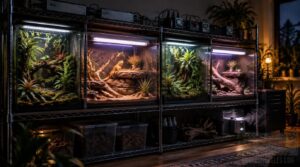
Lighting multiple enclosures comes down to one choice: LED bars or T5 UVB systems. You can run both, but you’ll want to know what each one actually does.
LED bars give you efficient, directional light and long life. Most don’t produce UVB, though, so basking species can end up in UV dead zones. T5 UVB systems cover that gap with steady output along the tube.
| Factor | LED bars | T5 UVB systems |
|---|---|---|
| UVB | Add-on needed | Built in |
| Lifespan | Tens of thousands of hours | Replace every 6-12 months |
| Mounting | Flush, slim | Bulkier, ballast |
| Control | Dimmable | Height sets dosage |
Mixing both across multiple enclosures works well if you keep mounting heights consistent. Watch your power strip load limits, since ballasts add up fast.
Installing Lights Across Multiple Enclosures
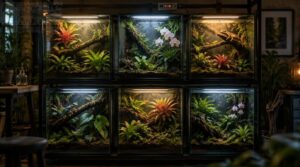
Picture a quiet wall of glowing glass, every enclosure lit evenly, not a single cord drooping. That’s the goal, and you can get there.
Picture a quiet wall of glowing glass, every enclosure evenly lit and not a single cord drooping
Start by mounting LED bars two to four inches above the tallest point in each of your multiple enclosures. Group similar fixtures together to cut shadows and shorten cable runs.
Next, tally your wattage. Respect power strip load limits, and keep 20 to 30 percent headroom so flexible power allocation stays possible when you add a tank. Raise the strip off the floor, away from splashes.
Photoperiod and Maintenance for Multiple Tanks
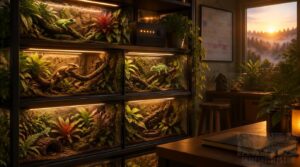
Sync the schedule, steady the animals, simplify your life. Solid photoperiod control starts with one shared sunrise and sunset across every enclosure.
Set tropical species to 12 to 14 hours of light, then ramp dawn and dusk gradually. Smart timers and dimming keep transitions soft, and a battery-backed clock stops drift after outages.
Modular lighting systems make this easy. Verify light uniformity in terrariums within 20 percent, and pick a plant growth spectrum if you’ve got live plants.
Peak UVB at midday, never at night. Log every bulb swap, replace UVB tubes every 6 to 12 months, and check settings during quiet hours.
A color-coded calendar helps. One glance tells you which tank is on track. Steady light, steady animals.
Frequently Asked Questions (FAQs)
What is the best type of lighting for a terrarium?
Your terrarium is a tiny sun-drenched world, so light it right. Great terrarium lighting means full spectrum lighting from LED grow lights, plus UVB lighting for reptiles.
Scaling to multiple enclosures? Match species needs first.
What not to put in a terrarium?
Skip treated wood, rusty metal, and silica sand. Your bioactive terrarium setup needs safer choices. Across multiple enclosures, match terrarium lighting systems, UVB lighting for reptiles, and plant growth lighting to each habitat’s real needs.
What is the best type of light for a paludarium?
For paludarium lighting, LED bars win. They give steady, even PAR with little heat, so your plants thrive and water stays stable. Add a UVB tube over the basking spot, then keep up UVB output monitoring.
What are the best LED lights for reptile enclosures?
Think of LED bars as your daylight workhorses. Run them over multiple enclosures, add modular LED strips for odd corners, and pair everything with T5 UVB systems at basking spots. That’s smart reptile enclosure lighting.
What are common terrarium mistakes to avoid?
Too fussy? Not really. Fix these: weak UVB Dose Scheduling, skipped Lux Uniformity Checks, one fixture over many tanks, sagging mounts, and messy wiring.
Use modular LED strips, cable management tools, and heat load balancing.
How long should a terrarium light be on?
Picture a sunrise that never stalls. Your light duration should run 12 to 14 hours, honoring photoperiodism.
Use a timercontrolled photoperiod with Dawn Dusk Ramping, and keep daynight light cycling steady. Consistency is your edge.
What is the best lighting for a terrarium?
The best lighting depends on what lives inside. Reptiles need UVB at the basking zone, and T5 UVB systems handle that well. Run Solarmeter checks, keep identical spectrum across multiple enclosures, and you’ve got control.
Does a terrarium need a lot of light?
Not always. Your light intensity measurement matters more than raw brightness. Across multiple enclosures, terrarium lighting systems should deliver a canopy UVB gradient, with UVI 23 basking spots only for desert species. You’ve got this.
How does UVB light differ from UV light?
Is UVB light a stronger UV light? Not quite. UVB spans 280 to 315 nm and drives vitamin D3 synthesis, while UV-A aids behavior.
Use Ferguson Zone presets, spectral ratio tuning, and lumen decay modeling.
What causes metabolic bone disease in reptiles?
Most cases trace back to calcium shortfalls. Weak UVB bulb, poor UVB reflection efficiency, and skipped light intensity calibration block vitamin D Bad thermal regulation in enclosures and thin UVA and UVB supplementation worsen it.
Conclusion
Picture your rack at dawn: six tanks glowing in sync, every basking spot warm, every shadow right where it belongs.
The best terrarium lighting systems for multiple enclosures aren’t the flashiest. They’re the ones sized to each tank, tuned to each species, and wired to one shared clock. Start with one fixture, test your UVB readings, then scale. Your animals won’t thank you out loud, but they’ll show it in every shed, meal, and sunrise.