This site is supported by our readers. We may earn a commission, at no cost to you, if you purchase through links.
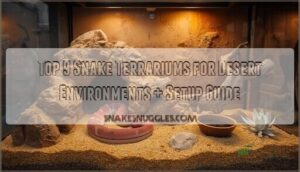
Your desert snake’s survival hinges on one critical decision: the terrarium you choose. Unlike tropical species that tolerate a range of conditions, desert snakes—from Kenyan sand boas to rosy boas—require precise environmental parameters that mirror their native arid habitats, where daytime temperatures can soar above 95°F while nighttime lows drop dramatically.
Get the humidity wrong by even 10-15%, and you’re inviting respiratory infections; select the wrong substrate, and your snake won’t exhibit natural burrowing behaviors that reduce stress and promote thermoregulation.
The right terrarium setup isn’t just about aesthetics or convenience—it’s about replicating thermal gradients, low moisture levels, and spatial complexity that allow these specialized reptiles to thrive in captivity, exhibiting the same behaviors they’ve evolved over millions of years in some of Earth’s harshest landscapes.
Table Of Contents
- Top 9 Snake Terrariums and Substrates for Deserts
- 1. Exo Terra Reptile Glass Terrarium
- 2. Exo Terra Outback Terrarium
- 3. Carolina Custom Large Glass Terrarium
- 4. Natural Coconut Fiber Reptile Bedding
- 5. Organic Coconut Reptile Bedding Substrate
- 6. Natural Forest Floor Bedding Substrate
- 7. Natural Cypress Reptile Bedding Mulch
- 8. Natural Aspen Snake Bedding Supply
- 9. Zilla Reptile Bedding Substrate
- Choosing The Best Enclosure for Desert Snakes
- Selecting Safe and Naturalistic Substrates
- Achieving Optimal Desert Temperatures and Humidity
- Enrichment and Decor for Desert Snake Terrariums
- Frequently Asked Questions (FAQs)
- Conclusion
Top 9 Snake Terrariums and Substrates for Deserts
Setting up a proper desert terrarium starts with selecting an enclosure and substrate that meet your snake’s specific environmental needs, from temperature retention to secure ventilation.
The following nine products represent some of the most reliable options available, combining both complete terrarium systems and specialized substrates designed for arid-adapted species.
Each option tackles key factors like humidity control, escape prevention, and naturalistic burrowing opportunities that desert snakes require to thermoregulate and display normal behaviors.
1. Exo Terra Reptile Glass Terrarium
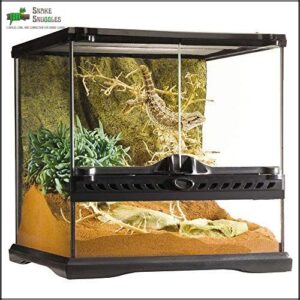
The Exo Terra Reptile Glass Terrarium stands as a solid foundation for your desert snake habitat, offering front-opening doors that minimize stress during maintenance and handling. Available in sizes ranging from 12x12x12 to 40x20x20 inches, you’ll find dimensions suitable for juveniles and smaller desert species, though larger snakes require more spacious alternatives.
The dual-door locking system prevents escapes, while adjustable glass ventilation panels help you maintain the low humidity levels desert snakes need to thermoregulate effectively, creating appropriate temperature gradients across your naturalistic setup.
| Best For | Hobbyists seeking a compact, escape-proof enclosure for small desert snakes, juvenile reptiles, or arid-dwelling species that need low humidity and easy front access. |
|---|---|
| Material | Glass |
| Weight | 13.2 Pounds |
| Brand | Exo Terra |
| Primary Use | Reptiles/Amphibians |
| Dimensions | 12 x 12 x 12 inches |
| Maintenance | Easy to Clean |
| Additional Features |
|
- Front-opening dual doors reduce stress during feeding and cleaning while preventing escapes with secure locks
- Adjustable ventilation panels help maintain the low humidity desert snakes require
- Multiple size options accommodate growing juveniles and smaller species
- Glass construction can be heavy and fragile during transport or repositioning
- Requires external heating equipment to reach proper desert temperature ranges
- Smaller models may not provide adequate space for larger adult desert snakes
2. Exo Terra Outback Terrarium
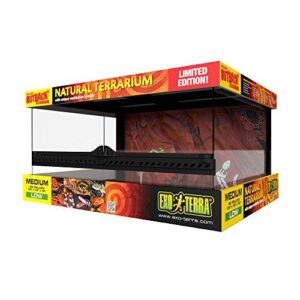
If you’re ready to enhance your desert terrarium, the Outback model offers a secure, front-opening design with a unique ventilation system and a hand-painted 3D rock background—perfect for authentic Desert Landscaping. Its stainless steel screen accommodates Terrarium Lighting while maintaining stable temperature gradients for desert snake hibernation cycles.
Outback Maintenance is straightforward, though you’ll want to monitor hinges and background durability. Thoughtful reptile habitat design here means your snake can burrow, bask, and thrive, fostering Reptile Health in a truly naturalistic setup.
| Best For | Reptile keepers looking for a front-opening desert terrarium with naturalistic decor and good ventilation for medium-sized species like bearded dragons, leopard geckos, or desert snakes. |
|---|---|
| Material | Stainless Steel |
| Weight | 0.01 Ounces |
| Brand | Exo Terra |
| Primary Use | Terrestrial Reptiles |
| Dimensions | 25 x 19.6 x 13.3 inches |
| Maintenance | Easy Access |
| Additional Features |
|
- Front-opening doors with secure locks make daily maintenance and feeding easy without stressing your reptile
- Unique hand-painted 3D Outback background creates an authentic desert environment right out of the box
- Stainless steel mesh top provides excellent ventilation while supporting heat lamps and other equipment
- Durability concerns—some users report the terrarium arriving broken or the background material flaking off over time
- Door hinges may wear out with frequent use, potentially requiring careful handling or replacement
- Limited cord management options since cable holes are only in the back, and the mesh top may sag under heavier lighting setups
3. Carolina Custom Large Glass Terrarium
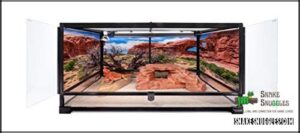
For serious keepers with large enclosures in mind, Carolina Custom’s 48×18×18-inch glass terrarium delivers outstanding temperature control through adjustable ventilation panels and optional bottom drainage—critical for maintaining stable desert ecosystems.
This reptile enclosure’s tempered-glass construction and front-opening design let you access your desert snake without disrupting its thermal gradient, while customizable features accommodate species-specific needs.
You’ll need a sturdy stand supporting 350–400 pounds when fully equipped, but the terrarium design rewards you with professional-grade functionality that grows alongside your herpetological expertise.
| Best For | Experienced reptile keepers housing larger desert snakes who need precise environmental control and have space for a heavy-duty, professional-grade setup. |
|---|---|
| Material | Non-tempered Glass |
| Weight | 60.4 Pounds |
| Brand | Generic |
| Primary Use | Reptile Habitats |
| Dimensions | 35.9 x 17.9 x 18 inches |
| Maintenance | Fully Opening Doors |
| Additional Features |
|
- Adjustable ventilation panels and optional bottom drainage give you excellent control over temperature and humidity for desert species
- Tempered glass construction with aluminum frame creates a durable enclosure that’ll last for years
- Front-opening design makes daily care and feeding much easier without disturbing your snake’s carefully maintained temperature zones
- Requires a reinforced stand capable of holding 350–400 pounds, which adds to your overall setup cost
- Large size and weight make it difficult to move or reposition once you’ve got it set up
- Premium construction comes at a higher price point than standard glass terrariums
4. Natural Coconut Fiber Reptile Bedding
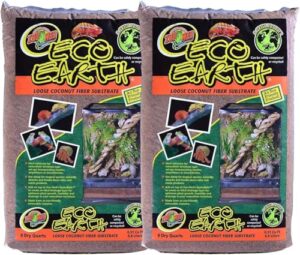
Zoo Med’s 8-quart natural coconut fiber bedding tackles desert substrate choices by supporting burrowing behavior without the respiratory hazards of pine or cedar shavings—a reptile bedding safety priority for keepers creating naturalistic vivariums.
When kept dry, this fiber substrate maintains the low humidity your desert snake requires while offering stable footing and natural aesthetics that improve any desert ecosystem.
You’ll appreciate the fiber substrate maintenance simplicity: spot-clean daily, replace when compacted, and rinse before use to minimize fine particulates that could irritate sensitive respiratory tissues in your collection.
| Best For | Keepers of desert snakes like ball pythons or sand boas who want a low-dust, burrowing-friendly substrate that maintains dry conditions without the respiratory risks of wood shavings. |
|---|---|
| Material | Coconut Fiber |
| Weight | 6.4 Pounds |
| Brand | Zoo Med |
| Primary Use | Naturalistic Terrariums |
| Dimensions | 16 x 15 x 5.5 inches |
| Maintenance | Easy to Vacuum |
| Additional Features |
|
- Supports natural burrowing and digging behaviors while providing stable, non-abrasive footing for desert species
- Low dust levels compared to pine or cedar reduce respiratory irritation when pre-rinsed before use
- Simple maintenance with daily spot-cleaning and full changes every 1–3 months depending on enclosure activity
- Some batches arrive overly dry and require pre-wetting or rinsing to reduce fine particulates
- Packaging inconsistencies reported by customers, with occasional single-pack deliveries instead of the advertised 2-pack
- Can be pricey for larger enclosures requiring frequent full substrate replacements
5. Organic Coconut Reptile Bedding Substrate
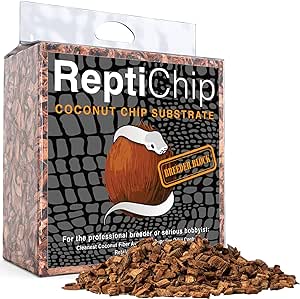
Professional breeders understand that this 72-quart compressed brick of organic coconut fiber tackles multiple desert substrate priorities simultaneously—humidity control, odor absorption, and burrowing stability—expanding to ten pounds of bedding that maintains the 30-40% moisture levels your desert snake requires without creating dampness.
The pH-neutral composition, generally ranging from 6.0 to 7.0, minimizes skin irritation risks while the fine-grade texture promotes natural excavation behaviors in species like hognose snakes.
Replace every four to eight weeks to prevent mold accumulation and maintain peak reptile health in your desert terrarium.
| Best For | Professional breeders and hobbyists keeping desert snakes like hognose or ball pythons who need a substrate that balances humidity control with burrowing opportunities. |
|---|---|
| Material | Organic Coco Chips |
| Weight | 10 Pounds (expanded) |
| Brand | Generic |
| Primary Use | Bioactive Substrate |
| Dimensions | Variable (expands) |
| Maintenance | Absorbs Waste |
| Additional Features |
|
- Expands from a compact 72-quart brick to 10 pounds of bedding, giving you plenty of substrate while saving storage space
- PH-neutral formula (6.0–7.0) helps prevent skin irritation while naturally absorbing odors to keep your terrarium fresh
- Fine texture lets desert snakes burrow and dig naturally without kicking up excessive dust that can irritate their respiratory systems
- Higher price point compared to basic substrates like paper towels or aspen shavings
- Can create a dusty cloud when you first hydrate and expand the brick, so you’ll want good ventilation or a mask
- Needs replacement every 4–8 weeks to avoid mold buildup, which adds to ongoing maintenance costs
6. Natural Forest Floor Bedding Substrate
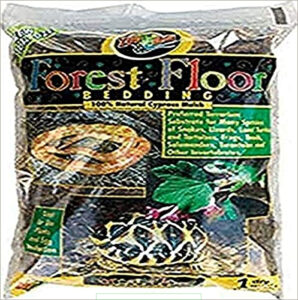
Forest floor bedding offers microhabitat creation that mimics the shaded pockets many desert snakes encounter near vegetation. This provides natural humidity control through moisture-retentive decomposed leaves, maintaining localized gradients without saturating the entire vivarium.
A substrate depth of two to four inches facilitates burrowing behavior in species like rosy boas while encouraging natural concealment instincts.
This layered material creates a stable temperature gradient when paired with overhead heating. However, you must monitor for mold growth and replace sections every four to six weeks to maintain ideal reptile care standards.
| Best For | Keepers of humidity-loving desert snakes like rosy boas who want naturalistic microhabitats with built-in moisture retention and burrowing opportunities. |
|---|---|
| Material | Natural Cypress Mulch |
| Weight | 10.6 Pounds |
| Brand | Zoo Med |
| Primary Use | Forest Floor Look |
| Dimensions | 18 x 12 x 6 inches |
| Maintenance | Spot Clean |
| Additional Features |
|
- Creates natural humidity gradients without soaking the whole enclosure, perfect for species that need localized moist spots
- Supports natural digging and hiding behaviors with a soft, layered texture that mimics native forest pockets
- Reduces dust compared to sand while adding visual realism to mixed desert setups
- Requires regular monitoring for mold growth and partial replacement every four to six weeks
- Can harbor pests like mites or beetles if not quarantined before use
- Makes it harder to spot waste due to dark color and varied texture
7. Natural Cypress Reptile Bedding Mulch
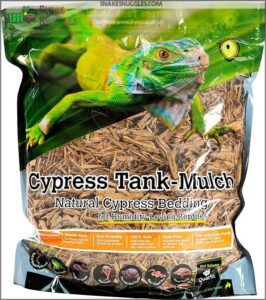
Cypress mulch benefits arid enclosures through its moisture-retention properties, which stabilize humidity gradients without creating saturated conditions unsuitable for desert snakes. Its irregular texture encourages burrowing while visually resembling desert floor debris found near shrubland edges, helping you achieve naturalistic terrariums.
The material’s aromatic oils require careful monitoring for respiratory sensitivity in your snake enclosure, though cypress remains safer than cedar alternatives. Reptile bedding safety improves when you select untreated products and maintain proper ventilation.
Cypress mulch supports temperature gradient establishment through its insulating layered structure, enabling thermoregulation in your snake’s habitat.
| Best For | Keepers of humidity-loving reptiles like ball pythons, iguanas, and frogs who want a natural, sustainable substrate that helps maintain moisture levels while allowing burrowing behavior. |
|---|---|
| Material | Cypress Wood |
| Weight | 1.95 Pounds |
| Brand | Generic |
| Primary Use | Tropical Humidity |
| Dimensions | 5 x 13.5 x 14 inches |
| Maintenance | Easy to Clean |
| Additional Features |
|
- High absorbency controls humidity effectively for tropical species while reducing odors and dust compared to other bedding types
- Made from 100% natural cypress timber by-product with no harmful chemicals, salts, or parasites, making it safe for reptiles at all life stages
- Easy to maintain and clean, dries quickly when wet, and can be mixed with other substrates like coconut fiber for planted enclosures
- More expensive than many alternative bedding options, which can add up for larger enclosures or frequent replacements
- Some customers report receiving dusty or damaged products, requiring washing or sifting before use
- The 8-quart size may not provide enough coverage for very large terrariums, and some wood pieces can be sharp or require initial preparation
8. Natural Aspen Snake Bedding Supply
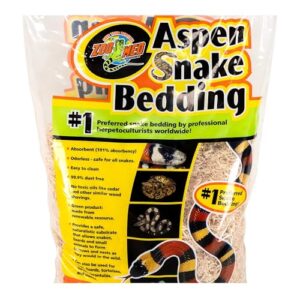
Aspen substrate dominates snake bedding recommendations because its dust-free composition and 191% absorbency rating eliminate respiratory hazards common in cedar alternatives while supporting natural burrowing behavior essential for desert snake thermoregulation.
Your snake enclosure benefits from aspen’s biodegradable wood fibers, which maintain desert humidity levels between 30-40% without encouraging mold growth that compromises reptile safety.
The material’s light coloration helps you monitor waste accumulation during spot-cleaning routines, and its renewable sourcing aligns with sustainable reptile habitat design principles while establishing proper temperature gradients through its insulating layered structure.
| Best For | Snake owners who need safe, absorbent bedding that supports natural burrowing behavior and makes waste cleanup easy. |
|---|---|
| Material | Aspen Wood |
| Weight | 2.15 Pounds |
| Brand | Zoo Med |
| Primary Use | All Snakes |
| Dimensions | 15.3 x 8.8 x 4.8 inches |
| Maintenance | Easy Spot Clean |
| Additional Features |
|
- 191% absorbency rating keeps enclosures dry and controls odors effectively
- Dust-free and free from toxic oils, making it safe for your snake’s respiratory health
- Easy to spot clean and biodegradable, with good value for the price
- Some users report it’s not completely dust-free despite claims
- Doesn’t retain moisture well if soaked, requiring more frequent changes
- May need regular replacement to prevent mold in humid conditions
9. Zilla Reptile Bedding Substrate
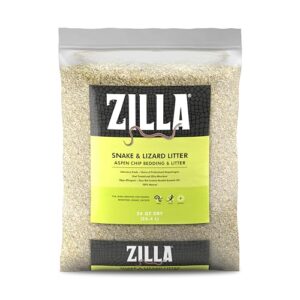
Zilla’s heat-treated aspen formula delivers substrate moisture control critical for desert snake health while maintaining the 30-40% ambient humidity desert species require for proper ecdysis.
You’ll find this reptile bedding option simplifies terrarium maintenance through its ultra-absorbent 24-quart chips, which support snake burrowing behavior without generating respiratory-compromising dust particles common in untreated wood products.
The material’s neutral coloration won’t interfere with your temperature gradient monitoring, and its hypoallergenic composition makes it suitable across multiple desert terrarium setups, from juvenile Western Hognose to adult Rosy Boas requiring consistent reptile enclosure conditions.
| Best For | Reptile owners with desert-dwelling burrowing snakes like hognose, rosy boas, or corn snakes who need low-dust bedding that absorbs moisture while still supporting natural digging behavior. |
|---|---|
| Material | Aspen Chips |
| Weight | 9.85 Pounds |
| Brand | Zilla |
| Primary Use | Burrowing Reptiles |
| Dimensions | 22.5 x 17.1 x 4.7 inches |
| Maintenance | Easy Spot Cleaning |
| Additional Features |
|
- Heat-treated aspen chips are hypoallergenic and free from toxic aromatic oils found in pine or cedar, making them safer for sensitive reptiles.
- Ultra-absorbent material controls moisture and odor effectively while maintaining the 30-40% humidity range desert species need.
- Large chip size makes spot-cleaning simple and produces minimal dust compared to finer substrates.
- Aspen chips can be harder to tunnel through than sand-based substrates, which may frustrate species that dig extensively.
- Chips sometimes stick to live prey items, making feeding messier for snakes that eat insects or rodents.
- The packaging can tear easily during shipping or handling, and it’s pricier than basic wood shavings.
Choosing The Best Enclosure for Desert Snakes
Selecting the right enclosure for your desert snake involves balancing several critical factors, from size and material to ventilation and security features that support thermoregulation in arid conditions. The ideal terrarium must accommodate your snake’s natural behaviors while providing you with practical access for maintenance and observation.
In the sections below, you’ll find specific guidance on enclosure dimensions, design styles, material choices, locking mechanisms, and airflow considerations that will help you create a safe, functional desert habitat.
Ideal Enclosure Size and Shape
Your desert snake deserves an enclosure that mirrors its natural roaming instincts, which means prioritizing floor space over height. For most desert species, you’ll want a rectangular terrarium offering at least 36–72 inches of linear movement, with 12–24 inches of vertical height to accommodate climbing branches without encouraging escape attempts.
This shape facilitates stable thermal gradients and exploration behaviors essential for thermoregulation.
When designing the terrarium, consider the importance of clear structure and organization, using effective writing guides to guarantee a well-planned environment.
Front-Opening Vs. Top-Opening Designs
Once you’ve settled on enclosure size, you’ll need to decide between front-opening doors and top-access designs, each offering distinct advantages for desert snake terrariums. Front-opening models provide larger access points while maintaining seal integrity and ventilation systems critical for arid conditions, whereas top-opening designs minimize escape risks from snakes that push against door mechanisms. Your choice depends on your reptile enclosure’s placement and your desert snake’s temperament.
When designing the terrarium, consider the importance of research methodology to guarantee a well-planned environment.
Material Selection: Glass, PVC, and Wood
Your material choice shapes not only your vivarium’s structural integrity but also its thermal insulation and moisture resistance—key factors in desert snake care. Glass enclosures offer excellent clarity and remain inert, resisting odors and stains, while PVC provides lightweight, impact-resistant panels with great heat retention.
Consider these material properties:
- Glass delivers exceptional visibility for observing basking behavior
- PVC excels at maintaining stable temperature gradients
- Wood offers natural aesthetics but requires careful sealing
- Each material demands specific maintenance protocols
- Durability varies notably with humidity fluctuations
Your reptile enclosure’s material directly influences long-term performance and animal enclosure design success.
Secure Locks and Escape Prevention
Beyond choosing durable panels, you’ll need locking mechanisms that reliably contain your desert specialist. Hasp locks with centralized posts engage multiple catches, while magnetic latches automatically close to prevent accidental escapes.
Install double-door systemic latches at access points to deter prying, and inspect all fasteners monthly—temperature swings can misalign secure doors. Position hiding spots away from latch zones to maintain quick access during routine lock maintenance.
Ventilation for Arid Environments
Once your locks are secure, turn your attention to Airflow Management. Even desert species need steady ventilation. Place screened vents near the top front and bottom back to generate a vertical air column that carries heat away from basking zones while preserving Thermal Gradients.
This cross-flow design prevents humidity spikes and filters airborne dust, supporting ideal temperature and humidity control without disrupting your carefully crafted Desert Climate microhabitats.
Selecting Safe and Naturalistic Substrates
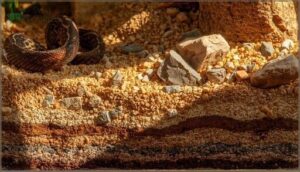
Substrate selection forms the foundation of a functional desert terrarium, affecting everything from thermoregulation to your snake’s ability to express natural burrowing behaviors. You’ll need materials that mimic arid conditions while remaining safe for extended contact with your snake’s ventral scales and respiratory system.
The following sections guide you through choosing substrates that balance authenticity with practicality, maintaining the low humidity and firm structure that desert species require.
Desert-Appropriate Substrate Types
You’ll need a substrate that facilitates thermoregulation and natural burrowing behaviors without compromising respiratory health. Fine-grain reptile sands mixed with clay improve stability for tunnel construction, while cocoa fiber blends with caustic-free minerals reduce dust inhalation risks.
Coconut coir maintains substrate moisture and humidity control in your desert terrarium, and cypress mulch provides excellent soil composition that resists mold while facilitating temperature gradients essential for proper desert snake care.
Creating Burrowing and Hiding Opportunities
You’ll want substrate depth between 6 and 12 centimeters to support stable snake tunnels and desert dens that won’t collapse during burrowing. Layer coarse material beneath finer particles to improve burrow design stability, and distribute multiple hiding spots across your enclosure size to create temperature gradients.
These hiding places reduce stress by mimicking natural crevices, promoting healthy snake behavior and enrichment while supporting essential reptile husbandry practices in arid environments.
Avoiding Hazardous or Dusty Materials
When selecting substrate for desert enclosures, you must recognize that certain materials pose serious respiratory risks to your snake through hazardous particles and poor dust control. Proper ventilation, enclosure size, and temperature gradient won’t protect against toxic substrate choices that compromise respiratory health:
- Avoid silica sand, which generates fine dust causing respiratory irritation
- Reject pine and cedar substrates releasing aromatic oils that trigger mucous membrane inflammation
- Skip play sand containing additives, perfumes, or contaminants
- Eliminate chemically-treated wood mulches that volatilize toxins in enclosed spaces
Substrate Maintenance and Replacement
Substrate maintenance is an ongoing commitment to your snake’s respiratory health and microbial management. You’ll maintain substrate depth at 2 to 4 inches for burrow stability while spot-cleaning daily to remove waste.
Replace desert substrates every 6 to 12 months to control humidity and reduce pathogen accumulation, scheduling full changes around health assessments to support peak reptile health and wellness.
Achieving Optimal Desert Temperatures and Humidity
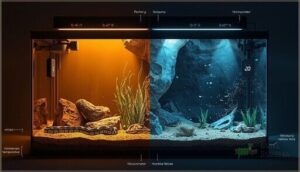
Replicating the harsh yet precisely balanced conditions of a desert environment requires more than just turning up the heat—you need to establish distinct thermal zones, control humidity with surgical precision, and monitor both continuously to prevent stress or illness.
Desert snakes have evolved to thermoregulate by moving between warm basking areas and cooler retreats throughout the day, so your enclosure must offer this same life-sustaining gradient.
Desert snakes thrive when their enclosure provides both warm basking zones and cool retreats for essential daily thermoregulation
Let’s examine how to create these critical environmental parameters using the right heat sources, monitoring tools, and humidity management techniques.
Establishing a Thermal Gradient
Your desert snake terrarium must feature a defined thermal gradient, allowing your snake to thermoregulate naturally between zones. Position basking zones at the warm end between 90–100°F (32–38°C) to support digestion and activity, while maintaining cooler areas around 75–79°F (24–26°C).
Monitor temperature gradients at multiple points throughout the enclosure to verify consistent heat distribution and ideal reptile health and wellness.
Heat Sources: Lamps, Mats, and Emitters
Choosing the right heat source transforms your reptile enclosure into a precisely controlled environment where your snake can thrive. Ceramic heat emitters radiate long-wave infrared heat without disrupting day-night cycles, while under-tank heating mats deliver consistent bottom warmth that maintains core body temperatures throughout cooler periods. Basking lamps establish defined heat gradients across your terrarium setup, creating essential thermal zones.
- Position heat lamps 10–15 cm above basking surfaces to achieve species-specific temperatures between 90–110°F (32–43°C)
- Pair heating mats with thermostats to prevent surface temperatures from exceeding 95°F (35°C) and guarantee safe ambient temperatures
- Install radiant heat panels across larger snake terrariums to distribute warmth evenly and eliminate dangerous hot spots
- Use pulse-proportional dimming controls with emitter controls to regulate heat emission and prevent overheating throughout the enclosure
Monitoring and Controlling Humidity
Once you’ve dialed in your thermal gradients, you’ll need precision tools to track ambient moisture levels. Digital hygrometers placed at multiple heights reveal desert microclimates within your vivarium, ensuring humidity levels stay between 20 and 40 percent for most arid species. Calibrate humidity sensors monthly against a known standard, maintain daily logs, and adjust ventilation or substrate moisture whenever readings drift beyond your target range for ideal reptile care.
| Equipment | Function | Maintenance |
|---|---|---|
| Digital hygrometers | Monitor humidity levels at substrate and ambient heights | Calibrate monthly against salt test or reference standard |
| Ventilation fans | Reduce moisture buildup without compromising thermal gradients | Clean vents biweekly to prevent dust accumulation |
| Water bowls | Provide localized humidity source away from basking zones | Refill daily; scrub weekly with reptile-safe disinfectant |
| Desiccant packs | Lower humidity in consistently moist snake terrariums | Replace every 4–6 weeks or when saturation occurs |
Water Dish Placement and Humidity Gradients
Your water bowl creates its own microclimate when you position it on the cooler end of the vivarium’s thermal gradients, lifting humidity levels 10 to 20 percent locally without saturating the entire terrarium design. Smart water placement encourages natural snake hydration while preserving the low ambient moisture desert microclimates demand.
To optimize your setup:
- Site the dish away from basking lamps to prevent rapid evaporation
- Use stable, non-slip surfaces that won’t tip during substrate maintenance
- Place near hide entrances to reduce stress during drinking behavior
- Monitor humidity control with sensors at multiple enclosure heights
Enrichment and Decor for Desert Snake Terrariums
Creating a stimulating desert terrarium goes beyond temperature control and substrate selection—you need to provide enrichment that mimics your snake’s natural habitat while promoting healthy behaviors.
The right combination of hides, basking surfaces, climbing structures, and naturalistic decorations can reduce stress, encourage activity, and support your snake’s physical and psychological wellbeing.
Let’s explore how to design an environment that keeps your desert species engaged and thriving.
Natural-Looking Hides and Basking Spots
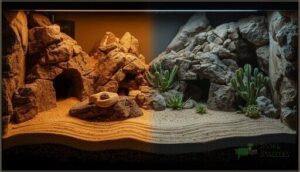
A well-chosen hide mimics Rocky Outcrops or burrows, anchoring your desert terrarium’s sense of safety. You’ll want Hide Designs with single entrances and overhead coverage, placed across Thermal Gradients.
Basking Rocks—rough, dark, and thick—hold warmth for hours, letting snakes thermoregulate naturally.
Desert Plants and textured substrate encourage hiding spots, shedding, and authentic reptile habitat design.
Climbing Branches and Ledges
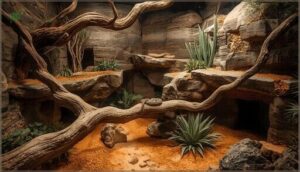
Beyond ground-level retreats, climbing structures provide arboreal enrichment in your snake terrariums. Branch placement should create at least two to three accessible routes, with diameters varying to build climbing skills and ledge design offering both vertical and horizontal surfaces near heat sources.
Secure anchors prevent shifts during exploration, while smooth, naturally textured materials protect skin—transforming reptile habitat design into a three-dimensional landscape that encourages thermoregulation and reduces stress.
Desert-Themed Decorations and Plants
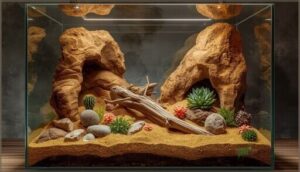
Authentic desert rock formations and carefully chosen cactus decor transform your terrarium setup and management into a convincing arid landscape that fosters both ecosystem management and environmental enrichment. When selecting succulent care elements and arid plant species for reptile landscaping, you’ll want to prioritize safety alongside aesthetics in your desert terrarium design.
- Rock crevices and driftwood mimic natural desert rock formations without trapping moisture
- Artificial plants designed for reptile enclosures prevent accidental ingestion hazards
- Non-toxic, pesticide-free succulents tolerate low humidity and bright terrarium lighting conditions
- Cork bark and clay hides boost burrowing opportunities while maintaining proper airflow
- Drought-tolerant live plants require monitoring for substrate contamination and waste buildup
Environmental Enrichment for Snake Wellbeing
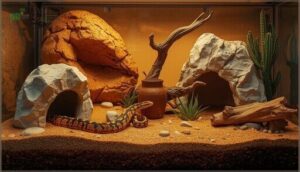
Cognitive stimulation through thoughtful environmental complexity determines whether your desert terrarium merely houses a snake or actively fosters natural snake behavior and animal welfare. By rotating hide placements every two weeks, adjusting thermal heterogeneity zones, and introducing varied substrate textures, you can encourage foraging instincts within naturalistic landscapes, thereby improving reptile care.
| Enrichment Type | Purpose | Implementation |
|---|---|---|
| Shelter Variety | Reduce stress indicators | Multiple hide box styles and locations |
| Substrate Complexity | Encourage burrowing behaviors | Layered sand-soil mixtures with depth variation |
| Thermal Zones | Support basking and exploration | Temperature gradients across enclosure length |
| Object Rotation | Prevent behavioral predictability | Biweekly repositioning of branches and decorations |
Monitor your snake’s response to each environmental enrichment adjustment. Increased exploration and natural foraging patterns confirm that you’re optimizing welfare through proper desert terrarium design.
Frequently Asked Questions (FAQs)
What lighting schedule works best for desert snakes?
To mimic the desert’s natural day-night cycle, your snake needs a consistent photoperiod of 12-14 hours of light to support its circadian rhythms.
Additionally, provide UVB lighting and thermal gradients to ensure proper thermoregulation and activity.
How often should desert snakes be fed?
You’ll feed adult desert snakes every 7 to 14 days, while juveniles need meals every 5 to 7 days to support growth—adjusting schedules based on each species’ metabolic needs and digestion rates.
Can multiple desert snakes share one terrarium?
Most desert species are territorial adults, so cohabitation risks include aggression and competition for resources.
Expert reptile enclosure guidance favors single-occupant snake terrariums to optimize welfare, minimize injury, and simplify desert terrarium management.
What signs indicate a desert snake is sick?
Is your snake suddenly sluggish or refusing food? Watch for lethargy, weight loss, abnormal shedding, visible wounds, discharge, or wheezing—these sick snake symptoms demand immediate veterinary advice to protect your desert snake health.
Do desert snakes need UVB lighting supplements?
While nocturnal species rely on dietary sources, diurnal desert snakes benefit from UVB lighting needs that support vitamin D synthesis and calcium metabolism—critical for desert snake health when replicating their bioactive ecosystem inside your desert terrarium.
Conclusion
Desert snakes thrive in captivity when you recreate the harshness they need—extreme heat gradients, bone-dry air, deep substrate for instinctive burrowing. Choose snake terrariums for desert environments that prioritize thermal precision over convenience, invest in low-humidity substrates like aspen or sand blends, and monitor conditions daily with reliable thermometers and hygrometers.
Your snake won’t adapt to improvisation; instead, you must engineer the exact microclimate its physiology demands, transforming glass and substrate into a functional slice of arid wilderness.
- https://academichelpexpress.blog/2024/08/please-use-the-bulleted-points-and-the-rubric-below-to-guide-your-work-your-pa/
- https://x.com/godofprompt/status/1990526288063324577
- https://www.writingclearscience.com.au/category/writing-guides/writing-research-papers/page/2/
- https://www.sciencedirect.com/science/article/pii/S0749208123000268
- https://onlinepubs.trb.org/onlinepubs/nchrp/cd-22/manual/v1appendixb.pdf