This site is supported by our readers. We may earn a commission, at no cost to you, if you purchase through links.

Most substrate problems don’t announce themselves—they show up as a respiratory infection three weeks later, or a shed that comes off in frustrating little pieces instead of one clean pull.
The floor of your snake’s enclosure does more biological work than most keepers realize: it regulates humidity, buffers temperature swings, and either maintains or suppresses the microbial load your animal breathes every single day.
For sensitive snakes especially, the wrong substrate isn’t just uncomfortable—it’s a slow-moving health risk. Getting substrate options for sensitive snakes right means understanding what your specific animal actually needs at a species level, not just grabbing whatever looks natural at the pet store.
Table Of Contents
- Key Takeaways
- Best Substrate Options for Sensitive Snakes
- Key Factors in Substrate Selection
- Top 5 Substrates for Sensitive Snakes
- Matching Substrate to Snake Species
- Frequently Asked Questions (FAQs)
- What kind of gravel do snakes hate?
- How often should sensitive snake substrates be replaced?
- Can substrate cause allergic reactions in sensitive snakes?
- What substrate depth works best for burrowing snakes?
- How do you transition a snake to new substrate?
- Are substrate additives safe for respiratory-sensitive snakes?
- Conclusion
Key Takeaways
- The substrate beneath your snake isn’t passive bedding—it actively regulates humidity and temperature, making it one of the most consequential health decisions you’ll make for a sensitive animal.
- Coconut fiber, sphagnum moss, and bioactive blends consistently outperform simpler options for sensitive species because they balance moisture retention, dust-free texture, and natural microfauna support without chemical risk.
- Substrate depth matters clinically—burrowing species need 4–6 inches minimum, while species-specific humidity targets (60–80% for ball pythons, 40–50% for corn snakes) should drive your material choice before aesthetics ever enter the picture.
- Wrong substrate choices don’t announce themselves immediately; respiratory infections and poor sheds weeks later are the real consequence, so replacing substrate every 4–6 weeks and spot-cleaning daily is non-negotiable for long-term snake health.
Best Substrate Options for Sensitive Snakes
Choosing the right substrate for sensitive snakes comes down to balancing safety, moisture control, and ease of maintenance. You need materials that won’t irritate delicate skin or respiratory systems while still supporting your snake’s natural behaviors.
A good starting point is understanding the full picture of snake tank maintenance and habitat setup, since substrate choices ripple into humidity, hygiene, and your snake’s overall wellbeing.
Here are five proven substrate options that meet these critical requirements.
Paper Towels and Newspaper
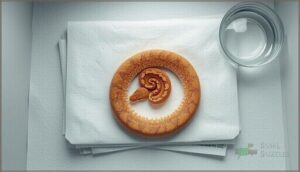
Paper towels and newspaper create a clean slate for beginners—you can spot waste immediately and swap them out in seconds.
The absorbency of quality paper towels wicks urates away from your snake’s belly, while newspaper’s cellulose content and fiber strength hold up under weight without tearing.
Both substrate options are dust-free, affordable, and ideal for quarantine or sensitive snakes recovering from skin infections.
Coconut Fiber and Coco Coir
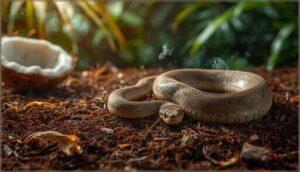
When you need humidity control without sacrificing cleanliness, coconut fiber and coco coir step up—they hold roughly ten times their weight in water. You’ll get a soil-like substrate depth of one inch that encourages burrowing while staying gentle on belly scales.
Triple-washed coco coir removes excess sodium and dust, protecting sensitive snakes from skin irritation and respiratory concerns. For more details on the of coco peat, check out this detailed guide.
Aspen Shavings and Cypress Mulch
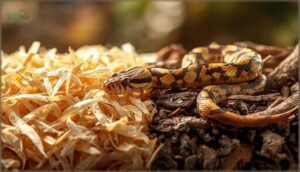
If you prefer drier enclosures, aspen shavings deliver virtually dust-free comfort with excellent absorbency—perfect for corn snakes and other moisture-sensitive species.
Cypress mulch offers a middle ground for substrate comparison, retaining modest humidity while suppressing odor through natural resins.
Both eco-friendly options avoid aromatic oils, ensuring shaving safety for delicate respiratory systems in your snake enclosure. For more details about its sustainable properties, check out these natural aspen wood benefits.
Bioactive Substrate Mixes
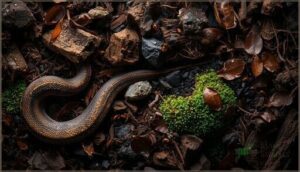
Bioactive substrate mixes take you beyond static bedding—they build a living ecosystem where microfauna handle waste and nutrient cycling stabilizes microbe balance. You’ll find these blends combining coco coir, orchid bark, and leaf litter to support isopods and springtails. The magic happens when substrate depth reaches three to four inches, letting your snake burrow while maintaining humidity control and ecosystem stability through saprophytic decomposition.
- Coconut fiber and orchid bark create porous structure
- Sphagnum moss amendments encourage cleanup crews
- Charcoal or clay improve moisture retention
- Substrate options support natural foraging behavior
Sphagnum Moss and Coconut Husk
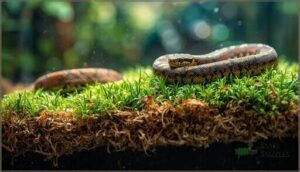
Sphagnum moss absorbs several times its dry weight in water—vital when you need stable humidity control for sensitive species. Coconut husk provides drainage while maintaining moisture, preventing the waterlogged conditions that fuel bacterial growth. You can layer these substrate options together: coir on bottom, moss on top. Both materials stay naturally inert and pH neutral in your snake enclosure.
| Moss Benefits | Husk Properties | Substrate Blends |
|---|---|---|
| Antiseptic compounds suppress surface microbes | Strong drainage with moisture retention | Layered approach optimizes humidity |
| Holds water for microenvironment control | Fibrous coir resists compaction | Eco friendly and adjustable setup |
| High porosity promotes airflow | Dust free for respiratory safety | Ideal for moisture loving species |
| Sustainable harvest preserves carbon stores | Expands from brick for easy use | Enables 50–70% humidity levels |
Key Factors in Substrate Selection
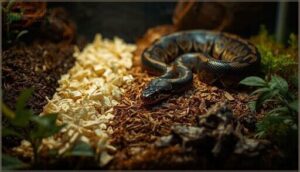
Choosing the right substrate isn’t just about what looks good—it’s about keeping your snake safe and healthy. You need to balance moisture retention with cleanliness, texture with practicality, and natural behavior with real-world maintenance.
Coconut fiber is one standout option—its low dust and soft texture make it a smart pick, as covered in this guide to choosing the safest substrate for snake terrariums.
Here are the five critical factors that should guide every substrate decision you make.
Safety and Non-Toxicity
Safety is non-negotiable in substrate selection — one wrong material can trigger chemical exposure, respiratory distress, or chronic skin irritation in sensitive snakes. For solid reptile care, prioritize these three criteria:
- Non Toxic Materials — no dyes, fragrances, or volatile organic compounds
- Toxicity Testing — look for MSDS-certified, pesticide-free reptile substrate
- Allergen Prevention — choose unbleached, sterilized options to protect snake health
Dust-Free and Soft Textures
Texture matters more than most keepers realize. Rough substrate options irritate delicate scales and stress sensitive snakes — two problems that compound quickly.
For solid reptile husbandry, prioritize dust control through fine-grade coco coir, coconut husk, or soft surfaces like aspen. These reptile substrate choices cushion movement, minimize respiratory irritants, and reflect genuine substrate safety — the kind your snake’s immune system quietly thanks you for.
Humidity and Moisture Control
Humidity control starts at the substrate level — not the misting bottle. Your substrate options directly influence water vapor release and evaporation rates inside the enclosure.
Coco coir excels here, absorbing moisture without oversaturating. Poor moisture management triggers harmful humidity swings; ball pythons need 50–60%, corn snakes around 40–50%. Control condensation control by keeping substrate damp, never soaked.
Odor Absorption and Cleanliness
A stale enclosure isn’t just unpleasant — it signals a cleanliness breakdown that affects your snake’s air quality and health.
Coconut husk and bioactive reptile substrate options excel at odor absorption by trapping waste compounds within their porous structure. Proper microbe balance converts ammonia into neutral byproducts, while consistent moisture management and substrate sanitization prevent anaerobic buildup.
Daily spot-cleaning keeps odor control effective between full changes.
Encouraging Natural Behavior
Your snake’s substrate isn’t just bedding — it’s the foundation of its psychological world. A well-designed bioactive substrate encourages burrowing behavior, scent-trailing, and snake exploration that mirrors natural habitat instincts.
Substrate is not just bedding — it is the psychological foundation where your snake’s instincts come alive
Thoughtful terrarium design, with varied textures and moisture pockets, unlocks environmental enrichment you can’t replicate with paper towels. That’s reptile husbandry done right: ecosystem balance and microbial balance working together to support genuinely expressive burrowing behaviors.
Top 5 Substrates for Sensitive Snakes
Now let’s get specific — because your snake deserves more than a guess. Each of the five substrates below has earned its place based on safety, texture, and how well it holds up in a real enclosure.
Here’s what you need to know before choosing.
1. Bio Dude Terra Firma Reptile Substrate
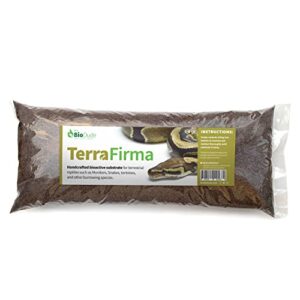
The Bio Dude Terra Firma is a handcrafted bioactive substrate built specifically for terrestrial reptiles — including ball pythons, king snakes, and monitors. What sets it apart is its no-drainage-layer design, which simplifies setup considerably.
The blend holds moisture without becoming waterlogged, accommodates burrow tunnels, and hosts beneficial microfauna like springtails and isopods that handle waste breakdown naturally. At $24.95 for 6 quarts, it’s a practical investment for sensitive species needing stable humidity and a naturalistic environment to thrive.
| Best For | Reptile keepers housing ball pythons, king snakes, fat tail geckos, or monitors who want a natural, low-maintenance bioactive setup. |
|---|---|
| Humidity Support | High humidity retention |
| Material Type | Organic plant mix |
| Snake Suitable | Yes |
| Odor Control | Moderate |
| Eco Friendly | Yes |
| Maintenance Level | Moderate |
| Additional Features |
|
- No drainage layer needed, so setup is simpler and cleaner than most bioactive builds
- Holds moisture well and supports high humidity — great for misting systems and sensitive species
- Works with live plants and microfauna like springtails, letting the enclosure essentially clean itself
- May contain wood pieces of uneven sizes, which could be an issue for smaller reptiles
- Needs occasional upkeep to keep aeration and drainage working properly
- Not a great fit for every reptile species, so it’s worth checking compatibility before buying
2. ReptiChip Coconut Reptile Substrate Bedding
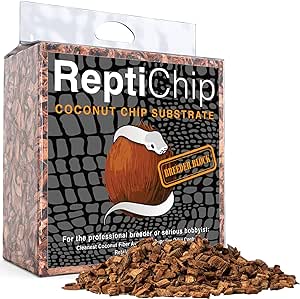
Where the Bio Dude leans into living ecosystems, ReptiChip takes a different approach — clean, simple, and moisture-focused. This 72-quart compressed brick of coconut husk expands to 10 lbs of soft, chip-like bedding once hydrated.
For sensitive snakes prone to shedding issues, that humidity retention is the real selling point. It’s dust-free, non-toxic, and easy to spot clean. The texture encourages natural burrowing behavior without abrasive edges. A reliable, no-fuss option when your snake needs stable moisture and a gentle surface.
| Best For | Reptile owners — especially those keeping ball pythons or other humidity-sensitive snakes — who want a clean, simple substrate that holds moisture well and encourages natural burrowing. |
|---|---|
| Humidity Support | High humidity retention |
| Material Type | Coconut husk |
| Snake Suitable | Yes |
| Odor Control | High odor absorption |
| Eco Friendly | Yes |
| Maintenance Level | Moderate |
| Additional Features |
|
- Excellent humidity retention, which helps with consistent shedding and overall reptile health
- Dust-free and non-toxic, making it a safe choice for sensitive animals
- Compressed block is easy to store and expands to a solid 10 lbs of usable bedding
- Tends to cost more than basic substrates, so it may not be the most budget-friendly option
- Breaking apart the block can kick up some dust if you’re not careful
- Needs regular spot cleaning to keep mold and odor from becoming a problem over time
BNOSDM Reptile Terrarium Substrate Bedding
BNOSDM takes a different angle — a true reptile terrarium bedding built around ecosystem function. The BNOSDM Reptile Soil Substrate decomposes waste naturally, supporting microbe balance while retaining moisture for reliable humidity control.
Substrate depth matters here; this mix accommodates burrowing without compacting. For sensitive snakes, that combination of eco system integrity and gentle texture makes substrate selection noticeably simpler — and snake health measurably better.
3. Zilla Reptile Bedding Substrate
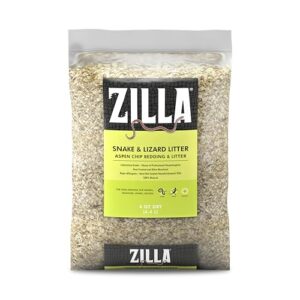
Where BNOSDM leans into ecosystem function, Zilla takes a more straightforward approach — heat-treated aspen chips that are hypo-allergenic, 100% natural, and free from aromatic oils that can irritate sensitive respiratory tracts. That last point matters clinically.
Many snakes react poorly to cedar or pine; Zilla sidesteps that risk entirely. The chips allow easy spot cleaning, and at 4 quarts, setup is quick.
Best suited for drier-environment species — not your humidity-dependent tropicals.
| Best For | Reptile owners keeping dry-environment species like snakes, monitors, skinks, and geckos who want a natural, easy-to-clean substrate without the respiratory risks of cedar or pine. |
|---|---|
| Humidity Support | Maintains humidity levels |
| Material Type | Coconut fiber |
| Snake Suitable | Yes |
| Odor Control | Decomposes waste |
| Eco Friendly | Yes |
| Maintenance Level | Moderate |
| Additional Features |
|
- Hypo-allergenic and free from aromatic oils, so it won’t irritate your reptile’s respiratory system the way cedar or pine can
- Easy spot cleaning thanks to the chip size — you’re not sifting through fine particles to find waste
- 100% natural and biodegradable, so disposal is guilt-free
- The small chips scatter easily and can end up outside the enclosure, which gets old fast
- Not a great fit for humidity-loving species or reptiles prone to ingesting their substrate
- Some buyers feel the price-per-volume ratio doesn’t stack up well against competing options
4. Sukh Sphagnum Moss for Reptiles
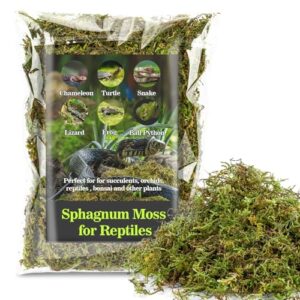
Moisture is the whole game here. Sukh Sphagnum Moss doesn’t just hold water — it releases it slowly, stabilizing humidity over days rather than hours.
That makes it invaluable for tropical species managing shedding cycles or egg incubation. Layer it loosely to create natural burrowing pockets, or blend it with coconut husk for a balanced substrate mix.
Keep it free from heat sources to prevent mold, and replace it periodically. At 5 ounces, it’s lightweight but genuinely effective.
| Best For | Reptile owners keeping tropical species like snakes, frogs, or geckos that need steady humidity for shedding, egg laying, or burrowing. |
|---|---|
| Humidity Support | Low humidity retention |
| Material Type | Aspen chips |
| Snake Suitable | Yes |
| Odor Control | Moderate |
| Eco Friendly | Yes |
| Maintenance Level | Low |
| Additional Features |
|
- Holds moisture and releases it slowly, keeping humidity stable for days without constant upkeep
- Soft and natural texture that supports burrowing, egg incubation, and healthy shedding cycles
- Lightweight and versatile — works on its own or mixed with other substrates like coconut husk
- Can get dusty over time and break down into powder, so it needs regular replacing
- May carry a noticeable smell, especially when wet
- Not a standalone substrate — works best as a supplement rather than a primary bedding layer
Matching Substrate to Snake Species
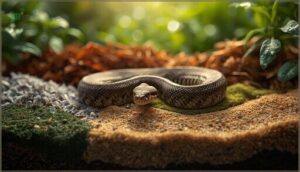
Not every substrate works for every snake — what a ball python thrives in might stress a corn snake out completely.
Getting this right comes down to knowing your species and what its body actually needs from the ground up. Here’s how to match the right substrate to your specific snake.
Ball Pythons: Humidity and Comfort Needs
Ball pythons are humidity-driven animals — their comfort zones depend on keeping levels between 60 and 80 percent consistently.
For reptile substrate, coco coir or a bioactive substrate mix works best, acting as a moisture reservoir that stabilizes humidity levels without waterlogging. This directly aids snake behavior and shedding tips: adequate moisture prevents retained shed and reduces respiratory stress noticeably.
Corn Snakes: Softness and Safety
Corn snakes are forgiving reptiles, but their smooth scales still need a substrate that won’t cause abrasions or trap excess moisture. Aspen shavings remain the clinical benchmark here — dust-free, soft enough for scale protection, and loose enough to support natural burrowing behavior.
Keep substrate depth around two to three inches, and you’ve nailed humidity control without oversaturation, supporting long-term snake skin health.
Boa Constrictors: Moisture and Size Considerations
Boas are big snakes with big moisture demands. Maintaining humidity levels between 55–75 percent is non-negotiable for snake health — and your reptile substrate does the heavy lifting.
Coconut coir or cypress mulch are smart substrate options for Snake Enclosures, offering solid Moisture Management and Humidity Control. Keep Substrate Depth at 2–4 inches for effective shedding tips support.
Customizing Substrate Mixes for Sensitive Snakes
No two sensitive snakes share identical needs — that’s where a tailored reptile substrate truly earns its place. Blending coco coir, topsoil, and leaf litter lets you dial in both Humidity Control and Microbe Balance for your species.
Adjust Substrate Depth to support Snake Behavior like burrowing.
A well-tuned bioactive substrate promotes Ecosystem Stability, and ultimately, long-term snake health through thoughtful reptile husbandry.
Frequently Asked Questions (FAQs)
What kind of gravel do snakes hate?
Sharp, angular gravel tops the list — it digs into a snake’s belly, disrupts natural movement, and causes skin irritation.
For reptile comfort and substrate safety, your snake habitat deserves better than jagged edges.
How often should sensitive snake substrates be replaced?
For sensitive snakes, replace substrate every 4–6 weeks with regular spot cleaning. Prioritize substrate hygiene the moment mold, odor, or visible waste appears — snake health depends on it.
Can substrate cause allergic reactions in sensitive snakes?
Yes — substrate sensitivity is real. Dusty or resinous materials trigger skin irritation, respiratory issues, and immune response flare-ups in snakes.
Allergy triggers like coco coir dust or mold cause sneezing, shedding problems, and mucous membrane irritation.
What substrate depth works best for burrowing snakes?
Most burrowing snakes thrive with 4 to 6 inches of reptile substrate. Larger species need up to 12 inches for proper burrow depth, tunnel stability, and natural digging behavior without compromising humidity levels.
How do you transition a snake to new substrate?
Think of it like moving apartments — don’t swap everything overnight.
Gradually mix new substrate with the old, preserve familiar scent cues, and keep humidity stable throughout the substrate acclimation process to minimize snake stress.
Are substrate additives safe for respiratory-sensitive snakes?
Some additives pose real Additive Risks to Respiratory Health.
For reptile care and Snake Safety, avoid anything with aromatic oils or preservatives — Toxicity Levels vary, but respiratory care should never be compromised.
Conclusion
The substrate you choose tonight mightn’t show consequences for weeks—that’s what makes it so easy to get wrong. But now you’re not guessing. You understand what sensitive snakes actually need from the floor beneath them.
The right substrate options for sensitive snakes aren’t about aesthetics; they’re biological decisions with real health implications. Choose deliberately, monitor consistently, and your animal’s next shed will tell you everything you need to know.