This site is supported by our readers. We may earn a commission, at no cost to you, if you purchase through links.
Running a room full of reptile enclosures changes everything about how you think about lighting. What works fine for a single tank—one fixture, one timer, done—becomes a logistical headache when you’re managing six enclosures stacked two high, each housing species with different UVB demands and photoperiod needs.
A chameleon on the top tier needs entirely different light intensity than the ball python two shelves down.
Getting this wrong doesn’t just mean dim tanks; it means stressed animals, weakened immune systems, and metabolic bone disease that shows up months later.
The right terrarium lighting systems for multiple enclosures make the difference between a collection that thrives and one that quietly struggles.
Table Of Contents
- Key Takeaways
- Choosing Multi-Enclosure Lighting Systems
- Installation Across Multiple Enclosures
- Top 5 Lighting Kits Compared
- Maintenance and Photoperiod Management
- Frequently Asked Questions (FAQs)
- What are common terrarium mistakes to avoid?
- How long should a terrarium light be on?
- What is the best lighting for a terrarium?
- Does a terrarium need a lot of light?
- How does UVB light differ from UV light?
- What causes metabolic bone disease in reptiles?
- How often should UVB output be tested monthly?
- Can live plants block UVB for basking reptiles?
- What are Ferguson Zone requirements for common species?
- Can plants thrive under reptile-specific UVB bulbs?
- Conclusion
Key Takeaways
- Matching each enclosure’s UVB intensity to its specific species—not just plugging in whatever fits—is what separates thriving animals from ones quietly developing metabolic bone disease.
- LED bars win on longevity and heat management across multi-enclosure setups, but T5 UVB systems still deliver broader, more proven UV coverage where desert species like bearded dragons need it most.
- Dead zones where UVB drops below UVI 1.0 can form silently behind screen tops, dense foliage, or poorly angled reflectors, so monthly Solarmeter checks aren’t optional—they’re your early warning system.
- Building with modular, timer-compatible fixtures from the start means your lighting grows with your collection instead of forcing a full rewire every time you add another enclosure.
Choosing Multi-Enclosure Lighting Systems
Getting the lighting right across multiple enclosures isn’t just about brightness—it’s about matching the right fixture to the right setup. Whether you’re running a stacked rack of snakes or a row of mixed reptile tanks, a few key factors will shape every decision you make.
Pairing the right light schedule with proper handling routines matters too—beginner reptile handling tips can help you build a routine that works alongside your enclosure setup.
Here’s what to think about before choosing your system.
Matching Fixture Types to Stacked or Side-by-side Enclosures
Not every fixture works for every layout — and that mismatch can quietly stress your animals.
- Stacked setups need external hoods or riser brackets with clear heat dissipation strategies to protect lower enclosures.
- Side-by-side racks suit modular bar lengths and expandable multitank LED lighting solutions spanning the full row.
- Mounting height guidelines recommend 2–4 inches above mesh lids.
- Bracket compatibility determines whether modular lighting systems slide directly onto integrated rail channels.
- Spectral zoning lets you assign adjustable brightness and timer settings per tier.
Implementing an air gap optimization strategy can further improve temperature stability across stacked enclosures.
LED Bars Vs T5 UVB Systems
Once your fixture types are sorted, the next step is picking your light source — and for multiple enclosures, this choice shapes everything from spectral tuning to your monthly power bill.
| Feature | LED Bars | T5 UVB Systems |
|---|---|---|
| Light Intensity | Moderate, wide spread | Strong, concentrated under tube |
| Heat Management | Minimal heat output | Separate heat source required |
| Longevity Metrics | Up to 4 years at 12 hrs/day | ~12 months typical replacement cycle |
LED lighting wins on cost analysis and longevity, while T5 UVB delivers broader, proven UV coverage across multiple enclosures.
The Sunergy Phosphor Blend(https://exo-terra.com/explore/academy/lighting/new-uvb-vho-t5-lighting/) replicates solar UVA and UVB spectrum more closely than competing T5 lamps.
Separating Daylight, UVB, and Heat Sources
Think of each light source as having one job.
Daylight spectrum tuning manages visible brightness, independent UVB placement delivers what reptiles need for vitamin D₃ synthesis, and heat lamp isolation keeps temperatures adjustable without disrupting either.
Zoned lighting controls and thermal buffer zones let you fine-tune each enclosure independently — a practical backbone for any full spectrum lighting guide for aquatic and reptile enclosures.
Expandability for Growing Snake and Reptile Collections
Collections grow faster than most keepers expect. That’s why starting with modular lighting system components — like the Lucky Reptile LED Strip Mini’s expandable direct-plug design — keeps multi-tank installations manageable. Adjustable rack systems pair well with expandable LED hoods and adjustable fixture height options as enclosures multiply.
- Modular LED Strips that chain up to 12W total
- Expandable timer-enabled strips scaling across rack rows
- Adjustable multitank LED lighting solutions with 50,000-hour lifespans
Progressive power distribution keeps your reptile terrarium setups future-ready.
Timer, Dimming, and Controller Compatibility
Smart Timer Integration separates a manageable multi-enclosure setup from a chaotic one. Exo Terra fixtures use Universal Plug Compatibility with any household timer, while TC 421 controllers bring PWM Dimming Control and Multi-Zone Synchronization to expandable multitank LED lighting solutions.
For precision, PID Temperature Regulation via REPTIZOO TC02 keeps temperatures stable. Flexible timer-enabled strips and intuitive controllers with adjustable brightness let you automate day-night cycles effortlessly.
Balancing Light Output, Heat, and Energy Use
When you’re running multiple enclosures, Heat Load Balancing becomes as important as brightness. LED lighting converts most energy into light rather than heat — unlike incandescent bulbs, which waste up to 90% as infrared.
For setups with multiple enclosures, a fixture like the LuminPacific LED UVB lighting system for large terrariums helps keep cumulative heat output low without sacrificing coverage.
Spectral Efficiency Optimization and Light Intensity Calibration let you dial in exactly what each species needs. With Flexible Power Allocation and adjustable multitank LED lighting solutions, Energy Consumption Metrics stay manageable without sacrificing coverage.
Installation Across Multiple Enclosures
Getting the lights up is one thing — getting them right across every enclosure is another. Each setup has its own quirks, from cable routing to screen interference, and small mistakes here can leave your animals with uneven coverage or burned-out bulbs ahead of schedule.
Here’s what you need to know to do it properly the first time.
Daisy-chaining Fixtures Safely
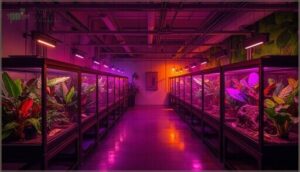
Daisy-chaining looks simple until a tripped breaker goes dark across your entire reptile room. Safe cable management and circuit capacity planning prevent that.
Before linking fixtures, verify three things:
- Daisy chain limits — Sunblaster and NEHERP cap chains at 8 units; Arcadia ProT5 allows 10.
- Connector rating verification — use only manufacturer-provided linking cables.
- Voltage drop monitoring — keep end-of-chain drop within 5 percent.
Positioning Lights for Even Enclosure Coverage
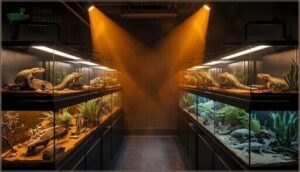
Even light distribution starts before you mount a single fixture.
Match tube length to about two-thirds of each enclosure for basking species, use reflector angle adjustment to direct output downward, and adjust mounting height so UVB reaches the basking zone without glass or acrylic blocking it.
Modular lighting system with adjustable brightness and mounting brackets makes coverage overlap planning across an expandable lighting setup straightforward.
Preventing UV Dead Zones Across Tanks
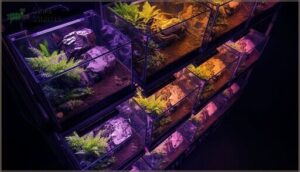
A dead zone — an area where UVB rays drop below UVI 1.0 — can quietly cause metabolic bone disease before you notice any symptoms. UVB mapping techniques like Solarmeter grid scanning every six inches across each tank reveal exactly where gaps hide. Reflector angle optimization and basking zone placement close those gaps systematically.
UVB dead zones silently cause metabolic bone disease long before symptoms ever appear
- Use gradient overlap strategy to blend adjacent fixture coverage
- Target UVI 2–3 at basking spots, under 1 in shade zones
- Check monthly — bulbs lose 20% output long before they visibly dim
- Multitank LED lighting solutions paired with T5 UVB supplementation improve light distribution across stacked racks
Managing Screen Tops and Foliage Interference
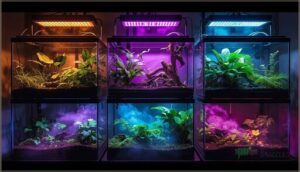
Screen tops and dense foliage are the two biggest culprits behind uneven UVB delivery in multitank installations.
Standard mesh blocks 30–50% of UVB, so under-mesh placement preserves full light intensity where reptiles actually bask.
For foliage interference, use plant positioning strategies that keep canopy away from basking zones — dense tropical leaves alone can absorb up to 50% of available UVB, quietly undermining your setup.
Aligning Fixture Strength With Enclosure Size
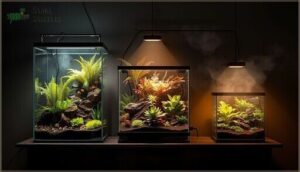
Fixture strength isn’t one-size-fits-all. A lamp that’s perfect for a 36-inch enclosure can wash out a 12-inch nano tank — or leave a 48-inch build with dead corners.
Match intensity scaling to your coverage ratio by considering:
- Mount height — lower placements increase power density but reduce beam uniformity
- Enclosure footprint — expandable multitank LED lighting solutions let you link units for wider coverage
- Adjustable brightness — light intensity control prevents heat management issues in tighter spaces
Power Strips, Load Limits, and Cable Organization
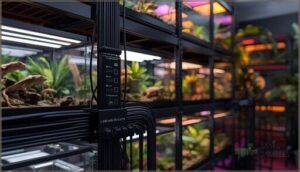
Once your fixture strength is dialed in, the wiring side needs equal attention. A grounded power strip with surge protection ratings of at least 1000J protects your gear from voltage spikes. Keep total wattage under 1440W for safe outlet load balancing.
Use cable management tools like clips and velcro ties, and always follow daisy chain safety guidelines — never stack strips without checking manufacturer specs.
Top 5 Lighting Kits Compared
Now that your setup is in place, picking the right lighting kit makes all the difference. Each of the five options below brings something distinct to the table, whether you’re managing a compact rack or a sprawling reptile room.
Here’s how they stack up.
1. LuminPacific Adjustable UVB Reptile Lamp
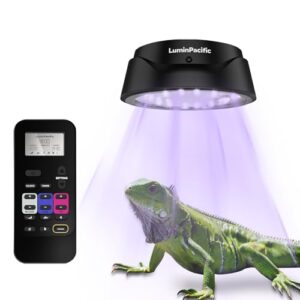
The Adjustable UVB Reptile Lamp packs a lot into a small polycarbonate housing — UVB, UVA, and far-red LEDs all in one unit.
At $35.99, it’s genuinely competitive for what you get.
The LCD remote lets you adjust each channel independently across 10 brightness levels, and five Ferguson Zone presets make dialing in species-specific UV exposure straightforward.
A 10-minute sunrise/sunset ramp keeps things natural.
Just know not a heat source, so you’ll still need a separate basking lamp.
| Best For | Reptile and amphibian keepers who want precise, species-appropriate UV lighting across multiple Ferguson Zones without breaking the bank. |
|---|---|
| UVB Support | UVB LEDs integrated |
| Power Draw | Not specified |
| Housing Material | Polycarbonate |
| Mount Options | Mesh, magnet, wood |
| Heat Output | Low heat LEDs |
| Price | $35.99 |
| Additional Features |
|
- UVB, UVA, and far-red LEDs all in one compact unit — no need to juggle multiple lights
- Five Ferguson Zone presets plus a custom mode make it easy to dial in the right UV for your specific animal
- The sunrise/sunset ramp and adjustable brightness help mimic natural light cycles, which keeps animals calmer and more active
- The remote timer can be finicky — several users report it failing or needing longer button presses than expected
- Magnet mounting doesn’t always hold well on smooth surfaces, so it can slip or fall
- It’s not a heat source at all, so you’ll need a separate basking lamp on top of this
2. REPTI ZOO T5 HO UVB Lighting Kit
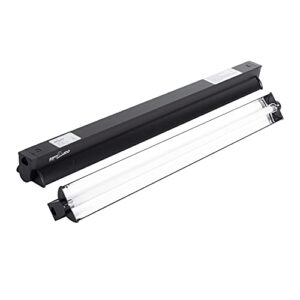
If LEDs aren’t your thing, the REPTI ZOO T5 HO UVB Lighting Kit takes a more traditional route — and does it well. The low-profile aluminum hood sits cleanly on any screen top, and the polished curved reflector pushes more UVB down into the enclosure instead of losing it sideways.
It comes ready with a Desert 10.0 UVB lamp, making it a solid pick for bearded dragons and tortoises.
Available in 24W, 39W, and 54W to match your enclosure length.
| Best For | Desert reptiles like bearded dragons and tortoises that need strong UVB exposure for healthy calcium metabolism. |
|---|---|
| UVB Support | Desert 10.0 UVB T5 |
| Power Draw | 24W |
| Housing Material | Aluminum/Plastic |
| Mount Options | Over mesh or vivarium |
| Heat Output | Not specified |
| Price | Not listed |
| Additional Features |
|
- Comes ready to go with a Desert 10.0 UVB lamp included
- Polished curved reflector pushes more UVB down where it counts
- Available in three wattages so you can match it to your enclosure size
- Bulbs tend to burn out faster than you’d hope
- Replacement lamps aren’t cheap
- A few users have run into durability and packaging issues
3. T5 UVB Reptile Light Fixture
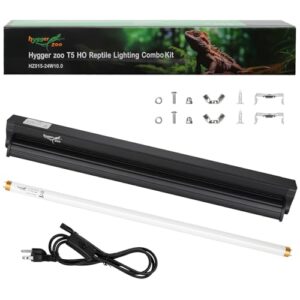
When you need clean UVB delivery without extra bulk, the T5 UVB Reptile Light Fixture is worth a close look. A polished curved reflector concentrates light downward rather than scattering it, which matters when you’re stacking enclosures and every bit of usable UVB counts.
The electronic ballast eliminates flicker — something diurnal reptiles respond to more than most keepers realize. It mounts on mesh lids or clips inside the tank, giving you real flexibility across different builds.
| Best For | Reptile and amphibian keepers who want reliable, focused UVB coverage for species like bearded dragons, chameleons, tortoises, and turtles across a range of enclosure setups. |
|---|---|
| UVB Support | 10.0 µW/cm² UVB |
| Power Draw | 24W |
| Housing Material | Aluminum |
| Mount Options | Mesh, inside, wood |
| Heat Output | Not specified |
| Price | $39.88 |
| Additional Features |
|
- Higher-than-average UVB output (10.0 µW/cm²) means your animals are actually getting the D₃ synthesis support they need
- The polished curved reflector directs light where it counts instead of letting it bleed out uselessly to the sides
- Flexible mounting options — mesh lid, inside the tank, or wood vivarium — makes it easy to fit into almost any setup
- Contains solid mercury, so a broken bulb means careful cleanup and proper disposal, not just a quick sweep
- UVB output fades over time, so you’ll need to swap it out regularly even if it still looks like it’s working fine
- Needs a compatible T5 socket, which could mean extra purchases if your current fixture doesn’t match
4. Hygger Zoo T5 UVB Reptile Light Fixture
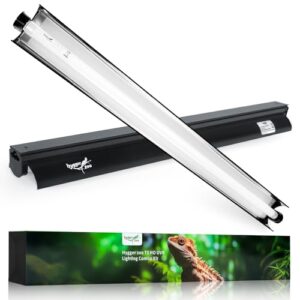
The Hygger Zoo T5 UVB Reptile Light Fixture punches above its weight for a 24W unit. Its polished curved reflector pushes 10% UVB and 30% UVA deeper into the enclosure, which is exactly what desert species like bearded dragons and tortoises need for D3 synthesis and bone health.
The 5.9-foot cord gives you real placement flexibility across stacked setups, and the flame‑retardant build adds a layer of reassurance.
Just plan on replacing the bulb every 6 to 12 months to maintain consistent UVB output.
| Best For | Reptile owners keeping desert species like bearded dragons and tortoises who need strong, reliable UVB coverage without breaking the bank. |
|---|---|
| UVB Support | 10.0 UVB bulb included |
| Power Draw | 24W |
| Housing Material | Glass |
| Mount Options | Mesh or inside tank |
| Heat Output | Not specified |
| Price | Not listed |
| Additional Features |
|
- The polished curved reflector pushes UVB and UVA deep into the enclosure — great for D3 synthesis and keeping bones healthy
- At 24W, it’s energy-efficient and the flame-retardant build gives you peace of mind during long light cycles
- Easy to set up with a simple on/off switch and a 5.9-foot cord that works well across stacked or tiered setups
- Some users report the bulb burning out faster than expected, so budget for replacements every 6–12 months
- The instruction manual is thin — installation can get confusing if you’re setting this up for the first time
- Durability is hit or miss, with a handful of users saying the fixture stopped working after a short period of use
5. REPTIDLDB T5 UVB Reptile Light
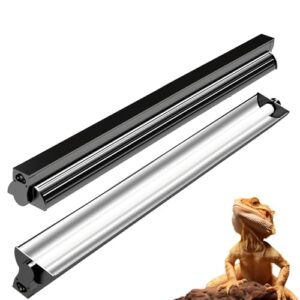
Four size options make the REPTIDLDB T5 UVB Reptile Light a flexible pick for mixed-collection setups.
Running from 8W at 12 inches up to 54W at 46 inches, you can match the fixture to each enclosure without overpowering smaller tanks.
The 10.0% UVB and ~30% UVA output promotes D3 synthesis for desert species like bearded dragons and tortoises, while the built-in HO electronic ballast keeps performance consistent.
No integrated timer, though, so pair it with an external controller.
| Best For | Reptile owners with mixed collections who need flexible UVB coverage across different enclosure sizes, especially for desert species like bearded dragons, tortoises, and chameleons. |
|---|---|
| UVB Support | 10.0% UVB tube |
| Power Draw | 24W |
| Housing Material | Not specified |
| Mount Options | Over mesh or tank lid |
| Heat Output | Minimal heat |
| Price | $35.56 |
| Additional Features |
|
- Four size options (12"–46") let you match the fixture to the tank — no overpowering smaller setups
- Strong 10.0% UVB and ~30% UVA output supports D3 synthesis, calcium absorption, and natural basking behavior
- Slim, low-heat design installs easily and works both externally over mesh or internally on a tank lid
- No built-in timer means you’ll need an external controller to automate the light cycle
- Some users report the bulb holder interior and reflective coating peeling after a few months
- Provides little heat on its own, so you’ll likely need a separate basking lamp to hit proper temperatures
Maintenance and Photoperiod Management
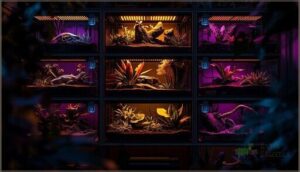
Getting the lighting right is only half the job — keeping it consistent is what actually keeps your animals healthy over time. When you’re managing multiple enclosures, small oversights in scheduling or bulb maintenance can snowball fast.
Here’s what you need to know to stay on top of it all.
Setting Synchronized Day and Night Cycles
Think of your controller as a conductor — every enclosure follows the same beat. Use these five steps for Unified Cycle Management:
- Sync all fixtures to a single clock via Clock Sync
- Enable Gradual Light Ramping over 15‑minute dawn/dusk transitions
- Apply timer automation across every channel simultaneously
- Configure day/night modes with consistent photoperiod schedules
- Add Backup Power Coordination to preserve your light cycle during outages
Choosing Ideal Daily Lighting Duration
Most reptiles do best with 10 to 14 hours of light daily — but the right photoperiod length depends on species, hours, and origin. Tropical animals need closer to 12–14 hours; desert species thrive at 10–12.
Use timers to lock in your light cycle precisely, and incorporate dusk shift timing to support activity correlation with natural behavior.
Adjust for seasonal light shifts gradually.
Tracking Bulb Output and Replacement Schedules
Bulbs don’t fail overnight — they fade. LED fixtures usually hold 70% of initial brightness after 6,000 hours, a process called Lumen Decay Modeling.
UVB Irradiance Monitoring matters even more, since spectral output can drop critically before you notice dimming.
Use Rolling Replacement Thresholds, track readings in a Calibration Log, and set an Automated Reordering System so you’re never caught short.
Preventing Overexposure and Underexposure
Once your replacement schedule is locked in, the next challenge is keeping exposure levels consistent across every enclosure. Too much light stresses animals; too little stunts plant growth. Here’s how to stay in the safe zone:
- Run Lux Uniformity Checks monthly, targeting within 20% of your set lux across all tanks.
- Follow UVB Dose Scheduling to coordinate photoperiods and prevent cumulative overexposure in adjacent enclosures.
- Apply Shade Mapping to identify dead zones or hot spots, then reposition fixtures or use diffusers.
- Use Dawn Dusk Ramping with Spectral Ratio Tuning via adjustable brightness settings and timers to smooth intensity regulation throughout each photoperiod.
Managing Heat Buildup in Enclosed Setups
Even with exposure levels dialed in, heat buildup can quietly undo your setup.
Passive Cooling Fins and Heat Sink Integration on high-wattage fixtures pull thermal load away from the enclosure. Pair that with smart Airflow Vent Placement — bottom intake, top exhaust — and you’re moving heat efficiently.
Thermal Interface Materials improve LED heat sink performance, while regular Temperature Sensor Calibration keeps your thermal regulation honest.
Creating a Maintenance Checklist for Multiple Enclosures
A solid checklist ties everything together — heat management, timers, LED heat sink performance, and environmental monitoring all need regular attention.
Log each enclosure’s inspection frequency, note any power safety checks on strips and circuits, and track your component replacement schedule against manufacturer ratings.
Good documentation protocols don’t have to be complex; a simple digital log with dates, observations, and accessible controllers makes staying consistent surprisingly straightforward.
Frequently Asked Questions (FAQs)
What are common terrarium mistakes to avoid?
Common mistakes include overwatering issues, drainage problems, and plant compatibility errors.
Poor heat management, neglected cleaning, wrong light spectrum, inconsistent timers, and uncontrolled humidity levels can all quietly derail even a well‑intentioned setup.
How long should a terrarium light be on?
Most reptiles thrive on 10–12 hours of light daily.
Match photoperiods to your species light needs, use automatic timers for circadian rhythm alignment, and adjust for seasonal light variation throughout the year.
What is the best lighting for a terrarium?
Full-spectrum LED lighting hits the sweet spot for most terrariums — it nails PAR optimization, spectral balance, and CRI accuracy while staying energy efficient, low-heat, and easy to run on a timer.
Does a terrarium need a lot of light?
Not exactly.
Your terrarium’s light demand depends on species-specific lighting needs — a sun-loving bearded dragon needs far more visible brightness needs and UVB necessity than a nocturnal gecko thriving under dim, energy-efficient illumination.
How does UVB light differ from UV light?
UV radiation covers UVA, UVB, and UVC. UVB rays sit at shorter wavelengths with higher photon energy, making them biologically active — essential for vitamin D synthesis in reptiles.
What causes metabolic bone disease in reptiles?
Metabolic bone disease is basically a perfect storm — Calcium Deficiency, Phosphorus Imbalance, UVB Deficiency, and Vitamin D3 Deficiency all disrupt calcium absorption, while Thermal Stress compounds the damage when UVB rays and vitamin D3 synthesis fall short.
How often should UVB output be tested monthly?
Test UVB output monthly. Bulb degradation can silently slash output by 30–50% while the light still glows, so monthly UVB checks catch drops before your animals pay the price.
Can live plants block UVB for basking reptiles?
Live plants can block UVB rays for basking reptiles, especially with high leaf density attenuation and plant species filtering.
Canopy UVB gradient forms, so plant placement effects matter—use UVB measurement strategies to guarantee proper UVB lighting for reptiles.
What are Ferguson Zone requirements for common species?
Ferguson Zones group species by UVB needs. Zone 1 UVB suits shade dwellers like leopard geckos, while Zone 4 exposure caters to mid-day sun baskers like chuckwallas. Match your setup accordingly.
Can plants thrive under reptile-specific UVB bulbs?
Plants can survive under reptile UVB rays, but they won’t truly thrive. UVB bulbs cause PAR Deficiency and poor Blue/Red Balance, slowing photosynthesis.
Add a Supplemental Grow Light for healthy plant growth.
Conclusion
Shedding light on the right terrarium lighting systems for multiple enclosures turns chaos into harmony. Whether you’re daisy-chaining LEDs or fine-tuning T5HO fixtures, the goal stays clear: replicate the sun’s embrace across every shelf.
With synchronized timers, strategic positioning, and bulbs tracked like clockwork, your reptiles thrive—no shadows, no stress.
Choose systems that grow with your collection, balancing UVB precision and energy thrift. The payoff? Healthy, vibrant animals that bask in your care.
Now, let their scales shine.
- http://hyperphysics.phy-astr.gsu.edu/hbase/Electronic/leds.html
- https://greenhome.osu.edu/natural-lighting
- https://talis-us.com/blogs/blog-209/expert-tips-on-how-to-set-up-reptile-lighting-effectively
- https://aquagroup.co.uk/blogs/guidance/essential-heating-lighting-for-reptiles-why-it-matters
- https://www.seaviewaquarium.com.au/article/reptile-lighting-guide-exoterra