This site is supported by our readers. We may earn a commission, at no cost to you, if you purchase through links.
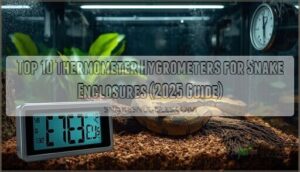
A ball python refused to shed for three weeks straight in an enclosure reading 78°F and 60% humidity—numbers that looked acceptable until a calibrated reference thermometer revealed the actual conditions: 72°F and 48% RH. That 6-degree gap and 12-point humidity deficit triggered retained eye caps and partial skin sloughing, complications that required veterinary intervention and weeks of corrective soaking.
Your snake’s health hinges on environmental precision measured in tenths of degrees and single-digit humidity percentages, yet most reptile keepers rely on uncalibrated sensors that drift 5-10% off true readings within months of deployment. Thermometer hygrometers for snake enclosures aren’t optional accessories—they’re diagnostic instruments that either prevent metabolic stress or document the slow accumulation of physiological damage you won’t notice until shedding failures, respiratory infections, or dehydration crises force emergency care.
Table Of Contents
- Key Takeaways
- Why Accurate Temperature and Humidity Matter
- Digital Vs. Analog Thermometer Hygrometers
- Key Features to Look for in Snake Enclosure Meters
- Top 10 Thermometer Hygrometers for Snake Enclosures
- 1. Fluker’s Digital Thermometer Hygrometer
- 2. Zoo Med Dual Thermometer Humidity Gauge
- 3. Repti Zoo Digital Thermometer Hygrometer
- 4. ThermoPro Digital Hygrometer Thermometer
- 5. Inkbird Digital Thermometer Hygrometer Monitor
- 6. Jedew Digital Hygrometer Thermometer
- 7. Zoo Med Digital Thermometer Humidity Gauge
- 8. Reptile Tank Thermometer And Hygrometer
- 9. Mini Digital Hygrometer Thermometer
- 10. Paizoo Reptile Thermometer Hygrometer
- Choosing The Best Thermometer for Your Snake
- Proper Placement and Installation Tips
- Calibration and Maintenance Best Practices
- Maximizing Reptile Health Through Accurate Monitoring
- Frequently Asked Questions (FAQs)
- Conclusion
Key Takeaways
- Uncalibrated thermometer-hygrometers drift 5-10% within months, creating temperature and humidity errors that trigger retained sheds, respiratory infections, and dehydration requiring veterinary intervention.
- Digital units offer 0.1°C resolution and faster response times than analog models, but both require quarterly calibration against certified references to prevent sensor drift that compromises accuracy.
- Position sensors at mid-enclosure height away from basking lamps and water dishes, deploying multiple units in large enclosures to capture thermal gradients and humidity zones that single-point monitoring misses.
- Species-specific needs determine essential features—ball pythons demand ±3% RH precision for 50-70% humidity ranges, while multi-sensor arrays with data logging become necessary for breeding programs and large constrictors.
Why Accurate Temperature and Humidity Matter
You can’t fake environmental stability in a snake enclosure—temperature and humidity swings translate directly into shedding failures, respiratory infections, and chronic dehydration.
A few degrees off or 10% humidity error might seem minor, but those margins determine whether your snake thrives or suffers through preventable health crises.
A few degrees or 10% humidity off determines whether your snake thrives or suffers preventable health crises
Getting the measurements right from the start protects your animal and saves you from scrambling to fix problems after they’ve already taken hold.
Impact on Snake Health and Shedding
Precision matters—your snake’s shedding cycles hinge on stable temperature gradients and humidity control. Inadequate moisture causes incomplete sheds and eye cap retention, while temperature swings slow metabolic rate and delay molts.
Proper hygrometer and reptile thermometer readings prevent dehydration risks, support mucous membrane health, and drive consistent, complete shedding. Temperature accuracy and humidity control define snake health and reptile health and wellness outcomes.
Ensuring the accuracy of scientific data, such as through methodological rigor, is vital for maintaining ideal environments.
Risks of Inaccurate Readings in Enclosures
False humidity readings throw off your entire care protocol. Sensor drift causes systematic errors that disguise mold-growth zones and mask dehydration risk.
Thermal stress escalates when temperature accuracy fails, and humidity errors go uncorrected without regular thermometer calibration. Calibration needs increase as devices age.
Spatial variability means a single thermometer hygrometer can miss hot spots that trigger health risks you won’t detect until symptoms appear.
Preventing Mold, Dehydration, and Illness
Accurate reptile thermometers and hygrometers defend against three critical threats.
Mold prevention demands keeping humidity below 60% with adequate airflow and substrate choice.
Dehydration signs—wrinkled skin, sunken eyes—emerge when temperature accuracy and humidity control fail.
Illness symptoms multiply when environmental balance shifts suddenly, triggering respiratory infections and dermatitis.
Monitor these parameters daily, because reptile enclosures don’t forgive guesswork.
Digital Vs. Analog Thermometer Hygrometers

Digital units display temperature and humidity on LCD screens with 0.1°C resolution, while analog dials rely on mechanical needles that introduce parallax error and viewing-angle discrepancies. Digital sensors deliver faster response times during rapid humidity shifts, though sensor drift over months demands regular calibration checks that analog models sidestep through simpler mechanics.
You’ll sacrifice precision with analog gauges, but you won’t worry about battery failures or recalibration schedules.
Display Precision and Resolution Differences
When you read a thermometer hygrometer displaying 0.1°C steps, you’re seeing display granularity—not necessarily sensor accuracy. Digital readouts show finer resolution than analog dials, but underlying measurement noise can still exceed what the screen presents. A device might read to 45.6% RH yet carry ±5% hygrometer accuracy, making that decimal misleading unless you verify calibration methods and true thermometer accuracy specs.
| Feature | Digital Thermometer | Analog Hygrometer |
|---|---|---|
| Resolution | 0.1°C / 0.1% RH | ~1°C / ~2% RH |
| Sensor Accuracy | ±0.5–1.0°C, ±3–5% RH | ±2°C, ±5–10% RH |
| Readability | High (numeric) | Moderate (dial) |
| Hygrometer Precision | Explicit decimal | Interpolated estimate |
Sensor Drift and Calibration Needs
Over months of use, even high-quality sensors wander from their factory calibration—digital thermometer hygrometers commonly drift 2–5% RH per year, while temperature readings can shift 0.5–1.5°C. Sensor drift accelerates under daily misting and thermal cycling, demanding regular sensor calibration and maintenance every three to six months to preserve thermometer accuracy, humidity control, and drift prevention.
| Calibration Methods | Frequency Needed |
|---|---|
| Salt-slurry (75% RH) | Every 3–6 months |
| Ice-water (0°C reference) | Every 6–12 months |
| Professional offset service | Annually (high-stakes) |
Key Features to Look for in Snake Enclosure Meters
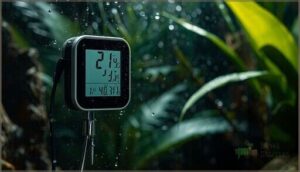
You can’t afford to guess regarding monitoring your snake’s environment—accuracy specifications, display clarity, and sensor responsiveness separate reliable units from dangerous gambles. The right thermometer hygrometer delivers measurements you can trust, responds quickly to environmental shifts, and survives the humid, high-temperature conditions inside your enclosure.
Here’s what to prioritize before you commit to any device.
Temperature and Humidity Accuracy Specifications
When you buy a thermometer hygrometer, check that temperature accuracy falls within ±0.5°C to ±1.0°C and humidity control hits ±3% to ±5% RH—measurements beyond those windows invite shedding failures and respiratory disease. Digital thermometer models publish explicit accuracy standards in their datasheets, while analog units drift without regular sensor calibration.
Three non-negotiables for reliable temperature and humidity measurement:
- Temperature ranges spanning your snake’s thermal gradient
- Hygrometer accuracy and precision under enclosure conditions
- Documented measurement errors and calibration intervals
Display Readability and Resolution
A clear display separates useful data from guesswork. Your digital thermometer should show temperature and humidity measurements at 0.1°C resolution and 1% RH increments—granularity that catches subtle shifts before they harm your snake. Digital backlight technology prevents squinting in dim rooms, while LED displays deliver visual clarity and reading precision across wide viewing angles that LCDs can’t match. For peak performance, it’s vital to examine humidity control systems that meet your specific needs.
| Feature | Digital Hygrometer | Analog Hygrometer |
|---|---|---|
| Display Accuracy | ±0.1°C resolution | ±2°C typical drift |
| Visual Clarity | LED backlight standard | Parallax errors |
| Sensor Resolution | 1% RH increments | 5% RH scale marks |
| Reading Precision | Real-time refresh | Manual observation |
| Viewing Angle | Wide-angle clarity | Limited perspective |
Thermometer hygrometer units with high-definition displays let you monitor environmental parameters from any position around the enclosure without bending or repositioning.
Response Time and Sensor Placement
Sensor calibration drives reliable environmental monitoring, yet slow response times betray even the best digital thermometer hygrometer. Most units deliver accurate temperature gradient readings within 30–120 seconds—critical when misting cycles or heating shifts demand rapid response.
Position sensors at mid‑enclosure height, away from radiant sources, to capture realistic humidity measurement without sensor drift. In tall setups, deploy two probes to meet accuracy standards across microclimates and prevent shedding crises.
Water-Resistance and Durability
Water resistance transforms your digital thermometer hygrometer from a disposable gadget into a durable monitoring asset. IP54-rated housings repel misting jets, while stainless-steel probes resist corrosion from substrate moisture.
Rugged designs pass drop tests, and moisture barriers seal battery bays against vapor ingress.
Durability tests validate these claims—look for units that survive enclosure humidity cycles without sensor drift or housing failure.
Top 10 Thermometer Hygrometers for Snake Enclosures
You’ve narrowed down the must-have features—now it’s time to see which units deliver on those specs.
The following ten thermometer-hygrometers represent field-tested options that span budget constraints, enclosure sizes, and accuracy requirements.
Each entry below highlights what sets it apart and where it fits in your snake-keeping setup.
1. Fluker’s Digital Thermometer Hygrometer
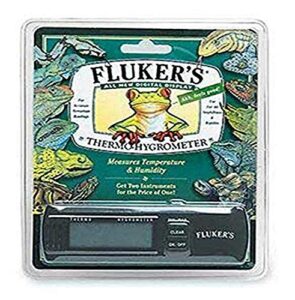
Fluker’s Digital Thermometer Hygrometer delivers simultaneous temperature and humidity readings on a compact digital display—making it a practical choice for smaller reptile enclosures where wall space runs tight.
The unit generally holds temperature accuracy near ±1–2°F, which won’t win any device comparison contests but stays adequate for routine monitoring in ball-python or corn-snake setups. You’ll find the digital hygrometer readable from across the room, and its adhesive mount simplifies installation.
Regular calibration tips still apply: verify readings against a known reference every three to four months to prevent sensor drift.
| Best For | Reptile and amphibian owners who need a budget-friendly digital monitor for basic temperature and humidity tracking in small to medium-sized enclosures. |
|---|---|
| Display Type | Digital |
| Power Source | Battery |
| Material | Plastic |
| Mounting Method | Adhesive |
| Temperature Accuracy | Not Specified |
| Humidity Accuracy | Not Specified |
| Additional Features |
|
- Displays both temperature and humidity on one compact, easy-to-read screen
- Simple adhesive mounting works well in most terrariums without drilling or hardware
- Affordable option that covers essential monitoring needs for common reptile setups
- Hygrometer accuracy can drift over time, requiring periodic calibration checks
- Adhesive backing may lose grip in high-humidity environments or fail to hold on certain surfaces
- Temperature precision of ±1–2°F falls short for species requiring tighter climate control
2. Zoo Med Dual Thermometer Humidity Gauge
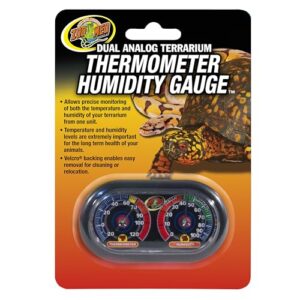
Zoo Med Dual Analog Gauge offers budget-conscious keepers an old-school solution—dual dial faces track both temperature and humidity without batteries or calibration drift. You mount it inside the enclosure with Velcro, position it mid-height away from basking lamps, and read the analog scales through the glass.
Gauge accuracy hovers around ±5% RH and a few degrees Fahrenheit, which means you’ll want a digital thermometer hygrometer nearby if your species demands tighter humidity control. For basic temperature monitoring in forgiving setups, it gets the job done.
| Best For | Budget-conscious reptile keepers with hardy species that don’t require precise humidity control and prefer a no-battery analog monitoring solution. |
|---|---|
| Display Type | Analog |
| Power Source | Battery |
| Material | Plastic |
| Mounting Method | Velcro |
| Temperature Accuracy | Not Specified |
| Humidity Accuracy | Not Specified |
| Additional Features |
|
- No batteries needed—analog dials eliminate calibration drift and ongoing maintenance costs
- Velcro mounting lets you reposition the gauge easily as you fine-tune your enclosure setup
- Tracks both temperature and humidity in one compact unit that reads through glass
- Accuracy sits around ±5% RH and a few degrees Fahrenheit, which won’t cut it for species needing tight environmental control
- Analog scales can be harder to read quickly compared to digital displays, especially in dim enclosures
- Some users report the readings drift over time or don’t match up with more precise digital instruments
3. Repti Zoo Digital Thermometer Hygrometer
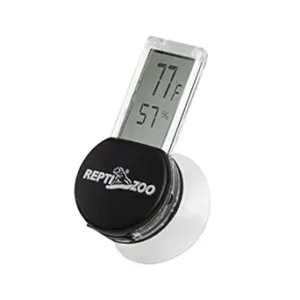
The Repti Zoo Digital Thermometer Hygrometer steps up from analog with a clear LCD that delivers temperature within ±1.8–3.6°F and humidity at ±5% RH—tight enough for most colubrid and python setups.
You mount the compact unit with a suction cup, threading the external probe into your reptile enclosure at mid-height to capture ambient conditions without the hot-spot skew that plagues single-point sensors.
Digital displays eliminate parallax error and viewing-angle headaches, but remember: even solid sensor accuracy means nothing if you skip quarterly recalibration against a known reference.
| Best For | Hobbyists who want a budget-friendly digital upgrade from analog gauges and need accurate ambient readings in small to mid-size reptile enclosures. |
|---|---|
| Display Type | Digital LCD |
| Power Source | Battery |
| Material | Glass, Plastic |
| Mounting Method | Suction Cup |
| Temperature Accuracy | Not Specified |
| Humidity Accuracy | Not Specified |
| Additional Features |
|
- Digital LCD eliminates guesswork and parallax errors—you get clear, simultaneous temp and humidity at a glance.
- External probe lets you position the sensor where it matters without placing the entire unit inside the enclosure.
- Affordable entry point for monitoring conditions in vivariums, brooders, and terrariums without breaking the bank.
- Suction-cup mounting can be finicky, especially if you want a sideways view or need to reposition frequently.
- Not fully waterproof—misting or high condensation zones can cause malfunctions or shorten lifespan.
- Sensor drift over time means you’ll need to recalibrate quarterly to maintain stated accuracy.
4. ThermoPro Digital Hygrometer Thermometer
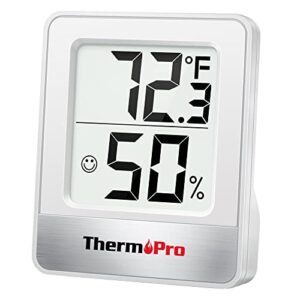
Beyond the Repti Zoo’s suction-cup simplicity, the ThermoPro Digital Hygrometer brings ±1°F sensor accuracy and a face-icon comfort indicator that flags DRY, COMFORT, or WET zones—handy when your ball python’s humidity monitoring demands drop below 50% RH or climb past 65%.
Its digital displays refresh every ten seconds, catching rapid shifts during misting cycles and giving you temperature control precision that analog dials can’t match.
Magnetic backing, tabletop stand, and hanging mount cover most reptile enclosure design and maintenance scenarios, though hygrometer precision depends on quarterly calibration tips you can’t skip.
| Best For | Reptile keepers who want fast, accurate humidity readings with multiple mounting options and a visual comfort indicator to quickly spot when conditions drift outside your ball python’s ideal range. |
|---|---|
| Display Type | Digital LCD |
| Power Source | Battery (Alkaline) |
| Material | Plastic |
| Mounting Method | Multiple Options |
| Temperature Accuracy | ±1°F |
| Humidity Accuracy | ±2-3%RH |
| Additional Features |
|
- High accuracy sensors (±1°F and ±2-3% RH) with 10-second refresh rates catch humidity swings during misting before your snake feels the effects
- Face icon instantly shows if you’re in the dry, comfort, or wet zone without needing to interpret numbers mid-tank maintenance
- Three mounting methods (magnetic, tabletop, hanging) let you reposition the gauge as your enclosure setup evolves
- No backlight makes nighttime checks impossible without a flashlight, which can stress nocturnal reptiles
- Requires quarterly calibration to maintain that ±2-3% accuracy claim, adding a maintenance step some keepers forget
- Compact 2.6″ display trades portability for smaller digits that are harder to read from across the room
5. Inkbird Digital Thermometer Hygrometer Monitor
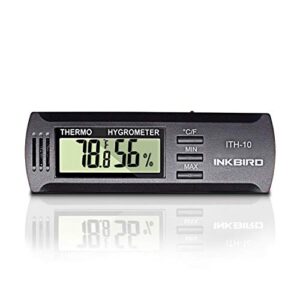
Inkbird’s compact thermometer and hygrometer slips into tight spaces—juvenile corn-snake tubs, adult milk-snake rack drawers—where larger units block airflow. Its ±1.8°F sensor accuracy and ±3% RH digital displays sit within acceptable tolerances for most colubrid and python species, though you’ll need to verify readings against a certified reference hygrometer during quarterly calibration methods.
The CR2032 coin cell lasts months, the 3.9-inch face mounts via magnet or adhesive, and humidity control tracking stays reliable if you keep sensor vents dust-free.
Reptile enclosure monitoring at this price point rarely beats Inkbird’s balance of portability and temperature monitoring precision.
| Best For | Reptile keepers who need a reliable, space-saving monitor for tracking temperature and humidity in small enclosures like juvenile tubs or rack systems. |
|---|---|
| Display Type | Digital LCD |
| Power Source | Battery (CR2032) |
| Material | Plastic |
| Mounting Method | Tabletop/Magnetic |
| Temperature Accuracy | ±1.8°F |
| Humidity Accuracy | ±3%RH |
| Additional Features |
|
- Compact 3.9-inch design fits easily in tight spaces without blocking airflow or taking up valuable enclosure real estate.
- Accurate sensors (±1.8°F and ±3% RH) provide reliable readings suitable for most common snake species when properly calibrated.
- Long-lasting CR2032 battery and flexible mounting options (magnet or adhesive) make it convenient for rack systems and glass terrariums.
- Calibration cannot be adjusted by the user, so you’re stuck with factory settings even if drift occurs over time.
- Some users report variability in accuracy and occasional display issues that may require replacement.
- Battery-powered design means you’ll need to monitor and replace the coin cell periodically to maintain consistent readings.
6. Jedew Digital Hygrometer Thermometer
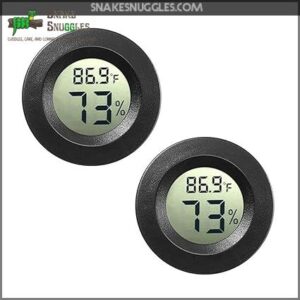
You’ll find Jedew’s round thermometer and hygrometer wedged into glass-terrarium corners or adhesive-mounted on PVC racks, its ±1°F sensor accuracy and ±3% RH digital displays meeting basic colubrid and ball-python temperature ranges without breaking budgets.
The 24-vent housing promises faster response, and its 0–70°C span covers desert kings to tropical carpet pythons—but user reviews split cleanly between “extremely accurate” and “5% humidity drift.”
Quarterly calibration methods against a certified digital hygrometer separate reliable units from outliers in reptile thermometer batches, making post-purchase verification non-negotiable for confident reptile enclosure monitoring.
| Best For | Snake keepers on a budget who need basic temperature and humidity monitoring for common colubrids and ball pythons, as long as they verify accuracy after purchase. |
|---|---|
| Display Type | Digital LCD |
| Power Source | Battery (LR44) |
| Material | Plastic |
| Mounting Method | Not Specified |
| Temperature Accuracy | ±1°F |
| Humidity Accuracy | ±3%RH |
| Additional Features |
|
- Affordable price point makes it easy to monitor multiple enclosures without spending much
- Compact round design fits neatly in terrarium corners or mounts on rack systems
- Fast sensor response with 24-vent housing helps you catch temperature swings quickly
- Accuracy varies significantly between units—some users report spot-on readings while others see 5% humidity drift
- Requires manual calibration check against a certified hygrometer to confirm your unit works properly
- Battery quality complaints, with some customers receiving dead or missing batteries on arrival
7. Zoo Med Digital Thermometer Humidity Gauge
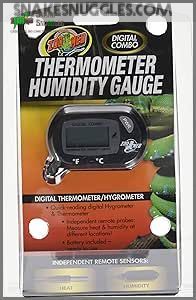
Zoo Med’s compact digital thermometer and hygrometer slips a single sensor probe into rack tubs or glass terrariums. Its ±1–2°C temperature accuracy and ±5% RH readings meet basic ball-python and corn-snake humidity control without requiring multi-point monitoring.
Button-cell batteries last weeks; LCD screens fade in direct basking-lamp glare. Device durability drops when probes contact misting spray, and factory digital calibration rarely holds past six months.
Quarterly verification against a certified reference hygrometer transforms this budget unit from guesswork into reliable reptile thermometers for starter enclosures.
| Best For | Budget-conscious reptile keepers with basic ball pythons or corn snakes who need simple temperature and humidity readings in smaller rack tubs or glass terrariums. |
|---|---|
| Display Type | Digital |
| Power Source | Battery (LR44) |
| Material | Plastic |
| Mounting Method | Suction Cup |
| Temperature Accuracy | Not Specified |
| Humidity Accuracy | Not Specified |
| Additional Features |
|
- Affordable single-sensor setup provides decent accuracy (±1–2°C temperature, ±5% RH) for common pet snake species without breaking the bank.
- Compact LCD screen and probe design fit easily into starter enclosures and rack systems where space is tight.
- Button-cell batteries offer weeks of operation before needing replacement, keeping monitoring costs low.
- Factory calibration drifts after about six months, requiring quarterly checks against a certified hygrometer to maintain reliability.
- Probe durability suffers when exposed to misting spray or direct water contact, limiting placement options in high-humidity setups.
- LCD display fades or becomes hard to read under direct basking lamp glare, making quick checks frustrating in brightly lit enclosures.
8. Reptile Tank Thermometer And Hygrometer
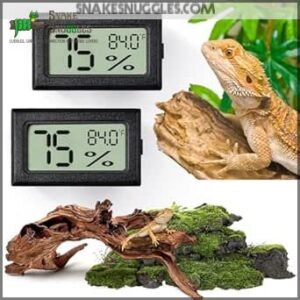
Vodolo’s dual-pack reptile tank thermometer and hygrometer stacks ±0.9°F device accuracy inside cordless plastic housings. LED screens toggle between Fahrenheit and Celsius, tracking temperature control and humidity management without probe cables tangling in substrate.
Double-sided adhesive mounts these digital hygrometer units on glass or acrylic walls; repeated misting degrades tape, dropping sensors into water bowls. Water-resistant shells resist occasional spray, yet direct contact with fog systems shortens electronics lifespan.
Enclosure monitoring across two zones suits hatchling racks where sensor technology must deliver consistent reptile thermometer readings without monthly recalibration.
| Best For | Reptile owners who need affordable dual-zone monitoring in smaller enclosures like hatchling racks or quarantine tanks where basic temperature and humidity tracking matters more than lab-grade precision. |
|---|---|
| Display Type | Digital LED |
| Power Source | Battery |
| Material | Plastic |
| Mounting Method | Adhesive |
| Temperature Accuracy | 0.9°F |
| Humidity Accuracy | Not Specified |
| Additional Features |
|
- Two units let you track both warm and cool ends simultaneously without buying separate meters
- Cordless design with adhesive backing keeps wires out of your substrate and away from curious snakes
- Quick Fahrenheit-to-Celsius switching helps if you’re following care guides written in different units
- Adhesive loses grip after repeated misting, so you’ll likely find these floating in water bowls eventually
- Some users report temperature readings drift off by a few degrees, which matters when your snake needs precise basking temps
- Battery-powered means you’ll need replacements over time, and there’s no low-battery warning before readings go wonky
9. Mini Digital Hygrometer Thermometer
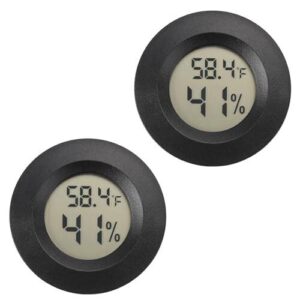
Pocket-sized units measuring under two inches deliver ±1.0°F temperature fluctuation tracking and ±3% to ±5% RH humidity control inside cramped drawer systems and nano-terrariums. These mini digital hygrometer thermometer devices refresh digital displays every ten seconds, revealing microclimate shifts faster than analog dials.
Miniaturized design suits hatchling tubs where bulky reptile thermometer housings block sight lines, yet sensor calibration against a reference standard prevents gradual drift.
Thermometer and hygrometer reviews confirm that proper reptile enclosure setup requires verifying accuracy before trusting these compact digital hygrometer readings long-term.
| Best For | Snake keepers managing hatchling tubs or nano-terrariums who need quick, space-saving temperature and humidity checks without blocking sight lines. |
|---|---|
| Display Type | Digital LCD |
| Power Source | Battery (LR44) |
| Material | Plastic |
| Mounting Method | Adhesive |
| Temperature Accuracy | ±1°F |
| Humidity Accuracy | ±3%RH |
| Additional Features |
|
- Updates readings every 10 seconds so you catch microclimate shifts faster than analog dials
- Compact size under 2 inches fits cramped spaces like drawer systems and small enclosures without getting in the way
- Battery lasts up to 9 months per LR44 cell, cutting down on maintenance interruptions
- Accuracy can drift by 1-2% over time, so you’ll need to verify against a reference thermometer periodically
- Adhesive backing may fail in humid environments above 75% RH, requiring alternative mounting solutions
- Small display can be hard to read quickly in dim lighting or from a distance
10. Paizoo Reptile Thermometer Hygrometer
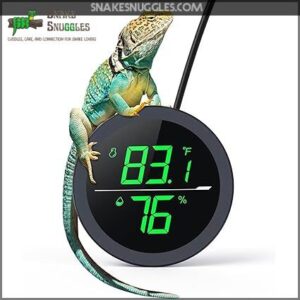
Paizoo’s 2-in-1 reptile thermometer hygrometer brings LED clarity and USB convenience to enclosures where battery replacement schedules lapse. The built-in measurement chip delivers sensor accuracy within typical ±1–2°F and ±5% RH margins, yet device reliability depends on consistent power—interruptions erase gradient tracking.
User reviews note adhesive failures in humid vivariums, and product comparison against battery units reveals durability concerns after months of operation.
Calibration tips stress verifying this digital hygrometer against reference standards before trusting thermometer selection and installation choices that shape long-term reptile care and husbandry outcomes.
| Best For | Reptile owners who want an affordable dual-function monitor with a clear LED display and don’t mind running a USB cable to their enclosure. |
|---|---|
| Display Type | Digital LED |
| Power Source | USB |
| Material | Acrylic |
| Mounting Method | Adhesive (3M) |
| Temperature Accuracy | Not Specified |
| Humidity Accuracy | Not Specified |
| Additional Features |
|
- Combined temperature and humidity readings on one bright, easy-to-read LED screen
- Long USB cable (140 cm) works well for larger tanks or setups far from outlets
- Slim design with included adhesive tape makes mounting simple on glass or acrylic
- Adhesive often fails in high-humidity environments, requiring alternative mounting solutions
- Some units stop working or display incorrect readings after a few months of use
- Requires constant USB power, so you’ll need an available outlet near the tank
Choosing The Best Thermometer for Your Snake
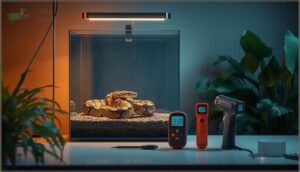
You can’t pick the right thermometer until you know what matters most for your setup and your snake. Budget, species-specific needs, and enclosure size all shape which features will protect your animal versus which ones just add cost.
Let’s break down how to match a device to your situation.
Price Vs. Performance for Different Budgets
Budget analysis for reptile thermometer and hygrometer choices divides into clear price points. Entry-level units under $15 deliver ±2–3 °C temperature accuracy and ±5–10% RH readings—sufficient for forgiving species but risky when precision matters.
Mid-range digital hygrometer options ($20–40) cut sensor drift and response lag, boosting cost efficiency.
Premium models exceeding $50 offer multi-sensor arrays and data logging that justify the investment only when performance metrics demand perfect environmental control.
Features for Specific Snake Species
After settling on a budget, you still need to match features to your snake’s biology. Species-specific humidity demands determine which reptile thermometer and hygrometer combination will keep your animal healthy. Ball pythons require 50–60% ambient humidity with periodic spikes to 70% during shedding, while corn snakes thrive around 40–50%. Matching your enclosure calibration capability to those precise species monitoring needs prevents respiratory infections, retained shed, and dehydration.
- High-humidity species (green tree pythons, rainbow boas) need hygrometers accurate to ±3% RH for arboreal zone tracking
- Desert dwellers (kenyan sand boas) tolerate wider margins but benefit from basking-spot temperature sensors
- Large constrictors require multi-point arrays to map thermal gradients across extended enclosures
- Moisture-sensitive morphs demand fast-response sensors that detect rapid humidity shifts before stress develops
- Seasonal breeders need data-logging features to track cyclic temperature and humidity adjustments during breeding periods
Compact Vs. Multi-Sensor Options
Once you’ve matched sensor needs to your snake’s biology, you’ll choose between a compact single-point reptile thermometer hygrometer and a multi-zone wireless monitoring system.
Compact digital thermometers work well in small enclosures with shallow thermal gradients, but multi-sensor arrays with data logging and device calibration features accurately track humidity control across basking, ambient, and cool zones—critical for proper sensor placement in larger vivariums.
Proper Placement and Installation Tips
You can mount the most accurate thermometer in the world and still get junk data if you stick it in the wrong spot. Hot spots near basking lamps, cold pockets along glass walls, and humidity gradients from substrate to canopy all skew your readings by several degrees or percentage points.
Position your sensors strategically, avoid common placement mistakes, and you’ll finally see what your snake actually experiences inside that enclosure.
Avoiding Hot Spots and False Readings
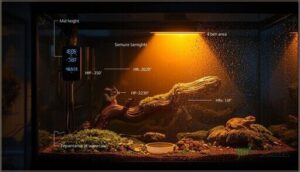
Even slight sensor placement errors will skew your hygrometer readings and thermometer accuracy. To achieve reliable temperature gradients and prevent hot spot formation, follow these strategies:
- Mount reptile thermometers at least six inches from basking lamps to avoid inflated readings that mask true ambient conditions.
- Position humidity sensors mid-height, away from water dishes, for accurate humidity mapping.
- Deploy multiple sensors across zones to identify false readings from sensor drift.
- Calibrate devices monthly against known references to verify humidity control precision.
Multi-Point Monitoring for Large Enclosures
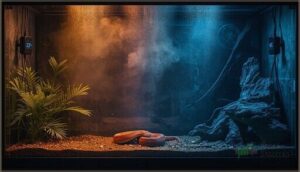
Large enclosures demand coordinated sensor networks across at least five interior zones to capture accurate zone mapping of temperature gradients and humidity control. Deploy calibrated reptile thermometers and hygrometer probes at representative heights, implement data logging every 1–5 minutes, and configure alert systems for threshold breaches.
Redundancy ensures environmental monitoring continues during sensor failures—your snake’s health depends on real-time visibility into every microclimate.
Integration With Misting and Humidification Systems
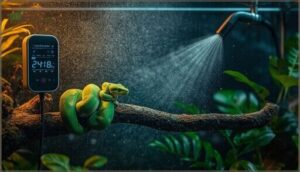
When you synchronize your hygrometer with automated misting systems, position humidity sensors away from spray zones to prevent inflated readings that trigger premature shutoffs.
Many reptile thermometers support 12V or 24V relay outputs for direct misting control, maintaining humidity levels within ±5% of your target.
Fast-response digital units reduce lag during humidity spikes, ensuring environmental monitoring governs misting cycles without overshoot or drenching.
Calibration and Maintenance Best Practices
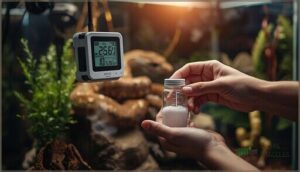
Your thermometer hygrometer won’t stay accurate on its own—sensor drift compounds over weeks, and without routine checks, you’re making decisions based on fiction rather than fact.
Digital units need verification against known references every 4–6 weeks, while analog gauges demand monthly comparison to prevent the slow creep of inaccuracy that undermines your entire husbandry protocol.
Here’s how to maintain precision and catch drift before it threatens your snake’s health.
How to Calibrate Digital and Analog Units
Your digital hygrometer needs annual calibration against a NIST-traceable reference—compare readings at two known points, record the offset, then apply corrections to future data.
Analog thermometers require physical adjustment: place the unit beside a certified standard, turn the calibration screw in small increments per manufacturer specs, and verify across multiple temperature points to confirm linearity before trusting those readings.
Cleaning and Preventing Sensor Drift
Quarterly cleaning with a microfiber cloth and distilled water keeps sensor drift in check—residue buildup from substrate dust and microbial films skews your hygrometer readings by 3–5% RH over three months.
Position reptile thermometers away from direct misting spray and basking lamps to extend accuracy verification intervals.
Regular maintenance schedules protect humidity control and environmental monitoring systems from calibration creep that compromises your snake’s microclimate.
Recording Maintenance and Calibration Dates
You wouldn’t skip your snake’s feeding log—so why gamble with calibration schedules and maintenance logs for your thermometer and hygrometer selection?
Environmental monitoring demands the same discipline. Track these three for sensor validation and data traceability:
- Calibration date and next due date (every 6–12 months)
- Reference standards used and ambient conditions during accuracy standards checks
- Drift measurements and any adjustments made to your reptile thermometer
Documented reptile enclosure maintenance prevents undetected sensor failure.
Maximizing Reptile Health Through Accurate Monitoring
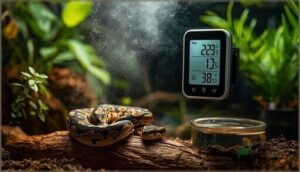
Accurate monitoring doesn’t just prevent emergencies—it builds a foundation for thriving captive environments where snakes shed cleanly, maintain hydration, and exhibit natural behaviors. When you catch environmental drift early, you stop dehydration and fungal colonization before they compromise your animal’s immune response or trigger secondary infections.
The strategies below translate raw sensor data into actionable husbandry decisions that protect long-term wellness in your enclosure.
Preventing Shedding and Dehydration Issues
Your reptile thermometer and hygrometers aren’t optional—they’re your first defense against shedding catastrophes and dehydration signs. Accurate humidity control preserves skin health by maintaining the moisture gradient your snake needs for clean molts.
When humidity levels drift just 10–15% off target, you’ll see retained eye caps and incomplete sheds within days. Temperature and humidity control systems prevent kidney stress and lethargy before dehydration becomes irreversible.
Early Detection of Environmental Imbalances
Your reptile thermometer and hygrometer catch trouble before you spot symptoms. Multi-point temperature control readings expose microclimate shifts that predict heating failures, while data trending reveals gradual humidity drift no visual check will detect.
Environmental alerts flag dangerous deviations within minutes, giving you time to correct misting errors or thermostat malfunctions.
Sensor calibration and imbalance prevention transform passive monitoring into active environmental management—the difference between reacting to illness and preventing it.
Supporting Long-Term Wellness in Snake Enclosures
Stability drives longevity—environmental stability paired with species research builds the foundation for wellness.
Your reptile thermometer and hygrometer deliver health monitoring data that informs enclosure design adjustments, humidity control and management protocols, and even reptile nutrition timing.
Consistent reptile care anchored in accurate thermometer and hygrometer readings correlates directly with reduced veterinary interventions and extended captive lifespans across genera.
Frequently Asked Questions (FAQs)
Can I use a household thermometer for snakes?
While your home’s glass thermometer may work for checking fever, it won’t capture thermal gradients, hotspot zones, or humidity critical for snake health.
Reptile-specific sensors prevent dangerous calibration drift and localized temperature errors.
How often should I replace my hygrometer?
Most digital hygrometers operate reliably for 12–24 months before sensor drift compromises accuracy. High-humidity enclosures accelerate degradation, so replace units when calibration checks reveal persistent drift exceeding 5–10% relative humidity.
Do wireless thermometers work in glass enclosures?
Yes, but placement matters—glass attenuates RF frequency signals from wireless thermometers. Position your sensor near the front panel and keep the receiver within line-of-sight to maintain signal strength and minimize wireless interference affecting environmental monitoring.
Whats the ideal nighttime temperature drop for snakes?
Most snakes need a nocturnal drop of 5–10°F to trigger natural reptile behavior and support digestion.
Reptile thermometers track these temperature fluctuations across thermal zones, ensuring proper humidity control and thermal gradients for ideal reptile care.
Should I use separate devices for multiple zones?
A single device fails and your entire environmental monitoring strategy collapses. Independent monitoring through separate devices per zone delivers precise microclimate management, enabling calibrated thermal zones and device redundancy that multi-sensor units can’t match.
Conclusion
Your snake won’t file a complaint about inaccurate thermometer hygrometers for snake enclosures—it’ll just stop shedding cleanly, develop respiratory infections, or slowly dehydrate while you trust a $12 sensor drifting 8°F off reality.
Precision monitoring isn’t paranoia when a 5-degree miscalculation triggers veterinary bills exceeding the cost of calibrated equipment by orders of magnitude.
Install accurate sensors, verify readings against references quarterly, and treat environmental data as the diagnostic intelligence it actually represents.
- https://www.nature.com/articles/srep08861
- https://www.sciencedirect.com/science/article/pii/S2949916X23000464
- https://www.chainzone.cc/led-vs-lcd-which-is-better-for-outdoor-digital-displays
- https://calright.com/analog-vs-digital-hygrometer-which-is-better
- https://www.amazon.com/ThermoPro-TP49W-Digital-Indoors-Thermometer/dp/B07WCR5Y4B