This site is supported by our readers. We may earn a commission, at no cost to you, if you purchase through links.
When metabolic bone disease strikes your bearded dragon—manifesting as trembling limbs, soft jawbones, and the inability to support their own weight—the culprit isn’t calcium deficiency alone, but rather the absence of UVB wavelengths between 280-315 nanometers that drive endogenous vitamin D3 synthesis in desert-adapted squamates.
Your reptile’s skeletal integrity, immune function, and reproductive viability depend entirely on photobiological processes that cannot occur under standard household lighting, regardless of dietary supplementation. The technical specifications separating therapeutic UVB provision from inadequate exposure aren’t academic minutiae—they’re the difference between a thriving captive population and chronic immunosuppression that leaves your leopard gecko vulnerable to opportunistic infections.
Selecting appropriate UVB lighting systems for desert reptiles requires understanding species-specific requirements, wavelength output degradation curves, and the nuanced distinctions between T5 HO fluorescent configurations, mercury vapor alternatives, and emerging LED technologies that balance spectral quality with thermal management.
Table Of Contents
- Key Takeaways
- Essential UVB Needs for Desert Reptiles
- Key Features of UVB Lighting Systems
- Choosing The Right UVB System for Your Reptile
- Top 10 UVB Lighting Systems for Desert Reptiles
- 1. Zoo Med Desert UVB Lighting Kit
- 2. Reptile Systems T5 Desert UVB Lamp
- 3. Repti Zoo T5 UVB Lighting Kit
- 4. Zilla Reptile UVB Light Bulb
- 5. T5 Ho Uvb Reptile Light Fixture
- 6. Lucky Herp Reptile Uvb Light Bulb
- 7. Repti Zoo UVB Desert Reptile Lamp
- 8. Reptile UVB Light Fixture
- 9. Haceryc Reptile UVB Light Fixture
- 10. Reptile UVB Light Bulb
- Proper Placement and Setup for Maximum Benefit
- Maintenance and Safety Tips for UVB Systems
- Frequently Asked Questions (FAQs)
- Conclusion
Key Takeaways
- Desert reptiles require UVB wavelengths between 280-315 nanometers to synthesize vitamin D3 and absorb calcium—without this specific light exposure, even well-fed animals develop metabolic bone disease, skeletal deformities, and immune suppression regardless of dietary supplementation.
- T5 high-output fluorescent systems deliver the most consistent UVB spectrum for desert species when positioned 12-18 inches from basking zones, though all bulbs require replacement every 6-12 months because UVB output degrades long before the bulb visibly dims or burns out.
- Species-specific UVB requirements vary dramatically—bearded dragons need basking zone UVI levels between 4.0-6.0, while leopard geckos thrive at 0.5-1.5—making one-size-fits-all lighting setups inadequate and potentially harmful to your reptile’s long-term health.
- Glass and plastic barriers block up to 60% of critical UVB wavelengths, so effective setups require mesh-topped enclosures, regular cleaning of bulbs and reflectors to prevent 20-40% transmission loss from dust, and UV meter verification to confirm therapeutic exposure levels at basking sites.
Essential UVB Needs for Desert Reptiles
Understanding your desert reptile’s ultraviolet-B requirements isn’t optional—it’s the foundation of successful long-term husbandry, directly influencing calcium metabolism, skeletal integrity, and overall physiological function. Without appropriate UVB provision, even well-fed specimens develop metabolic bone disease and immunosuppression, conditions that compromise quality of life and longevity across all desert-dwelling species.
Selecting the right setup means understanding output levels, fixture placement, and replacement schedules—our guide to UVB lighting systems for desert species breaks down exactly what your reptile needs at each life stage.
UVB lighting isn’t optional for desert reptiles—it’s the foundation of calcium metabolism, skeletal health, and preventing metabolic bone disease
We’ll examine the critical wavelength parameters, species-specific exposure thresholds, and the pathophysiological consequences of inadequate UVB before you select your lighting system.
Importance of UVB for Calcium Metabolism
Your desert reptile’s survival hinges on UVB lighting to drive vitamin D synthesis in the skin, which then activates calcium absorption across intestinal membranes, ensuring sturdy bone health and metabolic balance. Without adequate UVB dosage matched to species-specific UVB requirements, calcium metabolism collapses, compromising skeletal integrity and reproductive function—making proper UVB provision non-negotiable for maintaining vitamin D3 reserves in captive populations.
For more insight into the role of, recent studies highlight the complex factors influencing vitamin D synthesis.
Common Health Issues From Inadequate UVB
When UVB lighting falls short of your reptile’s physiological needs, metabolic bone disease emerges as the most devastating consequence, manifesting through skeletal deformities, limb abnormalities, and chronic calcium deficiency that compromises both structural integrity and immune suppression across multiple physiological systems—ultimately threatening reproductive issues, growth delays, and vitamin D3-dependent regulatory pathways critical to desert reptiles’ long-term health and wellness. Providing proper UVB lighting is essential for in reptiles, ensuring their ideal health and well-being.
- Soft or deformed bones develop when UVB-driven vitamin D3 synthesis fails to support adequate calcium absorption
- Behavioral changes including lethargy, appetite loss, and irregular basking attempts signal underlying metabolic imbalance
- Immune suppression increases infection susceptibility while slowing wound healing and shedding processes
- Reproductive health declines through reduced egg viability, thin shell formation, and diminished mating behaviors in breeding populations
Species-specific UVB Requirements (bearded Dragons, Leopard Geckos, More)
Bearded dragons demand ample UVB exposure, with basking zone UVI targets between 4.0 and 6.0 to support their diurnal basking behavior and accelerated reptile metabolism. In contrast, leopard geckos thrive under more modest UVB requirements (UVI 0.5–1.5) that reflect their crepuscular activity patterns within arid desert habitat conditions.
These examples demonstrate how species research reveals critical distinctions in UVB spectrum needs across desert reptiles. This underscores why one-size-fits-all UVB lighting approaches consistently fail to address these physiological differences.
Key Features of UVB Lighting Systems
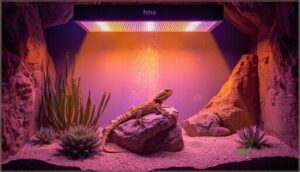
When you’re selecting a UVB lighting system for your desert reptiles, understanding the technical specifications that separate adequate from ideal performance becomes paramount to your animal’s long-term health. The most critical features—wavelength output between 280-315 nanometers, fixture type compatibility, and sustained photon flux density throughout the bulb’s operational lifespan—directly influence vitamin D3 synthesis efficiency and calcium metabolism in species ranging from bearded dragons to blue-tongued skinks.
Let’s examine the essential characteristics you’ll need to evaluate before committing to any particular system.
UVB Wavelength Range and Output
You’ll want to focus on spectral output between 280 and 315 nanometers, because this UVB spectrum drives vitamin D3 photobiology effects in desert species.
Most quality systems deliver wavelength peaks near 305–310 nm, maintaining intensity levels from 0.5 to 2.5 mW/cm² at basking distance, though output stability declines over months, requiring measurement with meters to verify your photon flux density meets species-specific UVB requirements.
High-output T5 Fluorescent Systems
You’re looking at the benchmark when evaluating T5 HO systems, which deliver consistent UVB spectrum through electronic ballasts paired with reflective materials that concentrate photon flux at basking perches.
These high-output T5 fluorescent fixtures, usually running 24 W or 54 W lamps with 16 mm tube diameter, meet demanding UVB requirements. Electronic ballasts guarantee stable output and dimming capability across your reptile lighting setup.
Mercury Vapor and LED UVB Options
Beyond fluorescent tubes, mercury vapor bulbs and LED UVB options expand your desert reptile lighting toolkit, each delivering distinct trade-offs in UVB spectrum, heat management, and lighting durability.
- Mercury vapor bulbs emit broad-spectrum UVB and UVA alongside significant radiant heat, functioning as single-source basking units that usually last 6–12 months before output degrades.
- LED UVB systems offer energy-efficient alternatives with minimal heat generation, though current models rarely match the intensity desert species require at basking zones.
- Heat management becomes critical with mercury vapor installations, since excessive thermal output can disrupt gradient stability and necessitate distance adjustments to prevent focal overheating.
- UVB spectrum coverage from mercury vapor spreads narrowly from a point source, creating steep gradients that suit bearded dragons when paired with secondary fluorescent fixtures for broader enclosure distribution.
Fixture Compatibility and Energy Efficiency
When selecting UVB lighting systems for desert reptiles, you’ll need fixtures engineered to optimize lamp efficiency while minimizing energy waste. Compatibility issues between ballasts and tubes directly compromise UVB output across your enclosure’s basking gradients.
| Feature | T5 High Output | Mercury Vapor |
|---|---|---|
| Energy draw | 24–54 watts | 100–160 watts |
| Reflectivity matters | High-polish interiors boost distribution | Point-source limits reflection gain |
| Fixture design | Linear housing aids even coverage | Dome or clamp fixtures concentrate beam |
| Compatibility issues | Ballast-tube mismatch drops UVB 40% | Socket rating must handle heat load |
Energy metrics reveal that reflectivity matters enormously—polished aluminum reflectors reclaim 30–50% more photons than matte surfaces, translating fixture design choices into measurable UVB lighting requirements your reptiles experience daily.
Choosing The Right UVB System for Your Reptile
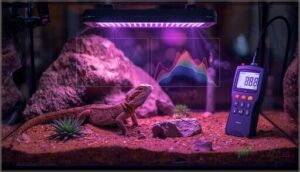
Selecting an appropriate UVB system requires careful consideration of your reptile’s photobiological requirements, enclosure dimensions, and long-term operational costs, as mismatched equipment can compromise calcium metabolism regardless of initial investment.
You’ll need to evaluate spectral output compatibility with species-specific UV Index targets (ranging from 1.0 for crepuscular geckos to 5.0+ for heliothermic agamids), bulb longevity projections that affect annual replacement expenses, and empirical performance data from established keepers who’ve documented health outcomes over multiple seasons.
The following factors will guide you toward a system that balances technical efficacy with practical sustainability for your specific husbandry situation.
Matching UVB Output to Species and Enclosure Size
Proper UVB calibration begins with thorough species research, since bearded dragons require a basking UVI of 3 to 6 while leopard geckos thrive at 1 to 2, and your enclosure design dictates lighting configurations—taller setups demand higher wattage or closer placement to maintain adequate basking strategies.
Desert reptiles housed in 24-inch enclosures need fixtures positioned 6 to 8 inches above basking zones, ensuring reptile lighting systems deliver species-appropriate UVB lighting requirements.
Evaluating System Lifespan and Replacement Intervals
System longevity directly impacts your husbandry budget and your reptile’s calcium metabolism. Phosphor coatings in T5HO tubes degrade after 9 to 12 months, while mercury vapor bulbs often fail by month 10, even when visibly lit. UVB output drops below therapeutic thresholds long before burnout.
Track replacement schedules with these evidence-based intervals:
- T5 fluorescent systems: Replace every 12 months to maintain spectral output above species-specific UV Index requirements.
- Mercury vapor bulbs: Swap at 8 to 10 months when UVB output declines by 40 percent.
- LED UVB lighting systems: Follow manufacturer specs, verifying with a Solarmeter to confirm adequate desert reptile exposure despite advertised multi-year lifespan claims.
Regular bulb degradation monitoring prevents metabolic bone disease.
Cost, Energy Use, and User Reviews
Your wallet will feel the initial sting—UVB Lighting Systems for Desert Reptiles range from $20 to $150, with T5 HO desert kits often exceeding $100, plus $10 to $40 replacement bulbs every year.
Energy Impact varies: Compact Fluorescent draws 14 to 28 watts versus mercury vapor’s 100 to 150 watts.
Owner Feedback consistently highlights improved appetite when Bulb Lifespan schedules align with manufacturer specs.
Consulting Reptile Care Experts for Recommendations
When specs and reviews still leave you uncertain, Expert Guidance from reptile care professionals can bridge the gap between catalog data and your animal’s real-world UVB Radiation needs. Consultation Benefits include customized Care Planning, enclosure-specific UVB Lighting recommendations for Desert Reptiles, and Owner Support that translates wavelength curves into practical Reptile Health outcomes—five reasons to seek a herpetology consult:
- Customized system selection matching your species’ photobiological requirements
- On-site or virtual habitat assessments for ideal fixture placement
- Evidence-based bulb replacement schedules tied to measurable Reptile Lighting performance
- Rapid troubleshooting during health concerns or equipment failures
- Continuing education resources as husbandry standards evolve
Top 10 UVB Lighting Systems for Desert Reptiles
You’ll find that selecting the right UVB system requires balancing spectral output consistency, fixture compatibility with your enclosure dimensions, and long-term operational reliability—criteria that separate professional-grade equipment from inadequate alternatives.
The following ten systems represent solutions that deliver appropriate UVB wavelengths (280-315 nanometers) while maintaining the photon flux density necessary for vitamin D3 photosynthesis in desert-adapted species.
Each option has been evaluated based on measurable output characteristics, replacement intervals, and practical application across varied enclosure configurations.
1. Zoo Med Desert UVB Lighting Kit
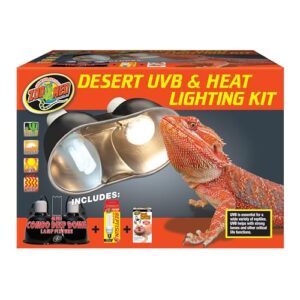
The Zoo Med Desert UVB Lighting Kit offers a complete, integrated solution for reptile owners. It combines a 75-watt Repti Basking Spot Lamp with a ReptiSun 10.0 Mini Compact Fluorescent (13 watts) in a Mini Combo Deep Dome Lamp Fixture. This setup effectively meets the thermal and photobiological needs of species like bearded dragons and leopard geckos.
The fixture features dual ceramic sockets, each capable of accommodating lamps up to 160 watts. Independent switches allow for precise environmental control, ensuring optimal conditions for your reptiles. However, it’s important to note that bulb replacement intervals align with those of standard compact fluorescent UVB sources. Regular replacements are necessary to maintain adequate spectral output for calcium metabolism.
| Best For | Reptile owners looking for an all-in-one lighting solution for desert species like bearded dragons and leopard geckos that need both UVB and basking heat. |
|---|---|
| UVB Output | 10.0 UVB |
| Wattage | 75w + 13w |
| Light Type | Combo (Incandescent + CFL) |
| Target Species | Desert reptiles |
| Brand | Zoo Med |
| Replacement Interval | Varies |
| Additional Features |
|
- Complete kit with everything included—basking lamp, UVB bulb, and dual-socket fixture ready to use out of the box
- Independent switches let you control heat and UVB separately for flexible day/night cycling
- Strong ceramic sockets handle up to 160 watts each, giving you room to upgrade bulbs as needed
- Bulbs tend to burn out faster than expected, requiring frequent replacements
- Heat lamp can be unreliable—some users report it shorting out or failing to turn on
- May run too hot for certain species like geckos, and might need modification to fit some enclosure lids properly
2. Reptile Systems T5 Desert UVB Lamp
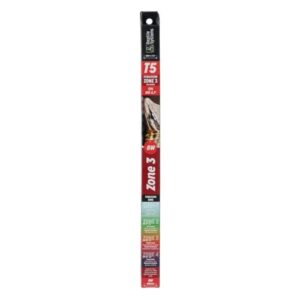
Aquarium Systems’ Reptile Systems T5 Desert UVB Lamp delivers high-intensity photobiological support specifically calibrated for desert-dwelling species such as bearded dragons, uromastyx, and tortoises. Utilizing a 24-watt T5 fluorescent format, it integrates seamlessly with compatible electronic ballasts and reflective fixtures to concentrate UVB output (280-315 nanometers) directly onto basking zones.
The lamp’s Zone 3 classification indicates suitability for daily baskers requiring intense UVB exposure, supporting vitamin D3 synthesis essential for calcium absorption. It maintains stable spectral output when operated at the recommended 15-25 centimeter distance from your animal, though annual replacement remains necessary to prevent photobiological decline.
| Best For | Reptile owners with desert species like bearded dragons, uromastyx, or tortoises that need strong UVB exposure for proper calcium absorption and bone health. |
|---|---|
| UVB Output | Zone 3 High UVB |
| Wattage | 24 watts |
| Light Type | T5 Fluorescent |
| Target Species | Desert-dwelling reptiles |
| Brand | Aquarium Systems |
| Replacement Interval | Not specified |
| Additional Features |
|
- Provides high-intensity UVB (Zone 3) that’s specifically designed for desert reptiles that bask frequently
- Helps reptiles produce vitamin D3 naturally, which is crucial for preventing metabolic bone disease
- Works with standard T5 fixtures and delivers consistent light output when positioned correctly
- Only suitable for high-UVB species—won’t work for reptiles that need lower exposure levels
- Needs to be replaced annually even if it still looks bright, since UVB output degrades over time
- Requires careful placement (6-10 inches from basking spot) to avoid under or overexposure
3. Repti Zoo T5 UVB Lighting Kit
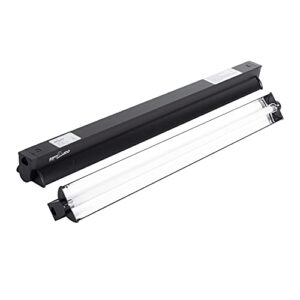
Repti Zoo’s T5 UVB Lighting Kit bundles a 24-watt Desert 10.0 UVB lamp with a sleek, low-profile fixture featuring a highly polished curved reflector that concentrates photobiologically active wavelengths (290-320 nanometers) directly onto your dragon’s basking platform. The integrated electronic ballast ensures rapid start and steady output, while the detachable power cable with on/off switch simplifies daily photoperiod management.
Though some users report premature bulb failure and costly replacements, the kit’s ETL-certified safety compliance and straightforward assembly make it accessible for intermediate keepers managing mid-sized desert enclosures.
| Best For | Intermediate keepers managing mid-sized desert enclosures who need a complete UVB lighting solution with good reflector efficiency. |
|---|---|
| UVB Output | 10.0 UVB |
| Wattage | 24 watts |
| Light Type | T5 Fluorescent |
| Target Species | Desert-dwelling reptiles |
| Brand | REPTI ZOO |
| Replacement Interval | Not specified |
| Additional Features |
|
- Curved reflector design concentrates UVB rays directly onto basking areas for better calcium metabolism
- Complete kit includes 24W Desert 10.0 UVB bulb, so you can start using it right away
- Detachable power cable with built-in switch makes daily light scheduling simple
- Bulbs may burn out faster than expected, leading to frequent replacements
- Replacement bulbs are expensive, increasing long-term ownership costs
- Only works with 100-120V input, so you’ll need a transformer for other voltage systems
4. Zilla Reptile UVB Light Bulb
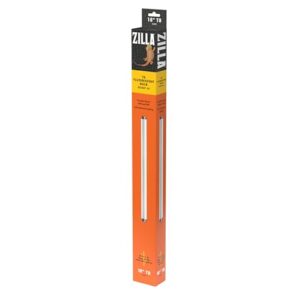
Zilla’s compact T8 UVB bulb delivers wavelengths between 290 and 320 nanometers—the photobiological sweet spot for calcium metabolism—through standard dome fixtures without specialty adapters, simplifying setup for leopard geckos and similarly modest desert species.
At typical mounting distances, you’ll get low-to-moderate UVB microwatts per square centimeter, which works well when paired with calcium supplementation and careful placement.
However, reports of early burnout and gradual output degradation mean you should replace this bulb every six to twelve months and confirm levels with a UV index meter.
| Best For | Budget-conscious reptile owners with small desert setups who want straightforward UVB lighting without investing in specialty fixtures. |
|---|---|
| UVB Output | Desert UVB |
| Wattage | 15 watts |
| Light Type | T8 Fluorescent |
| Target Species | Desert dwelling reptiles |
| Brand | Zilla |
| Replacement Interval | 12 months |
| Additional Features |
|
- Works with standard T8 fixtures, so no expensive adapters needed
- Covers the essential UVB spectrum for calcium absorption in desert reptiles
- Affordable option compared to pricier compact or mercury vapor bulbs
- Multiple reports of bulbs dying within a few months instead of lasting the full year
- UVB output fades over time, so you’ll need to replace it every 6-12 months even if it still lights up
- May not provide enough coverage for larger tanks without adding extra bulbs
5. T5 Ho Uvb Reptile Light Fixture
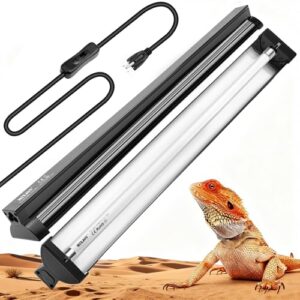
MIXJOY’s T5 HO fixture pairs a high-output 24W fluorescent tube with a polished aluminum reflector—boosting UVB delivery to basking zones by redirecting photons that would otherwise scatter—so you optimize the 10% UVB, 30% UVA Desert 10.0 spectrum critical for bearded dragons, tortoises, and iguanas.
The durable aluminum housing dissipates heat quickly, preventing thermal stress on ballast components, while flame-retardant materials and adaptable mounting brackets simplify installation under mesh tops. At just 5.9 ounces and 24 inches, you’ll achieve stable, energy-efficient performance without glass or acrylic interference blocking essential wavelengths.
| Best For | Desert reptile owners who need a reliable, high-output UVB solution for bearded dragons, tortoises, leopard geckos, or iguanas to prevent metabolic bone disease and support healthy growth. |
|---|---|
| UVB Output | 10% UVB |
| Wattage | 24 watts |
| Light Type | T5 HO Fluorescent |
| Target Species | Desert reptiles |
| Brand | MIXJOY |
| Replacement Interval | Not specified |
| Additional Features |
|
- Polished aluminum reflector maximizes UVB efficiency by focusing light directly into the basking zone instead of letting it scatter
- Lightweight aluminum housing dissipates heat fast, protecting internal components and extending bulb life
- Easy mounting system works with different enclosure setups without blocking essential UVB wavelengths
- Glass or acrylic barriers completely block UVB, so you’ll need mesh or open-top access for it to work
- The 10% UVB output might not suit all reptile species—some need lower or higher percentages depending on their natural habitat
- Doesn’t produce heat, so you’ll still need a separate basking lamp if your reptile requires warm temperatures
6. Lucky Herp Reptile Uvb Light Bulb
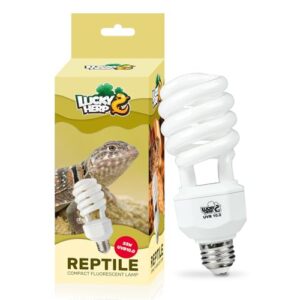
Lucky Herp’s compact fluorescent bulb screws into standard E26 bases, delivering 10% UVB and 30% UVA output at 23W. It is ideal for bearded dragons, tortoises, and smaller desert-adapted lizards requiring moderate to high UV indices without dedicated ballast infrastructure.
The claimed one-year UVB lifespan offers convenience, though real-world reports suggest replacing every six to twelve months when output degrades or color rendering dims.
Position twelve to eighteen inches above basking zones, confirm voltage compatibility (120V specification), and avoid glass barriers that filter critical wavelengths essential for calcium metabolism.
| Best For | Desert reptile owners seeking a budget-friendly UVB solution that fits standard lamp sockets without needing specialized ballasts. |
|---|---|
| UVB Output | 10% UVB |
| Wattage | 23 watts |
| Light Type | E26 CFL |
| Target Species | Desert reptiles |
| Brand | Generic |
| Replacement Interval | 1 year |
| Additional Features |
|
- Fits standard E26 bases, making setup simple without extra equipment
- Delivers solid 10% UVB and 30% UVA output for desert species like bearded dragons and tortoises
- High 90% CRI produces bright, natural-looking light that enhances viewing and reptile activity
- UVB output often degrades faster than the claimed one-year lifespan, requiring replacement every 6-12 months
- Some units arrive defective or fail prematurely according to user reports
- Can be damaged by heat from nearby bulbs, limiting fixture compatibility
7. Repti Zoo UVB Desert Reptile Lamp
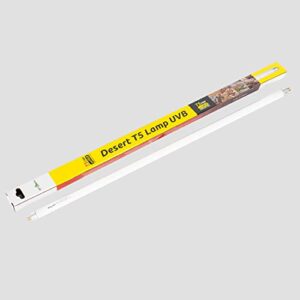
You’ll find this 22-inch T5 HO lamp delivers 10.0 UVB emission specifically calibrated for bearded dragons, blue-tongued skinks, and other desert-dwelling species requiring moderate to high UV indices within 24-inch enclosures.
The 24W glass tube emits wavelengths between 280-315 nanometers, essential for calcium metabolism and vitamin D3 synthesis.
However, field reports document inconsistent longevity, with some units dimming after three months rather than the standard eight-month replacement interval, requiring vigilant output monitoring with UV meters.
| Best For | Owners of desert-dwelling reptiles like bearded dragons and blue-tongued skinks who need reliable UVB lighting in 24-inch enclosures to support calcium absorption and prevent metabolic bone disease. |
|---|---|
| UVB Output | 10.0 UVB |
| Wattage | 24 watts |
| Light Type | T5 HO Fluorescent |
| Target Species | Desert dwelling reptiles |
| Brand | REPTI ZOO |
| Replacement Interval | 8 months |
| Additional Features |
|
- Delivers the right 10.0 UVB spectrum at 280-315 nanometers for proper vitamin D3 synthesis in desert species
- 24W output provides strong coverage for standard 24-inch terrariums
- Stimulates natural behaviors like appetite and activity while supporting bone health
- Inconsistent lifespan with some bulbs dimming or burning out after just 3 months instead of the expected 8 months
- Requires a UV meter to monitor output since dimming isn’t always visible to the eye
- Installation can be tricky and the price feels steep given the reliability issues
8. Reptile UVB Light Fixture
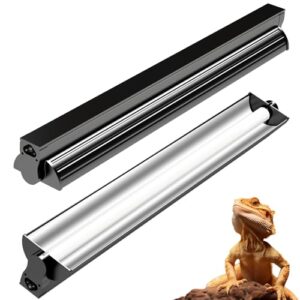
This 8W to 54W modular system accommodates bearded dragons, leopard geckos, and similarly sized desert species through adjustable fixture lengths ranging from 12 to 46 inches. This allows you to match UVB coverage precisely to enclosure dimensions without wasted photon flux beyond the inhabited zone.
The integrated alloy reflector concentrates UVB 10.0 output (290-320 nanometer range) toward basking zones, while the detachable cable with on/off switch simplifies installation in multi-enclosure setups.
User reports occasionally document shipping damage, requiring careful inspection upon delivery before installation.
| Best For | Reptile owners with desert species like bearded dragons or leopard geckos who need adjustable UVB coverage across different enclosure sizes. |
|---|---|
| UVB Output | 10.0 UVB |
| Wattage | 8 watts |
| Light Type | T5 Fluorescent |
| Target Species | Various reptiles |
| Brand | REPTIDLDB |
| Replacement Interval | Not specified |
| Additional Features |
|
- Adjustable sizing from 12 to 46 inches lets you match UVB coverage to your specific enclosure without wasting light
- Built-in reflector directs UVB output where your reptiles actually bask instead of scattering it everywhere
- Detachable cable and switch make it easy to set up multiple tanks without rewiring
- Ships with reported damage issues, so you’ll need to inspect everything carefully when it arrives
- UVB bulbs have limited lifespan and need regular replacement to stay effective
- May produce some heat output even though it’s minimal compared to basking lamps
9. Haceryc Reptile UVB Light Fixture
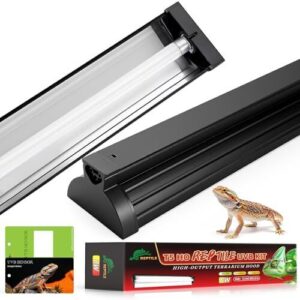
The Haceryc 8W system delivers 10% UVB and 30% UVA across a compact 12-inch footprint, targeting calcium metabolism and behavioral vitality in small-enclosure desert species through focused 290-320 nanometer emission. You’ll appreciate the curved polished reflector, which concentrates photon flux toward basking zones while minimizing wasted irradiance, paired with flame-retardant housing that ensures stable thermal performance throughout prolonged photoperiods.
The included UVB test card provides rudimentary output verification, though professional-grade solarmeter readings remain preferable for confirming efficacy thresholds before and after seasonal replacement intervals.
| Best For | Bearded dragon, tortoise, and gecko owners with small to medium enclosures who need reliable UVB output for calcium absorption and natural behavior support. |
|---|---|
| UVB Output | 10% UVB |
| Wattage | 8 watts |
| Light Type | T5 HO Fluorescent |
| Target Species | Reptiles and amphibians |
| Brand | Generic |
| Replacement Interval | Not specified |
| Additional Features |
|
- 10% UVB and 30% UVA output provides strong ultraviolet coverage for desert species, promoting vitamin D3 synthesis and healthy bone development
- Curved reflector design focuses light directly into basking zones, maximizing efficiency without wasting energy on tank walls or corners
- Includes a UVB test card so you can track when the bulb’s output starts dropping and needs replacement
- Only comes in 12-inch and 22-inch sizes, which won’t work for unusually shaped or larger custom enclosures
- Long-term durability isn’t fully proven yet, with some users still waiting to see how well it holds up after months of daily use
- Test card gives basic readings but doesn’t replace a real solarmeter if you want precise UVB measurements for sensitive species
10. Reptile UVB Light Bulb
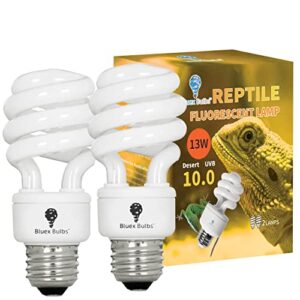
The Bluex Bulbs 13-Watt compact fluorescent solution offers desert keepers a self-ballasted E26 option compatible with standard dome fixtures, emitting UVA and UVB wavelengths across the 290-315 nanometer spectrum required for cholecalciferol synthesis in bearded dragons, tortoises, and similar heliothermic species.
You’ll find the two-pack format economical for simultaneous multi-enclosure management, though reported lifespan inconsistencies—with some units failing well before the advertised 10,000-hour threshold—necessitate proactive replacement monitoring and UV meter verification to prevent subclinical deficiency during extended operational cycles.
| Best For | Desert reptile owners who need affordable UVB lighting for bearded dragons, tortoises, or lizards in screened terrariums. |
|---|---|
| UVB Output | UVB Light |
| Wattage | 13 watts |
| Light Type | E26 CFL |
| Target Species | Desert-dwelling reptiles |
| Brand | Bluex Bulbs |
| Replacement Interval | 10,000 hours |
| Additional Features |
|
- Fits standard dome fixtures with E26 base, making setup simple
- Two-pack gives you a backup or lets you outfit multiple enclosures
- Provides essential UVA and UVB for vitamin D3 production and natural behaviors
- Many users report bulbs burn out way faster than the 10,000-hour claim
- Inconsistent quality means you’ll need a UV meter to check if they’re actually working
- Must keep at least 6 inches from reptiles to prevent overheating or burns
Proper Placement and Setup for Maximum Benefit
Even the most advanced UVB system delivers suboptimal photobiological benefits when positioned incorrectly, underscoring the critical importance of proper placement protocols that account for inverse-square law principles, species-specific behavioral thermoregulation patterns, and material transmission coefficients.
Your enclosure’s spatial configuration, combined with careful attention to mounting height, photoperiod programming, and substrate reflectance factors, determines whether your desert reptile receives physiologically adequate UVB exposure or suffers chronic deficiency despite premium equipment.
The following placement parameters provide evidence-based guidelines for maximizing UVB efficacy while preventing common installation errors that compromise calcium metabolism and long-term skeletal integrity.
Optimal Distance From Basking Zones
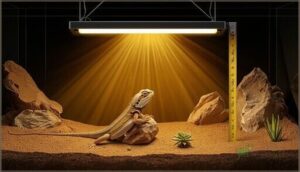
When you’re installing UVB lighting, precise basking heights matter more than you might think, because proper distance guidelines guarantee your reptile receives therapeutic UVB wavelengths without overheating or underexposure.
For compact bulbs, start at 8 to 12 inches above the basking zone, while T5 fluorescent reptile lighting systems usually require 12 to 18 inches to balance UV index targets with thermal gradients, supporting safe lighting adjustments as your animal grows.
Creating UVB Gradients Within Enclosures
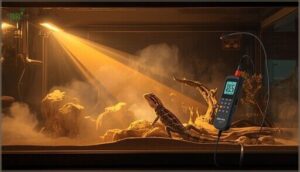
Once you’ve nailed basking height, gradient mapping across your enclosure design becomes the next priority, ensuring your desert reptiles self-regulate UVB exposure as they would under variable sun angles in nature. Position your UVB lighting at one end to establish a measurable UVB intensity decline across 20 to 40 centimeters, allowing behavioral thermoregulation through these carefully engineered UVB gradients:
- Install fixtures at enclosure extremes to create bright zones that fade predictably with horizontal distance
- Use UVB meters weekly during initial setup to confirm smooth wavelength transitions from high to low
- Angle lamps downward slightly to distribute UVB wavelengths across basking platforms without creating hazardous hot spots
- Adjust decor positioning to prevent dead zones that disrupt gradient continuity and limit reptile behavior options
Simulating Natural Daylight Cycles
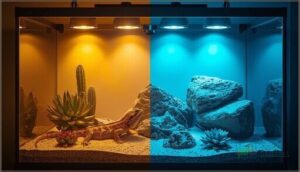
After establishing gradient continuity, photoperiod control through daylight simulation becomes paramount for maintaining circadian rhythm stability in desert reptiles, where UV index fluctuations mirror natural photobiology patterns your animals evolved to anticipate.
Program UVB cycles spanning 12 to 14 hours with dimmer-controlled ramps simulating dawn and dusk transitions, synchronizing reptile lighting intensity with species-appropriate light gradients that replicate seasonal photoperiod shifts across longitudinal habitat ranges.
Avoiding UVB-blocking Materials (glass, Plastic)
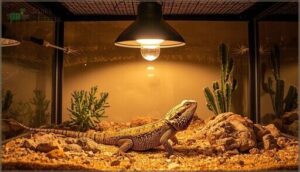
Position your UVB lighting inside mesh-topped enclosures rather than behind glass or plastic barriers. Ordinary smooth glass transmits minimal radiation, while polycarbonate blocks approximately 60 percent of critical wavelengths, compromising calcium metabolism pathways essential for desert reptiles.
These reptiles depend on unobstructed UVB radiation exposure to maintain physiological UV Index thresholds within safe enclosures, which is crucial for supporting ideal bone mineralization processes.
Maintenance and Safety Tips for UVB Systems
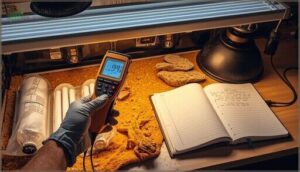
Even the most advanced UVB system requires diligent maintenance protocols to guarantee consistent photobiological efficacy, prevent premature output degradation, and eliminate potentially hazardous operational failures that could compromise both your reptile’s health and your household safety. You’ll need to establish replacement schedules aligned with manufacturer specifications (usually 12-15 months for T5 fluorescent systems, 8-10 months for mercury vapor configurations), implement regular output verification using calibrated UV meters, and maintain fixture cleanliness to prevent dust accumulation that can reduce UVB transmission by 20-40% within surprisingly short timeframes.
The following maintenance and safety protocols represent essential husbandry practices that separate successful long-term reptile care from the chronic health complications associated with neglected lighting infrastructure.
Regular Bulb Replacement Schedules
You can’t rely on bulb lifespan estimates alone, because UVB output degrades long before visible light dims, jeopardizing reptile health through inadequate UV Index exposure and compromised calcium metabolism. Replacement costs pale against veterinary bills for metabolic bone disease, so schedule optimization demands replacing fluorescent UVB lighting tubes every 6–12 months, mercury vapor bulbs every 10–12 months, and LEDs per manufacturer specifications.
Maintenance tips emphasize proactive replacement aligned with your enclosure’s peak basking seasons.
Monitoring UVB Output With Meters
Your UVB meter calibration and placement determine whether UVB output measurement protects your reptile or delivers false reassurance. Position the Solarmeter sensor at basking height, verify calibration best practices annually, and interpret UVI measurements against species-specific photon flux density targets.
Meter placement tips emphasize recording UV Index readings at multiple enclosure zones, documenting UVB readings analysis in maintenance logs, and replacing UVB lighting when output falls below therapeutic thresholds.
Cleaning Bulbs and Reflectors
Dust accumulation on UVB lighting surfaces reduces photon transmission by up to 40 percent, compromising calcium metabolism even when bulb replacement schedules remain current.
Your bulb maintenance protocol should employ lint-free microfiber cloths for dust removal from tube surfaces and reflector cleaning with isopropyl alcohol solutions (1:4 ratio with water), ensuring complete drying before reassembly to optimize UVB output and maintain therapeutic UV Index delivery across reptile lighting systems.
Using Manufacturer-approved Fixtures for Safety
Electrical safety begins with pairing your bulb and ballast from the same manufacturer, because mismatched components compromise UVB emissions and create fire hazards that threaten both your animal and your home.
Installation guidelines demand attention to three critical areas:
- Use GFCI-protected outlets in humid enclosures to prevent electrical shock during routine maintenance
- Maintain manufacturer-specified clearance distances between lamp surfaces and basking zones to prevent thermal injury
- Replace damaged housings immediately, as compromised fixtures leak harmful UV radiation beyond safe reptile lighting systems parameters
Frequently Asked Questions (FAQs)
Can UVB bulbs cause eye damage in reptiles?
When powerful light sources mimic the desert sun, direct ocular exposure to unshielded UVB can trigger photokeratoconjunctivitis—redness, swelling, corneal damage—especially if you position bulbs too close or ignore species-specific visual impairment thresholds.
Do different substrates reflect UVB differently?
Yes, substrate reflectance varies considerably across materials—light-colored calcium carbonate sand exhibits higher reflectivity than dark coconut fiber, while surface finishes and material variance directly influence UVB absorption patterns, necessitating reflectivity testing for ideal reptile lighting configurations.
How does humidity affect UVB penetration?
Think of humidity as a UVB gatekeeper—moist air reduces surface scattering and improves transmission through enclosure surfaces, yet condensation on glass can diffract wavelengths, demanding UV metering to confirm your desert reptiles receive adequate exposure.
Can you combine multiple UVB sources safely?
You can safely combine multiple UVB sources if you monitor cumulative exposure with a UV meter, maintain proper distances to prevent hotspotting, and verify UVB overlap doesn’t exceed species-specific daily exposure thresholds through careful multi-source positioning.
What happens if UVB exposure is excessive?
Overexposure triggers photokeratitis and corneal inflammation, while DNA damage accumulates in skin cells, disrupting replication fidelity and elevating mutation risk.
Immune suppression compounds these cellular injuries, creating cascading health consequences demanding immediate intervention and protective recalibration.
Conclusion
The irony remains inescapable: while your desert reptile evolved beneath unfiltered solar radiation spanning millions of years, its survival now depends on your ability to interpret manufacturer specifications, replacement schedules, and spectral output charts.
Selecting appropriate UVB lighting systems for desert reptiles isn’t optional husbandry—it’s the technological bridge between ancestral photobiology and captive longevity.
Your bearded dragon’s skeletal integrity won’t tolerate approximations or budget compromises when melanophore-mediated vitamin D3 synthesis demands wavelength precision that household lighting simply can’t deliver.