
This site is supported by our readers. We may earn a commission, at no cost to you, if you purchase through links.
You’ve invested in the perfect hide—a snug, dark refuge tucked into the cool end of your snake’s enclosure—but your reptilian friend refuses to use it, spending hours exposed in the open instead. This behavior, which contradicts the deeply ingrained survival instincts that have kept snakes concealed from predators for millions of years, signals that something in your setup isn’t meeting your snake’s fundamental needs for security, thermoregulation, or health.
Whether the hide is too large for your snake to feel properly enclosed, positioned in a zone with unsuitable temperature or humidity levels, or your snake is avoiding it due to parasites or respiratory infection, identifying why snakes refuse to use their hide requires understanding the intricate relationship between species-specific behaviors, environmental conditions, and physical health.
The solution often lies in subtle adjustments—resizing the hide, repositioning it within the thermal gradient, or recognizing early symptoms of illness—that restore your snake’s confidence in using its intended refuge.
Table Of Contents
- Key Takeaways
- Why Do Snakes Refuse to Use Their Hide?
- Environmental Factors That Affect Hide Use
- Health Issues That Cause Hide Avoidance
- Enclosure Setup Mistakes Leading to Hide Refusal
- How Age and Life Stage Influence Hide Use
- How to Encourage Your Snake to Use Its Hide
- Frequently Asked Questions (FAQs)
- Conclusion
Key Takeaways
- Snake hide refusal typically stems from environmental mismatches—oversized hides that fail to provide secure enclosure, improper placement within temperature gradients, or unsuitable humidity levels that contradict millions of years of evolved concealment instincts.
- Health complications including parasites, respiratory infections, and skin conditions during shedding cycles can drive snakes away from their hides as they seek relief rather than security, making sudden behavioral changes critical warning signs requiring veterinary attention.
- Effective hide use depends on replicating species-specific shelter preferences through proper sizing (snug enough to feel enclosed but spacious enough for full body length), strategic placement across thermal zones, and appropriate substrate choices that support natural thermoregulation behaviors.
- Creating multiple hides positioned along distinct warm and cool zones with correct humidity levels, combined with stress-reduction through gentle handling and proper ventilation, transforms rejected refuges into sanctuaries that restore your snake’s instinctive hiding patterns.
Why Do Snakes Refuse to Use Their Hide?
When your snake refuses its hide, you’re probably wondering if something’s wrong—or if this behavior is just part of their natural rhythm. Snakes evolved to spend most daylight hours concealed, so refusal often signals a deeper issue with their environment, health, or enclosure setup.
If you’re noticing these warning signs, reviewing why snakes need proper hiding spots can help you identify what’s missing in your setup.
Understanding the difference between normal instincts and true avoidance comes down to recognizing what drives your snake’s behavior in the first place.
Learning how ball pythons communicate through body language helps you spot the difference between a nervous snake and one that’s simply exploring its environment.
Natural Hiding Instincts Vs. Avoidance
Your snake’s reluctance to use its hide might seem puzzling, but understanding the line between natural concealment behavior and true avoidance requires careful observation. Snakes instinctively rely on hiding strategies and predator avoidance mechanisms, yet when they actively refuse shelter selection, something’s disrupting their normal survival tactics.
Understanding why snakes prefer tight-fitting hides helps explain why an oversized or poorly positioned shelter might trigger avoidance rather than comfort.
Consider these factors that distinguish healthy hiding behavior from concerning hide avoidance patterns:
Knowing whether your snake’s hiding habits fall within normal ranges can be easier when you understand how different small snake breeds naturally behave in captivity.
- Instinctual concealment behavior drives snakes to seek secure spaces for energy conservation and protection.
- Escape-oriented responses may override hiding when your reptilian friend perceives immediate threats in its environment.
- Camouflage reliance varies by species, with some preferring stillness over retreat into enclosed shelters.
- Risk assessment patterns influence whether your snake chooses hiding or alternative defensive postures.
- Ecological adaptations determine how frequently and intensely individual animals engage in concealment behavior throughout daylight hours.
Species-Specific Hiding Behaviors
Understanding your reptilian friend’s shelter preferences requires knowledge of species traits, since different snakes evolved distinct hiding strategies based on their ecological niches. Ball pythons demonstrate strong nocturnal burrowing behavior, seeking tight ground-level retreats, while arboreal species like green tree pythons prefer elevated shelters that mirror their forest canopy origins, reflecting millions of years of adaptation to specific snake habitats.
| Species Type | Primary Shelter Preference | Typical Hide Avoidance Trigger |
|---|---|---|
| Ground-dwelling colubrids | Leaf litter, hollow logs | Elevated or exposed hides |
| Arboreal species | Tree hollows, dense foliage | Ground-level or open shelters |
| Fossorial snakes | Subterranean burrows | Above-ground hide placement |
| Ambush predators | Concealed hunting spots | Hides blocking prey visibility |
Common Myths About Snake Hiding
Despite this ecological diversity, snake mythbusting reveals persistent misconceptions about hiding behavior that compromise reptile psychology understanding and snake welfare. Many keepers wrongly believe visible activity always signals distress, when your snake’s emergence might reflect normal thermoregulatory needs rather than hide avoidance.
Another myth suggests all species require deep burrows, yet numerous snakes naturally utilize shallow crevices or open refuges, making hide design choices more nuanced than conventional wisdom suggests.
Environmental Factors That Affect Hide Use

Your snake’s enclosure isn’t just a glass box, it’s a carefully balanced ecosystem that directly influences whether your reptilian friend feels secure enough to use its hide. Temperature extremes, humidity fluctuations, poor lighting choices, and inadequate ventilation can all trigger avoidance behaviors that leave you wondering why that perfect hide sits empty.
Your snake’s enclosure is a carefully balanced ecosystem where temperature, humidity, lighting, and ventilation directly determine whether it feels secure enough to hide
Let’s break down the environmental factors that make or break your snake’s willingness to seek shelter.
Temperature and Thermoregulation
Your snake’s refusal to use its hide often traces back to temperature problems in the enclosure. As ectothermic animals, snakes need proper thermal gradients to thermoregulate effectively, and when temperatures feel off, they’ll abandon even the most secure shelter.
Here’s what you need to monitor:
- Basking area maintains 28–32°C (82–89°F) for metabolic function
- Cool zone stays around 22–26°C (72–79°F) for retreat
- Temperature gradients allow movement between zones for self-regulation
- Heat sources distribute evenly without cold spots
- Temperature fluctuations remain minimal throughout day-night cycles
Humidity and Shedding Cycles
Beyond temperature, humidity control directly impacts your snake’s willingness to use its hide during shedding cycles. When moisture levels drop below species-specific thresholds, your reptilian friend faces skin health complications—retained spectacles and incomplete sheds plague ball pythons and boas in dry conditions.
Pairing proper humidity with the right hide dimensions creates a microenvironment where your snake can shed successfully without stress.
You’ll need hygrometers monitoring ambient humidity, as inadequate moisture triggers stress reduction behaviors like hide avoidance, while balanced humidity fosters normal sloughing and proper reptile care routines.
Lighting, Noise, and Enclosure Placement
Alongside thermal and moisture dynamics, lighting effects and noise reduction directly influence snake hiding behavior—indirect illumination minimizes glare at hide entrances, while quiet enclosure placement away from high-traffic zones encourages consistent hideout use.
Visual barriers and strategic positioning in room corners create ambient conditions that replicate your reptile’s natural concealment preferences, fostering environmental enrichment through thoughtful enclosure setup that respects instinctive shelter-seeking behaviors.
Air Circulation and Ventilation
Without adequate airflow threading through your snake’s enclosure, stagnant pockets of humid air accumulate near hides and substrate surfaces, creating respiratory stress that drives even security-seeking species into open areas where oxygen exchange improves.
Five ventilation systems that enhance air quality and circulation patterns:
- Screened lids spanning 30–50% of enclosure tops for passive oxygen level maintenance
- Side vents positioned at substrate level to create cross-drafts without temperature gradient disruption
- Low-flow fans integrated into custom setups for controlled environmental enrichment
- Strategic gap placement between enclosure components preventing humidity level stagnation
- Monthly filter inspections in PVC or acrylic habitats ensuring respiratory health through consistent enclosure conditions
Health Issues That Cause Hide Avoidance
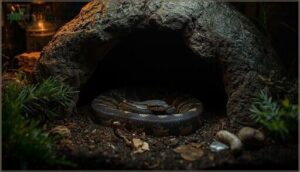
When your snake suddenly abandons its hide, it’s not always about comfort or environmental tweaks—sometimes, there’s a deeper health concern lurking beneath the surface.
Illness, parasites, and skin problems can dramatically alter your snake’s behavior, pushing it away from the very shelter it needs most.
Let’s examine the specific health issues that disrupt normal hiding patterns and what warning signs you should watch for.
Parasites, Infections, and Illness
Internal parasites like cryptosporidium, external mites, and respiratory infections can turn your snake’s once-beloved hide into a place it actively avoids, signaling that something’s wrong beneath the surface.
When illness strikes, your reptile may exhibit lethargy, weight loss, or labored breathing—all infection signs demanding immediate veterinary care.
A reptile-specialized veterinarian can provide proper illness diagnosis and parasite control, addressing health issues before they compromise your snake’s reptile health and wellness entirely.
Skin Conditions and Shedding Problems
When shedding issues arise—retained shed clinging in patches, redness from scale damage, or swelling that signals dermatitis treatment needs—your reptile may abandon its snake hide altogether, seeking relief rather than security.
Inadequate humidity control during shedding cycles frequently triggers these skin infections, compromising both reptile health and hygiene.
Addressing animal hiding avoidance requires careful snake care and maintenance adjustments to restore comfort.
Enclosure Setup Mistakes Leading to Hide Refusal
Even the most carefully selected hide won’t work if your enclosure setup actively discourages your snake from using it, and unfortunately, these mistakes are surprisingly common among both new and experienced keepers.
Your snake’s refusal to hide often stems from preventable issues with hide dimensions, placement strategy, substrate selection, or thermal management within the enclosure.
Understanding these four critical setup errors will help you identify what’s driving your reptilian friend away from its shelter and guide you toward creating an environment that actually encourages natural hiding behavior.
Inadequate Hide Size or Shape
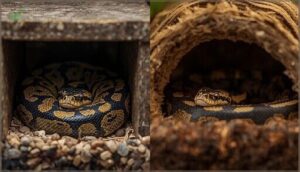
Think of your snake’s hide as a refuge—if it doesn’t fit just right, your reptilian friend won’t use it. When a hide is too small to accommodate your snake’s full body length and girth, it creates stress rather than comfort, prompting avoidance behaviors.
Here’s what disrupts proper hide dimensions:
- Cramped quarters that prevent complete body concealment and coiled spatial orientation
- Awkward openings with irregular shapes that impede smooth entry and exit
- Insufficient vertical clearance within the hideout, compromising your snake’s preferred resting posture
These enclosure design flaws signal instability rather than security, fundamentally altering hiding behavior and undermining the comfort your snake instinctively seeks in quality hiding places.
Poor Hide Placement in The Enclosure

Even perfectly sized hiding places fail when positioned poorly, which directly sabotages your snake’s sense of security and alters hiding behavior. Hides placed in high-traffic zones or exposed areas trigger stress responses.
Cave-like structures with multi-entry points, positioned strategically throughout the enclosure—not just corners—encourage natural concealment patterns by reducing snake visibility and providing authentic security features your reptilian friend instinctively craves.
Unsuitable Substrate and Decor Choices
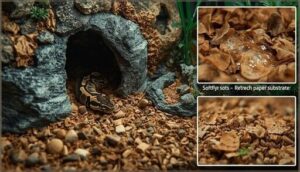
Your substrate preferences directly influence hide acceptance, especially when texture causes slipping or discomfort during movement. Sharp décor or chemically treated materials trigger sensory issues that override your snake’s instinct to seek shelter, while substrates retaining excessive moisture promote fungal growth and skin irritation.
Material toxicity from strong odors or inconsistent substrate depth around entrances creates unstable resting spots, making even well-designed hideouts feel unsafe to your reptilian friend.
Lack of Temperature Gradient

When temperature fluctuations eliminate functional basking zones, your snake can’t thermoregulate properly through selective retreat, prompting it to abandon hideouts positioned in zones that feel metabolically uncomfortable.
Gradient design requires thermal mapping across multiple heat sources to verify a persistent temperature difference between warm and cool extremities, because inadequate enclosure conditions disrupt digestion and stress-related hiding behavior in temperature-sensitive species.
How Age and Life Stage Influence Hide Use
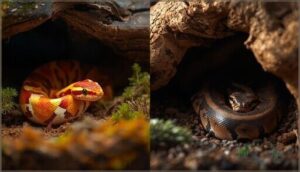
Your snake’s age and life stage play a surprisingly significant role in how it interacts with hides, influencing everything from boldness levels to metabolic needs. Younger snakes often exhibit different hiding behaviors compared to their older counterparts, while seasonal cycles like brumation and reproduction can temporarily shift your snake’s relationship with shelter.
Understanding these developmental and biological patterns helps you recognize what’s normal for your reptilian friend at different points in its life.
Juvenile Vs. Adult Snake Behavior
Your reptilian friend’s age dramatically reshapes hiding behavior, with juvenile snakes exhibiting higher metabolic rates and more frequent exploration compared to their adult counterparts. Young snakes require more secure refuges due to heightened predation vulnerability, influencing habitat use and thermoregulation strategies.
Growth patterns drive these differences in activity levels, as juveniles expend considerable energy traversing their environment while maturing into the methodical, territory-focused adults you’ll eventually observe.
Brumation, Reproduction, and Activity Patterns
Seasonal rhythms govern your snake’s hiding behavior with surprising precision, as brumation cycles and reproductive drives override typical concealment patterns you’ve come to expect throughout the year. During brumation, thermal regulation demands shift dramatically, causing extended refuge occupation as circadian rhythms slow and metabolic processes decrease.
Conversely, reproductive behavior triggers increased exploration and hide abandonment, with breeding-age adults exhibiting restlessness that contradicts their established activity patterns throughout non-breeding seasons.
How to Encourage Your Snake to Use Its Hide
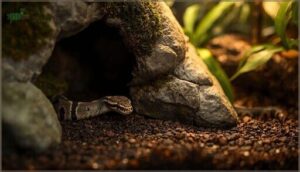
If your snake consistently avoids its hide, you’re not stuck with a permanent problem—several practical adjustments can reshape your reptilian friend’s behavior and restore its natural instinct to seek shelter.
The key lies in addressing the underlying environmental, physical, and behavioral factors that make your snake feel exposed or uncomfortable in its current setup.
Below, you’ll find targeted strategies that work with your snake’s biology rather than against it, giving you clear steps to create an environment where hiding becomes the preferred choice.
Improving Hide Security and Comfort
You can’t expect your reptilian friend to embrace a hide that feels more like a trap than a sanctuary. Start by offering snug enclosures—hideouts sized to fully enclose your snake without restricting movement, creating those comfort zones snakes instinctively seek.
Use multiple hiding places with varying textures along a stable gradient, position them with clear entry points, and verify they’re free from sharp edges that compromise secure enclosures and animal hiding effectiveness.
Adjusting Environmental Conditions
Often, tweaking your enclosure conditions transforms a reluctant snake into one that readily seeks shelter. Temperature Gradients establish preferred zones, while Humidity Control ensures adequate skin moisture—together creating microhabitats your snake instinctively gravitates toward. Consider these environmental factors:
- Maintain temperature ranges between 75-90°F with distinct warm and cool zones
- Adjust humidity levels to species-specific requirements (50-80% generally)
- Implement appropriate Lighting Cycles matching natural photoperiods
- Guarantee Airflow Management through proper Ventilation Systems
- Monitor hiding places positioned within favorable thermal gradients
Reducing Stress and Proper Handling
Consistent Gentle Handling—brief sessions lasting five to ten minutes—reduces stress indicators like tail-darting and elevated breathing rates, conditioning your reptilian friend to tolerate interaction without triggering chronic anxiety. Support the body evenly, avoiding thoracic pressure, while moving slowly to minimize startling reactions.
Calm environments with subdued lighting further lower cortisol-like responses, encouraging your snake to view hideouts as secure refuges rather than panic zones.
When to Seek Veterinary Advice
Dramatic shifts from established hiding patterns—your normally secretive ball python suddenly basking exposed for days—signal potential illness requiring reptile-experienced veterinary care. Watch for respiratory distress, mouth breathing, prolonged anorexia beyond two weeks, visible swelling, or repeated regurgitation as emergency signs demanding diagnostic tests.
Annual health checks catch parasites and infections early, while prompt treatment options preserve animal welfare through stress reduction and management protocols that restore normal snake behavior.
Regular environmental checks, including monitoring for temperature gradient issues, are vital for maintaining a healthy snake enclosure.
Frequently Asked Questions (FAQs)
Can snakes recognize their owners or handlers?
Your serpentine companion can distinguish your scent from strangers through olfactory memories and sensory discrimination. Captive snakes learn handler familiarity via repeated interactions, though reptile intelligence differs dramatically from mammalian attachment—recognition doesn’t equal affection in snake behavior.
Providing a stimulating environment with proper captive management techniques is essential for their welfare.
Do snakes need multiple hides in one enclosure?
Your reptilian friend thrives with multiple hideouts strategically positioned across the thermal gradient—warm side, cool side, and humidity retreats.
This enclosure complexity delivers environmental enrichment for reptiles while honoring their animal hiding and camouflage instincts without sacrificing thermoregulation.
How often should hides be cleaned or replaced?
You’d think hide maintenance would top every keeper’s list, yet far too many enclosures harbor bacterial colonies that’d impress any microbiologist.
Spot clean hideouts weekly, deep disinfect monthly, and replace porous materials showing wear or persistent contamination.
What materials are safest for DIY snake hides?
Your best options include non-toxic plastics like HDPE, safe woods such as mopani or cork, ceramic materials, and properly sealed foam with low VOC paints—all fundamental to responsible reptile husbandry and effective habitat creation.
Do feeding schedules affect snake hiding behavior?
While predictable feeding practices reduce stress and encourage normal hiding, your snake’s prolonged postprandial behavior—spending days concealed after large meals—paradoxically transforms the refuge from shelter into digestive sanctuary, reflecting millions of years of evolved survival strategy.
Conclusion
Think of your snake’s hide as its armor against the world—when abandoned, that armor has failed its purpose. Understanding why snakes refuse to use their hide enables you to recalibrate temperature gradients, resize enclosures, or detect health issues before they escalate.
The right adjustments transform a rejected refuge into the secure sanctuary your snake instinctively craves, restoring natural behaviors and ensuring your reptile thrives in captivity rather than merely survives.
- https://d1wqtxts1xzle7.cloudfront.net/47713309/How_Do_Nocturnal_Snakes_Select_Diurnal_R20160801-9808-1preg9b-with-cover-page-v2.pdf?Expires=1663688128&Signature=Us00x4o9hu5NCkYbjHunAZYCTFBdNC31n6R0U8IQRkC93v8fSrMB45ER~PV9IouWxI8KwNawED5XBkzB492pUK-Ln-AdAJL1o4wRIO9qcfi3kBvPwId6D~lnB20vG1YzCicxJk8C~2zuIZGfTRQgHfxyZ2Y~5Q0Ft7OYbMUn0wT~KDdNtiCadsQhPuPMHfu4RXsRbRvbnHg5hMFW4t0D5M6weTPqO2xTMZ8eDerh3U4e7LZXlYsbTVee2UUgiB64KlxSz9ZFvdECLQp5gIytHCTtbPLCsEvtV1h2C28OM0mCs~TJP6gEyJOxmcY0hD0x7Czss055OUbVHWelvVQrZw__&Key-Pair-Id=APKAJLOHF5GGSLRBV4ZA
- https://www.journals.uchicago.edu/doi/abs/10.1086/physzool.52.3.30155760
- https://www.jstor.org/stable/3889419
- http://www.herpconbio.org/Volume_12/Issue_3/Nordberg_Cobb_2017.pdf
- https://www.ncbi.nlm.nih.gov/pmc/articles/PMC6681033/