This site is supported by our readers. We may earn a commission, at no cost to you, if you purchase through links.
Your ball python squeezed into a tupperware container again—wedged so tight you wonder if extraction will require olive oil and prayers. That cramped, undignified position isn’t stubbornness or stupidity; it’s desperation.
Ball pythons evolved in the tight crevices and termite mounds of West Africa, where survival meant finding spaces that fit like a second skin. Without proper snake hides, your pet experiences chronic stress that suppresses immune function, triggers feeding strikes, and can manifest as respiratory infections or neurotic behaviors.
The right hide isn’t decorative—it’s a physiological necessity. Quality matters more than quantity, and choosing correctly means understanding how your snake actually uses these spaces throughout different life stages and seasonal cycles.
Table Of Contents
- Why Ball Pythons Need Quality Hides
- Key Features of The Best Ball Python Hides
- Choosing The Right Hide for Your Ball Python
- Top 10 Snake Hides for Ball Pythons
- 1. Exo Terra Snake Cave Hideout
- 2. Exo Terra Reptile Cave Hide
- 3. Zilla Reptile Bark Bend Terrarium Decor
- 4. Zilla Vertical Rock Cave Decor
- 5. Zilla Rock Den Terrarium Hide
- 6. Zilla Reptile Rock Lair Hide
- 7. Zilla Herp Hotel Terrarium
- 8. Pangea Reptile Hide Box
- 9. Zoo Med Reptile Cave Shelter
- 10. FCALIVV Reptile Hide Box
- Maintaining and Cleaning Ball Python Hides
- Frequently Asked Questions (FAQs)
- Conclusion
Why Ball Pythons Need Quality Hides
Your ball python isn’t just being dramatic when it burrows into a corner or refuses to come out—it’s responding to a deep-rooted survival instinct that demands shelter and security. Without quality hides, your snake will experience chronic stress that weakens its immune system, disrupts feeding, and can lead to serious health complications.
Quality hides aren’t optional—without them, your ball python suffers chronic stress that weakens immunity, disrupts feeding, and triggers serious health problems
Let’s look at the three critical reasons why investing in proper hides isn’t optional; it’s essential for your ball python’s wellbeing.
Security and Stress Reduction
Security isn’t just comfort—it’s survival instinct for your ball python. When you provide secure designs with proper hide placement, your snake shows fewer stress indicators like repetitive pacing or defensive strikes.
Research confirms that pythons with multiple calming environments display reduced cortisol-related behaviors. Quality snake hides create safe hideouts where your ball python can retreat completely, fostering the stress reduction essential for long-term health and easier handling.
Providing a methodological rigor approach to creating these environments can further improve their effectiveness.
Thermoregulation and Comfort
Your ball python doesn’t sweat or shiver—it moves between comfort zones to regulate body temperature. Quality snake hides positioned near heat sources on the warm side and away from them on the cool side create thermal gradients your snake needs.
A well-designed enclosure with proper hides facilitates thermoregulation while maintaining humidity management, letting your ball python choose its ideal microclimate for supreme comfort.
Shedding Support and Health Benefits
When your ball python enters a shed cycle, proper snake hides become shedding aids that support healthy ecdysis care. A well-designed hide maintains humidity control around the molt area, preventing skin health issues like retained eye caps or incomplete sheds that plague many captive reptiles.
Quality hides support successful shedding through:
- Stable moisture retention — Reducing skin desiccation during critical molt periods
- Stress-free seclusion — Minimizing disruptions that can interrupt normal shedding cycles
- Clean surfaces — Preventing parasites and irritants that complicate the shedding process
Key Features of The Best Ball Python Hides
Not all hides are created equal—and when you’re choosing one for your ball python, certain features matter more than others. A quality hide does more than just look good in the enclosure; it needs to stand up to your snake’s movements, keep them safe, and support their natural behaviors.
Let’s break down the four essential features you should look for before making a purchase.
Strong and Solid Construction
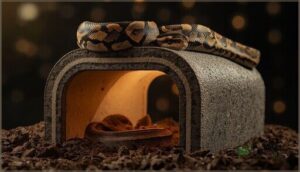
A hide that crumbles under your ball python’s weight isn’t just inconvenient—it’s dangerous. You need construction methods that combine thick, non-porous materials with reinforced seams to create structural integrity your snake can trust.
Proper durability testing ensures the hide won’t crack or warp in your reptile enclosure, while careful material selection guarantees it supports your python’s weight capacity without flexing or collapsing during daily use.
Secure and Safe Design
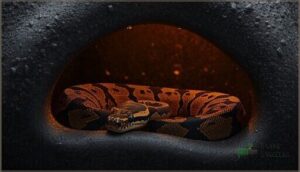
Your snake’s safety depends on tamper-proof construction that eliminates sharp edges and prevents escape. Look for hides with secure latches that keep the enclosure stable, smooth interior surfaces that won’t snag scales, and integrated ventilation systems that allow airflow without creating dangerous gaps.
Durable materials must withstand humidity and heat without warping—because a compromised hide puts your ball python at risk.
Non-Toxic, Easy-to-Clean Materials
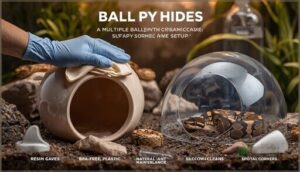
Choosing toxic-free materials protects your ball python from harmful residues that accumulate in the enclosure over time. Food-grade silicone, BPA-free plastics, and sealed ceramics resist staining and won’t leach chemicals during sanitization methods like bleach disinfection.
Non-porous surfaces are essential for easy cleaning—they prevent bacterial growth and allow rapid wipe-downs between deep cleans, keeping your snake habitat hygienic without extra effort.
Natural Look and Feel
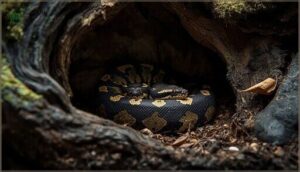
Your ball python’s enclosure should feel like home—not a sterile box. Hides with natural colors and texture variety reduce stress by mimicking rocky outcrops or bark shelters found in their native habitat.
Visual realism matters: matte finishes prevent startling reflections, while tactile enrichment from grooves aids healthy shedding.
Strategic hide placement in your terrarium transforms a functional necessity into authentic environmental enrichment.
Choosing The Right Hide for Your Ball Python
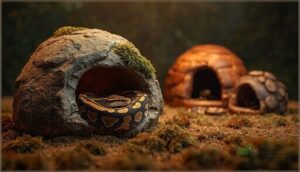
You wouldn’t wear a child’s jacket as an adult—and your ball python needs the same proper fit from their hide. Getting the size right, placing it strategically for temperature control, and matching the hide style to your snake’s personality all matter more than you might think.
Let’s walk through how to pick a hide that actually works for your specific python.
Proper Size and Fit by Age
Your python’s comfort hinges on getting the hide dimensions right—too spacious and they’ll feel exposed, too snug and they’ll avoid it altogether.
Here’s how age-based hides should match snake girth:
- Hatchlings to juveniles: 1.5–2 times their girth, allowing the body curve to fit without compression
- Subadults to young adults: 2–3 times girth, preventing curling against smooth surfaces
- Adult ball pythons: Match girth with vertical space for full extension
- Pro tip: Offer paired hides—one larger, one smaller—for seasonal habitat preferences
Placement for Temperature Gradient
Temperature control isn’t just about your enclosure’s overall range—it’s about where you place each hide along that gradient. Position one hide on the warm side (88–92°F) and another on the cool side (78–82°F) to let your ball python self-regulate through thermoregulation. Use digital thermometers inside hides to monitor microclimates, ensuring humidity and thermal zones stay stable.
| Zone | Temperature Range | Hide Function | Placement Tip | Why It Matters |
|---|---|---|---|---|
| Warm Side | 88–92°F | Digestion & activity | Offset from heat source | Facilitates metabolic processes |
| Cool Side | 78–82°F | Resting & stress relief | Away from basking spot | Prevents overheating |
| Shift | 82–88°F | Gradient management | Mid-enclosure access | Encourages exploration |
| Elevated | Variable | Vertical microclimates | On branches/platforms | Mimics natural behavior |
| Ground Level | Matches zone temp | Primary retreat | Floor-level security | Reduces stress |
Matching Hide Type to Snake Behavior
Your ball python’s personality tells you exactly which hide it needs. Watch how yours moves—does it seek tight, snug spaces or prefer a bit more room?
Snug hides that mimic natural burrows reduce stress by up to 15%, while dual-entry designs offer escape routes for anxious snakes.
Observe shelter security preferences and behavioral cues near your thermal gradient to match hide type to individual reptile care needs.
Top 10 Snake Hides for Ball Pythons
Now that you know what to look for, let’s walk through ten specific hides that actually work for ball pythons. I’ve chosen these based on construction quality, safety features, and how well they meet your snake’s behavioral needs.
Each option below offers something different—whether you’re setting up your first enclosure or upgrading an existing one.
1. Exo Terra Snake Cave Hideout
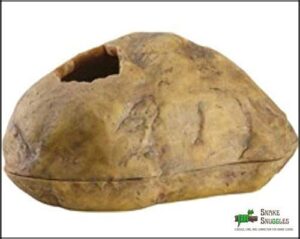
If you’re hunting for a dependable hiding spot that won’t tip over during feeding time, the Exo Terra Snake Cave Hideout checks every box. This ceramic construction blends into reptile environments naturally while giving your ball python the snug, secure space it craves.
The 9.8″ x 7.4″ x 4.7″ dimensions work well for juveniles and smaller adults, and the resin-ceramic blend means you won’t struggle with cleaning. It even includes moss for humidity—though you’ll want to swap that scratchy stuff for something softer.
| Best For | Ball python owners who need a stable, secure hide that won’t get knocked around and want something easy to clean that looks natural in their setup. |
|---|---|
| Material | Ceramic/Resin |
| Color | Brown |
| Cleaning | Easy to clean |
| Primary Use | Hiding/nesting |
| Size Category | Medium |
| Design Style | Natural look |
| Additional Features |
|
- Heavy ceramic build stays put even when larger snakes push against it during feeding or exploration
- Smooth interior won’t snag on shedding skin, and the whole thing wipes clean in seconds
- Compact size creates the tight, den-like feel that makes ball pythons actually use their hides instead of ignoring them
- The 9.8-inch size maxes out with smaller adults, so you’ll need a bigger hide as your snake grows
- Gets seriously hot if you place it directly on the warm side, which can turn it into an oven instead of a retreat
- The included moss is scratchy and skimpy—most owners toss it and add their own sphagnum right away
2. Exo Terra Reptile Cave Hide
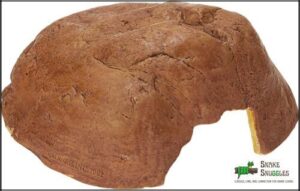
If you’re looking for a slightly smaller alternative, the Exo Terra Reptile Cave Hide offers a tight, den-like space perfect for hatchlings and younger ball pythons. This resin hide measures 9.5″ x 12″ x 3″ and weighs just over a pound—light enough to reposition along your enclosure’s thermal gradient without hassle.
The smooth interior prevents snagging during shedding, and the food-grade resin material resists bacterial growth.
You’ll appreciate the straightforward cleaning routine: warm water, mild detergent, and thorough drying before you return your snake to its cozy retreat.
| Best For | Owners of hatchling or juvenile ball pythons who want a compact, easy-to-clean hide that mimics a natural burrow and fits snugly in smaller terrariums. |
|---|---|
| Material | Resin |
| Color | Brown |
| Cleaning | Easy to clean |
| Primary Use | Hiding/stress reduction |
| Size Category | Medium |
| Design Style | Natural look |
| Additional Features |
|
- Smooth resin interior prevents skin snagging during sheds and makes cleaning quick with just warm water and mild soap.
- Food-grade, bacteria-resistant material keeps the hide hygienic and safe for your snake’s long-term health.
- Lightweight design lets you easily move it around to create the perfect warm-side or cool-side retreat along your thermal gradient.
- Entrance opening may be too narrow for adult ball pythons, limiting its usefulness as your snake grows.
- Some units arrive with sharp edges or damage, requiring inspection and possible smoothing before safe use.
- Durability concerns reported by multiple customers, with occasional cracking or breakage during routine handling.
3. Zilla Reptile Bark Bend Terrarium Decor
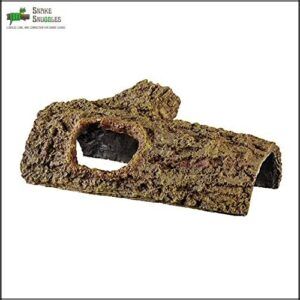
For a naturalistic middle ground, the Zilla Reptile Bark Bend brings woodland texture into your ball python’s enclosure. This plastic tunnel measures 10.75″ long x 5″ wide x 5.5″ high—snug enough for younger snakes while offering decent coverage for small adults.
The bark-textured exterior blends with substrates, and the non-porous surface resists bacterial buildup. Just watch for sharp edges on arrival; a quick sand-down solves that.
Position it along your thermal gradient so your python can regulate body temperature while feeling secure in its woodland-style retreat.
| Best For | Ball python keepers who want a naturalistic hide that blends into woodland-themed setups and works well for juveniles to small adults. |
|---|---|
| Material | Plastic |
| Color | Brown |
| Cleaning | Mild soap solution |
| Primary Use | Hiding/burrowing |
| Size Category | Medium |
| Design Style | Natural wood bark |
| Additional Features |
|
- Bark texture looks natural and helps the hide blend with most substrate types
- Non-porous plastic surface resists bacteria and cleans up easily with mild soap
- Can be positioned along your heat gradient so your snake stays secure while regulating temperature
- Size works best for younger snakes—larger adults may find it too cramped
- Some units arrive with sharp edges that need sanding before use
- Top observation window may be too small if you want to check on bigger pythons
4. Zilla Vertical Rock Cave Decor
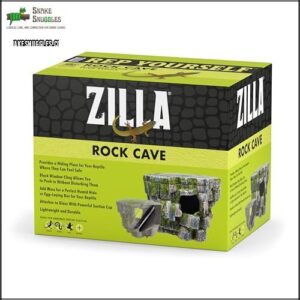
If vertical space is calling, the Zilla Vertical Rock Cave Decor mounts via suction cup to your terrarium glass—ideal when floor real estate runs tight. The realistic rock texture and hollow design offer cave security that mirrors how ball pythons seek compression in the wild.
Lightweight plastic stays durable through cleanings, though suction reliability varies; test the grip before trusting your snake’s weight. At 7.87″ x 5.51″ x 6.3″, it suits juveniles best while adding vertical enrichment to your enclosure layout without crowding substrate zones.
| Best For | Owners with limited floor space who want to add a vertical hide for juvenile ball pythons or smaller arboreal reptiles. |
|---|---|
| Material | Plastic |
| Color | Grey |
| Cleaning | Easy to clean |
| Primary Use | Arboreal hide |
| Size Category | Medium |
| Design Style | Realistic natural |
| Additional Features |
|
- Mounts to glass with a suction cup to free up valuable floor space in smaller terrariums
- Realistic rock texture blends naturally with most enclosure designs
- Lightweight plastic construction makes it easy to remove and clean
- Suction cup may lose grip over time, causing the hide to fall unexpectedly
- Size works best for juveniles—adult ball pythons may outgrow it quickly
- Some snakes ignore vertical hides entirely, preferring ground-level options
5. Zilla Rock Den Terrarium Hide
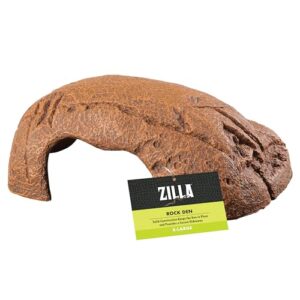
The Zilla Rock Den Terrarium Hide brings molded resin construction that balances security with enclosure aesthetics. At 6″D x 5″W x 7″H, it fits hatchlings and small juveniles comfortably—ball pythons instinctively seek snug retreats that offer body contact on multiple sides.
The non-porous exterior simplifies den maintenance; warm soapy water manages routine cleaning without harboring bacteria in hidden crevices.
Orange rock den benefits include thermal stability and a natural look that complements terrarium setup across desert or tropical themes, though you’ll want to inspect edges for sharpness and consider sizing up as your snake matures.
| Best For | Hatchling and small juvenile ball pythons that need a secure, snug retreat to reduce stress and encourage natural hiding behavior. |
|---|---|
| Material | Plastic |
| Color | Orange |
| Cleaning | Warm soapy water |
| Primary Use | Hiding/nesting |
| Size Category | Small |
| Design Style | Rock design |
| Additional Features |
|
- Non-porous resin construction makes cleaning straightforward with just warm soapy water, preventing bacterial buildup
- Compact 6″D x 5″W x 7″H dimensions provide the tight, body-contact fit that young ball pythons instinctively prefer
- Natural rock appearance blends into both desert and tropical terrarium setups without looking out of place
- Sharp edges may need filing or sanding before use to prevent injury to your snake
- Size becomes inadequate as ball pythons mature beyond juvenile stage, requiring a replacement hide
- Opening can be too large for some smaller species, reducing the secure feeling the hide is meant to provide
6. Zilla Reptile Rock Lair Hide
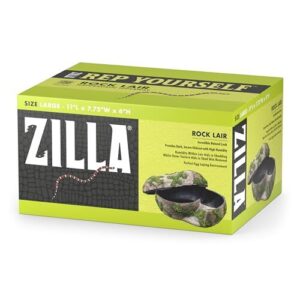
A semi-enclosed rock formation with textured interior surfaces, the Zilla Reptile Rock Lair Hide delivers the security-first lair design ball pythons seek during daylight hours. The single-entry den measures 11″ x 7.75″ x 6″—sized for juveniles up to mid-size adults—and its resin composite construction withstands routine handling while you maintain proper hide placement across your enclosure’s thermal gradient.
The rough inner texture mimics natural rocky crevices that encourage instinctive snake behavior, and the non-porous exterior simplifies weekly cleaning with soap or diluted disinfectant to keep your reptile habitat hygienic.
| Best For | Ball python owners seeking a durable, single-entry hide that provides secure daytime shelter for juveniles through mid-size adults while simplifying habitat maintenance. |
|---|---|
| Material | Plastic |
| Color | Grey |
| Cleaning | Easy to clean |
| Primary Use | Humid hide/shedding |
| Size Category | Large |
| Design Style | Natural mossy |
| Additional Features |
|
- Textured interior mimics natural rock crevices to encourage instinctive retreat behavior and help snakes feel genuinely secure
- Resin composite construction holds up to repeated handling and cleans easily with soap or diluted disinfectant
- 11″ x 7.75″ x 6″ dimensions fit standard 20–40 gallon enclosures without monopolizing floor space
- Single entry limits observation—you won’t see your snake without lifting the hide or waiting for them to emerge
- Bottom drainage holes may require hot glue modification if you’re adding moss or substrate to boost interior humidity
- Weighs 5.51 lbs, making it heavier than foam alternatives and trickier to reposition during cage cleaning
7. Zilla Herp Hotel Terrarium
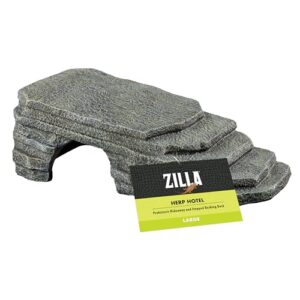
This dual-purpose platform gives you a basking surface on top and a shaded retreat underneath—a smart space-saver when your Ball Python enclosure is tight on floor area. Position the upper deck under your heat lamp so your snake can thermoregulate without leaving its primary hide zone.
The Medium Herp Hotel measures roughly 9″ x 5.5″ x 3.75″, fitting hatchlings and small juveniles, while the Large (13.5″ x 7″ x 4.75″) suits subadults. Its non-porous resin construction resists bacterial growth and cleans quickly with warm soapy water.
| Best For | Ball python keepers who need a compact dual-function piece that combines a basking platform and hide in one footprint, especially useful in smaller enclosures or minimalist setups. |
|---|---|
| Material | Plastic |
| Color | Medium |
| Cleaning | Warm soapy water |
| Primary Use | Basking/hiding |
| Size Category | Small |
| Design Style | Prehistoric design |
| Additional Features |
|
- Dual-purpose design saves floor space by stacking a basking area directly over a hide, letting your snake thermoregulate and feel secure without sprawling decor
- Non-porous resin surface resists bacteria and wipes clean with warm soapy water, making routine maintenance fast
- Stable rock-style construction with a wide base prevents tipping when your ball python climbs or pushes against it
- Medium size is too small for adult ball pythons; even the Large may feel cramped for snakes over three feet
- Some units arrive with sharp molding seams or cracks, requiring inspection and filing before use
- The shallow internal hide may not provide enough darkness or tight fit for nervous individuals who prefer snug, cave-like spaces
8. Pangea Reptile Hide Box
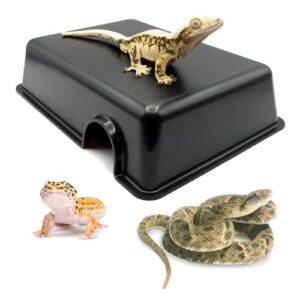
If you want a simple, no-nonsense reptile hide design that prioritizes snake shelter safety, Pangea’s 1/8″ thick plastic hide box delivers. The offset door placement keeps your ball python feeling secure—I’ve found snakes settle faster when they can’t be seen straight-on from every angle.
At 7″ wide by 2.25″ high, it fits juveniles perfectly while the smooth, non-porous surface makes cleaning your ball python enclosure a breeze. Plastic hide durability matters when hides get bumped during feeding or exploration, and this one won’t crack easily.
| Best For | Keepers with juvenile ball pythons who need a lightweight, easy-to-clean hide that reduces stress through thoughtful design. |
|---|---|
| Material | Plastic |
| Color | Black |
| Cleaning | Easy to clean |
| Primary Use | Hiding/security |
| Size Category | Small |
| Design Style | Minimalist black |
| Additional Features |
|
- Offset door placement helps snakes feel more secure and settle in faster
- Smooth, non-porous plastic makes cleaning and sanitizing quick and hassle-free
- Heavy 1/8″ thick construction holds up well to bumps during feeding and exploring
- May feel too lightweight and tip over without added weight for stability
- Size matters a lot—too large and your snake won’t feel as secure
- Some users feel it’s overpriced compared to similar hides from other brands
9. Zoo Med Reptile Cave Shelter
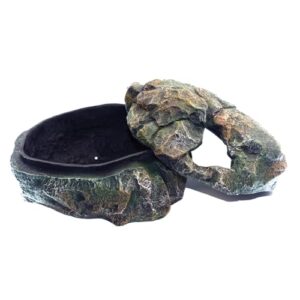
Zoo Med’s Reptile Cave Shelter offers a compact solution for juveniles and small adults. At 4.3″ high by 7.6″ wide, it’s sized for snug-fitting snake enclosures without excess space that can trigger stress.
The fiberboard shell with UV-stable finishes resists humidity, while the rounded interior prevents scale abrasion during shedding. I appreciate the single-entry aperture that mimics natural cave designs, encouraging your ball python to retreat confidently.
Non-porous surfaces wipe clean easily, making terrarium decor maintenance straightforward. Pair it with a second hide for proper thermoregulation.
| Best For | Ball python owners with juveniles or small adults who need an affordable, easy-to-clean hide that reduces stress through snug, cave-like security. |
|---|---|
| Material | Ceramic |
| Color | Black |
| Cleaning | Easy to clean |
| Primary Use | Hiding/shedding/nesting |
| Size Category | Large |
| Design Style | Naturalistic |
| Additional Features |
|
- Rounded interior and smooth surfaces prevent scale damage during shedding and daily movement
- Non-porous fiberboard cleans quickly with reptile-safe disinfectants and resists mold buildup
- Single-entry design mimics natural cave refuges, encouraging confident retreat behavior
- 4.3″ height may be too small for adult ball pythons over 3 feet, requiring a size upgrade
- Fiberboard construction is less durable than ceramic or resin alternatives and needs replacement if cracked
- Requires a second hide for proper thermal gradient management, adding to overall setup cost
10. FCALIVV Reptile Hide Box
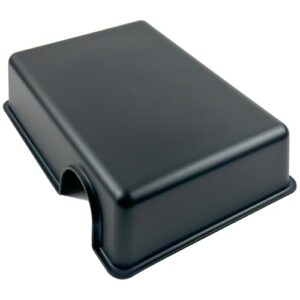
The FCALIVV Reptile Hide Box brings modern functionality to your ball python enclosure with shatter-resistant plastic construction. At 9.45″ deep by 6.89″ wide, it’s scaled for small to medium-sized snakes—juveniles fit comfortably, though full-grown adults need larger snake shelter options.
I recommend comparing the entrance diameter to your reptile’s girth before ordering.
The smooth, non-porous surface makes disinfection straightforward, and the lightweight design simplifies enclosure decor ideas during terrarium rearrangements. It’s dishwasher-safe for deep cleaning when substrate buildup occurs.
| Best For | Keepers of juvenile ball pythons or small reptiles like leopard geckos who want a low-maintenance hide that’s easy to clean and blends into modern terrarium setups. |
|---|---|
| Material | Plastic |
| Color | Black |
| Cleaning | Easy to clean |
| Primary Use | Hiding/privacy |
| Size Category | Large |
| Design Style | Modern |
| Additional Features |
|
- Dishwasher-safe and non-porous surface makes routine disinfection quick and prevents bacterial buildup
- Shatter-resistant plastic construction with smooth edges reduces injury risk during handling or feeding
- Lightweight design allows easy repositioning to adjust temperature gradients or refresh enclosure layouts
- Size may be inadequate for full-grown snakes—measure your reptile’s girth against the entrance before buying
- Plastic exterior lacks the naturalistic texture of rock or wood hides preferred by some keepers
- Interior depth may limit full-body concealment for broader-bodied species like adult bearded dragons
Maintaining and Cleaning Ball Python Hides
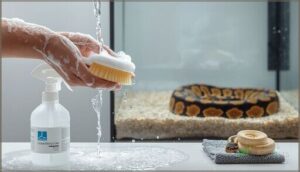
A clean hide isn’t just about aesthetics—it’s essential for preventing respiratory infections, mite infestations, and the buildup of harmful bacteria that can compromise your ball python’s health. Regular maintenance extends the life of your hides while creating a safer, more comfortable environment for your snake.
Here’s how to keep your python’s hiding spots in top condition through proper cleaning, preventive care, and safety inspections.
Safe Cleaning Methods and Disinfection
You’ll want to tackle your ball python hides with proven sanitizing techniques that won’t harm your snake. I recommend 70% isopropyl alcohol for quick disinfection protocols—just wipe surfaces and let them air dry.
For tougher grime in reptile enclosures, mix white vinegar 1:1 with water or use reptile-safe soap, then rinse thoroughly. These hygiene practices keep your enclosure safe without leaving harmful residues that compromise snake care and maintenance.
Preventing Mold, Parasites, and Odors
After you’ve disinfected your ball python hides, proper humidity regulation becomes your best defense against mold prevention and odor management. Keep enclosure humidity between 50-60% to discourage mold growth and parasite control issues.
I swap out damp substrate weekly and choose non-porous hides that dry quickly. This hide sanitation routine stops problems before they start—your snake deserves a fresh, clean space.
Inspection for Wear and Safety Issues
Regular safety checks help you catch wear detection issues before they threaten your ball python. Every two weeks, examine each hide for cracks, sharp edges, or loose parts that compromise security in the enclosure. Material durability matters—warped surfaces or chipped coatings signal it’s time for replacement, protecting your snake from injury.
- Deep scratches that could trap scales or claws during movement
- Weakened joints where your ball python’s weight causes wobbling
- Rough interior textures that may abrade delicate skin during shed cycles
- Faded finishes that might leach unknown chemicals into the habitat
- Unstable bases that tip when your snake presses against them
Frequently Asked Questions (FAQs)
How many hides does a ball python need?
Your ball python needs at least two hides—one on the warm side, one on the cool. This setup aids thermal regulation, reduces stress, and mimics their natural habitat perfectly.
Can I use homemade hides for ball pythons?
You can create DIY hide alternatives using food-safe plastics or untreated wood, but guarantee smooth surfaces, proper ventilation, and non-toxic custom hide designs.
Homemade hide safety requires regular inspection and thorough hide maintenance tips.
Do ball pythons prefer tight or spacious hides?
Should your ball python’s hide feel snug as a glove, or roomy? Most ball pythons prefer tight hides that mimic natural burrows—reducing stress and supporting thermal regulation—though individual snake behavior and enclosure layout matter too.
What humidity level should hides maintain for shedding?
During shedding cycles, your Ball Python needs humidity around 65% inside its humid hide.
Pairing that humid hide with a well-chosen hide box for shedding support keeps moisture in one cozy spot, so the rest of the enclosure stays comfortably dry.
Setting up a humid hide for easier ball python shedding gives your snake a snug, damp spot to loosen old skin and shed it cleanly.
This microclimate control aids complete sheds and prevents stuck scales—monitor with a hygrometer for ideal snake health monitoring.
Should I replace hides as my python grows?
Yes—your python’s growth stages demand proper hide sizing. When your snake reaches 2/3 your hand length, evaluate fit. A roomy hide signals it’s time for enclosure upgrades to support healthy python development.
Conclusion
Your ball python will spend 80% of its life inside whatever hide you choose—pressed against surfaces that either mimic the termite mounds of its ancestors or heighten its stress hormones with every breath.
The best snake hides for ball pythons aren’t about aesthetics or budget constraints; they’re about replicating the tight, secure microenvironments that allow your snake to thermoregulate efficiently, shed cleanly, and exist without the physiological cost of constant vigilance.
Choose accordingly.