This site is supported by our readers. We may earn a commission, at no cost to you, if you purchase through links.

Your ball python’s enclosure might read 85°F on one thermometer while the basking spot underneath actually hits 95°F—a seven-degree difference that can shut down digestion for days. Ectothermic reptiles can’t generate their own body heat, so they depend entirely on precise thermal gradients to regulate metabolism, digest prey, and maintain immune function.
A single misplaced probe or an uncalibrated gauge turns temperature management into guesswork, leading to refused meals, incomplete sheds, and respiratory infections that could have been prevented.
Selecting reptile thermometers for ball pythons requires understanding probe placement, calibration standards, and the difference between ambient readings and surface temperatures. The right monitoring setup gives you real-time data from both thermal zones, eliminating the dangerous gaps that compromise your snake’s health.
Table Of Contents
- Key Takeaways
- Why Ball Pythons Need Accurate Thermometers
- Key Features of Reptile Thermometers
- Ideal Temperature Ranges for Ball Pythons
- Where to Place Thermometers in The Enclosure
- Top 5 Reptile Thermometers for Ball Pythons
- How to Set Up Thermometers Effectively
- Common Thermometer Mistakes to Avoid
- Buying Guide: Choosing The Best Thermometer
- Frequently Asked Questions (FAQs)
- Conclusion
Key Takeaways
- Ball pythons depend entirely on external heat sources to regulate metabolism, digestion, and immune function, making accurate dual-zone temperature monitoring essential to prevent respiratory infections, feeding refusal, and incomplete sheds caused by even small thermal errors.
- Effective temperature management requires placing calibrated digital thermometer probes in both warm (88-92°F) and cool (78-82°F) zones at substrate level—never against heat sources—to capture the actual thermal gradient your snake experiences rather than misleading ambient readings.
- Single-zone monitoring creates dangerous blind spots that compromise thermoregulation, so investing in dual thermometers with quarterly calibration checks ensures you catch temperature fluctuations before they trigger stress behaviors or metabolic shutdown.
- Quality reptile thermometers should offer ±0.5-1°F accuracy, integrate with thermostat controllers for automated regulation, and include features like probe shielding and data logging to maintain the precise 10-14°F thermal gradient ball pythons need for healthy digestion and shedding cycles.
Why Ball Pythons Need Accurate Thermometers
Ball pythons are ectothermic, which means they can’t generate their own body heat and depend entirely on their environment to regulate essential functions. Without accurate thermometers, you’re basically flying blind—small temperature errors can disrupt digestion, weaken immune response, and trigger stress-related behaviors. Without accurate thermometers, you’re flying blind—small temperature errors can disrupt your ball python’s digestion and immune response, so understanding proper temperature management is essential for their health.
Without accurate thermometers, you’re flying blind—small temperature errors can disrupt your ball python’s digestion, immunity, and behavior
Getting the temperature right isn’t just about comfort; it’s about giving your snake the physiological foundation it needs to thrive. Getting the temperature right isn’t just about comfort; it’s about giving your snake the physiological foundation it needs to thrive.
Importance of Temperature Regulation for Ball Pythons
Ball python care hinges on temperature regulation—your snake’s survival depends on it. Reptile metabolism functions only within specific thermal gradients, making a reliable reptile thermometer and temperature controller essential. Without proper thermoregulation, your python can’t maintain thermal comfort or digestion support, risking heat stress and metabolic shutdown. Ensuring the accuracy of scientific study summaries is essential, and using methodological rigor can help improve research quality.
- Temperature gradients enable essential thermoregulation across the enclosure
- Reptile metabolism requires consistent heat for cellular energy production
- Digestion support depends entirely on adequate ambient temperatures
- Thermal comfort reduces stress-related behaviors and health complications
- Heat stress prevention protects respiratory function and overall vitality
Health Risks of Improper Temperature
Temperature stress wreaks havoc on your python’s system—metabolic issues and digestive problems emerge when readings drift outside safe ranges. Inadequate thermoregulation compromises cardiovascular risks, weakening immune defenses against infections. Without a reliable reptile thermometer and temperature controller, heat stroke becomes a real threat during thermal spikes. Temperature stress causes metabolic and digestive issues in pythons, so invest in accurate reptile thermometers to prevent immune problems and heat stroke.
Poor temperature regulation disrupts shedding cycles and nutrient absorption, undermining reptile health. You can’t afford guesswork when your snake’s survival depends on precision. Maintain precise thermal gradients with reliable heating solutions for snakes to support proper metabolic function and shedding cycles.
Behavior and Digestion Linked to Thermal Gradients
Your python’s digestive efficiency hinges on proper thermal gradients—active thermoregulation between warm and cool zones optimizes reptile metabolism and nutrient absorption. Proper temperature zones enhance your ball python’s digestive efficiency—pair this with appropriate feeding schedules for optimal health.
When temperature fluctuations disrupt this balance, enzymatic activity slows and gut transit times increase.
A reliable reptile thermometer and humidity gauge tracks these critical zones, ensuring your snake can self-regulate effectively and maintain healthy digestion after feeding.
Key Features of Reptile Thermometers
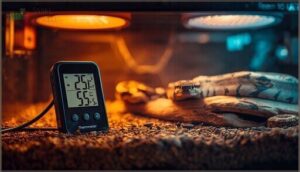
Not all thermometers are built the same, and choosing the right one comes down to understanding a few critical features that directly impact your ball python’s health. Digital models offer faster, more precise readings than analog versions, while probe placement determines whether you’re getting accurate data from each thermal zone.
The best units combine temperature and humidity monitoring with reliable calibration, giving you complete control over your snake’s environment.
Digital Vs. Analog Thermometers
When choosing between digital and analog options, you’ll find that digital thermometers offer instant readings on high-contrast LCD displays, making reptile temperature control straightforward even in dim lighting. Digital displays usually include programmable alarms and USB or battery power for flexible placement.
Analog models rely on mechanical sensors without electronics, providing durability in humid environments but requiring manual calibration methods to maintain thermometer accuracy over time.
Temperature Probe Accuracy
Precision matters when you’re trusting a digital thermometer to protect your snake. Most reptile temperature probes deliver readings within ±0.5 to ±2.0 degrees Celsius, though high-end sensor materials can narrow that margin to ±0.1°C.
Regular probe calibration using traceable accuracy standards prevents thermal drift over time, ensuring your thermostat and temperature controller maintain safe basking zones without guesswork.
Combined Thermometer and Hygrometer Units
You’ll find integrated thermometer and humidity gauge units ideal for tracking both thermoregulation and humidity in one device. These digital displays generally achieve sensor accuracy within ±0.5 to ±1.0°C for temperature control and ±3 to ±5% for humidity readings.
Many temperature controller models include probe placement options, data logging features, and user-adjustable calibration methods to guarantee reliable monitoring across your ball python’s thermal zones.
Calibration and Reliability
Reliability testing every three months keeps your digital thermometer and humidity gauge performing within manufacturer tolerances, usually ±0.5°C. Calibration methods like ice-water checks verify probe placement accuracy, while tracking sensor drift over time reveals when replacement is needed.
Your thermostat and temperature control system depend on accurate thermoregulation data, so maintenance schedules and functional tests protect your ball python’s health.
Ideal Temperature Ranges for Ball Pythons
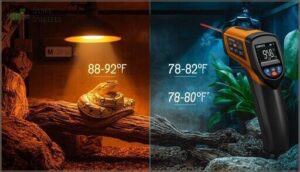
Ball pythons don’t just prefer specific temperatures—they depend on them for survival. Your enclosure must provide a clear thermal gradient, allowing your snake to move between warm and cool zones throughout the day and night.
Understanding these precise requirements helps you create an environment where your python can regulate its body temperature, digest meals properly, and shed without complications.
Warm Side Vs. Cool Side Requirements
Your ball python thrives when you establish a thermal gradient with the warm side between 88 and 92°F and the cool side around 78–82°F. This 10–14°F differential drives natural basking behavior and healthy digestion.
You’ll need reliable thermometer and humidity gauge placement in both zones to prevent thermal stress, which occurs above 95°F and compromises reptile health through respiratory disturbances.
Nighttime Temperature Guidelines
You can let nighttime temperatures drop to 75–78°F on the cool side without stressing your python, but the warm zone should stay between 88 and 92°F to support reptile thermoregulation. Use a digital thermometer and temperature control system to prevent dangerous temperature fluctuations:
- Maintain thermal gradients even during nocturnal heating periods
- Insulate enclosures against drafts for stable nighttime insulation
- Calibrate sensors in both warm and cool zones
- Monitor readings nightly to verify consistent temperature regulation
Effects of Temperature on Shedding and Feeding
Temperature stress disrupts shedding cycles and feeding patterns in ways you can’t ignore. When your ball python care lacks proper thermal gradients, digestion rates slow and incomplete sheds become common. A reptile temperature controller maintaining ideal thermoregulation prevents these issues—your snake won’t eat well in cold spots or shed cleanly without consistent temperature control.
| Temperature Issue | Impact on Shedding | Impact on Feeding |
|---|---|---|
| Below 78°F cool side | Prolonged shed duration, retained eyecaps | Reduced appetite, refusal to eat |
| Above 95°F warm side | Rapid dehydration during shed | Stress-induced feeding refusal |
| Inconsistent gradient | Irregular shedding patterns | Slow digestion, regurgitation risk |
| Ideal 78–92°F range | Clean, complete sheds | Strong feeding response, healthy digestion |
Where to Place Thermometers in The Enclosure
Getting accurate temperature readings starts with putting your thermometers in the right spots. You’ll need to monitor both the warm and cool sides of your ball python’s enclosure, placing probes where your snake actually spends time rather than directly against heat sources.
Let’s look at the three key placement zones that give you a complete picture of your enclosure’s thermal gradient.
Monitoring Both Thermal Zones
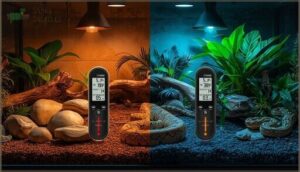
You’ll need at least two digital thermometers to capture the full thermal gradient across your enclosure. Place one probe on the warm side—usually 88–92°F—and another on the cool side at 80–85°F.
This dual-zone monitoring reveals how well your heat mapping aids thermoregulation. Accurate sensor calibration and regular checks prevent temperature fluctuation, ensuring your snake moves comfortably between zones for ideal temperature control.
Placement of Probes for Accurate Readings

Where you position your digital thermometer probe determines whether you get accurate readings or misleading numbers. Aim for the middle third of your warm zone at floor level—not directly under the basking light—to capture the thermal gradient your snake actually experiences.
Shield probes from direct radiant heat using a cover, and cross-check with a second thermometer during routine inspections to confirm your sensor calibration stays reliable.
Avoiding False Readings From Heat Sources

Heat source interference throws off your digital thermometer when probes sit too close to bulbs or pads. Poor sensor calibration from radiant warming creates falsely high readings that mask actual thermal gradient problems.
Protect your accuracy checks by:
- Positioning probes three to four inches from direct heat contact
- Using heat-resistant probe covers to block reflective warming
- Running dual sensors for temperature control cross-verification
- Recalibrating after changing bulbs or adjusting your thermostat
Shield placement matters as much as probe placement for reliable thermoregulation monitoring.
Top 5 Reptile Thermometers for Ball Pythons
You need reliable tools to track temperatures in your ball python’s enclosure, but not every thermometer is built for the job.
The following five products offer a range of options, from basic monitoring to full temperature control systems.
Each one covers specific aspects of maintaining proper thermal gradients for your snake.
1. Reptile Thermometer And Humidity Gauge
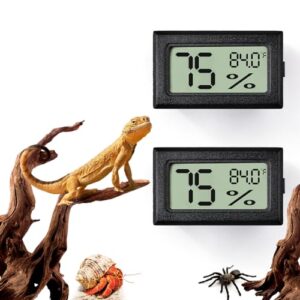
When you’re tracking both warmth and moisture levels in your ball python’s habitat, the BSRESIN Reptile Thermometer and Humidity Gauge delivers reliable digital displays for thorough monitoring.
This hygrometer-thermometer combo offers temperature probes accurate within ±1°F across a -58°F to +158°F range and humidity control readings from 10% to 99% RH (±5%).
The 5-second response time and compact design with sticky pad let you position units in both thermal zones, though calibration tips recommend verifying accuracy against known standards since some users reported occasional humidity gauge inconsistencies.
| Best For | Ball python owners who need an affordable, easy-to-read digital monitor for tracking both temperature and humidity in different zones of their enclosure. |
|---|---|
| Primary Use | Temperature/Humidity Monitoring |
| Material | Resin |
| Power Source | Battery (1.5V) |
| Suitable Species | Multiple Reptiles |
| Unit Count | 2 Pack |
| Color | Black |
| Additional Features |
|
- Fast 5-second readings with decent accuracy (±1°F for temp, ±5% RH for humidity) help you catch climate changes quickly
- Compact sticky-pad design lets you place multiple units around the habitat to monitor hot and cool spots
- Clear digital display makes it easy to check conditions at a glance without squinting at analog dials
- Some users report the humidity readings can be off, so you might need to verify against another gauge
- Fragile construction means you’ll need to handle them carefully during tank cleaning
- No batteries included and only a 3-month battery life means you’ll be replacing them fairly often
2. Digiten Reptile Temperature Controller Thermostat
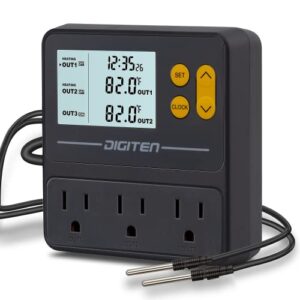
The DIGITEN TTC-1003 reptile temperature controller offers three-outlet management, combining thermostat settings with timing functions for all-encompassing ball python care. Its dual temperature probes track readings from 14°F to 248°F across your warm and cool zones, while the large digital displays show real-time data alongside programmable heat source compatibility for ceramic emitters and under-tank heaters.
Though calibration techniques remain essential—some units experienced functionality concerns—this thermostat’s day-night temperature control facilitates effective thermoregulation when paired with regular monitoring and proper probe placement away from direct heat sources.
| Best For | Reptile keepers who need flexible day-night temperature control and multiple heating zones for ball pythons or similar species. |
|---|---|
| Primary Use | Snake Hide Box |
| Material | Plastic |
| Power Source | None |
| Suitable Species | Ball Pythons/Large Snakes |
| Unit Count | 1 Unit |
| Color | Black |
| Additional Features |
|
- Three separate outlets let you manage heating and lighting independently with different schedules
- Wide temperature range (14-248°F) with dual probes gives you precise control over warm and cool zones
- Day-night programming adjusts temperatures automatically to mimic natural cycles
- Reliability issues reported, with some units failing after a month of use
- Setup can be confusing, and the temperature outlets don’t have day-night functions—only the timer outlet does
- Probes aren’t waterproof and need careful placement away from direct heat for accurate readings
3. Reptile Red Heat Lamp Bulbs
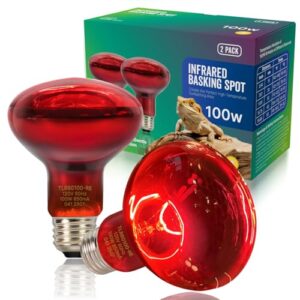
Red bulb benefits include nighttime warmth without disrupting your ball python’s natural day-night cycle, since infrared heating emits light invisible to the human eye.
You’ll create thermal gradients with a warm side around 88–92°F when you pair these reptile heating solutions with a thermostat for reliable temperature control.
Heat lamp safety requires placement above the basking spot to prevent burns, while bulb replacement becomes necessary when dimming signals reduced heat output.
Always use heating equipment with digital thermometers monitoring both zones to confirm your infrared heat lamp maintains proper thermal conditions.
| Best For | Ball python owners who need reliable nighttime heating that won’t disrupt their snake’s sleep cycle while maintaining proper temperature gradients. |
|---|---|
| Primary Use | Temperature Controller |
| Material | Plastic/Electronic |
| Power Source | Plug-in AC |
| Suitable Species | Multiple Reptiles |
| Unit Count | 1 Unit |
| Color | Black |
| Additional Features |
|
- Provides invisible infrared warmth that keeps your python comfortable at night without disturbing natural day-night rhythms
- Creates the ideal 88–92°F basking zone when paired with a thermostat for precise temperature control
- Works well with digital thermometers to monitor both warm and cool sides of the enclosure
- Bulbs may dim over time and need replacement within a year to maintain consistent heat output
- Requires careful placement above the basking spot to prevent direct contact burns
- Doesn’t heat air efficiently on its own, so you’ll need additional equipment like thermostats and monitoring tools
4. Infrared Heat Lamp Bulb For Reptiles
You’ll find infrared heating lamps delivering concentrated warmth directly to your ball python’s basking zone, with 100-watt bulbs creating surface temperatures near 90°F when paired with a reliable thermostat for temperature control. These reptile heating solutions emit radiant energy that penetrates substrates, though thermal monitoring with probe thermometers remains essential to prevent overheating.
Safety precautions include maintaining 12–18 inches clearance from substrates and inspecting fixtures for cracks during bulb replacement cycles.
Infrared benefits include immediate heat source options without disrupting nocturnal behavior, though regular output checks guarantee consistent performance.
| Best For | Ball python owners who need a reliable nighttime heat source that won’t disrupt their snake’s natural sleep cycles while maintaining proper basking temperatures. |
|---|---|
| Primary Use | Reptile Heating |
| Material | Glass |
| Power Source | Standard Socket |
| Suitable Species | Reptiles/Amphibians |
| Unit Count | 2 Pack |
| Color | Clear/Infrared |
| Additional Features |
|
- Delivers immediate infrared warmth to create a consistent 90°F basking spot when used with a thermostat
- The soft red glow allows you to monitor your snake at night without disturbing its natural behavior
- Long 25,000-hour lifespan means fewer bulb replacements compared to standard heat lamps
- Some users report bulbs burning out much faster than the advertised lifespan
- Requires careful placement 12–18 inches from substrates to prevent burns or overheating
- May not provide enough heat for larger enclosures without adding multiple bulbs
Leoterra Ball Python Hide (with Built-in Thermometer Features, if Applicable)
The Leoterra Ball Python hide markets convenience by integrating environmental sensing into a single enclosure design element, though thermometer accuracy claims require independent verification with calibrated digital probes. You’ll need to confirm actual specifications before purchase, as built-in sensors vary considerably across sellers.
| Feature | Practical Consideration |
|---|---|
| Thermometer Accuracy | Cross-check readings with external digital probe; built-in sensors may drift ±2°C |
| Hide Placement | Position on warm side to monitor basking zone temperature gradients effectively |
| Enclosure Design | Fits standard terrariums for juveniles; verify dimensions against your ball python’s size |
| Temperature Control | Supplementary indicator only; maintain separate thermostat for reliable regulation |
| Reptile Safety | Verify probe doesn’t create sharp edges or contact points inside reptile hide interior |
Independent thermometers remain essential for temperature gradients verification across your entire terrarium setup.
How to Set Up Thermometers Effectively
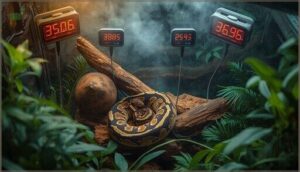
Setting up thermometers correctly ensures you’re getting reliable readings that reflect what your ball python actually experiences. Proper placement and integration with your heating system prevents guesswork and keeps temperatures stable.
Here’s how to install and configure thermometers for accurate monitoring throughout your snake’s enclosure.
Step-by-step Installation Guide
Start your terrarium setup by mapping thermal zones before positioning any heating equipment. Secure probes at basking and cool sites—avoid direct lamp contact to prevent false spikes. Route cables neatly for power safety and proper cable management.
Calibrate your thermometer against a known reference, then verify readings across the temperature gradient. Document probe placement for future calibration tips and maintenance.
Integrating With Thermostats and Controllers
Your reptile temperature controller becomes the command center linking heating equipment to precision monitoring. Position temperature probes in your basking and cool zones—never touching heat sources directly—so controller settings reflect true ambient conditions.
Consider these integration essentials:
- Enable safety cutoffs and alarms to prevent dangerous temperature spikes
- Run thermostat calibration monthly using a reference thermometer for accuracy
- Match your heat source management strategy to compatible ceramic emitters or regulated lamps
Proper thermostat selection ensures your temperature gradient stays stable through every cycle.
Common Thermometer Mistakes to Avoid

Even experienced keepers make temperature monitoring errors that compromise their ball python’s health. Misreading thermal conditions isn’t always obvious until your snake shows signs of stress or refuses food.
Understanding these common pitfalls will help you maintain accurate readings and create a truly stable environment.
Misplaced Probes and Sensors
You can’t trust readings from a probe dangling outside the enclosure—it’ll only measure ambient temperature, not your snake’s microclimate. Placing sensors under substrate shields them from radiant heat, while probes touching glass or metal surfaces introduce reading drift. Here’s how probe placement affects accuracy:
| Probe Location | Reading Error |
|---|---|
| Outside enclosure | Reads room temp, not thermal gradients |
| Under substrate | Shields from heat source interference |
| On metal/glass | Conducts heat differently, causes drift |
| Unshielded probe | Unstable from humidity gauge fluctuations |
Position your reptile temperature controller probes where your python actually basks—mid-level on the warm side and in the cool retreat—to capture true temperature gradients and maintain proper thermostat control.
Relying on Single-zone Readings
Beyond probe placement, monitoring just one zone leaves critical gaps in your thermal gradient analysis. A single sensor can’t reveal how heat source variability affects your python’s ability to thermoregulate between zones.
You need readings from both warm and cool sides—plus integrated humidity gauge data—to spot temperature fluctuations that a reptile temperature controller might miss, ensuring proper temperature control across the entire gradient.
Ignoring Calibration and Maintenance
Even with sensors in both zones, calibration errors can silently undermine your temperature control accuracy. Digital probes experience sensor drift—sometimes several degrees within months—creating false readings that compromise your temperature gradient management.
To prevent equipment failure, follow these maintenance schedules:
- Calibrate your thermostat and humidity gauge quarterly
- Check probe placement monthly for corrosion
- Test your reptile temperature controller against a reference thermometer
- Replace aging sensors showing inconsistent readings
- Document calibration dates to track sensor drift patterns
Regular maintenance catches problems before they trigger stress behaviors or feeding refusal.
Buying Guide: Choosing The Best Thermometer
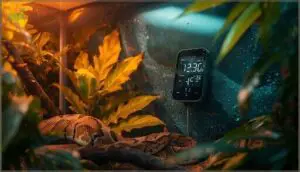
Selecting the right thermometer for your ball python’s enclosure involves more than just picking the first digital display you find online. You need to evaluate how the device fits your specific setup, whether it can withstand daily use in a humid environment, and if the features justify the price tag.
The following factors will help you narrow down your options and invest in equipment that delivers reliable temperature monitoring for years to come.
Compatibility With Your Enclosure
Your thermometer must fit your specific enclosure design, not just sit inside it. Probe placement should correspond to the cage’s warm and cool zones to avoid biased readings, while sensors need ratings for reptile habitat humidity and substrate conditions. Check that mounting options work with your terrarium walls without compromising ventilation systems or security features during installation.
| Compatibility Factor | Why It Matters |
|---|---|
| Sensor Placement | Ensures accurate readings in both thermal zones |
| Enclosure Materials | Affects calibration consistency and mounting stability |
| Humidity Control Range | Prevents sensor damage in high-moisture environments |
| Ventilation Systems | Maintains airflow without sensor interference |
Durability and Power Options
Sensor reliability begins with your choice of power supply, since battery-powered units using AA or AAA cells usually last 6–12 months, while USB-adapted models eliminate battery replacement entirely.
Device longevity depends on probe construction—stainless steel sheaths resist corrosion in humid heating equipment zones better than plastic alternatives.
Thermostats with memory functions retain your temperature gradient settings after outages, maintaining consistent reptile temperature controller performance.
Price Vs. Features Comparison
You’ll find entry-level digital thermometers at $10–20, delivering adequate ±1–2°F accuracy for basic temperature control without multi-zone features.
Mid-range thermostat units between $40–80 add pulse-proportional heating equipment regulation and programmable day-night cycles, balancing cost against improved temperature gradient stability.
Premium models exceeding $80 provide dual-channel reptile temperature controller outputs, Wi-Fi monitoring, and fail-safe protection—essential features for serious keepers managing complex setups.
When selecting a thermostat, consider the importance of temperature accuracy for maintaining a healthy environment.
Trusted Brands and Reviews
You can trust established reptile temperature controller brands like Zoo Med, Vivarium Electronics, and Herpstat for consistent thermostat performance in ball python care.
Customer feedback reveals that products meeting UL safety standards deliver reliable temperature control over time, while independent product reviews from herpetology forums highlight accuracy and durability.
Market trends show digital controllers with fail-safe features earn the highest ratings for reptile care applications.
Frequently Asked Questions (FAQs)
Can I use human thermometers for ball pythons?
You could try one, but human devices miss the mark—they’re built for quick body checks, not tracking humidity or reading basking spots where your ball python needs precise thermoregulation for reptile health and wellness.
How often should thermometers be replaced or upgraded?
You should replace digital thermometers every one to three years depending on calibration stability, while analog units need replacement every twelve to twenty-four months as probe accuracy degrades with thermal cycling and moisture exposure.
What causes sudden temperature spikes in reptile enclosures?
When temperatures skyrocket, you’re likely facing equipment failure, thermostat malfunctions, or heat source issues. Environmental factors like direct sunlight, poor sensor placement, and disrupted thermal gradients also compromise temperature control and thermoregulation.
Are wireless thermometers reliable for monitoring ball pythons?
You can rely on wireless thermometers for tracking ambient temperatures, though signal interference and battery degradation occasionally disrupt readings.
High-quality models with proper sensor calibration and data logging match wired accuracy when carefully chosen and regularly verified.
Conclusion
Temperature errors don’t announce themselves—they compound silently until your ball python stops eating or develops a respiratory infection. Choosing reliable reptile thermometers for ball pythons means eliminating that risk entirely.
Dual-zone monitoring with calibrated probes gives you the precision ectothermic species require, transforming guesswork into measurable control. Your snake can’t regulate its own heat, but you can regulate every degree of its environment.
That distinction separates adequate husbandry from care that actually protects long-term health.
- https://www.scribd.com/document/356795007/Research-Methods-Knowledge-Base
- https://www.sciencedirect.com/science/article/pii/S0260691723000977
- https://mramphibian.com/best-reptile-thermostats/
- https://www.reddit.com/r/snakes/comments/5tvceo/recommendations_and_reviews_thermometers_and/
- https://community.morphmarket.com/t/best-hydrometer/28163