This site is supported by our readers. We may earn a commission, at no cost to you, if you purchase through links.

Your ball python hasn’t eaten in three weeks, and you’re wondering if something’s wrong with the enclosure—but without a thermometer, you’re guessing. Snake metabolism, immune function, and digestion all depend on precise temperature control within species-specific ranges, usually between 75°F and 92°F depending on the zone. A five-degree miscalculation can trigger respiratory infections, regurgitation, or chronic stress that shortens your snake’s lifespan.
Digital thermometers with probe sensors let you track both the warm basking area and cool retreat simultaneously, catching dangerous fluctuations before they compromise your snake’s health. Pairing these devices with thermostats creates a fail-safe system that detects heating element malfunctions and prevents lethal overheating scenarios.
Understanding which thermometer type suits your enclosure design—and where to position it for accurate gradient readings—transforms guesswork into reliable husbandry.
Table Of Contents
- Key Takeaways
- Do You Need a Thermometer for a Snake Tank?
- Why Accurate Temperature Matters for Snakes
- Types of Thermometers for Snake Tanks
- Where to Place Thermometers in The Enclosure
- How Thermometers Support Snake Health
- Thermometer Use for Different Snake Species
- Common Temperature Mistakes in Snake Tanks
- Pairing Thermometers With Thermostats and Hygrometers
- Choosing The Best Thermometer for Your Setup
- How Often to Check and Calibrate Thermometers
- Frequently Asked Questions (FAQs)
- Conclusion
Key Takeaways
- Snakes can’t generate their own body heat, so they depend entirely on external temperature control between 75°F and 92°F to maintain metabolism, digestion, and immune function—meaning a thermometer isn’t optional equipment but foundational to preventing respiratory infections, regurgitation, and premature death.
- Digital thermometers with probe sensors paired with thermostats create a fail-safe monitoring system that tracks both warm basking zones (88-92°F) and cool retreats (75-80°F) simultaneously, catching dangerous fluctuations and equipment malfunctions before they compromise your snake’s health.
- You’ll need multiple thermometers positioned at substrate level on both the warm and cool sides of the enclosure to accurately map the thermal gradient your snake uses for thermoregulation, since single-point measurements can’t detect localized hot spots or cold zones that cause stress.
- Temperature requirements vary significantly by species—ball pythons need 88-92°F warm zones with 78-80°F cool zones at 50-60% humidity, while corn snakes thrive at 80-88°F warm and 72-78°F cool with 40-60% humidity—so species-specific monitoring prevents the guesswork that leads to health problems.
Do You Need a Thermometer for a Snake Tank?
A thermometer isn’t optional in snake care—it’s foundational equipment that safeguards your animal’s health through precise temperature control. You need reliable tank monitoring to verify that your heating systems maintain species-appropriate thermal gradients, which usually range from 75°F on the cool side to 88-92°F on the warm side, depending on your snake species.
Without consistent thermometer accuracy, you’re fundamentally managing your snake habitat blindfolded, risking both overheating and dangerously cold spots that compromise temperature regulation. Your reptile care protocol should include at least one thermometer, though experienced keepers often deploy multiple units to map the complete temperature gradient.
Without accurate thermometers, you’re managing your snake’s habitat blindfolded, risking deadly temperature extremes you can’t detect or prevent
Pairing thermometers with a thermostat creates a fail-safe system, allowing you to detect equipment malfunctions before they endanger your animal—because temperature fluctuations you can’t measure are problems you can’t solve. Ensuring the accuracy of temperature readings is vital, much like addressing methodological flaws in scientific research.
Why Accurate Temperature Matters for Snakes
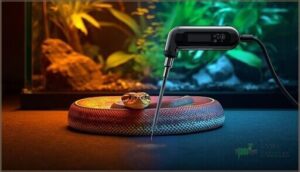
Snakes can’t produce their own body heat, which means they depend entirely on their environment to maintain the metabolic functions that keep them alive. Without precise temperature control, your snake’s ability to digest food, fight off infection, and perform basic physiological processes breaks down rapidly. If you’re keeping a boa constrictor, you’ll need to understand how to set up proper heating for boa constrictors to keep them healthy year-round.
Understanding exactly why temperature accuracy matters will help you recognize what’s at stake in your enclosure setup. Snakes rely on external heat sources to regulate their body temperature, so maintaining the right thermal gradient in their enclosure directly affects their ability to digest food and fight off illness.
Snake Thermoregulation Needs
Your snake’s survival hinges on behavioral thermoregulation—moving between zones to stabilize body temperature. You must establish thermal gradients with heat sources like a heat mat, pairing them with a thermostat and thermometer for precise temperature control.
Most species need basking areas around 85–90°F and cooler spots near 75–80°F. Without these environmental factors and a proper temperature gradient, your snake can’t regulate metabolism or digestion effectively.
Risks of Incorrect Temperatures
When temperatures drift outside your snake’s ideal range, immune function crashes and bacterial infections take hold. Prolonged exposure disrupts digestion, delays gastric emptying, and triggers environmental stress that elevates cortisol levels. Maintaining proper heating and lighting in your snake’s enclosure becomes critical to prevent these cascading health failures and keep your snake thriving.
Temperature fluctuations without proper thermal gradients compromise reptile physiology—you’ll see respiratory issues, regurgitation, and stunted growth. That’s why choosing the right reptile thermometers for ball pythons and placing them correctly matters so much for catching temperature problems before they affect your snake’s health.
That’s why thermostat-controlled heating paired with accurate temperature and lighting regulation protects against these health impacts.
Types of Thermometers for Snake Tanks
You’ll find several thermometer types designed specifically for reptile enclosures, each with distinct advantages depending on your setup and monitoring needs. Digital models with probe sensors offer precision and reliability, while analog stick-on thermometers provide basic visual readings at a lower cost.
Understanding the differences between these options—including probe, infrared, and touchless technologies—will help you choose the right tool to maintain accurate temperature gradients in your snake’s habitat.
Digital Vs. Analog Thermometers

Your choice between digital and analog instruments fundamentally shapes temperature monitoring precision in your snake’s habitat. Digital displays update readings every 1–2 seconds with battery-powered probes, delivering near real-time accuracy that aids proper thermostat calibration and heating and lighting adjustments. Consider these contrasts: For owners managing compact enclosures, selecting the right thermometer-hygrometer for small vivariums ensures you capture both temperature and humidity trends without sacrificing wall space or visual clarity.
- Digital models provide numeric precision with high/low alarms for temperature gradient verification
- Analog thermometers operate without batteries using bimetallic strips or liquid gauges
- Digital sensors respond faster to fluctuations in the temperature environment
- Analog reliability shows through physical needle locations on dial faces
- Calibration methods differ—digital thermometer accuracy usually ranges ±0.5°C versus analog’s broader 1–3°C tolerance
Temperature sensors in digital units excel at tracking warm-side basking zones, while analog instruments serve as dependable backup monitors despite slower response times.
Probe, Infrared, and Touchless Models

Sensor technology expands beyond basic displays to offer specialized heat monitoring solutions suited to reptile enclosures. You’ll encounter probe thermometers with wired sensors that track substrate-level temperatures continuously, infrared models that measure surface heat from a distance without contact, and touchless devices delivering rapid spot checks across your temperature gradient.
Each approach demands distinct calibration methods—probes require precise placement near heating and lighting zones to avoid skewing thermostat readings, infrared units need emissivity adjustments (commonly 0.95 for enclosure materials), and touchless thermometers depend on clear sightlines for accuracy. Pairing multiple sensor types strengthens your temperature control strategy and protects against single-point failures.
| Feature | Probe Models | Infrared/Touchless Models |
|---|---|---|
| Measurement Method | Physical sensor insertion at specific points | Non-contact infrared energy detection |
| Response Time | Continuous monitoring with stable readings | Instant spot checks, single-point data |
| Placement Requirements | Careful positioning to avoid heat source contact | Clear line of sight to target surface |
| Calibration Needs | Depth and location adjustments for accuracy | Emissivity settings and distance considerations |
| Best Use Case | Monitoring warm/cool zones and substrate temps | Quick verification of basking surfaces and gradients |
Where to Place Thermometers in The Enclosure
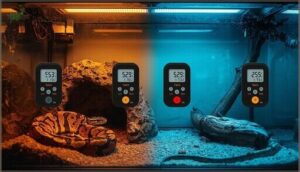
You can’t manage what you don’t measure, and that means placing your thermometers where they’ll actually tell you what’s happening in your snake’s world. The warm side, cool side, and gradient zones each need their own monitoring to verify your snake can regulate its body temperature properly.
Here’s where to position your thermometers for accurate, actionable readings.
Monitoring Warm and Cool Sides
You’ll need to position your thermometer on both the warm and cool sides to capture the essential temperature gradient—usually 88 to 92 Fahrenheit near heat sources like your heat mat, dropping to 78 to 82 Fahrenheit on the cooler end.
This gradient allows natural snake behavior and thermal cycling, so place probes at eye level on each side, avoiding direct contact with heating elements to prevent false readings.
Measuring Temperature Gradients
Gradient mapping reveals how your heat mat creates distinct thermal zones. Aim for a 10 to 15°C spread between sides, using multiple thermometers at different heights to capture vertical stratification and microclimate control.
Digital probes with fast response times track these shifts accurately, while temperature logging over several weeks confirms your thermostat-controlled heating maintains stable gradients, not isolated hot spots that stress your snake.
How Thermometers Support Snake Health
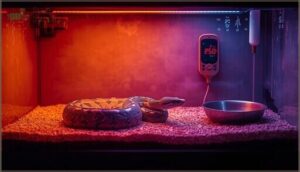
Thermometers aren’t just measuring devices—they’re your first line of defense against conditions that can slowly compromise your snake’s health. When temperatures drift outside the ideal range, your snake’s immune system weakens, digestion slows, and stress hormones climb, even if outward symptoms don’t appear right away.
Let’s examine how precise temperature monitoring directly protects your snake from two of the most common husbandry-related problems.
Preventing Illness and Stress
Consistent temperature control shields your snake from a cascade of health problems, from respiratory infections to disrupted shedding cycles. When you maintain thermal gradients between warm and cool zones—88–92°F and 78–80°F for ball pythons, for example—you support normal snake behavior, stress reduction, and immune resilience.
Regular health monitoring through thermostat-controlled heating prevents thermal distress that compromises digestion, wound healing, and overall reptile health.
Ensuring Proper Digestion
Your snake’s digestive health hinges on precise thermal gradients that activate enzyme production and regulate gut transit. Basking effects at 88–92°F post-feeding accelerate meal timing and prevent regurgitation—critical outcomes that thermostat-controlled heating paired with accurate temperature monitoring delivers.
Without proper heating and lighting management in your snake tank, even humidity-optimized environments fail to support complete digestion.
Thermometer Use for Different Snake Species

Different snake species come from wildly different habitats, which means their temperature requirements vary greatly and demand precise monitoring to keep them healthy. What works perfectly for a ball python from the warm grasslands of West Africa won’t match the needs of a corn snake adapted to temperate North American climates.
Understanding these species-specific temperature ranges will help you set up your thermometer placement and heating equipment correctly from the start.
Ball Python Temperature Needs
Your ball python thrives when you maintain a temperature gradient from 88-92°F on the warm side to 78-80°F on the cooler end, which you’ll monitor using a reliable thermometer positioned at substrate level.
A heat mat paired with thermostat-controlled heating prevents dangerous fluctuations that disrupt digestion rates.
Maintaining 50-60% humidity control aids healthy thermal cycles and respiratory function throughout your snake’s enclosure.
Corn Snake and Boa Constrictor Requirements
While ball pythons require tighter temperature ranges, corn snakes and boa constrictors need slightly different temperature control in your enclosure design. You’ll maintain 80-88°F (27-31°C) on the warm side and 72-78°F (22-26°C) on the cooler end using thermostat-controlled heating. Track these zones with accurate thermometers, since:
- Corn snakes thrive at 40-60% humidity levels
- Boa constrictors need 60-70% during shedding
- Breathable substrate prevents false temperature gradient readings
Regular monitoring ensures proper snake behavior and digestion across your snake habitat.
Common Temperature Mistakes in Snake Tanks

Even experienced keepers can overlook temperature errors that compromise their snake’s health, from relying on ambient air readings to misplacing heat sources that create dangerous hot zones.
These mistakes often stem from misunderstanding how snakes actually use thermal gradients or from trusting faulty equipment without verification.
Let’s examine the most common temperature pitfalls and how to recognize them before they affect your animal.
Overheating and Cold Spots
Temperature extremes undermine snake thermoregulation, creating zones where your animal can’t regulate body heat properly. Overheating above 32°C causes tissue damage and scale burns, while cold spots below 23°C slow digestion and suppress metabolism.
You’ll need multiple thermometers across your enclosure temperature gradient—not just one—to detect hotspots from your heat mat or heat source options and verify thermostat-controlled heating maintains safe, consistent thermal gradient zones throughout.
Misreading Thermometer Data
Even properly positioned thermometers can mislead you if sensor accuracy degrades through battery drain, electrical interference, or calibration drift. Infrared guns measure surface heat—not air temperature—while analog models lag during rapid temperature fluctuations, masking dangerous thermal swings in your thermostat-controlled heating system.
Cross-check readings with a second thermometer and hygrometer to catch interpretation errors before they compromise your temperature gradient.
Pairing Thermometers With Thermostats and Hygrometers
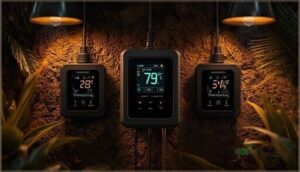
A thermometer alone won’t keep your snake’s environment stable—you need a thermostat to actively regulate heat sources and prevent dangerous temperature swings. Pairing these tools with a hygrometer creates a complete monitoring system, since temperature and humidity work together to support your snake’s respiratory health, shedding cycle, and overall comfort.
Here’s how these three instruments work as a team to maintain the precise conditions your snake needs.
Maintaining Stable Temperatures
You’ll want to pair your thermometer with a thermostat-controlled heating system to lock in those thermal gradients your snake needs for proper thermoregulation. Place digital probes at multiple enclosure points—warm side, cool side, and mid-level—to capture microclimates accurately.
Document daily temperature readings to detect shifts before they compromise your snake’s health, and always validate that your heat mat or ceramic emitter maintains consistent enclosure climate without dangerous spikes.
Monitoring Humidity Alongside Temperature
You’ll need digital hygrometers positioned near basking zones and humid hides to capture humidity gradients that complement your thermostat-controlled heating. Proper humidity management—50–60% for ball pythons, 40–60% for corn snakes—promotes snake hydration, shedding, and respiratory health while microclimate control prevents mold.
Pair humidity sensors with enclosure ventilation checks and temperature and humidity control logs to maintain species-specific ranges year-round.
Choosing The Best Thermometer for Your Setup
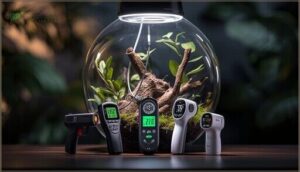
Not all thermometers deliver the same level of precision, durability, or ease of use, so selecting the right model depends on your enclosure design, budget, and monitoring preferences. Some brands consistently outperform others in accuracy and long-term reliability, while certain features—like dual probes, wireless connectivity, or alarm functions—can greatly improve your ability to maintain stable thermal gradients.
Understanding which specifications matter most for your setup ensures you invest in a thermometer that aids your snake’s health without unnecessary complexity or expense.
Recommended Brands and Features
When evaluating thermometer reviews and brand comparison data, you’ll find that AcuRite digital models with remote probes deliver reliable temperature gradient monitoring, while Zoo Med ReptiTemp units offer reptile-specific calibration tips and alert features.
ThermoPro’s infrared options enable quick spot checks without contact, and Extech RHT series products combine hygrometer functions with thermostat-controlled heating compatibility, providing thorough product ratings across diverse feature sets.
Budget Vs. Premium Options
Budget constraints often steer you toward basic digital or analog thermometers priced under $15, which suffice for straightforward setups, though accuracy matters—expect tolerances near ±2 °F and minimal warranty support. Premium features like dual probes, data logging, hygrometer integration, and thermostat-controlled heating compatibility justify higher cost comparisons when managing multiple enclosures or species requiring narrow thermal margins, delivering long-term reliability alongside extended warranties.
- Basic models offer essential temperature readings without data storage or sophisticated calibration.
- Mid-range units add hygrometer functions and external probe placement for gradient mapping.
- Premium systems integrate with heating and lighting systems, providing cloud sync and trend analysis.
How Often to Check and Calibrate Thermometers
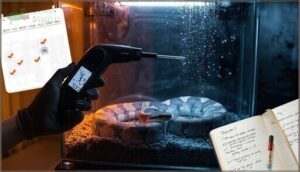
Maintaining accurate temperature readings requires consistent monitoring and periodic calibration to guarantee your snake’s environment remains stable. Daily checks confirm your heating equipment is functioning correctly, while routine calibration verifies your thermometer hasn’t drifted from true readings over time.
Understanding how often to perform these tasks protects your snake from temperature-related health issues and gives you confidence in your husbandry practices.
Frequency of Temperature Checks
Heat fluctuations don’t follow your schedule, so you need to check your thermometer at least twice daily—once in early morning and again in late afternoon—to capture diurnal temperature variations across the gradient.
Daily checks confirm your thermostat-controlled heating and heat mat maintain stability, while temperature logging reveals patterns that protect your snake’s long-term health.
After adjusting equipment, monitor intensively for 1–2 weeks.
Ensuring Long-Term Accuracy
Regular sensor calibration prevents temperature drift that threatens your snake’s welfare, so you’ll need to verify accuracy every 3–6 months using ice-water and boiling-water tests that confirm probe placement isn’t compromising readings. Your calibration frequency should increase if you observe inconsistent data, while pairing your thermometer with accuracy verification through a secondary hygrometer strengthens your humidity management and control alongside thermostat-controlled heating across the temperature gradient.
To ensure the thermometer’s reliability, it’s vital to follow proper calibration methods for accurate temperature readings.
Frequently Asked Questions (FAQs)
Can I use a laser thermometer for snake tanks?
You can use a laser thermometer for supplementary surface readings in your snake habitat, but probe or infrared options with fixed sensors deliver more reliable temperature gradients and thermostat-controlled heating accuracy for consistent monitoring.
Do baby snakes need different temperature monitoring?
Yes, juvenile snakes need more frequent temperature checks to support growth and digestion, as their smaller enclosures experience faster fluctuations.
Monitor basking zones (85–90°F) and thermal gradients daily for ideal hatchling care.
What happens if my thermometer stops working overnight?
If your thermometer fails overnight, temperature drops or spikes may go undetected, disrupting your snake’s gradient and risking stress, digestive issues, or illness.
Backup monitoring and thermostat-controlled heating provide essential emergency protocols.
Should I use multiple thermometers in one enclosure?
Multiple thermometers improve enclosure monitoring by capturing temperature gradients across warm and cool zones, verifying sensor placement accuracy, and providing fail-safe redundancy if one probe malfunctions—especially valuable when paired with thermostat-controlled heating systems.
How do seasonal changes affect tank temperature readings?
Seasonal shifts can dramatically alter your tank’s temperature gradient, as outdoor climate changes influence indoor ambient heat, ventilation effects, and humidity levels—requiring you to recalibrate thermometers and adjust thermostat-controlled heating regularly.
Conclusion
The same precision that guides surgical instruments now belongs in your reptile room—because your snake’s survival hinges on numbers you can’t feel with your hand. A thermometer for snake tank setups isn’t optional equipment; it’s the difference between thriving and merely surviving.
When you measure both basking and retreat zones with calibrated accuracy, you’re not just preventing problems—you’re building the thermal foundation that lets natural behaviors, immune function, and longevity flourish exactly as evolution intended.
- https://www.linkedin.com/posts/bohdanlukianets_tasks-study-research-activity-7373377539521667072-UTEi
- https://www.sciencedirect.com/science/article/pii/S2949916X23000464
- https://arxiv.org/html/2507.17948v2
- https://runtimerec.com/analog-sensor-woes-dealing-with-drift-noise-and-non-linearity
- https://www.exanovomed.com/info/what-can-cause-a-digital-thermometer-to-read-h-102962070.html