This site is supported by our readers. We may earn a commission, at no cost to you, if you purchase through links.
A pinky mouse can weigh 1 gram or nearly 4, and that gap decides whether your hatchling eats comfortably or refuses the meal entirely. Move up the scale and the spread widens: a jumbo rat can weigh 399 grams.
Feeding the wrong size causes real problems. Prey that’s too small leaves your snake underfed, while prey that’s too large risks regurgitation, stress, and lasting damage to your animal’s health.
A reliable frozen rodent size chart removes the guesswork by matching grams to snake weight and body width. Here are the numbers, the girth rule, and the label checks that keep every meal safe.
Table Of Contents
Key Takeaways
- Match each meal to your snake’s actual weight in grams rather than the supplier’s label, since sizes like "fuzzy" or "weaned" vary by brand and a pinky can range from 1 to nearly 4 grams.
- Check girth before every feeding by keeping prey no wider than 1 to 1.5 times your snake’s widest body point (1.25 for ball pythons), and move up only one size at a time after consistent clean meals.
- Weigh a sample from each shipment after patting off the ice glaze, because labeled weights can be off by more than 20%, and switch suppliers if your feeders consistently run light.
- Thaw feeders in a sealed bag in the refrigerator, never refreeze them, and call a reptile vet if your snake regurgitates twice, has a firm bloated belly, or gets prey stuck in its mouth for hours.
Frozen Feeder Mouse Size Chart in Grams
A reliable mouse size chart in grams starts with the smallest feeders and ends with full adults, and every stage sits within a fairly narrow weight band. A frozen pinky weighs roughly 1 to 3.9 grams, depending on whether it’s a small or large pinky. A frozen fuzzy runs about 3 to 7 grams, while a hopper, often sold as frozen weaned or frozen small, lands near 7 to 12 grams.
Matching these weights to the 10% rule is simpler with a corn snake food size guide that pairs prey size with snake weight.
Adults come next. Small adults weigh 13 to 25 grams, standard adults reach 18 to 35 grams, and jumbo mice start at 30 grams.
Suppliers draw these lines differently, so a Layne Labs fuzzy isn’t identical to another brand’s. Always match your snake to actual gram weight, not labels. Weight is only half the picture, since the girth rule for feeding says prey should be roughly 1 to 1.5 times the width of your reptile’s widest body point.
Frozen Feeder Rat Size Chart in Grams

Rats pick up where mice leave off, and the weight bands get much wider. Frozen pinky rats weigh 3 to 12 grams, fuzzies run 10 to 19, and pups land at 20 to 34. Weaned rats reach 35 to 49 grams, and small rats cover 46 to 89.
Most keepers spend their time in the larger sizes, so here’s a quick reference for your frozen feeder rat size chart in grams:
| Feeder | Weight | Snake weight |
|---|---|---|
| Medium rats | 85-149g | 840-1,490g |
| Large rats | 150-279g | 1,490-2,790g |
| Jumbo rats | 280-399g | 2,790-3,990g |
Weights within a label can vary by more than 20%, so weigh each feeder before you thaw it. Good suppliers keep frozen rats within 5% of the labeled weight, so ask about it.
Some keepers skip the guesswork by breeding their own rats for snake food, which gives them control over size before anything goes in the freezer.
How to Choose The Right Feeder Size
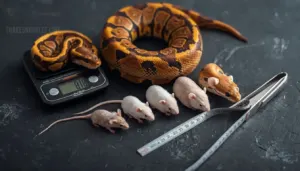
Picking the right feeder comes down to three checks you can run before every meal. We’ll cover your snake’s weight and body condition, how prey girth compares with body width, and why supplier labels shouldn’t be trusted over a scale.
Work through them in order, and you’ll match each snake with a meal it can swallow, digest, and grow from.
Snake Weight and Body Condition
Picture a 450g female ball python that looks lean, with a slightly triangular body and a spine you can see from above.
At 450g, she’s right in the range where checking a ball python weight chart can confirm that her lean build suits her age and size.
Her keeper keeps offering the same medium rat, assuming appetite means she’s fine. She isn’t.
Her snake weight in g and shape both say she needs more, so prey size selection should follow the scale and her body condition, not her enthusiasm.
Comparing Prey Girth With Snake Width
Weight tells you roughly what to offer, but width tells you whether it’ll go down safely. Wrap a flexible tape around your snake’s widest mid-body point, just behind the shoulders, and average three readings to the nearest half millimeter.
Then measure the rodent at its thickest point behind the front legs. Aim for prey about 80% of girth, and never beyond your snake’s widest point.
Checking Supplier Labels Against Actual Weight
Package labels give you a starting point, but a scale gives you the truth. Weigh a few thawed rodents from each new shipment and compare the average against the stated gram range. Pat each one dry first, since leftover ice glaze inflates the number.
Trust the scale over the label: weigh a sample from every shipment, dry off the ice first, and let real numbers guide each meal
If frozen feeder mice or rats consistently run light, switch suppliers or adjust your feeding plan.
Species-Specific Feeder Sizes and Feeding Frequency

Most species follow a simple pattern, but the details change how you feed. Here’s how your snake’s growth stages usually line up with prey:
- Ball pythons: rat pups to medium rats, every 5-7 days as hatchlings and every 10-14 days as adults.
- Corn snakes: pinky mice (2-5g) up to adult mice (20-30g), every 5-7 days when young.
- Boas: mice first, then medium or large rats, every 7-10 days as subadults.
- King snakes and hognose snakes: mice sized to girth, every 5-7 days for juveniles.
Some hognose snakes need scenting before they’ll take frozen/thawed prey, so keep a backup plan ready. Match each meal to your snake’s midbody, then adjust as it grows. Keep this chart handy and feed with confidence.
Feeder Sizing Mistakes and Veterinary Warning Signs

Even careful keepers misjudge prey size now and then, and the consequences range from a skipped meal to a medical problem.
Below, you’ll find the two areas that matter most: oversized meals and early upgrades, and the signs that mean it’s time to call a reptile vet.
Knowing both helps you feed with confidence and step in before a small error becomes a serious one.
Avoiding Oversized Meals and Premature Upgrades
Most feeding trouble starts with good intentions. You see a healthy snake, an empty bowl and a bigger rodent in the freezer, and you jump ahead.
Don’t. Keep prey no wider than 1.5 times your snake’s girth, or 1.25 for ball pythons, and move up one size category at a time, only after consistent clean meals. When in doubt, go smaller.
When to Contact a Reptile Vet
Say you feed your ball python a medium frozen-thawed rat on Saturday, and by Monday it’s brought the meal back up. Don’t just wait and retry.
Regurgitation twice, a firm bloated belly, or a prey item stuck in the mouth for several hours all call for a vet. Same-day care applies to labored breathing or a lopsided jaw.
Frequently Asked Questions (FAQs)
What is the safest way to thaw frozen feeders?
Thaw frozen feeder mice or rats in a sealed, leak-proof bag in your refrigerator at 32–40°F. Hopper mice need 6–12 hours, while larger rats take 24– Use them within 24 hours, and never refreeze them.
How long can frozen rodents be stored in the freezer?
Your freezer works like a slow clock, quietly ticking against quality. Sealed frozen feeder mice and rats hold well for 6 to 12 months at 0°F (-18°C), though door-opening kitchen freezers shorten that safe window.
Can I refreeze thawed rodents safely?
Say you thawed three mice but your corn snake only ate two. Don’t refreeze the third. Bacteria multiply once it thaws, and freezing won’t kill them, so discard it.
Thaw only what you’ll feed today.
How should leftover uneaten prey be handled?
Pull uneaten thawed prey within one to two hours, and live prey within 20 to 30 minutes. Double-bag it, bin it outdoors, never refreeze it, then wash your hands and sanitize your tongs.
Are frozen rodents as nutritious as live prey?
In one study, snakes fed frozen-thawed prey showed no measurable growth difference from live-fed snakes. Yes, frozen feeder mice and rats match live prey nutritionally when stored properly, and they’re safer for your snake.
Do different snake species prefer different prey?
Snakes share a reputation for being simple eaters, yet your ball python will ignore a perfectly good rat. Ball pythons favor mice, corn snakes accept both, and king snakes strike almost anything, including other snakes.
Conclusion
A gap of just 3 grams can separate a pinky your hatchling swallows easily from one it refuses. That’s why a dependable frozen rodent size chart belongs next to your freezer. Match prey weight to your snake’s body, check that the meal is no wider than the thickest part of its body, and confirm every label against a scale.
Get those three checks right and feeding becomes calm, predictable, and safe. Stock accurately weighed feeders.