This site is supported by our readers. We may earn a commission, at no cost to you, if you purchase through links.

A ball python stares at the adult rat you’ve dropped into its enclosure, flicks its tongue twice, then retreats to the opposite corner. You’ve just witnessed gape limitation in action—your snake’s hardwired biological programming that overrides hunger when prey exceeds safe swallowing diameter.
Unlike the myth that snakes can unhinge their jaws to eat anything, ligament flexibility and jaw anatomy set hard physical limits that determine which meals your snake can safely consume.
When a snake refuses oversized prey, it’s not being picky or stubborn. It’s making a survival calculation based on esophageal diameter, digestive capacity, and the very real risk of regurgitation or intestinal obstruction. Understanding these refusals means recognizing the difference between appropriate feeding challenges and dangerous miscalculations that trigger life-threatening health crises.
Table Of Contents
Key Takeaways
- Snakes refuse oversized prey through hardwired survival instincts that detect when meals exceed their gape limitation of 1.5–2 times head width, preventing regurgitation, impaction, and potentially fatal digestive blockages.
- Offering prey exceeding 90% of your snake’s midbody diameter triggers life-threatening complications including regurgitation within 12–48 hours, intestinal obstruction requiring surgery, and aspiration pneumonia from forced feeding attempts.
- Match prey diameter to 70–90% of your snake’s trunk measurement and advance only one size category every 4–6 successful feedings, documenting each response to identify your individual snake’s tolerance thresholds.
- Feeding refusals signal biological wisdom rather than stubbornness—your snake is calculating survival risks that you can’t override, making precise prey sizing the difference between healthy feeding and medical emergencies within 48–72 hours.
Why Snakes Refuse Oversized Prey
Snakes aren’t being difficult when they refuse prey—they’re responding to hardwired survival instincts that have kept their species alive for millions of years. Your snake evaluates every meal through a lens of risk versus reward, and oversized prey triggers warning signals that override hunger.
Snakes refuse oversized prey not out of stubbornness, but because millions of years of evolution taught them that the wrong meal can kill
Understanding these three core reasons behind refusal gives you the insight to feed smarter, not harder.
Natural Feeding Behaviors
Snakes rely on prey detection methods like thermal sensing and visual cues to initiate feeding sequences. You’ll notice patterns progressing from detection to strike, constriction, and ingestion. Feeding refusal often signals mismatched prey size—your snake instinctively avoids meals exceeding its anatomical capacity. Natural snake behavior prioritizes successful handling over forced consumption, protecting digestive efficiency. Researchers utilize scientific study summaries to better understand animal behavior and decision-making processes.
Key natural feeding behaviors include: Snakes may also refuse food when they’re stressed from excessive handling, which disrupts their natural feeding rhythm and comfort level.
- Thermal sensing locates warm-blooded prey during nocturnal hunting
- Strike sequences trigger through movement and visual detection
- Digestion rate factors depend on ambient temperature and prey composition
- Foraging strategy types vary between species and maturity levels
- Post-feeding resting states extend several days after large meals
Gape Limitation and Physical Constraints
Your snake’s mouth opens wider than you’d think—but jaw anatomy sets hard limits. Most species handle prey up to 1.5–2 times their head width, depending on gape mechanics and ligament flexibility. If your snake refuses appropriately sized meals, strategies to safely boost their appetite can help restore feeding without forcing oversized prey.
Exceeding this threshold triggers regurgitation because esophageal tissue can’t accommodate oversized prey diameter. Digestive constraints kick in when prey size disrupts normal swallowing sequences.
Measure girth carefully—feeding physiology demands precision in prey selection. Start with prey roughly the width of your snake’s body at its thickest point, then learn how to adjust prey size safely as growth progresses.
Stress and Safety Considerations
Beyond anatomical limits, stress determines feeding success. When you offer oversized prey, your snake’s heart rate spikes and erratic movements follow—direct responses to perceived danger during feeding refusal. Maintaining a consistent feeding schedule for baby snakes helps reduce stress triggers that lead to refusal behaviors.
- Elevated stress reduces feeding success across multiple species
- Safe handling protocols prevent defensive bites during sessions
- Stable temperature and humidity gradients support normal digestion issues prevention
Chronic stress signals warrant veterinary assessment for snake health and welfare.
Risks of Offering Prey That’s Too Large

Offering prey that’s too large isn’t just a feeding mistake—it’s a direct threat to your snake’s health and survival. Understanding these specific risks helps you avoid preventable injuries and medical emergencies. If you’re unsure whether a feeder is appropriate, guidance on choosing the correct feeder size can help you match prey dimensions to your snake’s body safely.
Oversized meals trigger a cascade of physiological complications, from immediate digestive distress to life-threatening blockages.
Regurgitation and Digestive Issues
Regurgitation strikes when your snake swallows prey exceeding its distensible capacity—a common digestive health crisis in both constrictors and venomous species. This feeding disorder triggers acute gastric stress, forcing the meal back up within 12-48 hours.
Chronic regurgitation from repeated prey size miscalculations causes dehydration, weight loss, and poor body condition. If you witness multiple episodes alongside lethargy, veterinary evaluation becomes non-negotiable to rule out obstructive gastric issues threatening snake health.
Impaction and Health Hazards
Gut obstruction ranks among the deadliest feeding complications when prey exceeds digestive capacity. Impaction risks escalate with oversized meals—you’re gambling with snake mortality each time prey diameter surpasses 1.5x body girth.
- Abdominal distension signals blockage 7-21 days post-feeding
- Absent fecal output indicates complete intestinal obstruction
- Progressive lethargy warns of systemic failure requiring surgical intervention
Prevention beats treatment—always match prey size to snake dimensions.
Injury Risks During Feeding
Oversized prey turns feeding time into a battlefield. Tooth breakage occurs when snakes struggle with prey diameter exceeding their gape width, while mucosal lacerations follow forced jaw distension.
Regurgitation within 24-72 hours introduces aspiration pneumonia risk—respiratory complications that demand immediate veterinary intervention. You’re not just risking digestive issues; you’re inviting trauma that compromises your snake’s entire feeding apparatus permanently.
Signs Your Snake is Refusing Oversized Prey

Your snake won’t always broadcast its discomfort in obvious ways. Recognizing refusal behaviors requires careful observation of both physical symptoms and behavioral shifts that emerge before, during, and after feeding attempts.
These warning signs reveal whether you’ve misjudged prey size—giving you the power to correct course before serious health complications develop.
Behavioral Cues Before and After Feeding
Your snake’s feeding posture reveals everything. Watch for increased tongue flicking and jaw stretching—these prey assessment behaviors signal sensory evaluation before striking.
Hesitation during regular feeding attempts indicates environmental adaptation issues or unsuitable prey size. Post-feeding, expect 24–48 hours of temporary lethargy as normal digestion cues.
Prolonged refusal paired with defensive coiling? That’s your snake’s temperament communicating stress, not hunger—and oversized prey often triggers this exact snake behavior pattern leading to feeding refusal.
Physical Symptoms of Discomfort
Lethargy after attempted meals signals digestive problems—your snake’s body can’t handle oversized prey.
Watch for mouth-breathing, hissing, and dilated pupils indicating snake stress and discomfort signs. Regurgitation represents the most severe feeding issue, often causing dehydration.
Prolonged refusal behaviors paired with body tension near the jaws? That’s impaction risk. These digestive health warnings demand immediate prey size adjustment to prevent serious complications.
Changes in Feeding Response Patterns
Feeding latency spikes when your snake hesitates before striking—this prolonged prey assessment indicates borderline prey size acceptance. You’ll notice increased tongue-flicking as your snake evaluates whether ingestion is possible.
After consuming oversized meals, extended digestion pauses reflect metabolic shifts requiring more energy. Younger snakes show tighter thresholds for acceptable prey dimensions.
These feeding cues signal that regurgitation and digestion issues are imminent without immediate prey size correction.
How to Choose The Right Prey Size
Selecting the right prey size isn’t guesswork—it’s a precise calculation based on your snake’s body measurements and growth stage. Getting this wrong invites regurgitation, impaction, or outright refusal, so you need a reliable method that works every single time.
Here’s how to match prey to your snake’s actual needs, shift sizes safely, and account for the unique requirements of different species and ages.
Measuring Girth and Matching Prey

Accurate girth measurement controls feeding success. Use a flexible measuring tape around your snake’s midbody—the widest trunk section—then convert the circumference to diameter (circumference ÷ 3.14).
Maintain prey diameter at 70 to 90 percent of the trunk diameter for ideal swallowing. Hatchlings tolerate 60 to 80 percent ratios.
Exceeding 90 percent dramatically increases the risk of regurgitation and stress during snake feeding.
Gradual Prey Size Transition

Once you’ve nailed girth measurement, it’s time to bump up prey size—but don’t rush it. Snakes thrive on incremental shifts that honor their digestion patterns and growth rates.
- Advance one mouse size category every 4 to 6 feedings to allow physiological adjustment without shocking the system.
- Monitor acceptance rates at each new prey diameter before pushing further.
- Keep feeding frequency stable during transitions—don’t change meal size and schedule simultaneously.
- Document each feeding’s prey diameter and your snake’s response to identify tolerance thresholds.
- Pause size increases if regurgitation or refusal occurs, reverting to the previous prey size for 2 to 3 cycles.
Gradual prey size adjustment prevents digestive rebellion and maintains consistent feeding guidelines throughout your snake’s growth trajectory.
Species and Age-Specific Guidelines
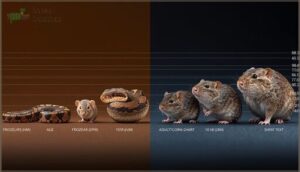
Prey size tolerance shifts dramatically between species and life stages. Ball python hatchlings accept prey equal to 80–100% of midbody girth every 5–7 days, while adult colubrids may tolerate slightly larger meals less frequently.
Growth rates dictate when you advance prey categories—juveniles doubling body mass every 8 weeks signal readiness for the next size.
Feeding charts customized to your snake’s species prevent both underfeeding and dangerous overreach.
Solutions for Feeding Refusals Due to Prey Size

Feeding refusals don’t have to spiral into full-blown health crises if you act quickly and systematically. The solution starts with downsizing prey immediately, then addressing every environmental factor that might be sabotaging your snake’s feeding response.
Here’s your three-part action plan for getting your snake back on track.
Adjusting Prey Size and Feeding Frequency
Start with prey diameter no larger than 20% of your snake’s girth to prevent digestion issues.
Hatchlings need meals every 5–7 days, juveniles every 7–14 days, and adults every 10–14 days, depending on species.
Feeding schedules can shift based on environmental conditions, so understanding reticulated python natural habitat and behavior helps owners replicate the cues that regulate appetite in the wild.
For a front-opening enclosure with proper burrowing depth, this tricolor hognose snake care sheet breaks down feeding schedules and substrate setup by life stage.
Increase prey size gradually—10–15% increments over several successful feedings. Monitor growth and adjust feeding schedules accordingly, skipping meals during shedding cycles when refusal is natural.
Creating a Stress-Free Feeding Environment
Beyond prey size, environmental control directly impacts feeding refusal. Maintain enclosure temperatures between 78–88°F during feeding schedules to support digestion.
Minimize handling 48 hours before and after meals—stress reduction matters. Dim lighting and quiet surroundings create a stress-free feeding environment that respects snake temperament.
Consistent routines eliminate anxiety triggers, helping your snake accept appropriately sized prey without hesitation.
Monitoring Health and When to Seek Help
Vigilance separates responsible keepers from those who miss critical health issues.
Track your snake’s weight monthly using a precise scale, noting fluctuations beyond 10%. Maintain a feeding diary documenting prey size, refusals, and digestion problems.
Emergency signs—persistent regurgitation, labored breathing, or sudden weight loss—demand immediate veterinary care. Regular health checks reveal patterns that prevent minor feeding refusal from becoming life-threatening snake health crises requiring expert intervention.
Frequently Asked Questions (FAQs)
Can snakes learn to accept larger prey over time?
Some snakes show temporary willingness to attempt larger prey after gradual conditioning, but jaw mechanics and digestive capacity create hard limits.
Individual temperament matters more than learning—growth patterns determine safe feeding adaptation.
Do wild snakes refuse oversized prey as often?
In nature’s arena, prey selection isn’t random—wild snakes consistently choose meals matching their gape size.
Field observations confirm they pause, retreat, or switch to smaller prey when confronted with oversized options, avoiding risky captures.
How does temperature affect prey size acceptance?
Temperature gradients directly shape metabolic rates and digestive enzyme activity in ectothermic snakes. Warmer conditions boost gut motility, widening prey size acceptance, while cooler temperatures slow digestion and trigger more selective feeding behaviors.
Because prey must pass through the snake’s widest midbody region, temperature-driven digestive changes can influence safe meal size.
Should I switch to multiple smaller prey items?
Think of feeding like portion control—multiple smaller prey items reduce regurgitation risk, align with natural snake feeding guidelines, and support digestive health through better meal portioning while maintaining proper prey size adjustment and nutrition.
What prey alternatives exist beyond rodents for snakes?
You can offer bird prey like chicks and quail, fish diets for aquatic species, amphibian foods including frogs, invertebrate options such as earthworms, or reptile eggs—each matching your snake’s natural feeding biology and nutritional requirements.
Providing a diverse diet with snake food sources can help guarantee your snake receives a balanced nutrient intake.
Conclusion
What’s more dangerous than a hungry snake? A keeper who ignores the warning signs. When your snake refuses oversized prey, it’s protecting itself from regurgitation, impaction, and respiratory distress that could prove fatal within 48–72 hours.
Match prey to girth measurements, shift sizes gradually over 4–6 weeks, and recognize refusal for what it is—biological wisdom you can’t override. Your snake’s survival depends on respecting those physical limits, not testing them.