This site is supported by our readers. We may earn a commission, at no cost to you, if you purchase through links.
Your bearded dragon’s skin hangs in stubborn patches during shedding, your ball python develops cloudy eyes that won’t clear, or your crested gecko suddenly stops eating—these aren’t random health issues, but direct consequences of humidity levels you can’t even see. While most reptile keepers obsess over temperatures and UVB lighting (which matter considerably), humidity silently determines whether your ectothermic companion thrives or struggles with chronic respiratory infections, dysecdysis, and compromised kidney function that shortens their lifespan by years.
Desert species like leopard geckos require dramatically different moisture environments (20-30% relative humidity) compared to tropical chameleons (60-80%), yet many enclosures maintain arbitrary humidity levels that fall somewhere uselessly in between, creating physiological stress that compounds over months. Understanding why humidity matters for reptiles means recognizing that moisture isn’t just about comfort—it’s the invisible environmental factor that controls respiratory health, successful ecdysis cycles, proper hydration status, and ultimately determines whether your careful husbandry produces a thriving animal or one that merely survives.
Table Of Contents
- Key Takeaways
- Why Humidity Matters for Reptiles
- How Humidity Affects Reptile Health
- Determining Species-Specific Humidity Needs
- Measuring and Controlling Humidity in Enclosures
- Advanced Humidity Management Strategies
- Frequently Asked Questions (FAQs)
- Why do reptiles need humidity?
- Is 50% humidity ok for ball python?
- What happens if the humidity is too low?
- Can I use tap water for misting?
- How often should I calibrate my hygrometer?
- Do baby reptiles need different humidity levels?
- What causes white residue on enclosure glass?
- Should I adjust humidity during brumation periods?
- Conclusion
Key Takeaways
- Humidity directly controls three critical physiological systems in reptiles: respiratory function through mucociliary clearance, successful ecdysis by maintaining skin elasticity and preventing dysecdysis, and renal health by regulating fluid balance and preventing kidney stone formation through proper hydration.
- Species-specific humidity requirements vary dramatically based on evolutionary origins, with desert reptiles like bearded dragons requiring 20-30% relative humidity while tropical species such as green tree pythons need 60-80%, making precision environmental control non-negotiable rather than optional for responsible husbandry.
- Incorrect humidity levels trigger cascading health consequences including incomplete shedding with retained eye caps, chronic respiratory infections from disrupted mucus viscosity, and long-term kidney dysfunction from concentrated metabolic wastes that crystallize into renal calculi when filtration pathways can’t maintain proper dilution.
- Advanced humidity management combines digital hygrometers positioned at mid-height for accurate monitoring, automated misting systems that maintain target levels within ±3%, and strategic enclosure design creating humidity gradients through substrate layering and vertical zoning that mirror natural habitat microclimates.
Why Humidity Matters for Reptiles
You can’t simply set up a terrarium and hope your reptile thrives—humidity levels directly control whether your pet’s respiratory system functions properly, whether shedding occurs without complications, and whether long-term organ health remains intact.
Humidity levels directly control your reptile’s respiratory function, shedding success, and long-term organ health
Species-specific requirements range dramatically, from the arid 20-30% relative humidity that bearded dragons require to the tropical 70-80% levels that green tree pythons need for survival, making accurate environmental management non-negotiable rather than optional.
Choosing the right substrate plays a crucial role in maintaining these humidity levels, especially for species requiring moisture-retentive materials like reptile substrates designed for humid environments.
Understanding why these moisture parameters matter physiologically will help you recognize the critical differences between desert-adapted and rainforest-dwelling species, identify the serious health consequences that arise from incorrect humidity levels, and implement the precise environmental controls your reptile’s biology demands.
The Role of Humidity in Reptile Habitats
In reptile habitat creation, humidity control acts as a fundamental environmental parameter alongside temperature and lighting, directly influencing thermoregulation, metabolic efficiency, and behavioral patterns such as basking site selection and retreat use.
Proper humidity levels establish environmental gradients that allow your reptile to move through distinct moisture cycles within a single enclosure, mimicking the microclimates found in natural habitats and supporting species-specific humidity requirements essential for physiological homeostasis.
Using tools such as digital thermometers and hygrometers can guarantee accurate measurement of these critical conditions.
Differences Between Desert and Tropical Species
Species comparison reveals striking climate variations that dictate humidity requirements: desert dwellers such as bearded dragons thrive in humidity levels below 25 percent with thick, water-conserving skin and nocturnal activity patterns that minimize moisture loss, while tropical species like green tree pythons demand 60 to 90 percent humidity with thinner skin facilitating moisture exchange, frequent drinking behavior, and continuous access to ambient moisture for respiratory health and thermoregulation.
Notably, both desert and tropical reptiles have evolved specialized adaptations for survival despite their vastly different habitats.
Consequences of Incorrect Humidity Levels
When humidity levels drift outside species-appropriate ranges, you’ll witness cascading health consequences that compromise respiratory health, trigger incomplete shedding with retained eye caps in geckos and box turtles, increase dehydration risk through increased respiratory water loss, and promote microbial growth of mold and fungal allergens that irritate airways.
Collectively demonstrating why precision humidity control isn’t optional but fundamental to reptile health.
How Humidity Affects Reptile Health
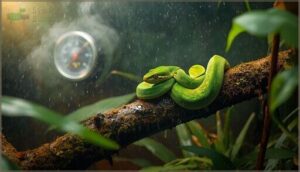
When you maintain proper humidity levels in your reptile’s enclosure, you’re supporting fundamental physiological processes that directly determine whether your animal thrives or merely survives.
Incorrect humidity levels doesn’t just cause minor discomfort—it triggers cascading health problems affecting your reptile’s integumentary system, respiratory function, and internal organ efficiency. Understanding these three critical pathways will help you recognize why precision control isn’t optional but essential for responsible reptile husbandry.
Getting started with proper monitoring is easier than you think—accurate reptile humidity gauges for beginners remove the guesswork and give you confidence in maintaining those critical environmental parameters.
Impact on Shedding and Skin Health
Your reptile’s ability to shed smoothly hinges on one critical environmental factor: moisture in the air, which directly influences skin hydration and scale health throughout the shedding process (ecdysis). Proper humidity control facilitates efficient shedding techniques by maintaining skin elasticity and preventing dysecdysis, or incomplete shedding, which can compromise overall reptile health and reptile dermatology.
Consider these humidity cycles effects:
- Adequate moisture (species-dependent, usually 50–80% for tropical species) keeps shed sheets pliable, reducing tearing and retention around toes, eyes, and tail tips
- Low humidity increases skin flaking and creates tight, crusty shed that traps old layers against new skin, elevating infection risk and delaying normal turnover
- Excess humidity with poor ventilation promotes fungal dermatitis on damp substrates, complicating cleanup and skin barrier integrity during active shedding periods
Balanced humidity maintains the lipid-rich skin surface and natural oils essential for flexible, complete sloughing, ensuring your reptile’s integument remains smooth, uniformly pigmented, and free from microcracks that invite bacterial or fungal invasion.
Respiratory System and Infection Risk
Respiratory health in your reptile depends on mucociliary function, which dry air severely disrupts by slowing cilia movement and reducing the airway’s ability to clear trapped pathogens.
Proper humidity therapy (matching species-specific targets through thoughtful humidity control and management) promotes normal mucus viscosity and barrier defense, while chronic imbalance in your reptile enclosure management increases infection risk, stress, and susceptibility to pneumonia and bronchitis.
Hydration and Kidney Function
Your reptile’s physiological equilibrium hinges on fluid balance, which environmental moisture directly influences through cutaneous absorption and evaporative losses that affect kidney filtration rates, urine concentration mechanisms, vasopressin regulation pathways, and electrolyte management systems critical to overall reptile health and wellness.
- Inadequate humidity control and management elevates urine osmolality, concentrating metabolic wastes and mineral solutes that crystallize into renal calculi (stones) when filtration pathways can’t maintain proper dilution.
- Chronic dehydration from low enclosure moisture triggers prolonged vasopressin release, which reabsorbs water aggressively in collecting ducts, reducing urine volume and potentially impairing long-term kidney function in susceptible individuals.
- Species-specific humidity needs determine cutaneous water uptake efficiency, with tropical taxa absorbing environmental moisture through permeable skin to supplement oral intake and maintain hydration homeostasis.
- Proper reptile care and husbandry recognizes that electrolyte management depends on adequate moisture availability, as insufficient environmental water drives physiological stress responses that compromise renal health over time.
Determining Species-Specific Humidity Needs
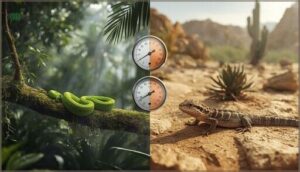
Before you can control humidity effectively, you need to know exactly what your reptile requires, and that starts with understanding where it comes from in the wild. Different species evolved in vastly different climates, meaning a ball python’s needs will look nothing like a bearded dragon’s, and getting this wrong can compromise everything from shedding to respiratory health.
Let’s break down how to determine the right humidity levels for your specific reptile and translate that knowledge into practical enclosure management.
Researching Native Environments
Understanding your reptile’s native habitat forms the cornerstone for precise environmental control, guiding you toward species-appropriate humidity levels that mirror the climate data, terrain types, and seasonal rainfall cycles of the region where your animal evolved.
Species research into ecosystem dynamics, including vegetation cover, soil moisture, and elevation-dependent microclimates, informs conservation efforts and reveals the environmental adaptation strategies necessary for captive success.
Typical Humidity Ranges for Popular Reptiles
Your pet’s ideal climate zone varies dramatically based on its evolutionary origins, with tropical species demanding 60 to 80 percent relative humidity while desert dwellers thrive near 20 to 40 percent—a difference that makes species research and humidity sensors critical for environmental control and ideal reptile hydration.
The ideal humidity levels for different species are as follows:
- Tropical lizards (green iguanas, chameleons): Maintain 70 to 90 percent humidity to prevent respiratory distress and skin drying
- Desert reptiles (bearded dragons, leopard geckos): Target 20 to 40 percent with occasional damp zones supporting hydration
- Semi-arboreal species (crested geckos): Create gradients from 40 to 70 percent across vertical zones
- Aquatic turtles: Sustain 70 to 85 percent near basking areas for shell and respiratory health
- Temperate snakes (corn snakes, ball pythons): Balance 40 to 60 percent to perfect shedding and kidney function
Adapting Care to Your Reptile’s Requirements
Once your species research confirms target humidity levels, you’ll translate those numbers into habitat design by selecting substrate materials that either retain or shed moisture, positioning water sources to influence local humidity gradients, and integrating environmental enrichment elements like live plants or misting zones that support natural reptile behavior while maintaining precise humidity control essential for ideal reptile health and nutrition.
Measuring and Controlling Humidity in Enclosures
Once you’ve identified your reptile’s specific humidity requirements, the next challenge lies in accurately measuring and maintaining those levels within the enclosure, which requires both the right instruments and strategic environmental modifications.
Digital hygrometers provide the precision necessary for monitoring relative humidity (with accuracy usually within ±1-2%), but their placement, calibration, and the methods you employ to adjust moisture levels will determine your success in creating ideal conditions.
Understanding how to measure current humidity, implement adjustments through various techniques, and establish beneficial gradients within the habitat will enable you to provide your reptile with the environmental control essential for thermoregulation, proper ecdysis (shedding), and overall physiological function.
Choosing and Placing Hygrometers

Accurate humidity monitoring begins with selecting digital hygrometers that deliver ±1-2% probe accuracy and undergo monthly hygrometer calibration using salt tests or commercial kits to maintain sensor reliability.
You’ll want to position your sensor at mid-height in a central location representing typical airflow, avoiding direct heat sources, water dishes, or misting zones that produce artificially skewed readings, ensuring proper sensor placement for consistent humidity control and effective reptile humidity control across varying humidity levels.
Methods for Raising or Lowering Humidity
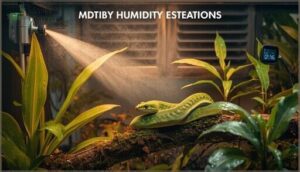
Once hygrometer calibration confirms your humidity sensors are delivering accurate readings, you can adjust humidity levels through targeted interventions that raise or lower moisture: misting systems combined with misting timers deliver scheduled humidification for tropical species requiring 60-80% relative humidity.
While improved ventilation control using exhaust fans or adjustable vents reduces moisture accumulation in desert-dwelling reptile enclosures, and fogging systems provide fine-particle moisture distribution that promotes respiratory health without saturating substrate surfaces.
Creating Humidity Gradients and Microclimates
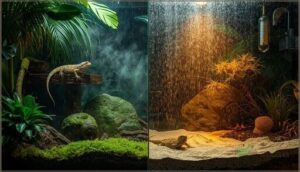
Beyond basic moisture control, microclimate design lets you establish a humidity gradient that mirrors your reptile’s natural habitat by creating distinct zones within the enclosure. Effective enclosure zoning pairs thermal mapping with strategic moisture control, offering your animal physiological choices that promote natural behavior and improve metabolic function.
Five Key Techniques for Humidity Gradient Creation:
- Position basking spots 3 to 5 inches from heat sources to drive localized humidity increases near warmer areas, establishing a predictable thermal-moisture relationship.
- Install vertical shelves to generate height-based humidity differences, with elevated microclimates capturing rising warm air and retaining higher moisture concentrations.
- Layer moisture-retentive substrates like coco coir or sphagnum moss within 2 to 4 inches of the surface on the humid side, while maintaining shallower, drier substrate elsewhere.
- Integrate shallow water features near cooler zones to sustain localized humidity plumes without saturating the entire enclosure, preventing respiratory stress from excessive ambient moisture.
- Arrange dense foliage along enclosure perimeters to increase transpiration and raise near-surface humidity levels by several percentage points through natural plant respiration.
Advanced Humidity Management Strategies
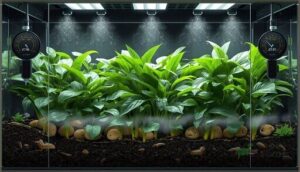
Once you’ve mastered basic humidity control with hygrometers and manual misting, you can explore more complex approaches that reduce daily maintenance while improving environmental stability for your reptiles.
Experienced keepers often integrate automated systems, account for seasonal variation in their husbandry protocols, and leverage bioactive enclosure designs that self-regulate moisture through living soil ecosystems. The following strategies represent the cutting edge of reptile environmental management, each offering distinct advantages depending on your species’ requirements, your available space, and your commitment to replicating natural habitat conditions.
Automated and Smart Humidity Systems
You’ll find that Smart Sensors and IoT Integration now power Humidity Controllers that deliver precision climate control without constant manual intervention, maintaining target relative humidity within ±3 percent through Automated Misting systems and intelligent dehumidification cycles that respond to real-time enclosure conditions, while Humidity Monitoring and Adjustment via mobile apps provides remote oversight and Climate Modeling capabilities that anticipate your reptile’s environmental needs before stress signals emerge.
| Feature | Benefit for Reptile Keepers |
|---|---|
| WiFi-enabled Smart Controls | Remote monitoring and instant adjustments from anywhere |
| Automated Systems with scheduling | Simulates natural day-night humidity cycles automatically |
| Multi-sensor integration | Coordinates temperature and humidity for unified climate management |
| Historical data logging | Identifies patterns and optimizes long-term Reptile Humidity Control |
| Energy-efficient operation | Reduces humidification costs by up to 30 percent through intelligent cycling |
Seasonal Adjustments and Environmental Changes
While Smart Sensors handle daily automation, Seasonal Shifts demand your vigilant eye on Humidity Fluctuations as winter’s low ambient moisture and summer’s high heat alter Humidity Levels inside your enclosure, requiring Environmental Adaptation through adjusted misting cycles, recalibrated ventilation openings, and modified substrate moisture that enables Thermal Cycling while maintaining species-appropriate Microclimate Management through strategic Seasonal Humidity Management and proactive Environmental Control Systems.
- Recalibrate humidifier output before dry winter months to counteract furnace-driven air desiccation
- Reduce ventilation during humid summer periods to prevent mold while sustaining target relative humidity
- Monitor temperature-humidity coupling as cooler nights increase condensation risk and affect shedding cycles
Bioactive Enclosures and Natural Moisture Cycling
Bioactive Substrates utilize living soil communities to automate Moisture Cycling through microfauna-driven decomposition, plant transpiration, and layered drainage systems that create self-regulating humidity control within your naturalistic terrarium design, establishing stable Microclimate Creation through strategic Enclosure Design.
Where springtails and isopods process waste while releasing moisture, dense foliage buffers evaporation rates, and substrate depth gradients provide variable humidity levels that support thorough Microfauna Management and precise moisture management for ideal reptile humidity.
| Bioactive Component | Humidity Function |
|---|---|
| Live plants | Release water vapor through transpiration and buffer rapid fluctuations |
| Microfauna (springtails, isopods) | Break down waste while releasing moisture through decomposition cycles |
| Layered substrate | Provides capillary action and depth-variable moisture zones for gradient control |
Frequently Asked Questions (FAQs)
Why do reptiles need humidity?
You might think reptiles, being cold-blooded, care only about heat—but humidity control actually determines whether your reptile sheds cleanly, breathes easily, stays hydrated, and thrives through proper moisture regulation and environmental adaptation.
Is 50% humidity ok for ball python?
A 50 percent humidity level sits at the lower acceptable boundary for ball python care, supporting basic respiratory health and enclosure management.
Though you should increase it toward 60 percent during shedding cycles to prevent dysecdysis and improve snake shedding success.
What happens if the humidity is too low?
When humidity drops too low, your reptile faces dehydration risks, shedding difficulties stemming from dry skin adhering to itself.
Respiratory issues, including nasal passage irritation, and potential eye irritations that compromise overall health and comfort.
Can I use tap water for misting?
You can use tap water, but minerals will leave white deposits on glass and clog misting systems over time, while chlorine risks irritating mucous membranes.
So, distilled or filtered water alternatives safeguard reptile health and equipment longevity.
How often should I calibrate my hygrometer?
Like checking your smoke detector, annual calibration keeps your hygrometer trustworthy for reptile humidity control, though sensor accuracy demands six-month intervals if environmental monitoring involves rough handling or extreme conditions affecting device maintenance.
Do baby reptiles need different humidity levels?
Baby reptiles often require slightly elevated humidity levels compared to adults because developing organs and frequent shedding cycles make hatchlings more vulnerable to dehydration, respiratory stress, and incomplete ecdysis during critical juvenile development phases.
What causes white residue on enclosure glass?
White residue on enclosure glass usually results from mineral buildup caused by hard water evaporation, soap residue from cleaning, biofilm formation mixing with minerals, glass scratches trapping deposits, or condensation deposits concentrating along humid surfaces requiring improved ventilation.
Should I adjust humidity during brumation periods?
Yes, you should adjust humidity levels during brumation—desert species usually need 20 to 40 percent humidity, while tropical species tolerate 40 to 60 percent, with gradual transitions preventing respiratory stress and dehydration throughout the cooling period.
Conclusion
Your reptile’s next shed, its respiratory resilience through winter months, and its long-term renal health all hinge on decisions you’re making today about moisture management—decisions that either compound into thriving vitality or accumulate as subclinical stress that erodes lifespan.
Why humidity matters for reptiles becomes undeniably clear when you recognize that this single environmental parameter influences more physiological systems simultaneously than any other husbandry factor you control, making precision in moisture regulation non-negotiable for responsible herpetoculture.