This site is supported by our readers. We may earn a commission, at no cost to you, if you purchase through links.
A ball python with a soft, rubbery jaw isn’t being picky. It’s running out of calcium, and the bulb above its tank is usually the culprit.
Snakes need UVB to make vitamin D3, and without D3, calcium passes through the gut unused. Within months, metabolic bone disease sets in: kinked spines, stunted growth, jaws that bend. Corn snakes want UVI 2.0 to 3.0 at the basking spot, while boas need 0 to 0.7. Guess wrong, and your snake pays.
This snake terrarium lighting guide shows you how to match UVB output, heat, and timers to your species, so every light you buy earns its place.
Table Of Contents
- Key Takeaways
- Identify Your Snake’s Lighting and UVB Needs
- Choose Suitable Terrarium Lights and Heating Equipment
- Position Lights, Basking Zones, and Shaded Hides
- Set Daylight Timers and Nighttime Heating Controls
- Monitor Temperatures, Measure UVB, and Replace Bulbs
- Frequently Asked Questions (FAQs)
- Are snakes ok with LED lights?
- Should you turn the heating lamp off for a snake enclosure at night?
- What is the best lighting for snakes?
- How many lights do I need for my snake?
- What lights do I need for a snake enclosure?
- How many hours of light do snakes need?
- Should I turn my snakes heat mat off at night?
- What wattage should my snake light be?
- Can colored lights harm my snakes vision?
- Do snakes need moonlight simulation at night?
- Conclusion
Key Takeaways
- Without UVB, your snake can’t make vitamin D3 or absorb calcium, and within months that can lead to metabolic bone disease with soft jaws, kinked spines, and stunted growth.
- You’ve got to match the UVB level to your species, since corn snakes want a UVI of 2.0 to 3.0 at the basking spot while boas need only 0 to 0.7, and light intensity drops fast with distance, so measure it with a Solarmeter.
- You should build a single warm basking zone with UVB and heat together, keep the far end cool and dark, run a 12-hour on/off timer, and use a thermostat-controlled ceramic heater instead of any glowing bulb at night.
- You can’t judge a UVB bulb by how bright it looks, because output fades long before it burns out, so replace your tubes every 6 to 12 months and check your temperatures and UVI regularly.
Identify Your Snake’s Lighting and UVB Needs
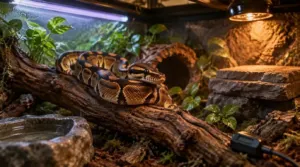
Your snake’s lighting isn’t a guess, and the wrong setup can cost you its health. Before you buy a single bulb, you need to know what your species actually requires. Below, you’ll find UVB and bone health, then the specific needs of ball pythons, boas, corn snakes, and other common keepers’ picks.
Corn snakes can thrive without UVB, but a complete corn snake care guide explains how optional lighting fits into their overall habitat setup.
UVB, Vitamin D3, and Bone Health
You might think calcium supplements cover everything, but your snake needs more. UVB bulbs trigger vitamin D3 synthesis in the skin, and that vitamin drives calcium absorption in the gut. Skip it, and calcium goes unused.
Weak bone health ends in metabolic bone disease. You’ll see soft jaws, kinked spines and stunted juveniles. Prevent it.
Ball Python and Boa Lighting Needs
Ball pythons and boas share the same rule: species-specific care beats guesswork. Both are crepuscular, so keep UVB lighting gentle.
- Use 5% UVB bulbs over mesh.
- Aim for UVI 0.7–1.4 for pythons.
- Keep boa basking zone UVI at 0–0.7.
- Hold 88–92°F on the warm side.
- Run 12 hours on, 12 hours off.
Maintain a clear temperature gradient so snakes choose. Replace T5 HO bulbs every 10 to 12 months, because UVB output degrades to about 30% after one year even while the light still looks bright.
Corn Snake and Other Species Requirements
Corn snakes follow different rules. They bask more openly, so they handle stronger UVB bulbs than ball pythons do.
Because corn snakes move between warm and cool zones throughout the day, it helps to understand how snakes handle moving between temperatures before you fine-tune your enclosure gradient.
Use a 6% T5 HO tube and aim for UVI 2.0 to 3.0 in the basking zone. Verify it with a Solarmeter. Keep a clear temperature gradient, run a 12-hour cycle, and block nothing between bulb and snake. Kingsnakes, milksnakes, and rat snakes want the same setup.
Choose Suitable Terrarium Lights and Heating Equipment
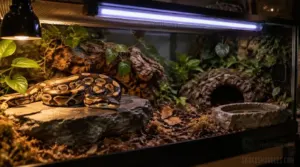
Your snake can’t pick its own lights, so you have to get this right. Three choices shape your setup: UVB tubes, LED daylight, and heat sources. Here’s what to compare before you buy.
Since each species has different needs, this snake enclosure lighting guide can help you match UVB strength, bulb placement, and daily light cycles to your snake.
UVB Tubes, Bulb Strength, and UVI
Double the distance from your light and UVI drops to roughly one-fourth. That’s the inverse square law, so UVB intensity punishes guesswork.
Choose T5 HO UVB tubes over T8s. Their stronger UVB output lets you mount higher while keeping useful UVI. Match bulb strength to your snake: ball pythons need UVI 2-3, so a 7% tube near 25 cm works.
LED Daylight and UVA Lighting
You’ll want LED Daylight running 10 to 12 hours a day. Pick 5000K to 6500K, which mimics the sun and helps your snake’s circadian rhythm. It’s cool-running, so it won’t wreck your temperature gradient.
UVA light matters too. Snakes see it, and it drives feeding and activity. Mount fixtures 6 to 12 inches above the basking spot.
Heat Lamps Versus Lightless Heaters
The right heat source decides whether your snake thrives or just survives. Heat lamps build a true basking spot and drive a clean temperature gradient. They also dry the air, so watch humidity.
Ceramic heat emitters give light-free warmth at night. Pair both with thermostats, and you’ve got reliable thermal regulation. Skip the thermostat and you risk burns or fire.
Position Lights, Basking Zones, and Shaded Hides
Picture a sun-baked ledge at noon, with cool shade one step away. Your terrarium needs that same split.
Smart light placement starts at one end. Mount your UVB lighting and heat lamp over a single basking zone, so your snake gets warmth and UV together. Keep the far end dark to build a clear temperature gradient.
Get this right and you’ll feel it:
- Your snake basks calmly, not nervously.
- You stop worrying about burns.
- Shaded hides give it real security.
- Shedding gets smoother.
- You feel like a keeper who knows the craft.
Add one opaque hide in the basking zone and another at the cool end. Check fixture maintenance monthly, because aging bulbs lose output and shift your UV exposure.
Set Daylight Timers and Nighttime Heating Controls
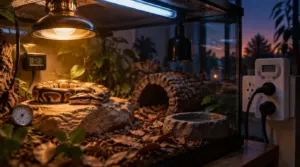
Program it once, check it twice, and never touch it again. Your snake runs on a clock, and your timer is the hand that winds it.
Set your snake’s timer once and trust it, because a steady daily rhythm keeps your pet’s whole world running on time
Set your timer settings to 12 hours on, 12 hours off. That photoperiod mimics natural daylight, and lights-off around 6 to 8 p.m. tracks sunset. Plug your UVB and basking lamp into one outlet. Keep light cycle consistency tight, because a sloppy schedule stresses your snake. A dual-outlet day night reptile timer lets you run daytime lamps and nighttime heat on separate schedules without ever touching a switch.
Heat at night? Use ceramic heat emitters. They produce zero light. Run them through a thermostat, or a day and night timer like the Zoo Med, rated 8A/900W. Plug day gear in the upper outlet and night gear in the lower one. Confirm your basking spot temperature holds firm.
Monitor Temperatures, Measure UVB, and Replace Bulbs
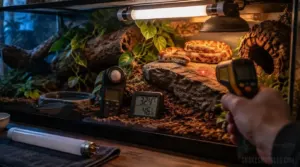
Guessing is how snakes get sick. Check your numbers weekly.
Use a digital thermometer and hygrometer, plus an infrared gun, to confirm your temperature gradient. Aim the gun at the exact spot where your snake basks, not the air. Target 88-92°F for pythons, 85-90°F for colubrids, with a cool end of 75-80°F.
Test UVB output with a Solarmeter 6.5R at basking height, after a 15-minute warm-up. Measure on your snake’s side of the mesh, since screen can block 30-60%. Ball pythons need a UVI of 0.0-0.7; corn snakes, 0.7-1.0.
Don’t wait for a dim glow. UVB bulb replacement comes every 6-12 months, because output fades long before your eyes notice. Replace sooner if readings fall below 70% of the first measurement.
Frequently Asked Questions (FAQs)
Are snakes ok with LED lights?
Yes, your snake controls LED lights fine. They support a steady circadian rhythm and add no heat. But they don’t replace UVB lighting or your basking zone, so keep your temperature gradient running separately.
Should you turn the heating lamp off for a snake enclosure at night?
Turn it off. Your snake needs darkness to keep its circadian rhythm and photoperiod steady, so skip any nighttime red or infrared heat light. Use a thermostat-controlled ceramic emitter instead and keep nights above 70°F.
What is the best lighting for snakes?
T5 HO tubes stay effective for about 12 months, then fade invisibly. Here’s your best setup: low-output UVB lighting over a basking spot, tight temperature control, and a 12-hour photoperiod. Replace your UVB bulbs yearly.
How many lights do I need for my snake?
Think of your enclosure as a small sun and a quiet hearth, two jobs, two tools. You need two fixtures: one UVB lighting tube over the basking spot, plus one lightless heater. Skip extra heat lamps.
Your temperature gradient and light cycles stay stable.
What lights do I need for a snake enclosure?
Think of your enclosure as a small sun. Fit T5 HO UVB bulbs for UVB lighting and vitamin D3 synthesis, add a 6500K LED, and run ceramic heat emitters at night. Keep a 12-hour photoperiod.
How many hours of light do snakes need?
Your snake’s sun is a switch you control. Give it 12 hours of light and 12 of dark. Run UVB exposure on the same timer. Corn snakes can stretch to 13 hours in summer, and drop to 10 in winter.
Should I turn my snakes heat mat off at night?
Usually, no. Keep your heat mat on at night if your room drops below your species’ minimum, and run it through a thermostat. Ball pythons need ambient above 70°F, so night heat protects them.
What wattage should my snake light be?
Picture a heat lamp as a campfire, not a furnace. Match wattage to enclosure size: 50W for small setups, 75W for medium, 100W for large. Boas usually need 150W. Check basking temperature and adjust.
Can colored lights harm my snakes vision?
Yes, colored lights can harm your snake’s vision. Red and blue bulbs muddy contrast, flatten depth cues, and disrupt day and night cycles. Skip them. Use full-spectrum UVB light by day and total darkness at night.
Do snakes need moonlight simulation at night?
No. Your snake doesn’t need moonlight simulation. Keep nights dark so its circadian rhythm stays steady. Run a consistent photoperiod on a timer, and if you need warmth, use a ceramic emitter instead of a glowing bulb.
Conclusion
Match the bulb to the species, match the distance to the UVI, and match the timer to the season. Do those three things, and your snake keeps a firm jaw, a straight spine, and a healthy appetite.
Keep this snake terrarium lighting guide bookmarked, then check your UVB output every few months. Bulbs fade long before they burn out, and your snake can’t tell you it’s squinting at a dud. Measure, replace, repeat, and relax.