This site is supported by our readers. We may earn a commission, at no cost to you, if you purchase through links.

A corn snake that paces the glass at midnight isn’t exploring. It’s hunting for a place to feel safe, and a loose, roomy hide won’t give it one.
Snakes settle best when both walls touch their coils, and that contact also helps them warm up or cool down. Without it, you get restless crawling, skipped meals, and escape attempts. The best caves for corn snakes fit like a sleeve, stay put when shoved, and have smooth, rounded openings.
Here are three safe picks, plus the sizing, placement, and cleaning habits that turn a simple hide into a snug, secure retreat.
Table Of Contents
- Key Takeaways
- Why Corn Snakes Need Snug Hiding Caves
- How to Choose Safe Corn Snake Caves
- Top 3 Corn Snake Cave Setup Products
- Where to Place Corn Snake Hiding Caves
- Cleaning Corn Snake Caves and Managing Moisture
- Frequently Asked Questions (FAQs)
- What are the best hides for corn snakes?
- What’s the best enclosure for a corn snake?
- What is the best substrate to use for a corn snake?
- What is a corn snake’s best environment?
- How many caves does a corn snake need?
- Should a humid hide be filled with sphagnum moss?
- Do baby corn snakes need smaller caves?
- How often should a corn snakes cave be replaced?
- Conclusion
Key Takeaways
- Your corn snake needs a hide that fits like a sleeve, so its back touches both the top and bottom when coiled, because that contact is what makes it feel secure and stops the restless crawling, skipped meals, and escape attempts.
- Pick a cave that’s made of non-toxic, smooth, easy-to-clean material, stays put when shoved, and has a rounded opening, and size it to your snake: about 1 to 1.5 inches wide inside for hatchlings, 1.5 to 2 for juveniles, and 2 to 3 for adults.
- Offer at least two identical hides at opposite ends of the enclosure, one on the warm side and one on the cool side, so your snake can control its temperature without leaving cover.
- Keep caves healthy by scrubbing them weekly and drying them fully, and use a humid hide with damp (never soggy) sphagnum moss on the cool side to help with shedding.
Why Corn Snakes Need Snug Hiding Caves
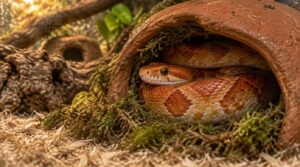
Corn snakes spend their days underground in burrows or under logs, so a roomy, open enclosure feels exposed to them. Hiding caves fix that. When a snake’s back touches both the top and bottom of its shelter, it settles, and a snug fit is what makes that contact possible.
If you’re building the setup from scratch, this step-by-step guide to a naturalistic corn snake enclosure shows how to pair snug hides with the right substrate and temperature gradient.
Corn snakes are burrow dwellers, so an open enclosure feels exposed, and a snug hiding cave lets their back touch top and bottom and settle
Snug hiding caves also support natural behaviors like wall-seeking, coiled resting, and ambush waiting. Snakes with proper hides explore more and feed with more confidence once they come out. Offering multiple hiding spots, such as purpose-made hides, cork bark, or branches, further boosts your snake’s confidence to explore the whole enclosure.
Safety goes beyond comfort. Direct contact with the walls helps your snake warm up or cool down, and an enclosed cave holds humidity during shedding, especially with damp sphagnum moss inside. Without a tight hide, you’ll often see restless crawling and escape attempts.
How to Choose Safe Corn Snake Caves
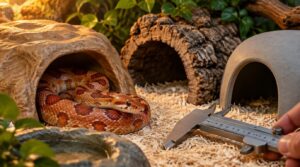
A good cave keeps your corn snake secure, and a bad one can cause real harm. Check each cave against eight safety points before you buy. Here’s what to look for, starting with materials.
Non-Toxic Cave Materials
The material of a cave matters because Corn Snakes spend hours pressed against its walls. Choose nontoxic materials you can verify:
- Natural cork bark, untreated and chemical-free
- Cured resin, smooth-edged and sealed
- Glazed ceramic, which stays non-porous
- Durable plastic, free of strong odors
Skip anything painted, scented, or sticky. If a new hide smells harsh, air it out outside first.
Snug
Safe materials only get you halfway. A cave also has to feel snug, because Corn Snakes pick security over warmth. They want their body touching the walls and ceiling, much like a burrow under a rock.
Choose hiding caves dark enough that you can’t easily see your snake inside. Put one on each side of the enclosure for better safety.
Size-Appropriate Fit
Snug only works if the size is right. Your Corn Snake should touch both walls when coiled, so match the hiding cave to its length. Hatchlings need about 1 to 1.5 inches of interior width, juveniles 1.5 to 2 inches, and adults 2 to 3 inches.
Upgrade when your snake can’t touch both sides. Skip oversized caves, since they hurt Safety.
A snug fit helps your snake feel secure, so browse these snake hides and reptile caves to find the right size and style for your enclosure.
Smooth
walls protect your Corn Snakes during every shed and every squeeze into a hide. When you shop for reptile caves, look for smooth nonporous surfaces that won’t snag new skin.
Picture these:
- Resin hiding caves with polished interiors
- Sanded Java wood branches
- Plastic tub hides, wiped clean
They also simplify humidity control, since you can disinfect every surface fully.
Safe Openings
A safe opening decides whether a cave protects your corn snake or puts it at risk.
Adults need a 1 to 1.5 inch opening, while juveniles need under 0.5 inches to stay escapeproof.
Choose smooth, rounded edges, and sand rough spots. Oval shapes ease passage.
Caution: oversized openings weaken the snug, dark, secure environment your snake needs.
Stable
Picture a cave tipping like a loose boulder the moment your snake squeezes inside. That’s a risk you can avoid.
Stable Reptile Caves stay put. Corn Snakes push, burrow, and coil hard, so Hiding Caves must hold firm and keep a snug, secure environment. Check for:
- A wide base
- No wobble when pressed
- Weight that resists shoving
- Solid, crack-free walls
Secure Placement
Think one cave is enough? It isn’t. Placement shapes your snake’s security.
Put snug hiding caves at opposite ends, and keep them dark inside.
| Zone | Placement |
|---|---|
| Warm | Directly over heat source |
| Cool | Far end |
Use identical hides so neither wins by default. Avoid doors and busy spots, and make sure each hide can’t tip when your corn snake slides in.
Easy Cleaning And Inspection
A cave you can’t clean properly becomes a bacteria trap fast.
Choose a non-porous material like resin or plastic. It wipes down in minutes and tolerates reptile-safe disinfectants. Better for easy maintenance: a removable top that lets you scrub every curve.
Your quick routine:
- Check for waste or urates.
- Wipe, disinfect, and rinse.
- Dry fully before returning it.
Top 3 Corn Snake Cave Setup Products
You’ve got the safety basics down, so now it’s time to put them to work. The three products below each handle a different part of a corn snake cave setup. Read the "Best for" and "Caution" notes to see which one fits your enclosure.
1. Artificial Handmade Cave Hideout with Ladder
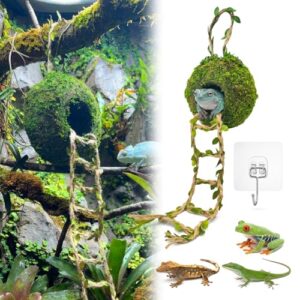
Want to give a young corn snake some vertical enrichment? This 4-inch hanging cave comes with an integrated hemp rope ladder that gives your snake ground-to-nest access. The preserved moss and hemp texture offers grip and holds humidity, creating a humid micro-climate that aids shedding.
It weighs just 1 ounce, and the long top rope lets you suspend it in tall terrariums.
Caution: the opening may be too small for adult corn snakes, and the ladder may not feel sturdy.
| Best For | Owners of small or young arboreal reptiles and amphibians who want to add a humid hideout to the upper space of a tall terrarium. |
|---|---|
| Material | Moss and hemp rope |
| Size | 4-inch cave |
| Weight | 1 ounce |
| Habitat Use | Hanging terrarium cave |
| Humidity Support | Creates humid micro-climate |
| Best For | Small arboreal species |
| Additional Features |
|
- Hangs from a long top rope, so it makes use of vertical space in tall terrariums.
- Real preserved moss and hemp texture gives good grip and holds humidity, creating a humid micro-climate that helps with shedding.
- The built-in hemp rope ladder gives climbers easy ground-to-nest access, and the cave weighs only 1 ounce.
- The 4-inch opening may be too small for larger reptiles or tarantulas.
- The ladder may come across as cheaply made and not very sturdy.
- It works best for small arboreal species and isn’t ideal for adult crested geckos or other larger pets.
2. Fhiny Resin Climbing Branch Set
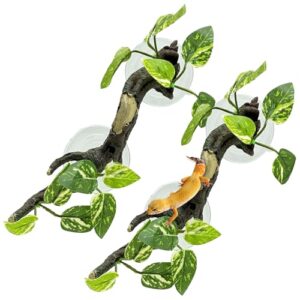
Prefer climbing over hanging? This branch set mounts to the tank wall with two suction cups, so your corn snake gets a lifelike perch without a rope to wrestle.
The resin and plastic branches measure about 8.66 x 2 inches, with bark texture and leaves that add shade. They work on glass and acrylic tanks.
Caution: suction cups may lose hold near heat sources, and some units have sharp edges that need sanding before use.
| Best For | Owners of small reptiles like geckos, hatchlings, and juvenile snakes who want a lifelike climbing and resting perch that attaches to the tank wall. |
|---|---|
| Material | Resin and plastic |
| Size | 8.66 x 2 inches |
| Weight | 11.64 ounces |
| Habitat Use | Climbing and resting branch |
| Humidity Support | N/A |
| Best For | Small reptiles like geckos and snakes |
| Additional Features |
|
- Lifelike bark and leaves look like a real tree branch and provide shade.
- Two strong suction cups attach it securely to glass or acrylic tank walls.
- Made of safe resin and plastic, and gives small reptiles a place to climb and rest.
- Suction cups may lose their hold when placed near heat sources.
- Branches are sized for small reptiles, so larger animals may outgrow them.
- Some units have sharp edges that need sanding before use.
3. Tender Tropicals Leaf Litter
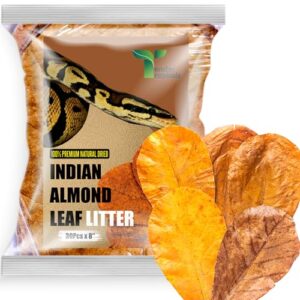
Want something softer underfoot? These leaves cover the floor instead of the walls, giving your corn snake cover to burrow under and explore.
The pack holds 30 dried Indian Almond (Catappa) leaves, each roughly 8 inches long. Soak them first to activate moisture retention, which helps hold humidity and builds a natural forest-floor look.
Caution: leaves vary in size, shape, and color, and they’re decorative, so deeper or larger enclosures still need additional bedding.
| Best For | Keepers of juvenile corn snakes and bioactive setups who want a natural forest-floor look with cover for burrowing and hiding. |
|---|---|
| Material | Dried Indian Almond leaves |
| Size | About 8 inches per leaf |
| Weight | N/A |
| Habitat Use | Forest-floor substrate |
| Humidity Support | Improves humidity retention |
| Best For | Isopods, springtails, small reptiles |
| Additional Features |
|
- Helps hold humidity once soaked, which supports a bioactive enclosure.
- Creates a realistic forest-floor appearance and gives snakes, isopods, and springtails places to hide and explore.
- Comes in a resealable pack of 30 dried leaves, each about 8 inches long.
- Must be soaked before use to activate moisture retention, so it is not ready to use straight from the pack.
- Leaves are natural, so size, shape, and color vary from piece to piece.
- Works as decorative substrate only, so larger or deeper enclosures still need additional bedding.
Where to Place Corn Snake Hiding Caves
Once you’ve picked your caves, placement decides whether they actually work. Corn Snakes use hiding caves to regulate temperature as much as to feel safe, so location matters.
Put one cave on the warm side, near the 80-85°F basking area, and one on the cool side at 70-75°F. Keep them at opposite ends of the enclosure. That distance preserves a clear gradient and lets your snake choose a temperature without leaving cover.
Set each cave on flat, level ground, not loose substrate that can shift. Face the openings toward open space so you can check on your snake easily. Keep caves away from tank edges to prevent tipping, and arrange branches and plants around them without blocking the entrance.
Caution: keep the water bowl on the cool side, away from the warm cave.
Cleaning Corn Snake Caves and Managing Moisture
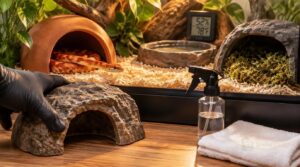
Caves only work when they stay clean and dry enough. Cleaning takes a few minutes each week, and it keeps your Corn Snakes healthy.
Scrub caves weekly with a 3% bleach solution or a commercial reptile cleaner, then let everything dry completely before your snake returns. Remove feces, urates, and shed skin the moment you spot them.
For humidity control, keep levels at 40-60% and raise them to 70% during shedding. Better for stability: a single moisture source, not a damp enclosure.
- Line a humid hide with moistened sphagnum moss.
- Place it on the cool side of the enclosure.
- Replace the moss regularly to prevent mold.
- Mist substrate lightly rather than soaking it, and spot clean contaminated areas every day.
Frequently Asked Questions (FAQs)
What are the best hides for corn snakes?
Corn Snakes spend most of their day hidden.
Your best hiding caves are snug, smooth, and stable. Offer multiple hides, warm and cool, plus a moist one for humidity control. Keep substrate out of them.
What’s the best enclosure for a corn snake?
The best enclosure for your corn snake is a secure, front-opening tank or PVC vivarium, ideally 4 feet long for an adult. Add moss caves for enrichment, support natural behaviors, and keep humidity control simple.
What is the best substrate to use for a corn snake?
For corn snakes, the best substrate is dust-free, humidityfriendly coconut fiber or lignocel, layered 3 to 4 inches deep. It encourages natural behaviors like burrowing. Top it with clean leaf litter. Avoid pine and cedar.
What is a corn snake’s best environment?
A 90°F basking zone paired with a 75-82°F cool side gives your Corn Snakes real temperature control. Add 40-60% humidity, safe substrate, and snug hiding caves on both ends for solid reptile safety.
How many caves does a corn snake need?
Your corn snake needs at least two hiding caves, one warm and one cool, so it can regulate temperature without exposure.
Multiple hides are even better. They add security and stress reduction throughout your enclosure.
Should a humid hide be filled with sphagnum moss?
Yes, sphagnum moss is your best fill for a humid hide. It holds water and releases it slowly, so the moss insert keeps humidity management local. Use chemical-free moss, keep it damp, never soggy, and replace it when it sours.
Do baby corn snakes need smaller caves?
Is it true that a baby corn snake feels safer in a tiny cave? Mostly, yes. Hatchlings want snug hiding caves where they touch the walls while coiled. Size them so your corn snake can still turn around.
How often should a corn snakes cave be replaced?
Replace your corn snake’s cave based on its material. Resin caves last 6 to 12 months before scratches harbor bacteria. Wood needs quarterly mold checks. Swap aspen monthly. Replace right away if it wobbles.
Conclusion
A snug hide is a seatbelt for your snake’s nerves. The best caves for corn snakes touch both sides of the coils, stay put when nudged, and open smoothly, so nothing scrapes or snags. Pick one that fits like a sleeve, then place it where warm and cool zones meet.
Check it weekly for cracks, scrub it clean, and keep it dry. Do that, and the midnight pacing fades, replaced by a snake that rests.