This site is supported by our readers. We may earn a commission, at no cost to you, if you purchase through links.

A corn snake can squeeze through a gap barely wider than your thumb, and most owners learn that lesson at 2 a.m. with a flashlight and an empty tank. Escape is only one challenge. Plain paper towels and a bare plastic tub keep a snake alive, but they ignore how it burrows, climbs, and regulates its body heat.
Creating a naturalistic enclosure for corn snake care fixes that. You’ll build a setup with deep substrate, warm and cool zones, and real hiding spots that trigger natural behavior. Here’s how to build it step by step, starting with the right size and a lid that locks.
Table Of Contents
- Key Takeaways
- Choose an Enclosure That Fits Your Corn Snake
- Lay Naturalistic Substrate or Build a Bioactive Base
- Set Up Heat, Lighting, and Humidity Gradients
- Add Secure Hides, Climbing Branches, and Snake-Safe Plants
- Maintain The Enclosure and Adjust It as Your Snake Grows
- Frequently Asked Questions (FAQs)
- What is the best enclosure setup for a corn snake?
- How to make an enclosure for a corn snake?
- What do corn snakes like in their enclosure?
- How big should an enclosure be for a corn snake?
- How do you make a corn snake natural setup?
- How do you make a bioactive corn snake enclosure?
- What is the best enclosure for a corn snake?
- What is a corn snakes natural habitat?
- How often feed corn snakes in captivity?
- What size water bowl is recommended?
- Conclusion
Key Takeaways
- You’ll need a locking lid and an adult enclosure at least 90 cm long, because corn snakes escape through tiny gaps and outgrow starter setups.
- You’ll get the best burrowing and hiding behavior from a deep, damp loam substrate, and a bioactive layer with drainage, springtails, and isopods keeps it clean and mold-free.
- You’ll want a temperature gradient with a warm basking end around 28–32°C and a cooler side around 22–26°C, controlled by a thermostat, so your snake can choose its own spot.
- You’ll keep your snake secure and engaged with anchored hides at both ends, sturdy climbing branches, and snake-safe plants, then adjust the setup as it grows.
Choose an Enclosure That Fits Your Corn Snake
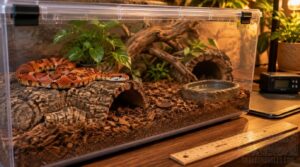
Measure your snake first, because enclosure size depends on length, not age alone. A baby corn snake setup works best in a 20 to 40 cm box with several hides and shallow substrate, so your hatchling feels secure. Juveniles need 60 to 90 cm with some climbing room. For an adult corn snake tank, aim for 90 to 150 cm long.
Once you’ve sized the tank, this corn snake enclosure setup guide shows how to arrange hides and floor space so it works.
Plastic enclosures are a smart pick. They resist warping from humidity, hold heat well, and stay easy to scrub. Whatever you choose, you’ll need a locking lid, because corn snakes are escape artists.
Treat 90 cm as your minimum enclosure size for adults, and leave room for a heat mat and a thermostat, since you’ll want both ready beforehand.
Lay Naturalistic Substrate or Build a Bioactive Base
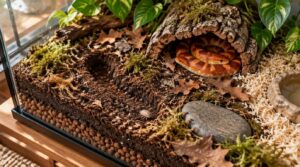
You’ve got your enclosure, so now it’s time to build the ground your corn snake will live on. You’ll choose between two setups, and each one shapes how your snake burrows and rests. Let’s look at both so you can pick the one that fits your routine and your snake.
For a side-by-side look at how each material handles humidity, odor, and cleanup, see this corn snake substrate options compared guide.
Burrow-friendly Substrate
Choosing substrate types for corn snakes starts with texture. Mix fine loam and sandy loam, 1–4 mm particles, avoiding sharp bits. Pile it 8 to 12 inches deep for burrowing.
Substrate selection includes moisture control: keep it 40–60% damp, layer clay beneath the loose top, probe walls gently. Collapses mean finer sand. Stable burrows become natural hiding spots snakes love.
Bioactive Drainage and Clean-up Crew
Your burrows stay healthier when you build a bioactive substrate beneath them. Start with a drainage layer of gravel or expanded clay, then add mesh and your loam mix on top.
Once the layers are in place, add a handful of leaf litter and your springtails and isopods, and this step-by-step guide to setting up a bioactive vivarium for snakes shows how to keep the whole system balanced.
Release springtails to curb mold and isopods to clear waste. You’ll keep humidity near 60 to 80 percent, so check the layer every couple of months.
Set Up Heat, Lighting, and Humidity Gradients
Once your substrate is down, you can build the climate on top of it. Proper thermoregulation in captivity depends on a temperature gradient, which doubles as environmental enrichment because your snake picks its own spot.
A proper temperature gradient lets your snake choose its own spot, turning basic heat control into enrichment
Aim for a basking spot of 28–32°C and 22–26°C everywhere else. Put the heat source at one end, run it through a thermostat, and let nights drop to 20–24°C.
For layout inspiration that keeps the warm and cool zones well separated, browse these reptile habitat design ideas before you set up your enclosure.
Run low-intensity, full-spectrum light 12–14 hours a day with a 15–30 minute dawn and dusk ramp. Skip UVB lighting unless a vet confirms you need it.
For humidity control, keep the basking area at 40–60%. Put the water bowl on the cool side, mist for 2–5 minutes during sheds, and check a hygrometer in each zone.
Add Secure Hides, Climbing Branches, and Snake-Safe Plants
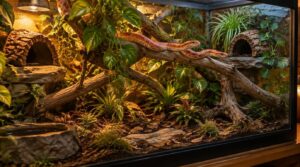
Anchor every feature before you add a single plant, because a naturalistic terrarium design falls apart if something shifts under your snake.
Here’s your checklist:
- Place secure hides at warm and cool ends, raised off the bioactive substrate so moisture can’t pool.
- Mount climbing branches in a vertical and diagonal network, using rough, sanded natural wood (never cedar or pine).
- Pick snake-safe plants like pothos or spider plant, potted heavily so they can’t tip.
Test each branch by pressing down hard. It should hold roughly ten times your snake’s weight without wobbling, and at least one should sit at mid-height or higher.
Quarantine new plants for two to four weeks, and always avoid loose potting media entirely.
Maintain The Enclosure and Adjust It as Your Snake Grows
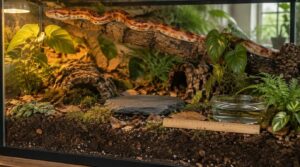
Plan to Maintain The Enclosure and Adjust It as Your Snake Grows, because a hatchling’s setup won’t suit an adult. Measure your corn snake every month and upgrade the enclosure size once its length passes 70% of the enclosure’s height or its weight jumps 20 to 30%.
Expand inside first. Add hides at different heights, sturdier branches, and a deeper substrate layer of 4 to 6 inches in your naturalistic terrarium. Skip relocation unless you truly need it.
Check your bioactive setup after any change. Keep the warm side at 32 to 34°C and the cool side at 24 to 26°C, and let humidity levels settle for six to eight weeks. Rotate décor seasonally, and log your dimensions every quarter.
Frequently Asked Questions (FAQs)
What is the best enclosure setup for a corn snake?
Most escapes start with a loose lid, so lock it. You’ll want a roomy 120 cm naturalistic enclosure with a bioactive environment, a 28–30°C temperature gradient, humidity control around 50%, and two secure hiding spots.
How to make an enclosure for a corn snake?
The smallest snake always finds the biggest gap. So lock a 40gallon breeder tank, build a naturalistic enclosure with a bioactive environment, add a temperature gradient, and keep humidity control steady.
Add two snug hides.
What do corn snakes like in their enclosure?
Ironically, your corn snake loves what you can’t see: snug hiding spots on both sides, a warm-to-cool temperature gradient, and humidity control around 40–60%.
You’ll want deep substrate depth for burrowing in a naturalistic enclosure.
How big should an enclosure be for a corn snake?
Adult corn snakes reach four feet. A 40-gallon tank works.
For your enclosure dimensions calculation, give a naturalistic enclosure a 4-foot longest side and leave room for substrate depth, a temperature gradient, and humidity control.
How do you make a corn snake natural setup?
Wild corn snakes shelter in southeastern leaf litter and burrows. You’ll copy that with a naturalistic enclosure: bioactive substrate, a 24–32°C temperature gradient, humidity control near 50%, and two snug hides positioned in thermal zones.
How do you make a bioactive corn snake enclosure?
Ready to build a living habitat? You’ll layer a mesh barrier and drainage stone, add bioactive substrate, release your cleanup crew. Finish with a temperature gradient and humidity control to keep this naturalistic enclosure thriving.
What is the best enclosure for a corn snake?
Does a 40-gallon tank suit every corn snake? Not quite.
You’ll want a naturalistic terrarium with a thermal gradient, bioactive substrate, humidity control for snakes, and hides, giving your snake behavioral enrichment, room to stretch.
What is a corn snakes natural habitat?
Ever wonder where your corn snake would choose to live? You’d find it across the southeastern US habitat, from Louisiana to North Carolina, tucked into hardwood forest habitat, fields, and farm edges, always near hiding spots and prey.
How often feed corn snakes in captivity?
How often should you feed? Keep a snake feeding schedule of 7-10 days, using the prey size guideline of 1-5 times head width.
Watch your snake feeding response; reptile enclosure setup affects corn snake care.
What size water bowl is recommended?
Picture a quiet pond. Good reptile habitat design starts with water bowl size: a shallow water bowl, 10–12 cm wide for adults, 6–8 cm for hatchlings. It also helps with humidity regulation and corn snake care.
Conclusion
Think a bioactive setup sounds like too much work? It’s mostly front-loaded effort. Once the substrate, hides, and gradient are in place, weekly upkeep takes minutes.
Creating a naturalistic enclosure for corn snake care pays you back every time your snake tunnels under bark, basks on the warm side, or tucks into a snug hide at dusk. You’ll spot healthier shedding, steadier appetite, and calmer behavior. Build it once, and your snake proves it works.